
by Neil Stobbs
This is a study of the holders of Hornby Castle in the late 16th. century and the early 17th century.
The main part of the study deals with the two wills of Sir Edward Stanley KB, who became Lord Monteagle, as described below.
The main thesis is the examination of the wills in an attempt to show the preparations one individual made to ensure that his bequests were carried out. Also, the efforts he was prepared to make to ensure that his soul would be received into the hereafter.
An attempt is also made, to follow some of the recipients of the bequests in other sections of the documents contained in the volume and to fit them into the context of the large estate of which Hornby Castle was a part.
An introduction to the Stanley family is included in an attempt to place the 1st Lord Monteagle in his historical context and to attempt to illustrate the prevailing ethos of loyalty set against self interest which seems to have been the norm amongst the nobility of the period.
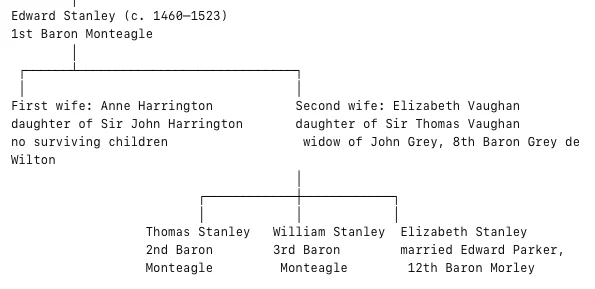
The Stanley family was one of the influential families in the War of the Roses between the Yorkists and the Lancastrian factions of the English nobility.
Their help was rewarded as seen below.
Lord Stanley who, at the battle of Bosworth in 1485, successfully changed allegiance and threw the Lancashire and Cheshire host on to the side of the Earl of Richmond, who won and became King Henry VII. According to Col Chippindall
‘His reward was immediate and great: he was created Earl of Derby and given many additional lands eschested from the discomfited Yorkists. He was also given the wardship and marriages of the two coheiresses of Sir John Harrington of Hornby Castle in Lancashire. Losing no time he married the eldest daughter Anne to his son Sir Edward Stanley, knight and the second daughter Elizabeth to his kinsman, John Stanley’.
The 1st. Lord Monteagle made two wills, the first in 1513, before he went to fight at the battle of Flodden Field where he led the Lancashire host with distinction.
The second will was made in 1523 in the year which he died.
The son and heir mentioned in the second will is Sir Thomas Stanley, K.B., 2nd Lord Monteagle, born in 1508.
His mother, Anne Harrington, was the heiress whose family previously owned Hornby castle and was virtually given as a reward to the Earl of Derby for his support of the future Henry VII.
The extent of the reward for supporting Henry VII can be seen from the description of the estates which came to Sir Edward the future Lord Monteagle and his wife as their share of the Harrington Estates. Quoting again from Col. Chippindall
‘Sir Edward Stanley, KB and his wife Anne received as their share of the Harrington lands Hornby Castle, with its demesne and the manors of Hornby, Tatham, Melling, Arkeholme, and Gressingham’.
He also received from the Crown
‘The manor of Farelton in Lonsdale and the manor of Farleton in Kendal, co. Westmorland, the manor of Bryerley and half the manor of Hemesworth in co. York, and the avowson of the church of Hemesworth and all other manors,and avowson of abbeys, priories, churches, chapels, chantries and other ecclesiastical benefices which formerly belonged to James Harrington knight, in the counties aforesaid which by reason of the forfeiture and attainder of the said James are in our hands’
If this was the portion given to the first son, presumably the kinsman who received the second co-heiress of the Harringtons, would also get something, and the father who received the original grant would not dispose of all his gift, at least while he was alive. The methods used for obtaining land and power in this period are obvious from these entries in the material under study.
The holdings of the Earl of Derby in Lancashire were and I think are still vast. He owned the mill on the River Bela, in what was Westmorland, on the site of which now stands the papermill [Ed in Beetham] of Henry Cooke. Sefton Hall in Liverpool is the seat of the Earl of Derby at the present time?
Sir Edward died on the 6 or 7th of April 1523. His will details the way and where he was to be buried, and is detailed in the examination of the second will below. He was succeeded by his only son Sir Thomas Stanley K.B. and Lord Monteagle mentioned above. He was born in 1508, and was in his ‘nonage’ at that time. This fact is clearly of concern to the 1st Lord Monteagle, as he frequently refers to it in his second will. Many of the bequests are couched in terms of seven years, which would bring the term of years up to the majority of the heir. Sir Thomas married twice, his first wife being Mary, daughter of Charles Brandon, Duke of Suffolk. The second was Ellen daughter of Sir Thomas Preston of Preston Patrick. Mary was the mother of his son and heir Sir William Stanley, who became the 3rd Lord Monteagle, on his father’s death in 1560.
The second Lord Monteagle increased his estates by purchasing from the Crown the lands and buildings of the dissolved Priory of Hornby. He obviously took advantage of Henry VIII’s shortage of money to increase his own holdings. He presumable would have received more property as the dowry of his first wife. As well as some from the dowry of his second wife?
In his will he appears to have obtained leases of the parsonages of Melling, and Bolton-le-Sands in co. Lancaster and of Clapham in co. York.
He died on 18 August 1560.His will was dated 28 July 1558.
The third Lord Monteagle, Sir William Stanley, was also married twice: First, to Anne daughter of Thomas Preston and widow of Sir James Layburne of Cunswick, co. Westmorland, by whom he had his only child Elizabeth, born c.1558; and secondly, to Elizabeth, daughter of Sir John Spencer, of Althrop (married in London in September 1575). It looks on first examination that Sir William married his aunt?
Again it is difficult to place persons with the same name without definite dates. This anomaly needs further research. The second marriage is to the Spencers of Althorp, the best known modern descendant being The late Princess of Wales who was born Lady Diana Spencer. Her brother had the title Viscount Althorp before succeeding to the title.
The third Lord Monteagle died in 1581 at Skipton. His ‘Yorkshire Inquisition’ indicates that he held land in Sedbergh, Dent, Bentham and Graystongill in Yorkshire. It was presumably in addition to the lands held elsewhere from his father. His heir was his only daughter Elizabeth, who was by this time wife of Edward Parker, Lord Morley. She inherited Hornby Castle and took possession of her inheritance, but she was dead by 1585.
She had quite a large family, six children, of whom the eldest William born in 1575 inherited the title of Lord Monteagle on the death of his mother c1585, aged 10. He inherited his father’s title in 1618. He was known as Sir William Parker Lord Monteagle to distinguish him from his grandfather in deeds of Hornby, until he inherited his father’s title when he is called Lord Morley and Monteagle.
The estate remained in the Parker family until the Commonwealth when Hornby castle was captured by the Parliamentary forces in 1643, the then Lord Morley and Monteagle having sided with the King. After the Restoration of 1660, Lord Morley and Monteagle found the estate in the hands of Major John Wildman. Due to laws passed which said basically that any lands purchased during the Commonwealth could not be taken from their present owners by the previous owners and had to be purchased from them. This made Lord Morley attempt to raise money to do just that. What actually happened seems to be somewhat obscure but eventually Lord Morley was left with a much depleted estate. He lived in Hornby Castle until his death in 1697, he had no children and therefore the two baronies of which he died possessed fell into abeyance. His wife died in 1700.
1513 Will (1st)
The first will written in 1513 and the transcript, done by Col. Chippindall in 1939 is printed, as previously stated in the Transactions of the Chetham Society Vol. 102.
It is printed in the form of the original will and consists of three pages of close print, 46 lines x 10 words x3 = 1380 words.
The second will of 1523, consists of nine pages giving a total of 9x46x10 = 4140 words.
The first part of this will is dealt with in some detail later in the study. The second part of the will consists of detailed bequests which fill five pages of continuous text averaging 10 words per line and 46 lines per page, so 5x10x 46 = 2300 words.
There is no punctuation at all in either will, and the words follow on with occasional capitals on words which may or may not be at the beginning of a sentence, or statement of intent. It does become clear on further study the appearance of an upper case letter on the beginning of “And” tends to indicate the beginning of a statement.
Both the wills are taken from the post mortem
“Inqisition taken at Preston in Amounderness, co. Lancaster, 16 September 15 Henry VIII [1523] before James Worseley Esq. the King’s eschestor there by virtue of the King’s writ to him directed”
The preamble of the first will appoints James Bishop of Ely and Randall Poole clerk amongst others to carry out the requirements of the will. He says
It is the last will of me the said Edward never to be chaunged
Yet within ten years he made a second one!
“to the heire male of my body lauffully begotten“
is quoted, in the second will he admits the existence of a bastard son! Things change in ten years.
The reason for making the will follows:
“And for as moche as by the Kings Highe comandmet I am assigned and appoynted to attende upon the honorabill Lorde the Erly of Surrey the Kings lieutenant in the Northe parties to serve the King in his warres for the defence of knowlege that the King of Scotts is entred in to this Realme intending to make Batill and Warr ayenst our sovereign lords subjects For the Resistence of whose Maliciouse purpose I the said Edward with all the power that I can make am setting forthwards towards my said lord lieutenant ayenst the said King of Scotts and therefor by my writing I make my Will that if it fortune me to dye in Battaile or other wise in this tyme of warr wiche godd defend”
The next part of the will tends to cause some confusion in my mind. It continues after the last quotation without and break or indication of change
“that then the said Reverend Father my right kind and loving Brother shall have the Rule and Custodie of Thomas Stanley my son and heir apparaunt hym to marry after his discrecion whar it shall seme hym to be to my said son Honorabull and profitable”
On further reading it becomes obvious that the Lord Bishop is the only one addressed in the salutation and not the presence of another relative. It is noticeable that the wish is that any marriage shall be profitable, as well as honorable. He then goes on to command that any money spent on the marriage of his son, an equal amount shall be spent on the marriage of his daughter Jane Stanley.
“According to an acte made in the last parliament holdyn at Westminster for suche persons as served the King in his Warres”
He makes provision for the facts that the Lord Bishop may not make a marriage for the son, and hence not spend any money, or the son may die before he is married. The provision is as follows :-
“I will that my said Feoffs [Tennants with obligation of military service] suffer myne executor yerly durying the time of xvj yeres [16 years] next after the makyng of this my will to take and parceyve of the revenue of my said lands the summe of xlvli [£40] wiche amountithe to the somme of Sevyn hundreth and fourty pounds wiche I will that my said daughter Jane shall have to her marriage or toward her fynding [funding] and leving [living] if she be not disposed to Marriage”.
Jane is not mentioned in the second will so presumably she had already married and received her portion of the estate.
The Lord Bishop is granted the sum of 40 marks [£13/3/4d] a year as long as he was in charge.
The settlement on his wife Anne, the co heiress of the Harringtons of Hornby whom his father married off to him, includes the right to live and enjoy the castle at Hornby. He ties it up in the following manner :-
“Also I will that my said wif shall have the kepyng of Horneby Castell during the term of xvj yers after the makyng of this my will if she lyve so long and also be sole and not married during that time and that my said foeffs shall delyver her yerly the Revenues of my said lands towards the Charge of the House and payments of Constabull Wages and other offices there Fourty pounds so that she dwell in it and kepe house in it or ells that myn executors se it kept”
The first part of the bequests to his wife indicates that there was a Marriage Settlement drawn up at their marriage presumably in 1485/6. It says that she shall have a life interest in his father’s lands and his to the value of 200 marks, but they are let for £ 100 or thereabouts.
Again there is the stricture “so long as she live the Soole and not married“
If she married she was to have a yearly income of £40, in settlement of the rents etc. She was also to have
“hir Reasonable dowe owt of all my said lands without sute at suche tyme as she shall resonable require them”.
He also makes provision for the marriage portion for his bastard daughter Mary in the terms:-
“Yerly, Fourty marks till the somme of Six hundreth Marks shall be had”
He also acknowledges the existence of a bastard son Edward Stanley by the bequest of
“the clere yerly value of ten pounds over al charges —- for terme of his lif”
Edward is mentioned in the second will, where his annuity rises to 10s and 6d.
There is no mention of his daughter Mary. Presumably married off! There follows without any break after the entry regarding Edward the words
“the remayndre to my right heirs”.
There is reference in the latter part of the will of his son being “during his said Nonage” indicating that he was not of age to assume the titles and etc.
He was born in 1508, and was therefore only 16 in 1524 when the examination “post mortem” took place, but would have been only 5, when his father’s first will was made in 1513.
Hence the references to ‘16 years next following’, this would bring him up to the age of majority, and all the bequests would cease to be effective because the control of the source of income for the bequests had passed into the hands of the son, unless of course they were for term of life of the recipient, when they would be honoured, at least it would be presumed so, by the testator.
The final part of the will recognises the various debts which Sir Edward has to various people :-
“And wher I the said Sr Edward stand bounded in divers Recognisance’s and other writings to the use of the late King Henry the vijth and to other in divers greet somas of Money It is my will that men Executors shall take and perceive yearly the Revenue and profits of the Residue of all my lands and tents during the space of xvj yes next after the Making of this will for payments of my detest discharge of my friends that be bounded for me defence of my Lands and of my sons inheritance and the yearly shall give accept thereof to my said lord of Elie”.
He seems to have been heavily in debt to the previous King Henry VII, who was responsible for the advancement of the Stanley family in the form of his father, in previous times.
The second will of Sir Edward Stanley was made in 1523 after he was advanced to the Peerage as Lord Monteagle after the Battle of Flodden Field in 1513.
It was before his departure for this battle he made his previous will
This is my Translation from the words written therein, and rearrangement of the words into paragraphs to make them more readable.
In the name of god Amen. For as much as the life of man is in these wretched World short uncertain unstable and transitory it is necessary and requisite for every good true christian to provide foresee and to ordain for the life ever lasting in heaven.
I therefore Edward Stanley Knight Lord Monteagle of the order of the Garter being in whole and good deliberate and perfect Memory and of clear understanding laudes thanks and prayer be to almighty God my maker and redeemer remembering the good and sweet intellect of this sentence
” Memento homo quod Cinis es et in Cinerem reverteris1“ and of this”dispone domus tue quia morieris2“
Willing while reason ruleth my mind and quietness in the Member of my Body of the temporal goods somewhat for the health of my soul to dispose order make and establish this my present testament and last will the 5th day of April in the year of our Lord god a 1523 and in the 14th year of the reign of our sovereign lord King Henry the 8th, in manner and form as hereafter is expressed and written
First and principally I give and bequeath my soul to almighty god the glorious and holy trinity, to our lady Saint Mary mother of Mercy, Saint Margaret and to all the saints of heaven my body to be buried in the new Chancel to be made at my costs and charges in and with all convenient haste at the east end of the Chapel of Saint Margeret at Hornby and I will that my Executors undernamed bestow and expend in and about the Walls, Buildings, Ironwork, Glass and covering the same new Chancel the Sum of 100 marks [£68.] and more if it shall be seen requisite to my said executors
and Moreover for the hallowing of the same Chapel yard as shall be requisite The same Chapel to be dedicated in the honour of God and of the blessed Saint Margaret.
And in case I depart this present life before the hallowing of the same chapel and chapelyard them my body to be for the time humate within the Priory church at Hornby.
And further more will that on the next day after the dedication of the same Chapel my body be exhumate and transfered with the consent and assent of the prior there which has granted me the same the case happening in his days and of other having the interest and so to be brought and buried within the new Chapel aforesaid
Also I will that my said Executors order and cause a convenient Marble Stone to be laid upon me with an Image of Copper and Gilt graven in the same and with six Scottchans{?} of my arms with scriptur[?] thereunto necessary or else to lay my body in a standing tomb there with an Image in Grose Copper and Gilte thereupon as shall be most agreeable and seeming Chancel, and my helms and arms to be set upon or else this otherwise to be devised and ordered by my said executors and at their decision and in as much as they may avoid the pomp of this wretched world
And for the same to bestow the sum of 100 marks more or less as shall be seen to my Executors convenient.
And also I will that my said executors cause my funeral to be ordered and done after and in like manner and form as other Barons of England being of the order of the Garter have be used and accustomed to be used
That is to say in avoiding pomp and vainglorie of this world with Black Gowns to my servants my children, and my friends as shall by my executors appointed and devised the day of my burial with dole and distributions among poor folk and other in alms the said day of my Burial and for the same to be stawe[?] the sum of £100 and more shall be seen to my said Executors.
Also I will in case my body be first, humate at the priory that then the day of Removing of the same my executors cause mass and dirge to be done for my Soul at Saint Margaret Chapel
And then to give in Alms to priest Clerks and poorer folks as to them shall be thought expedient.
Also I will that 24 white Gowns be given to 24 honest poor men to bare torches and to do other service the day of my said Burial.
Also I bequeath to every priest saying Mass and doing service the day of my Burial for his labour 8d. and to every Clerk 4d.
And further I will that Master Richard Beverley Prior of the Black Friars in Lancaster or in his absence, another Doctor of Divinity be provided to make a sermon and to have for his pains and labour 20/ -.
Item I bequeath to the Abbot of Croxton 40/-
and to the Convent there other 40/- to pray for me
Item to the Abbot and Convent of Crista [Kirkstal, Leeds?] other 40/-
Item to the Abbot and Convent of of Jervaux 26/8d.
Item to the Abbot and Convent of Fouernes[Furness?] 5 mark. [33/8d.]
Item to the Abbot and Convent of Walley 40/-
and a Crimson Gown of my wife’s and ladies to make a vestment
Item to the Abbot and Convent of Cockersand 5mark [33/8d]
Item to the Prior and Convent of Lancaster They all to pray for my Soul. 40/-
Also I bequeath to the’ Prior of Horneby Capelyn within the Castle Chapel of Horneby’ for my Corperisaunt and Mortuarie and for my wife’s mortuary £6/13/4d.
Item I bequeath to every one of my four mother churchs, that is to say:
Saint Peter at York
Saint John at Beverley
Saint Wilfred at Ripon 6/8d. [1 mark]
Also I bequeath to the High Awter[?] of my parish Church of Melling for my Tethis oblacions’ and offerings unpaid and negligently forgotten 20/-
Also I bequeath to the Prior of Hornby for a general absolution of me and to pray for my Soul, my wife’s soul and the souls of my Children 40/-
Also I bequeath to the most excellent prince and my sovereign good lord King Henry the 8th. a small gold ring with a tabill[?] of a diamond 8th sware[square?] set in the same
and a hundred pounds in Gold [£100] beseeching his grace to pray for my soul and to be good and gracious good lord unto my son and heir, to my servants and my executors for performance of my will.
Also I bequeath unto my Lord Cardinal his grace a gold ring with a point of a diamond set in the same and £20 in gold beseeching his grace to be good to my executors and favourable for the confirmation of my ‘Chauntre Bedehouse Free Scole’ [Bedehouse= Almshouse,?] to be had according to the tenor the foundation [fundacione] thereof
Also I will that the same foundation be inviolate in every part kept and performed as though it were in this my present testament and last will wholly insert and written and according to the tenor thereof.
Also I bequeath to these parish churches hereafter following and named 20/- and a Cow
to go to their church works for their Ornaments and lights as shall be thought most needful and necessary by the Church wardens and Ministers of the same that is to say:
Lancaster, Bolton in Lonsdale, Halton, Melling, Tunstall, Thornton, Warton, Whittington, Ingleton, Bentham, Clapham, Horton, Tateham, Sladeburn and Claghton.
[It is interesting to note the inclusion of Warton in the above list showing the extent of his influence in the local area., and also York, Beverley and Ripon previously, and of Preston and Warrington following, giving some indication of the extent of his influence in the North]
Also I bequeath to the Friars of Preston to pray for my soul and all Christian souls 13/4d [2 marks]
Also to the friars of Warrington for like prayers 13/4d.
Also I will that Yearly my ‘obiet’ [Death] be kept with dirge and Mass on the day of my departing from this present life at which obiet I will that the Prior of Hornby for the time being and there present have for his labour 12d.and 12 other priests, every one of them 4d.
And that yearly there be new lights made and set about my Grave and Tomb the day of my obiet to the ‘valor of xiij li of wax [value of £12 or 12lbs weight?]
And this obiet to be made according to the tenor of the foundation of my Chantry with distribution to poor people and that at 26/8d.
the same obiet to expend yearly
[Obiet is the date of death]
It is interesting to note that Col Chippindall says:
‘His death took place on 6 or 7 April 1523, whilst engaged in rebuilding the church at Hornby. He was buried temporarily in the graveyard of Hornby Prior with a view of being translated to a vault in Hornby Church when the alterations to that church should be completed: but this intention, it is said, was never carried out and the place of his burial has been lost.’
After all the trouble that was taken in laying down the conditions and requirements for his burial in his will, and providing for his soul to be prayed for, that his body was lost seems to have been to say the least careless and in the most to have been a neglect of the duties willed by their Lord.
Also I will that my officers and servants, being officed under me during my pleasure, [appointed by me?] continue and enjoy their said offices, except my executors prove them not true nor substantial for the performance of this my will and for the weal [wellbeing?] and profit of my said son and heir.
Also I will that all such patents and leases as I have made and granted of offices or Firms for term of life or lives, or term of years may take effect and be firm and stable to them to whom all such grants are made, except my executors can find reasonable cause of forfeiture.
Also I will that my executors content and pay all my debts that I owe that can be duly proved before three of them at the least with reasonable composition and restitution to such persons as can truly prove any oppression or wrong to them done by me, and that proved to ask of them forgiveness in my name.
Also I will that my executors take and perceive all debts, duets[?], arreraags [arrears?], Renrs, and fermes [?] that are and shall be due and owing unto me at the day of my departure out of this world or at any time after, for and toward the performance of this my testament and last will.
And whereas I am in suit at the Common place before the King’s Justices there at the King’s Suit for the sum of £200/39s/5d. I will that Sir Richard Tempest Kt. content and pay unto my said Executors the sum of £336 delivered him of Trust and for divers considerations which he and others knoweth and then that with all diligence contention be made to my said sovereign Lord the King of the same £200/39s/5d.and the residue to remain to my executors towards the performance of this my will.
And also where I delivered for the Jackets and Cundethe[?] Money of 200 Soliders to go Northward to my lord treasurer in the Month of March last past £40 which my servant John ap Holl hath received of the King’s Treasurer of his War at the ‘new Castell opon tyne’ [Newcastle upon Tyne], I will that Nicholas Tempest and the said John ap Holl retain in their hands £20 of the same equally to be divided between them towards the Jackets for the said Wars and their charges pain and labour ‘sueteyned[? sustained] in that journey.
There follows details of those owing money to him and the request that they pay up!
‘Also I will that where as John Standish and Rauff[Ralph?] Bradshaw are indebted to me in divers sums of Money I will that they content and pay the same to my said executors for and towards the performance of this my will.
Moreover, I will that every one of my executors, my children, my servants, and friends have their legacies according as I have assigned and appointed unto them and hereafter followeth which | intend to deliver with my own hands or I depart this present life.
In the following part of the study I have used the words, spelling and phrases as set out in Col. Chippindall’s transcription. Feeling that quite often the original phrasing tells more of the intention than a more modern literal translation. Also these actual quotations are inset and in italics.
There is a list of the executors, in order of precedence:
Right Honorable Lord Thomas Darcy Kt. Lord Darcy Menell and Lord of Knaithe
[these titles seem to belong to one person as the second and third parts do not appear in the bequests].
Sir John Husie
Sir Alexander Radcliffe Kt.
Lawrence Starkey esquire
Richard Banke gentilman.
The bequests follow and it is interesting to note the material bequests which are given,
My Lord Darcy to have
my ‘Coller of Garters and my best George set withe stones belonging to the same.‘
Presumably this is the insignia of the Order of the Garter, and the clasp or George which held it in place?
He is also to have ‘ my too best litter horses, My litter and all things pertayning to the same with a Covering of Tawney Tynsill and grene velvett’
From this entry it would appear that the nobility travelled by litter, suggesting that the roads as such were not passable to wheeled vehicles, or at least with any speed or comfort.
He is also given the farming rights to various properties for a period of nine years
‘ paying the fermes therof according to his leese theruppon made’
He apparently already leased them from Lord Monteagle.
Sir John Husie Kt. to have
‘a Salte of Gold with a Cover and a grey Horse that I bought of Rauff arrowsmythe‘
A Salt would be the vessel for holding salt on the Lord’s table. It was of considerable importance as one was ‘seated above or below the salt’ depending upon precedence. Being of Gold it was obviously an important and valuable bequest.
Sir Alexander Radcliffe Kt. to have ‘ a Gowne of myne of Sadd Russet velvet furred with blak Bugge‘
Laurence Starkey Esquier to have
‘ all his playte wiche lieth in plege in myn hands for xlli and to be discharged of the said xlli as my bequest. And that the said Laurance shall in Joye all such graunts as I have made unto him bifor this day accordinge to the purport of his writting thereupon to hym by me made‘.
It would appear that Laurence Starkey was in debt to Lord Monteagle for loans which he had received on the pledge of presumably silver or gold plate. His bequest was obviously the cancellation of these debts and the return of the plate.
Laurance was also to be
‘ my deputie stuarde and to my son at Cockersand abbey Retayning to me and my son the Fee‘.
This part of the bequest is some what obscure, and hinges on the translation of ‘Retayning’. Does it mean that Laurence retained or returned the fee?
Richard Banke, the last Executor, named as a gentleman, to have :-
‘annnuitie of ten markes by yer owt of my lordshipe of Breerly in Yorkshire.
And also to enjoye his leesse of serten lands of Breerly Hemmysworthe and Schrafton according to too deeds indented therupon severally made dated under my seale the furst day of Marche last past’.
Having provided recompense for those who must be executors of the will;
Lord Monteagle goes on to provide for his family.
‘My Childer Thomas my son and heir to have the residue of all my Goods Moveabell and unmoveabell her above and foloyng in this my testament and last will not bequeathed my detts funeralls perolute and this my present testement and last paid my call with the Fundacion of my Chauntre Bedehouse and Free Scole fulfilled {and Gods blessing and myne}‘
This is one of the points where the lack of punctuation produces some difficulty in interpretation of the intention.
Immediately after the end of the words in brackets above follows without any break
‘Edward my Bastard son to have and enjoy xli vjd. for terme of his lif owt of serten of my lands in Bosseley in Cheshir accordinge to my graunte thereupon to hym made so yt he be faithfull and true to my son and heir and aydyng assisting and fortifyenge towards the performas of my testament and last will‘.
Does the bracketed blessing refer to the Chantry etc or his bastard son?
It is also to be noted that he appears to be trying to prevent any possible dispute about the future inheritance of the lands by naming the son as bastard and also in willing him to aid assist in the carrying out of the terms of the will.
The bequest continues:
‘And as concernyng his detts in London wiche as he seethe is xli vjs. viijd. to be paid at the sight and and discrecion of myne Executiors fyndyng hym as is aforesaid.’
The amount of the debts is very close to the yearly bequest, could this be coincidence? There is also a ‘string’ attached to make sure the bastard son supported the true heir.
A final bequest before itemising those to his servants is as follows:
‘Thomas Langton Esquire Baron of Walton and Elsabethe his wif he to have a jerken of Blak satten furred with libards and his wif a Gown of Blak velvet‘
‘Edward Langton son and heir of the said Thomas and Elsbeth my Godson sex kye to be put to some frends of his for increase to his profetts‘
It is obvious why this bequest is separated as the son was the Godson of Lord Monteagle.
What ‘sex kye ‘ are is a matter of speculation.
Obviously sex = six, but kye is a more difficult problem.
Is it a sum of money or is it a clerical error for kyne = cattle ? The words ‘to be put to some friends of his for increase’ could mean that they were cattle which were to be the nucleus of a breeding herd to be managed, by friends, to increase their numbers and hence the value of the bequest?
Or a sum of money to be put out to loan at a premium, thus increasing the total recouped?
Many of the servants have their debts discharged as well as having the tenures confirmed during the nonage of the heir.
Various terms are for 7 years which would bring their termination up to the majority of the heir.
Fees and annuities are confirmed to continue.
Other servants have their wages up to date to be paid and various ‘rewards’ are specified to be paid in addition.
Some gifts are specified as ‘nothing’, others as a ‘cowe’ and one a ‘grey gelding’.
Many of the monetary gifts are specified in shillings and pence in the will, the amounts are basically still in marks, i.e. multiples of 6/8d.
He wills that the executors have their expenses for the executing the will and also for the maintenance of his son and of his inheritance during his nonage.
He then asks that the King will take on the overseeing of the wardship and marriage of his son and heir
‘thereto have him in ordering and guiding during his Nonage to bryng hym up to vertue and Cunning as shall apperteigne to a lyke man is son as I beyng his father am.’
It is interesting to note that these requests were obviously taken seriously by Henry VIII, as in 1527-28, Sir Thomas, then age 20, attended Cardinal Wolsey on his embassy to France, and in 1532-33, at the age of 24, he was made a Knight of the Bath at the coronation of Queen Anne Boleyn.
He continues in the normal form to make sure that the executors have sufficient funds from rents etc… to continue to look after his son and heir during his ‘nonage’.
He also reiterates the fact that he wishes foundation of the Chantry, Bede House and Free School to be established with out possible interference from any cause.
It was not yet established at the time of the will.
It is set out in the following terms :-
‘ I will that myn Executors susteyn all charges to accomplisshe ordeyn direct and stablisse the same According to the tener therof And as it appereth by a Boke in the hands of Mr Richard Bower als Strikley Remaynyng In case I depart this present life or it be fully fynyshed and sealed withe the delyverie of the same according as I have devised’.
It would appear that the requirements for the foundation were set down in a ‘Book’, so that no one could deny their existence.
There are then bequests to finance the establishments from the revenues of no less than thirteen lands and tenements in the ‘countie of Lancaster’ and one in ‘Westmerland’.
He also adds the further exhortation
‘It is my last will never to be chaunged that the said foeffees shall contynue their astate of and in all the premisses with the appurtenaunces to the use here under writtyn that is to say for the enstablishment performans creacione foundacione ordering and dotacione of my said Chauntrie or Hospitall bedehouse and fre Scole’
He seemed determined that these establishments should be built!
There then follows some bequests prefaced with the word
‘Item’:-
The first is for
the Guild or Fraternity of Jesus founded within the parish church of Lancaster to pray for ‘my Soul, the Souls of Anne and Elizabeth my wives , my Children’s souls and all my friends’ souls’,
for this they are to be given 40/ -.
The next Item is a Mark to
‘the too Sociats with the prior of Horneby‘.
The meaning of this is not obvious to me, other than it may be in the same mode as the previous Item.
There then follows various bequests to ensure the well-being of his children legitimate and otherwise.
The first is to the Constable of the castle of Hornby, one James Anderton that he has his job and a fee of £5 per year to look to the well being of the heir during his ‘Nonage’.
The second is somewhat convoluted in language but basically asks his brother Thomas who is apparently the parson of Baddisworthe to try and make Edward’s bastard daughter Mary, who is apparently now a widow called Radcliff, to accept her portion as laid down by the Executors.
It may be remembered that in the first will she was given 40 marks a year until she had had six hundred, towards her marriage as long as she obeyed the executors.
It would seem that she had caused some trouble, even though she seems to have been married and widowed during the intervening years.
Family life seems to have had its difficulties, in the upper classes, even in the sixteenth century.
The will finishes with a normal disclaimer to annul all previous wills of whatever date .It also contains the requirement that :-
‘And thereppon I do Require the same Richard Bower {alias} Strikley to make me an Instrument once or mo as shalbe thoughte requisite and neacessarie to myne Executors And thes to Recorde and to Bere wittnes in all and singler the premisses Richard Beverley Doctor Thomas Evington Prior of Horneby Gefferey Redmayn Fraunces Morley Thomas Crofte Alexander Parker Hugh Dicconson Nicholas Gardener Olyver Thomson Thomas Twissilton Humfrey Wynder Robert parker Richard Pynkok and you all here present and pray you be good and lovyng to my son’.
Even at the last Edward Lord Monteagle does not seem to believe that only one copy of his will be sufficient for all the executors to know all the bequests, and each should have a copy.
The Death of Lord Monteagle
The conclusion of the long list of bequests and exhortations raises more questions than it answers for the modern researcher. A vast amount of work is left to be done if anything of the truth of his wishes is ever to be unravelled.
The list of thirteen named witnesses and apparently others unnamed seems a considerable number to witness the will, even of so important a person as this.
The first named {Doctor} Richard Beverley is named elsewhere in the will as being Prior of the Black Friars in Lancaster.
It could be that the ‘Doctor’ positioned between the first two names could apply to either of them, as adjectival descriptions seem to have been placed after the noun to which they applied in some cases.
Thus Doctor Thomas Evington could be Prior of Horneby, or Thomas Evington could be a person without a style, and the Prior of Horneby be named by style alone. This would bring the number of witnesses to fourteen.
Gefferey Redmayn is named elsewhere as Esquire and as a servant who was to retain his present tenancy and have his debts owing rescinded. He is also noted in the inventory as
‘A Free tenant of the Manor of Hornby’ under Wraith holding the lands and tenements by Knights Fine where he and other tenants paid a total of 48s. 8d’.
Fraunces Morley is listed amongst the Freeholders of Hornby Castle in 1537 ‘Franciscus Morley arminger‘. He is also noted as being a witness at the post mortem inquisition of Lord Monteagle in 1524. He is mentioned in the survey of 1580 as being the previous holder of the manor of Wennington, now held by Thomas Morley.
Thomas Crofte named as Thomas Croft of Claughton, also as Thos Croft under Robrondale in the 1580 Survey. There is also a Thos Croft the younger there mentioned. Both Thomas the elder and Thomas the younger appear in the 1580 Survey as Free tenants of the manor of Farleton. This raises the question of being able to identify specific individuals when the same name appears on many occasions without any exact indication. It seems unlikely that the Thomas Croft who appears as a witness to the will in 1523 would be the one who is mentioned in the survey of 1580, at least 57 years later. If he was a witness to the Lord Monteagle’s will one would assume that he was a person of some consequence and of an age to have been so considered.
Even if he were only 30 then he would have been 87 in 1580. Considering the life expectancy at the period to have been much less than this, the named Thomas would not seem to have been the one mentioned later. This shows in some small way the difficulty in arriving at a definite identification of any individual at such a distance in time. The difficulties continue with Alexander parker, written with a small ‘p’ as is the surname of Robert parker later in the list. Yet in the list of servants who shall receive their wages and rewards as listed the surname has an uppercase ‘P’! Alexander Parker is listed as ‘of the stable’.Previous entry is to Edward Parker ‘grome of my Chamber‘ So, was Alex grome of the stable? He was rewarded in the sum of 10/ -.
Elsewhere in the Roll of Lands of 1524 there is the entry under the heading of
Delivery of Monies :- ‘And in monies delivered to Alexander Parker the Lord’s keeper of the Stock as in the farm of Barkerkin 106s.8d. And money delivered to the same Alexr Parker as in the farm of part of Hornby Park £15 11s. 6d.’
It would appear that Alexander was an important servant with a number of positions.
Hugh Dicconson appears in the role of servants as Hugh Diconson given a reward of 10/- over and above his wages due. Can we assume that he was on an equal level of importance with Alexander Parker, as he was given the same reward? He was a witness to the Will, so can we assume he must have been of some importance in the household?
Again one of the problems of trying to deduce facts from material prepared so long ago. Can we actually use these deductions in the reconstruction of the life of the area in this period?
I think we must as we have no other sources of this type available, and it allows us some insight into the workings of the system at that time, and comparison with the information we can glean from the wills and inventories which we do possess. There was not much change in the system around the turn of the century, and even though this data is from early 16th century it must have some bearing.
Nicholas Gardener is listed amongst those servants who
‘I will shall in Joye their offices durying the nonage of my son and heir with suche fees as they have hadd in my time‘
He is the Baliff of Ellall, Ellel or Elliall depending where it appears in the various documents.
In the 1584 survey it was found to be 403 acres 1rood 22 1/2 feet in extent, having a value of £109 10s.2d. yielding a rent of £23 13s. 10d. There are 33 tenants at will and one free tenant. It is interesting to note that the free tenant, one Thomas Rigmaiden
‘holds there certain lands and tenements by Knights Service and pays yearly, 1 lb pip[er]is 1lb Qi, 1 par cular albis pa 12d’.
Is this an indication of an extended peppercorn rent? What 1lb Qi is, is as yet not clear nor is 1 par cular alga pa 12d
Assuming that the manor was the same size in 1524 he would be considered to be an important servant of the estate, and of sufficient importance to be a witness at the signing of the will of the Lord. The name Nicolas Gardyner appears in the Roll of Lands of 1524, with a variation of spelling, and in circumstances which would appear not to have been in keeping with his office of bailiff of the manor.
Nicholas Gardyner 3s 4d. for americaments on him imposed by the Court in the 12th Hen. viij for divers trespass committed
I suppose that it could be him, but I doubt it. He would presumably as Bailiff be sitting in judgement in the Court?
Olyver Thomson is one of the servants to have an annuity by the year during their lives. His is stated as :-
‘to enjoie the ferme of the great Close in Farleton in Lonnesdale for vij yeres accordyng to his lese theruppon’
Humphrey Wynder is mentioned as the Bailiff of:-
‘my lordshipp of Farleton in Kendall Whittington and Netherhutton in Lancashire’
The Farleton in the 1580 Survey seems to have been the Farleton in Lonsdale as it is said to be within about half a mile of the castle. No detail is given of the Farleton in Kendal, which would have been in Westmorland.
Humphrey Winder is also named as a tenant at will of land in Caton, which he tenants jointly with a George Foxcroft. Again, the appearance of the same name at a distance in time of over 50 years brings forward the probability of them not being the same individual, but two bearing the same name two generations apart. If parish records do exist, it may be possible to trace the relationship between them, if any.
Robert parker, the witness, is given in addition to his wages due:-
‘to have the Tithe Barn of Hest during my terme paying the Rent accustomed‘.
It must have been of some monetary value to have the lease of the Tithe Barn, whilst still paying rent to the estate. Does this infer that the lessor of the barn, could charge other persons to store their tithe products in it till they were collected by the tithe collectors. Or some other reason?
In the accounts for 1582 a Robert Parker is indicated as being the rector of Melling. Again, the position of a frequently occurring name separated in time.
Richard Pynkok the last named witness is the first of the servants named to have wages plus reward. His reward is five Marks. One witness has no other entry in the documents or accounts as far as can be traced and that is Thomas Twissilton.
Why he was included in the group witnessing the will, is somewhat of a puzzle when all the others were traceable. It is interesting to note that his name does not appear in the index of the volume 102. He is quite a mystery man.
The concluding part of the inquisition lists numerous leases held by various persons under variable terms. They are followed by a list of the holdings of the late Lord Monteagle, which is interesting in itself, in that it gives some indication of the extent of the holdings of one man during this period.
There is an indication of the value placed on the properties by the jurors and also in some cases, on what ‘service’ the various properties were held. The jurors say:
‘the hospice or messages &c. In Horneby are worth yearly clear 10s. and are held of Thomas Stanley, son and heir of Edward Stanley Lord Monteagle as of his Castle or Manor of Horneby by fealty only.
The manor of Little Harwood is worth yeraly £5 and is held of Thomas Langton Esq. service unknown to the jurors.
The Castle and Manor of Horneby, lands &c, the manors of Melling in Lonesdale, Arrome, Cawood, Roburndale, Tunstall, Wennygton, Wraton, Wraa, Ergholme in Lonesdale, parcel of the ‘manor of Horneby, and other manors {illegible} and manors of Over Kellet, Bolton in Lonesdale, Hethe Charnock, Chorley, Assheton, Nether Hutton, {illegible} co .Lancashire, are held of the King in chief by one Knight’s fee and are worth, clear, that is Horneby with Mellings and other manors 100 marks, Farelton in Lonesdale 20 marks, lands in C 20 marks, in Wenningtron 5 marks, in Tateham £20, in Greshyngham 5 marks, in Over Kellet 10marks, in Walton in Lonesdale[?] 20s., in Elhall 10 marks, in Hethe Charnoch and Chorley 20 marks, in Makerfield 5 marks, in Shevington 20s., in Bolton on the Moor [illegible], in Burghton £10, in Hiesham 10 marks, in Nether Hutton als Priesthutton £7, … Park in Forton 20s., in Lancaster held of the King in fee burgage and worth yearly 20s.,in Little Harwood . . . worth yearly 40s. Lands &c in Preston in Amounderness, Keverdon, Walton le Dale and Penwortham . . .held of Thomas Langton Esq., services unknown, worth yearly 40s.
Those in Chawgeley held of the Abbot of Whalley, service unknown, worth yearly 20s’. Those in Oxcliff and Ovangle held of the King
as of his Duchy of Lancaster in socage and worth yearly 20s.
The last few lines of the quotation are reproduced as near as possible to the layout as shown by Col Chippindall, in an attempt to show the manner in which the proceedings of the inquisition were recorded.
As the majority of the material is printed in a manner which would not have been common place in 1939, it must be assumed that the transcription followed the layout of the original documents. There is little attempt to keep amounts of money payable on the same line as the property to which it applied. The breaking of words at odd places can cause some difficulty in reading the whole. It appeared to be more important to keep the beginning and end of lines under each other than to make obvious sense of the material.
The variable spelling of some of the place names may make further study and mapping of the extent and exact location of the various properties somewhat difficult. The Survey of the 1580’s does contain some information as to the boundaries of some of the Manors which may be of help. One problem is that the names applied to the various boundary indicators may be difficult to trace from modern maps. Various terms, not of present usage, are in the document referring to service conditions.
- by fealty only
- held of the King in chief
- by one Knight’s fee
- held of the King in fee burage
- held of the King as in his Duchy of Lancaster in socage
The definitions as far as they are available are taken from Nuttall.
- fidelity or faithful adherence of a tenant or vassal to the superior of whom he holds his lands, involving loyal fulfilment of all the conditions of the tenure; loyalty.
- to hold it {the land} directly from the sovereign by honourable personal service
- The amount of land possession of which entailed knight service
- Knight-Service. A tenure of lands held on condition of military service.
- tenure of land from an overlord for a yearly rent. (Penguin)
- tenure of land by any certain or determinate service. (Nuttall & Penguin) Feudal tenure of land involving payment of rent or other service to superior. (Concise Oxford)
It is interesting to see how many ways land could be held, by one person, mainly from the King either directly or indirectly. Elsewhere in the documents under study do other terms regarding the holding of tenure appear, especially in the detailed Survey of the estate (Loc. sit.)
- Free tenants or libi Tenentes
- Tenentes ad Voluntatem, Tenants at will
- Demaynes Hold by Lease or hold. In his own hands.
- Tenants by indenture.
Other terms used in the accounts.
- Fermes
- Grissome
- grissomes off the tenenants thes comyng every vij yeare
- Rents off the Glebe Lands
- Rents off the Tythe barnes
- In halfe off the mortueryes
- For ther grysomes being Dobling ther Rents Sedbergh and Dent.
- Footnote gresspoms or fines in the Manor of Hornby were eight times the rent for a descent fine.
- A descent fine, a fine payable when an heir takes over a lease?
- Fines were collected on the marriage of a tenant’s Daughter. 12 1581.
As a footnote to the above these following have been extracted and added to give further indications of the burial customs of the period.
Charges about the Lord Monteagle’s Burial. [The 3rd Lord Monteagle.]
Paid by Christopher Carus esquire to John Troutbeck surgeon for his labour and pains in and about the keeping of the body of the Right Hon. Sir William Stanley, knight Lord Monteagle upon the ground after his Lordship’s Death from the 10th November 1581 unto the 12th December then next following being 33 days at vjs a day from himself and his man with xiijs xd for spices for preserving the said Corpse upon the ground the said time besides xxs by Robert Symson as appears by a bil. 9/11/10d Also paid by said Christopher Carus to Eddied Hudsmythee als Beisey painter for his pains at the burial. xjs.
Indications of how the Estate benifited from the death of the Commoner Kinds.
Richard Hully for the last part of his grissom respited unto the death of his mother Now unpaid this year as in years before 33/4d.
Wife of Roger Garner of Ellel for the price of one heriot due to the Lord afor the death of the said Roger her husband due at Easter Anno 20 Eliz: unpaid 28s
The executors of William Ashe 5s
Thomas Johnson 20d
John Marshe 20d
James teals 20d
Christofer Atkinson 20d
John Clapham 20d
for half their mortuaries due to the Lord within the Rectory of Clapham due to be paid to Thomas Readman 15s
It would appear from the study of this material that the provision for the after life was important to the higher level of society. They attempted to make it clear what they wanted done with their body and what should be done with their worldly goods. They also attempted to make sure that their family members, legitimate or not, were provided for and protected whatever the circumstances, for many years ahead.
There is some indication that not all the requests were carried out, cf. the loss of the body of Lord Monteagle. There is some indication that the requests were carried out, cf. the care taken by Henry VIII of the son of the deceased, and his elevation to the Order of the Bath at the Coronation of Anne Boleyn.
If the other bequests were carried out in full is at present unknown and considerable research would have to be undertaken if one were ever to succeed in doing so.
References:
Nuttall Nuttall’s Standard Dictionary of the English Language 1933
Penguin Penguin Dictionary of English.
Concise Oxford The Concise Oxford Dictionary.
Chippindall A Sixteenth Century Survey and Year’s Account of the Estates of Hornby Castle Lancashire with an introduction on the owners of the Castle by Colonel W.H Chippindal Volume 102 of the New Series of Remains Historical and Literary Connected With the Palatine Counties of Lancaster and Chester. Printed for the Chetham Society 1939.
- Remember, man, that you are dust, and to dust you shall return.” from the Book of Genesis in the Bible (Genesis 3:19) ↩︎
- Loose translation: Put your house in order, for you are going to die; you will not live from the Book of Isaias in the Bible (Isaias 38:1) . ↩︎
Published in Mourholme magazine issues 33, 34, 35 and 36 between 1998 and 2000