By John Findlater
“England has the richest tradition of philanthropy in the world. It reached its peak in the last part of the nineteenth century. The vast network of charitable societies which had been formed to supply every imaginable need represented a sort of private-sector welfare state “1
“The Church provided welfare services for the Catholic middle ages, the wealthy merchants of Tudor and Stuart England took on the responsibility from the Church, and the period following the restoration of the monarchy in 1660 took from the economic life of the country the principle which was to become the pattern for charitable work down to our own day, the joint stock venture”2
One historian’s3 thesis was that the wealthy merchants and gentry had a more long-term view of eliminating poverty permanently by making the poor, self-supporting, through education (so this idea is not new’); donations for education accounted for over one quarter of all charitable giving.
Protestants, generous in supporting good causes, did not seem to regard building or beautifying churches as a good cause. Perhaps the Society for Promoting Christian Knowledge (founded 1699 by Rev. Thomas Bray) was the first large scale example of the ‘joint stock company’ type of charity which gave a big boost to charity schools, which peaked in mid-eighteenth century.
There was a tradition of charitable giving in Warton Parish which had grown, higgledy-piggledy over time, as in many other parishes. In an attempt to sort things out, following an Order in the House of Commons in 1898 the Charity Commissioners after Inquiry [30 May 1899], held in every Parish wholly or partly within the Administrative County of Lancaster into Endowments subject to the provisions of the Charitable Trusts Acts 1853 to 1894. It was published in 1900.
This Inquiry drew on a Report made 23 January 1826 and contained in a General Digest of 1865-8 (It has to be emphasized that the full report is very detailed, and anyone attempting to summarize it soon regrets attempting the task) an attempt to summarize the document, beginning with Warton township, follows:
The Free Grammar School and Hospital of Jesus had been founded by the Archbishop of York, Mathew Hutton, (licensed 15 November in the 37th Year of Queen Elizabeth’s reign). Stipulations were made about administration, salaries, and subventions.
The report said that the 1826 inquiry had shown:
..There is in Warton a building called an almshouse, consisting of three tenements under one roof and a room in the centre ..formerly used as a chapel, these buildings are now in good repair…By [Inclosure award 17 April 1817] an allotment was set out containing 2rIIp sm part of Warton Cragg to John Hutton of Maske Hall ..let by the late Vicar to Robert Jennings at a nominal rent upon condition he inclose it .he has put up a good fence and brought it into cultivation and it is supposed has already been re-imbursed his expenses. …There is also a schoolhouse upon which there is an inscription .1594. This house consists of a schoolroom on the ground floor four apartments above of which three are occupied by Robert Gibson the usher, and the other is used as a Sunday school. This building is now in bad repair. ..A part of Warton Cragg was also set out upon inclosure 4, containing 3rl9p to the trustees. This has not been inclosed and is used as a playground. Warton schoolhouse Considerable uncertainty seems to have surrounded the finance.“ since 1815 Mr Hutton has made no payment in respect of the charity.”
These disquieting matters were set out4:
“The last schoolmaster died in 1808 and the vacancy was not filled but the late vicar who died in 1823 insolvent, retained for his own use the yearly sum of £20 which ought to have been paid to a schoolmaster. From 1808 to the present time, the school has been kept by an usher, who, for a small payment which he receives from another charity, hereafter mentioned, leaches the poor children of the parish reading, writing, and accounts …the usher has received no allowance from this charity since 1815.
The hospital was, about 30 years ago, put into good repair and an additional room was then erected over each tenement the expenses of which., were defrayed by a subscription. It appears that two almsmen were formerly appointed for each tenement by the vicar, with the consent of the Huttons of Maske Hall and each received the annual allowance of £23-6-8 but, for many years past, the almsmen had ceased to reside in the hospital and let their respective tenements at the best rent they could obtain; since 1815 no almsmen had been appointed and the hospital is now occupied by persons who have been placed there by the overseers of the township., and partly by persons who were originally tenants to the almsmen.
It does not appear that since 1637 any person has been appointed to supply the places of the [original] warden or governors …and it may be a question whether the present vicar has any authority to fill up these vacancies or to act himself as warden or governor.
In 1818 an information was filed in the Court of Chancery by the Attorney General at the relation of Charles Clowes Esq. the owner of a considerable estate at Warton against the said Mr Hutton and the Rev. Mr Washington, vicar of Warton. and praying for an account of what Mr Hutton had received in respect of the yearly rent charge of £24 and in respect of the fourth part of rents and profits of the Manor of Woodham and, also, an account of his payments in respect of the charity. On 5th August 1818 the answer was put in by Mr Hutton; but on the decease of the relator. Charles Clowes, no further proceedings took place.
Under the circumstance, the interference of a court of equity seems necessary as well as the re- establishment of this charity and the recovery of the property belonging to it, as for the appointment of new governors or trustees ”
On 6 May 1830, after a Court decree a scheme was to be set up to re-establish, manage and regulate the charity. The Rev James Barns, Vicar of Warton and 24 other trustees were appointed. A charge against the defendant John Hutton, was allowed, with further accretions. £ 1289-13-7d consols had been purchased. All this had been confirmed by the court and decree nisi made absolute 4 July 1833.
The scheme established, directed that the schoolhouse and hospital be repaired and reopened; the cost defrayed; there should be 16 trustees, at least of whom the vicar should be one; when reduced to six, the number was to be made up again. When repaired the school should be re-opened.
The income to be applied as follows: £20 to the master, yearly by half-yearly payments, for the usher £6-13-4d, for each almsman £3-6-8d and £5 reserve for extra repairs after ordinary repairs. The remainder to be paid to the schoolmaster, or, if neglectful to the usher. In the case no usher be necessary, or a vacancy or discontinuance occur, the stipend should be paid to the schoolmaster. If through want of accommodation less than six almsmen be appointed, the trustees might give each almsman extra.
It was under this scheme that the school and hospital were being conducted, when Mr Bryce inspected in 1865 on behalf of the schools Inquiry Commissioners. The master placed his income at £70. There were 11 children, including one or two girls under 12 whose attainments were moderate. No classics had been taught for some while. There was no usher. The headmaster was required to be a member of the Church of England, though this had not been imposed, originally.
The attention of the Endowed Schools Commissioners had been drawn to the school in 1872 when 24 children attended, including three girls paying fees of 2d and 3d a week. Inspectors had pronounced the teaching inefficient, accommodation unsuitable, and the township was likely to be called on to supply deficiencies.
Upon application, by the vicar, an order was made to appoint 10 new commissioners in addition to the surviving six including the vicar and vesting real estate in the Official Trustees of the Charity Lands. By Order, the transfer of £971-16-5d residue had been directed and there was a conference between Mr Fearon an assistant Commissioner, and the trustees.
By the approved scheme, set up in 1875, repairs were to be conducted and £25 further provided yearly. The remainder of the endowment was to be applied to the education of children.
A new governing body of 11 was constituted, seven to be representative, three by the ratepayers of Warton, Silverdale, Yealand Conyers, Yealand Redmayne and two by Carnforth, Borwick, Priest Hutton and two by the subscribers to the school (under a complicated tenure), as well as four co-optative governors. The previous corporation was expressly dissolved.
The school was, thenceforth, to be conducted as a public elementary school, with weekly fees not exceeding 9d a week. Mr William Scott the existing master would retire, with a pension of £20. An upper department would be open to scholars who had passed appropriate examination for 11-12 year olds, with tuition fees between 30s and £4 a year, fixed. The tuition would be given by the principal teacher of the elementary school at an additional payment for each scholar, to include English grammar, composition, literature, geography, history, elements of geometry and algebra, natural science, latin or some foreign language, drawing, vocal music. Provision was made for funds to be available for exhibitions, if extra resources were available when Mr Scott’s pension ceased.
This situation had continued until 1884 when, lacking suitable accommodation, the upper department, was discontinued. Mr Scott had not died until 1894, so there had been no exhibitions. Between 1882 and 1884 there were 12 to 14 scholars, of whom half were girls and the fee charged was the minimum, 30s yearly.
Following an official inspection in 1889, a new scheme was approved in 1892. The 1875 scheme as regards the provision for the almshouses was confirmed, except that the number of the governing body was reduced to seven, of whom four were to be representative and elected, three by the ratepayers of Warton-with-Lindeth, Silverdale, Yealand Conyers and Yealand Redmayne, one by the Governors of the Grammar School at Lancaster, being the headmaster or assistant or some other fit person for five years: and three co-optative for seven years.
The present governors were William Oliver Roper, Beechfield, Yealand Conyers, solicitor, re-elected in 1899, The Rev William Sleigh vicar of Silverdale and Edmund Whinnerah, land agent of Cross Bank Warton, both elected in 1895; of the governors of Lancaster Grammar School, George William Barrow tailor, of Lancaster: the co-optative members were Edward Bousfield Dawson, Aldcliffe Hall, barrister and Henry James Jenkinson, Holmere Hall, Yealand Conyers, gentleman, both re-appointed. Edward Barton of Warton Grange, ironmaster, was appointed 16 March 1898.
The endowment was set out, which was producing a gross income £74-ls + £3-15s from the Warton charity annually. £25 was being applied to the almshouses, £20 between the three occupants and £5 for repairs. The house stands on the site of the ancient hospital but there is no evidence to show when it was built. It was occupied by three old men, aged 79, 76, 78 belonging to Warton, and Carnforth, they were appointed 6 January 1896, 28 March 1899, and 10 May 1899. None was in receipt of relief. There was little competition for vacancies.
The school average attendance the previous year had been 55. Fees were 1d a week for 4th and higher standards. The master was Arthur Francis Perfect appointed November 1876 at £80 per year, besides half school pence, use of the master’s house which formed part of the school building His wife taught sewing and received £10 yearly. There was one pupil teacher.
Since Mr Scott’s death in 1894 an exhibition of £20 had been offered, tenable for three years at the Lancaster Grammar School One had been awarded in 1895 and another in 1898. The governors were currently in debt to the bank for £44.
The report of 1826 said that Thomas Mansergh, by his will of 16 April 1700, directed that from the profits of his property in Borwick, Warton, Burton-in -Kendal and elsewhere his executors
set up a trust to place four -and as many more of the poorest boys as profits would extend to .. to be apprentices for seven years or such term as the trustees should think fit.
By Indenture of 27 June 1801 it appears that there were about ten trustees but “of the above trustees now living are only Edward Cumming of Yealand Redmayne, John Jenkinson and Thomas Clarkson of Yealand Conyers, Joseph Banks of Carnforth and Francis Molloy who does not act, having no property and not residing in the parish.”
Details of the properties are given. The annual income had “lately amounted to £113-8s, the residue after repairs and expenses is applied to putting out apprentices”. The Premium allowed was £10 per annum and up to 1822, £2 for clothing but funds were inadequate to continue. In July 1825 there were 16 apprentices.
The accounts were kept by John Higgin Esq., solicitor, Lancaster. The income it was admitted had suffered diminution and “had occasioned considerable dissatisfaction” out of ignorance, but the Inquiry had not shown any misconduct.and suggested publishing an extract of the accounts. There was a proposal to increase the number of trustees, presently numbering only five, to 10, at least one trustee from each township.
The Charity was brought before Chancery in 1835 by the sole Trustee. In 1836 new Trustees were appointed. Again, in 1857/8 new trustees were appointed and, in 1885, it was directed that there were to be 13 trustees residing in Warton within convenient distance. The Charity Commissioners in 1896 authorised the Parish Council to appoint an additional trustee and, under separate order, from the Parish Council of Silverdale. The present trustees [1899] were: Edward Sharp, Linden Hall, Borwick; William James Sharp of the same place; Thomas Jackson, Hall Gowan, Carnforth; Rev Thomas Holland Pain, Vicar of Warton ; Edward Cumming Backhouse of Hilderstone, Yealand Redmayne; Henry James Jenkinson of Yealand Conyers – all appointed in 1885: John Edward Willan of Lindeth House, Silverdale; Henry Thornton of Yew Tree House, Silverdale; Edward Barton of Warton Grange, Warton appointed on 5 July 1892. Also, John Edward Waller Watson, of Warton was appointed by the parish council of Warton-cum-Lindeth; the Rev. William Sleigh, Vicar of Silverdale, was appointed by the parish council of Silverdale on November 1892.
Mr WH Winder was the Treasurer and Clerk of the Charity with a salary of £10 annually. The endowment consisted of:
- A farm with land in Borwick, Over Kellet and Burton of 84 acres. also 44 acres of land in Borwick on annual let to William Townson in 1819, and, from 1896 to J Brown and son £150. (they repair and pay tithe £11-10s).
- House, garden and croft of 2r[oods] at Borwick tenanted in 1826 by Mrs Watson but by 1899 let to John Dugdale at £15 annually. Some time after 1826 the endowment also included
- The right of shooting on the estate let to Col. Marton. at £15 and
- £322 3s in New Consols standing in the name of the Official Trustees from 1857 producing dividends £8-17s annually The gross income £179-17s.
The Trustees met twice a year with dinner: £2-10s was provided for this .; a yearly payment of 10s 6d was paid to Mr CW Winder for auditing the accounts. The income after deductions was applied in apprenticing Since 1893 applicants must have resided two years in the ancient Parish. There were 40 apprentices on the books some bound in 1893, six to eight appointed annually . Trades to which apprentices had been bound were cabinet maker, blacksmith, plumber, cyclemaker, painter, joiner, stonemason, shoemaker, hairdresser, grocer, tailor, outfitter, draper, printer.
The Trustees stated that the Charity fulfilled a useful purpose .. by securing greater scope and a more advantageous training for poor boys who would otherwise become locomotive-engine cleaners or mere idlers.
Charities of Lawrence and Others
John Lawrence by a will dated 7th February 1726 gave to John Buckhouse and three others, the sum of £200 on trust that, they should place the same out at interest, the produce thereof to be distributed equally amongst six of the poorest women of the parish for life unless the trustees and Vicar concurring find cause to deprive her.
John Dawson, on 29 June 1767, bequeathed £30 extra to this charity – paid in 1772 by his executor. In 1809 this was added to by £100 bequeathed by Thomas Adamson. The sum of £300 “is now” [1826] in the hands of the Rev Henry Sill of Burton who in 1814 gave a promissory note for the amount with interest at 4 1/2 %. But on Mr Sill wishing to pay the money in, the interest was reduced to 4 1/4 % .There had generally been three trustees – two only were alive in 1826, Edward Cumming and James Hodgson but another was about to be appointed.
It had been agreed in 1729 that recipients should be single, of the Church of England, preference being given to the oldest and poorest and in the case of equality in age and poverty the one born in the parish to be preferred.
Such of the women as belong to the Township of Warton also received the benefit of a bequest of Robert Lucas. By 1858 these charities and those of Lucas and others were administered as one. (see below)
Charities of Lucas and Others
By indenture, on 19 May 1784, between Edmund Dawson Esq of first part and Charles Clowes Esq, the Rev. Thomas Hest, Vicar of Warton, William Hest, Jackson Mason, Thomas Nicholson, John Marshall, and John Peel (trustees) and the churchwardens and overseers of the township of the other part; reciting the will of John Lawrence and Robert Lucas by his will 15 May 1754 gave £30 in trust produce to buy suitable books for one, two, or three boys yearly who should live in Warton and be taught at the Free Grammar School there.
Also a further £30 was to be invested and the interest paid to such widows belonging to the township of Warton as should receive Lawrence Charity.
In addition Elizabeth Redman, by her will of 28 July 1756 gave to the officiating minister of Warton and his successors £20 in trust, the produce to be laid out to best advantage in good books – bibles, testaments and “the Whole Duty of Man” .- and that they should distribute these at Whitsuntide, yearly, to poor boys of Warton “as had been taught there, could read well and were fit to go off to trade or husbandry“, a Bible and “The Whole Duty of Man” to each. [Ed The Bible is still being presented in 2026, it was not until 1967, that girls started receiving it, as the Trust expressly referenced boys only]
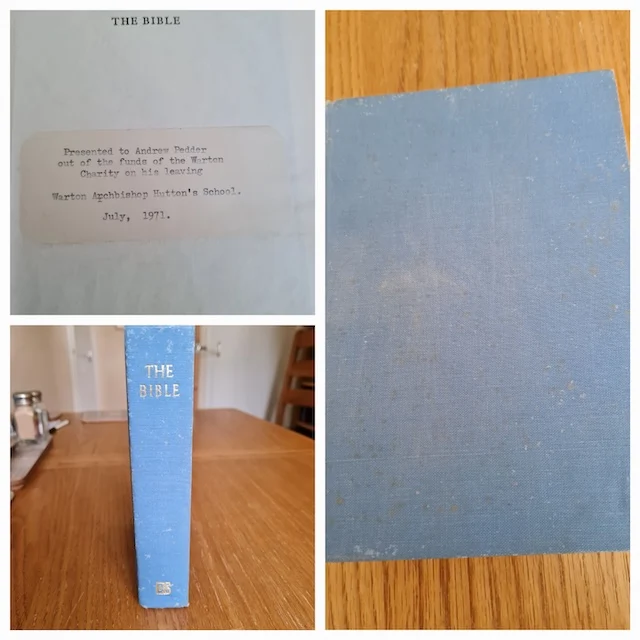
A Bible that was received in 1971 It was also reported that John Dawson, Esq. intended, in his will of 29 June 1767 to give £30 to Lawrence’s Charity and interest of £30 to the usher, but he died without bequeathing and his brother Edmund, his executor and residual legatee made good and added an amount so as to purchase £100 3% consols and he added to Robert Lucas’s two £30’s to purchase a further £100 Consols and making Elizabeth Redman’s £20 to £35 – in all £235 3% Consols. Edmund Dawson, Charles Clowes, William Hest and Jackson Mason were the trustees. Subsequently this was again added to by Isabel Richardson making £262 6s 7d – dividends of £7-17s-4d per annum (£3-15s to usher, £2-12-4d Books, £1-10-0d to widows in Lawrence Charity).
By Court Order, on 6 November 1858, John Jenkinson, John Edward Willan, Edward Dawson, Edmund Clowes and overseers were discharged as Trustees. The Vicar and Churchwardens of Warton and the incumbents of Yealand Conyers and Silverdale were appointed in 1859 and the above charities were administered as one. The churchwardens who acted as trustees were the vicar’s nominees, the one representing Warton (excluding Lindeth now part of Silverdale), the other churchwardens of Warton were elected respectively by the townships of Borwick, Carnforth and Priest Hutton being consulted only in so far as their respective townships were concerned.
The Rev Henry Sill, mentioned in 1826, became insolvent about that year and out of £330 in his hands only enough remained to purchase £131-19-7d 3 1/4 % Bank Annuities, which were transferred to the Official Trustees in 1858 together with some other small bequest originally from Mrs Isabel Richardson also referred to. The total gross income was £11-11s 4d.
By custom the beneficiaries were grouped 1). Warton 2). Carnforth, Borwick, Priest Hutton 3). Silverdale, Yealand Conyers, Yealand Redmayne: the two poorest women from each group benefitted, the townships in each of 2 and 3 taking turns to supply the recipients. All but one beneficiary at the time of the inquiry [1899] were widows receiving 12s annually, in two half yearly payments, and £1-7-6d, from a second sum of stock, was split between the two poorest women in Warton, if they were widows, if one was a spinister and the other a widow, the widow got it all!: 15s8d from Mrs Richardson’s augmentation was paid to one poor householder in Warton and £3-15s formerly paid to the usher of Grammar School had, for a number of years, been paid into the general account of the school. Books had also been supplied and this fund had £20-7-3d to credit with the Lancaster Banking Company’s branch in Carnforth.
Sleddall’s Charity
From 1801, this Kendal charity, bought Bibles and Prayer Books for communicant householders in Warton, when recommended by the Warton Vicar. It amounted to a handful only over the years. – Also in 1825, £20 had come via Mrs Gathorne of Kirby Lonsdale from exors. of the late Mrs Sanderson of Hining but the originator was unknown. It was paid to Edmund Clowes trustee of the above charities. Mrs Gathorne had also paid 20s yearly herself or through Mrs Sawrey of Warton to distribute amongst poor housekeepers of Warton township.
Charities in Other Townships
Sherlock’s Charity – Dr. Sherlock gave £30 to the poor – stated in the Parliamentary Returns 1786. According to the 1826 report it was in the hands of Mr Thomas Harris a landowner; it paid £1.5s yearly. This was distributed to the poor, along with produce from the two following;
Kilner’s Gift and Poor’s Land. Killner’s Gift Thomas Kilner gave a rent charge of 8s 4d on a close in Borwick called Chapel Field (held by Thomas Harris in 1826), paid annually to the poor.
Poor’s Land A piece of land was supposed to have been taken off a common in the dim past, producing 11s annually for the poor. This was presumed to be the piece, three roods (customary measure) possessed by the township, not known how. Upon enclosure of Borwick Moor, an allotment was set out in respect of this land containing 1 rood. The whole was then held by Richard Morland upon a parol(?) agreement for 3 years from Candlemas 1825 at a rent of £3.19s. This letting, in the same manner as long as could be remembered, took place at a public meeting. It been let previous to 1805 at a rent of £2.2s but the tenant had become insolvent when he quitted with £5.1s arrears due. This sum was advanced by the then overseer Thomas Jackson, who agreed he retain the increased rent beyond £2.2s until the debt to him discharged. An additional allotment in Over Kellet was sold for £6. This money was in the hands of James Hodgson who paid 5s interest yearly. These two sums £2.2s and 5s were passed to the overseer.
Out of this total, received by the overseer, sums varying from 4s to £2 were distributed at Easter to such poor as do not receive weekly relief. However, as stated by the assistant overseers of Borwick in 1863 to the Charity Commissioners, Thomas Harris who held £30 in 1826 had died in receipt of poor law relief himself, and possessed no property so that the Sherlock Charity was lost. Killner’s Gift had continued: the rent-charge of 8s 4d from Chapel Field (6 1/2 statute acres) owned by Thomas Jackson of Hall Gowan, Carnforth was passed to the two overseers and the churchwarden representing the township at Warton Church by whom it was distributed with the Poor’s Land Charity. This latter charity, received the yearly tenancy rent of £3 for Bull Close, (2 acres 1 root statute measure) let by the overseers to Col Marton of Capernwray Hall (presumably the Poor’s Land described in 1826). Of the additional allotment nothing was known and James Hodgson mentioned before had no known representative.
Until 1896 this combined income was for 12 years, through misapprehension, paid into the funds of the Lancaster Union in relief of the poor rates. At Christmas of that year it was divided between the two former recipients and since then it had been distributed about Easter when the payments were received equally among five poor persons, of whom the churchwarden above mentioned (one of the acting trustees) was one.
Carnforth
Poor’s Land Charity – In 1862 the overseers of Carnforth obtained a deed of feoffment, dated 25 January 1737 (no. trace of this was found by the Inquiry), whereby Henry Hadwin granted to James Lucas, Jonathan Peel and Francis Bainbridge … to permit and suffer the churchwarden and overseers …… to lease to best advantage for the benefit of the poor, the land called Hollowgate (1 acre 2 roots) and a parcel called Myers (1/2 acre statute measure). In 1826 it had been reported that the land which had previously been vested in Thomas Lawrence, John Peel and Francis Bainbridge, producing annually £1.17s, had been under the management of John Peel, supposed to have been the survivor of the trustees. Since his death the land had been let by the churchwarden and overseer to the highest bidder at a meeting of the township. It was in the occupation of John Whormby for seven years from 14 February 1825, at rent of £3.17s paid yearly on the 24th December to poor persons not in receipt of constant relief. In 1861 Hollowgate had been let to James Stockdale Harrison for 999 years, yearly rent £4.4s and with permission sold to him 19 June 1868 for £167 invested in £178.5s Consols in the name of the Official Trustees of Charitable Funds. The annual dividends £4.18s had been remitted through the Lancaster Banking Company to the churchwardens and overseers who after consultation divided the money among the recipients, taking it to their homes on Christmas Eve. The previous Christmas there were 29 then on the list, some in receipt of poor law relief. The sums to each from 5s to 2s 6d.
Greenbank’s Charity According to the 1826 findings, a gift to the poor from the will of William Greenbank, produced £2.10s yearly from land then vested in James Ainslie. This sum had formerly been paid by Mrs Ainslie and Miss Elizabeth Wilson, then distributed under their direction. Since the death of Miss Wilson in 1818 nothing had been paid. There appeared to be no legal foundation for the charity which had lapsed.
The School Early in the nineteenth century the Presbyterian Chapel, the congregation of which had been dissolved, was converted into a township school and used until 1849. There was no evidence to show under whose management it had been nor in whom the site was vested. Then by indenture, 30 August 1849 and enrolled in Chancery 9 February 1850, the Dean and Chapter of Worcester and the Lord of the Manor of Carnforth granted to Rev. Thomas Dean, Vicar of the parish of Warton, and to John Thompson Kew and Joseph Caley yeomen, churchwardens, and their successors, a school for the education of children and adults or children only of the labouring manufacturing or poorer classes in Carnforth, in union with the National Society for Promoting the Education of the Poor in the Principles of the Established Church.
On the site a school and a master’s house were erected by subscriptions of £273.10s raised by the vicar, and a grant of £60 from the National Society. The old schoolroom then converted into a cottage, was appropriated by the trustees of the new school and annexed to the latter as an endowment. In 1861 a bazaar realised £650. The promoters proposed to hand over £564 to the school trustees to be used at their discretion and application was made in1862 to appoint additional trustees. The Charity Commissioners established an order 4 July 1862 vesting management in a committee consisting of the principal minister. curate or curates, if appointed by the former; the churchwardens of Carnforth; and 15 contributors to the school. This scheme had been ignored after 1875 (there was a new church in Carnforth in 1873) but the anomalous position was settled after the report on the Inquiry by the Vicar of Warton formally surrendering claim to fees arising from church offices at Carnforth.
In 1871 the Trustees had purchased (from money handed over in 1861) a £500 bond of Mersey Docks and Harbour Board, interest at 4%. redeemable in 1907 and transferred in 1892 to the Finance Board of Diocese of Manchester in trust for the Carnforth School Endowment therefore, consisted of the above bond producing £20 annually and £2 rent from the cottage, let as a builder’s store to Thomas Pool. The £22 was paid to the master of the National School conducted as a public elementary school.
Priest Hutton
Sherlock’s Charity In the 1826 report it was said that Dr Sherlock had given £9 for the poor of the township, yearly. However, £10 (whether from this or not) had been placed by the late William Dawson of Priest Hutton in the Bank of Worswick & Co in Lancaster. The bank had failed in 1822 and though a small dividend had been declared no application had been made by August 1825. This charity appeared to have been lost. It was also stated that there was a house and garden which had been given to the poor which had produced a rent of £1.5s per annum. There was a house occupied by paupers, who were placed by overseers, but it does not appear from whom the house derived or that any rent was ever distributed in charity to the poor in respect of these premises. The Vicar stated to the Inquiry that he knew of no house in the township answering to the description of the paupers’ house mentioned in the 1826 report.
Notes
- Whelan Robert, “The Corrosion of Charity”, Institute of Economic Affairs, Health and Welfare Unit (1996), ↩︎
- Ibid. p3 ↩︎
- W.K.Jordan, “Philanthropy in England; 1480-1660” George Allen and Udwin, 1959 ↩︎
- This was reported in The Times ↩︎
Published in Mourholme Magazine Issues 32, 33, 34 and 35 published in1998 and 1999