
by Michael Wright
It is always interesting to look at old plans, particularly when they show what might have been. A copy of Rennie’s 1792 plan for the Lancaster Canal (Lancashire Record Office Ref. DDPd 25/34) shows a proposed branch to Warton Crag, where reserves are marked. How different would Warton’s history have been if this had been constructed?
The cost of building the canal north from Preston was cleverly reduced by avoiding the need for locks all the way to Lancaster and beyond. This also greatly reduced running costs. By careful choice of water-level it was possible to construct the canal along the eastern edge of the low ground north of Preston, and bring it very close to the centre of Lancaster, where so many of its financial backers lived. The chosen level made a Lune crossing feasible, if expensive, and gave us one of the finest aqueducts in the country. The merchants in Kendal who impatiently awaited the arrival of the canal, and its attendant cargoes of cheap coal, knew that the level course could not reach them, and that the expense of the aqueduct over the Lune had so depleted finances that further major expenditure on a flight of locks was out of the question for the time being. They would have been dismayed to know, when work started on the canal in 1792, that it would not reach Kendal until 1819.
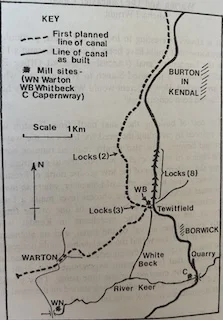
The level course came to its natural conclusion in the mounds of glacial debris that blocked the route north at Tewitfield. This obstruction was eventually surmounted by the Tewitfield flight of eight locks, which raised the water-level by 75 feet, sufficient to put the canal on a new level course all the way to Kendal. The Rennie plan of 1792 shows a different solution to the problem of climbing between the glacial mounds north of Tewitfield. It was proposed to carry the line of the canal further west and then raise the level by means of three locks near Tewitfield, so as to pass along the hillside to the east of Holme Tarn. Indeed, the start of this first-planned route can still be seen heading west from the bridge over the M6 motorway at Tewitfield. A canal-width excavation lines up with the tiny branch of canal still to be seen in the Tewitfield Basin, where it is now used for turning the boats. Three locks were to have been constructed at the west end of the excavation (some two or three hundred yards from the present Tewitfield Basin) and these would have raised the canal above the level of Holme Tarn. North of the tarn two further locks were to have raised the canal high enough for it to pass through the gap now followed by the railway and the turnpike road (A6). It would then have skirted along the lower edge of the hillside east of Hilderstone Moss, some 30 feet below the level later constructed. The remaining 30-foot rise needed to reach Kendal was to be achieved by building four more locks north of Holme.
But the question of lock construction was for the future. The immediate need as the level course extended north from Carnforth was to provide a temporary terminus for the canal, but one that would leave the canal as a viable business proposition. able to generate income for the later completion to Kendal. The temporary terminal would have to be close to a reliable water-supply to keep the canal topped up, and it should be as near as possible to a good rail link to Kendal, and elsewhere. Both these requirements could be met if the canal was brought to its temporary halt at Tewitfield. Here the Whitebeck could provide water, and the main road from Lancaster to Kendal lay only 150 yards away (where the Longlands Hotel now stands). As for generating more income, one of the main purposes of the canal, to carry limestone south, could be fulfilled by opening a quarry right alongside the canal just to the north of Capernwray Mill. So conveniently placed was this outcrop of limestone that a short branch canal was later built right into the floor of the quarry (Wegber Quarry).
The one real complication was the water-supply. At Capernwray the Keer flow was left untapped. The level of the canal required construction of an aqueduct over the Keer a few yards upstream from Capernwray Mill, so it was possible to leave the mill and its water-supply undisturbed. If water had been taken from the Keer compensation would have been due not only to Capernwray Mill but also to Warton Mill further downstream. At Tewitfield things could not have worked out so agreeably to both parties. The canal needed water from White Beck, but this was the only source of power for Whitbeck Mill. The mill had to be bought out and compensation paid. The water of the Whitebeck could then be diverted into the canal.
It was at this stage that the extension to Warton must have been considered. It would have required a further 2 1/2 miles of level canal construction, but the question was, would it pay for itself? The limestone of Warton Crag beckoned, but there was already access to limestone at Capernwray, and this right alongside the canal. A terminal at Warton would not give access to the best roads, so that onward transport from Warton would be useful for a few villages. And the Warton branch which looked so attractive on the original plans would have been fraught with problems, some of which must have been obvious to Rennie before work on the canal had even started. The level course which had worked so well as far as Tewitfield, and which had politely skirted the edge of Lancaster would have blundered right into the heart of Warton clumsily disrupting the village before passing on to the fields below the Crag. And even here the limestone was not next to the line of the canal but would have had to be brought some 60 or 80 feet down this hillside. Most telling of all, the groundwater conditions at Warton would have been difficult. Not only would it have been very expensive to seal the canal over the fissured limestone that lies under the village, but there would have been no obvious water-supply to keep the canal topped up. Water there is in plenty within the fissured limestone, but it emerges very close to the valley floor, almost at the level of the canal.
It seems that a canal terminal at Warton was always very unlikely. Warton was missed out of the canal development just as it was with the later turnpike and railway. Had the engineering conditions been more favourable Warton may have had some benefit from a branch canal, especially if a limestone quarry had been opened up. But trade through Warton would have been limited to Warton itself. Carnforth was already on the canal, and the Yealands were close to the northern extension. The biggest commercial impact on Warton might have been at the present day, when we might have been discussing the pros and cons of a Warton Marina development.
Published in Mourholme Magazine Issue 33 1998