“Saw ye the charming Ettie,
As she swept along the vale?
There is no girl so pretty
In our glorious Silverdale.Mr Burrow of Silverdale, a former member of the Society brought Mr Abbot’s poems to light. A Mrs Cole, an Abbot descendant, researching her family, saw a known name over the Butcher’s shop in Silverdale and stopped to make enquiries. Mrs Cole has kindly supplied the details of Richard Abbot’s life and a copy of his poems.
In 1901 a Richard Abbot published, in Darlington, a book of poems. He was 82 years old then, and much of the book is standard Victorian versification on suitably elevated subjects. There are however some more personal poems which have reference to the Arnside/Silverdale area in the 1820’s.
His parents, Richard Abbot and Margaret Burrow were married in Beetham in 1817. Young Richard was christened in Burton in Kendal on December 25th 1818. His mother died when he was only three. She is buried in Beetham churchyard, though she died in a cottage at Gateside, near Kendal. One of Richard Abbot’s happier poems recalls details of his early life there; the kindly cobbler who kept guinea pigs in cages, the clang of the smith’s anvil the sound of the bagpipes played “by th’ itinerant, kilted, bare-kneed Scot” and the dame school where he learned his ABC and also to “lake”1.
The father was a Contractor on the Lancaster and Kendal canal, and also farmed on the Ingleborough fells. Richard attended school at Ingleton till he was eleven, when his father took him away to start work as a shepherd on his farm. When Richard was sixteen his father was incapacitated by an accident. Richard had to go out to work, first in quarrying and then on the railways. He moved to Teesdale where he rose to be manager of a large quarry.
From his poems it is clear that some of his childhood was spent in Arnside, his mother’s birthplace.
Hail! Arnside next my mission is to thee;
Hail! to thy green woods and thy rocks so blue
Thy war and time-worn tower – grey and green
Around this pile I’ve wandered hand in hand
With pretty Esther Borrow my young auntRichard still knew Arnside when he was old enough to woo Etty, “The Rose and Pride of Arnside” He wooed her “by Beelah’s Stream And Beetham’s bonnie braes” and sang her praises by the Fairy Steps and ” In Sylvan shades nigh Dallam Tower“, but he did not marry her. She died and was buried in “Yon sacred Fane of Beetham“. Richard certainly courted other young ladies. “Sweetest Lucy _Lucy Swan” and Nancy Swales who was “brown but bonny, ” and still another with golden hair and “beauty ripe.”, but which of them, if any, was the Sarah Greenfield he married in 1839 is not known. It remains however Etty, who is most clearly brought to life in a clear setting. Perhaps Arnside’s “blue” rocks are a little unexpected, but then they had to rhyme with “knew” two lines further on.
- Lake Oxford English Dictionary To play, take a holiday from work. Earliest examples go back to the 13th century ↩︎
Published in Mourholme Magazines Issue 16 1991
Information has come from various people, and especially from Mrs Florence Walker, Mrs Barbara Walker and Mrs A. Beck.
In a village the memory even of people intimately involved in the village life can fade quickly if something is not written down quite soon. Here is the story of one such person, written down from the accounts of some of those who remembered her.
Blanche Smith was born in Yealand Redmayne on 11-12 December 1899 and christened Bertha Blanche Hodgson. Hodgson (commonly pronounced Hodgen) was one of the most frequent family names in the village. Her father worked at Trowbarrow quarry, where he lost an eye in a bad accident. In his day he was a great skater, and was known to have skated to Preston and back in a day along the canal. Her mother came from Barbon. She became chair-bound as a result of rheumatism. At one period she used to have herself stung by bees, an alleged cure for rheumatism. Her neighbours, the Friers, were bee-keepers. Blanche had much of the management of her mother, who became cantankerous in her later years. There were three brothers. Garnett hoped to be a farmer; but he became a stationmaster in various places and came to live in Manchester. Frank served time at the smithy in Yealand Storrs when it was run by a Mr Anderson (who died in 1930). Subsequently Frank acquired his own forge in the Manchester area. Harold, the third brother, was pleasant and able to work, but he had a disability, Though it is not now clear what the trouble was: “he had a large head and limped. Blanche had to look after him a good deal.
Blanche seems to have been at school for a while in Barbon (near Carnforth), where her grandmother lived. She also attended the Yealand school and the school by the Yealand Conyers meeting house. After school she served time at Sims, a confectioner’s in Silverdale. She had to walk there each day taking Sims his can of milk. Then she was at the big bakery, Hartley’s in Millhead, in what was afterwards Latham’s slipper factory. It was not the full training in cake decoration she wished to do, but she was able to take further classes in Lancaster. At the period she was in Millhead there were no buses, and she used a bicycle. (Indeed, a common way of getting from the Yealands to the Roxy cinema in Carnforth then was on the steps of someone’s bike).
So she began a career of baking and making cakes and decorating them for many years, though not in a commercial establishment, since she married and lived in Yealand. In the early part of the 1914 war Blanche became engaged to Ted Smith, who worked on the railway. But he was called up, and suffered in a gas attack; his health was permanently affected, though he was able to work again after returning home. Ted and Blanche married, and their only child, Frank Hodgson Smith, was born.
Blanche would recall that Frank learnt to walk in the first “village hall”. This was a wooden hut by the roadside near the Red Bank barn. It held about twenty to thirty people and was only eleven feet wide, a roof beam is in a nearby garage – and Blanche’s mother as well as Blanche herself were active in running it. From this group grew the Women’s Club which ran the village hall which was set up in 1920-21; it was well supported by Blanche, who busied herself in providing the refreshments. This second village hall was half an army hut from Carlisle; and it was Blanche’s father and uncle George (nicknamed ” Kruschen’ tor his liveliness and capacity for dancing) who transported the Yealand half from Borwick and helped to erect it. Both halves lasted over sixty years before having to be replaced.
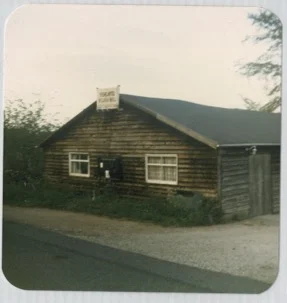
The second village hall in The Yealands replaced in 1986 Blanche became much involved in the running of the parish church of St John over many years, from ironing the church linen to being made the first woman churchwarden; she was very proud of this position, and was on the church council. She worked hard for the Yealand Manor, Beechfield, The Larches. Later, summer sales, held in different houses each year – newcomers with different ways of organising things came into St John’s and managed to offend Blanche so that she retired from the church.
She remained busy in many other directions, from her cake making to being on the committee of the almshouses at Warton. She also supported some of her neighbours in highly personal ways. When she was about sixty, she was a governor on the local school. She became a trustee of the village hall.
Frank, her son, won a scholarship to the George Fox school in Lancaster, and grew up to be a likeable youth; he worked for the Post Office in Lancaster. He became engaged, but he joined the Royal Marines and was killed while serving on the Gloucester off Crete. This was a time of prolonged suspense, since it was not till the end of the war that Ted and Blanche finally knew that Frank was presumed dead.
Frank’s fiancee Eileen married later in the war period; she and Blanche remained on close terms, and Blanche would stay with Eileen in Kendal. Blanche even made Eileen’s ruby wedding cake, and it must have been one of the latest cakes she made.
One of Blanche’s main characteristics was getting on with things; she was generally doggedly busy, and interested. She had a talent for telling a story, and was outspoken, though not aggressive, to those with whom she differed. She was very loyal to those she took to: “She was kindness itself” and “You were hers for evermore” were comments. When she was older, she could be opinionated, but chiefly over matters concerning the village. Thus, she was scornful about the numbering of houses and the naming of Eight Acre Lane: it had always been simply, “the lane”. She was particularly firm that all of Yealand Redmayne as far as “the lane” was really Yealand Storrs: this was technically true. Also, she objected to the village hall’s title as “Yealand Village Hall” – it should be “Yealands”, she felt.
Ted, after many years of ill-health, had died long before her; and one of his last remarks, “I must have been a pretty bad bugger to deserve all this,” would always bring a tear to her eye. She had lost Frank by war, but did take on an evacuee, who was seven at the time. He went back to Salford in the normal course, but returned to Blanche – he seems to have run away from home. She and Ted fostered him. When he was fourteen, he became deaf after meningitis. He married a deaf girl, and they often came to stay.
In age Blanche developed cataracts. After one early operation her left arm and her finger swelled so that her wedding ring stuck and the finger began to go purple. There was a late-night crisis, and neighbours arrived with inappropriate tools. Her brother Frank eventually took the ring off with a small saw. The ring, a broad, rounded band, was remade she’d felt naked without it.
Finally, after a later eye operation an infection developed, and she had an unhappy fright one fevered night when she thought she saw her dead brother Garnett by her bed, though she allowed herself to be jollied round. But the infection got worse, and she eventually died in the early autumn of 1985, a little short of her eighty-sixth year.
Information has come from various people, and especially from Mrs Florence Walker, Mrs Barbara Walker and Mrs A. Beck. There is room for correction in this note, and for a fuller account of her numerous activities in the village.
Published in Mourholme Magazines Issue 16 1991
By Eddie Sandes
Part 1 Silverdale
Eddie Sandes was probably best known locally as a Morecambe Bay fisherman, but in the 1970’s Mr Bradley recorded an interview with him about his experiences as a farm hand at the end of the First World War. Mr Bradley has kindly allowed this shortened version of the tape to be printed. (A transcription of the whole tape has been put in the archives. )
When he was thirteen Eddie started working for Jonathan Robertson, first at Knowe Hill, then at Bank House Farm, living in at both places. Bank House had about forty acres, but did not carry so many cows as a farm of that size today, Eddie said.
‘ .. . never above six or eight at the most milking. And you can tell it was a good piece, really a good farm … well, the same farm today … It has twenty odd milk beasts. They’ve got a milking parlour put up, haven’t they? . . . Well, that’s thirty then. So the same farm now is going to have thirty milk cows on it as had six or eight on. ‘
( Who got him up?) Well, the boss, Jonathan. . . Oh, well, he wasn’t a hard task master. I wouldn’t say. Probably seven o’clock, half past six. He wasn’t one of these real hard cases, you know … it was only a small farm and he just liked to live his life and went on. He didn’t do much work himself … Spent a lot of time on rabbiting and things like that … He was a very keen poultry man. He used to do a lot of showing Bard Rocks … That was very popular about here at that time. There was a few in Silverdale. Matt Slater. Him and a fellow called Jackson. He isn’t here now. He’s dead. Old Dr Jackson too .. He was a well known sportsman. He was very keen on this poultry.’. . .
Well of course the lad’s job, the first thing, was to get the cows up ready for milking, you see. .. of course the boss used to milk what you’d say the cows that give the most milk. milking wi’ hand, you know, Because the old-fashioned the faster you could milk them, the better milker you were, the more milk the cow gave. .. Therefore the boss picked the best. Those giving the most milk out. And the lads did what they call the stripper. They were cows that weren’t giving much, what was going to calve again before long … they didn’t give them much cake then, not like they do now. Some of them a bit, but in summer. . . None at all in summer. No.’
‘Yes. Well, yes. Tried (ploughing) . But of course they were never satisfied with a lad’s ploughing, weren’t farmers. They were very proud about their ploughing in those days. How straight it had to be and the depth and everything. Used to spend a lot more time working the land than they do now. Rolled it about more. Put it that way … It was a slow job getting crops in … Very slow. ‘ ‘…
of course, all farms kept a bit of everything then. A pig or two. A few hens, which they don’t now … So then the next job was going feeding these few hens which then they used to be fed outside, not like they are now. I used to take some corn and throw it down on the grass, you know, that’s what the hens got.’ ‘ ….
There’s a lot of good grassland now that was more or less. . well, nearly going to waste .. er .. probably trees growing on it … Bright’s Farm … What they call the Lots, which is a real cattle on it. In those days it was nothing but that wild gorse. We used to go burn it off in summer and snathen it off and that, so the sheep didn’t get fast among it. .. (How many sheep?) … not many. Mick Mason keeps about a hundred yowes now Because he lets them out on the marsh. Well, then about a dozen was a lot, going back. (Then there was very little marsh, not as much as twenty or thirty yards. ) Now there’s probably what? A mile? Quite a mile. Yes.
‘You’d be always found your job. .. Used to fell a tree somewhere because there … was more wood about then than there is now. More waste land. Used to fell a tree and we’d saw it up. Might be you’d spend all day sawing wood up, rather than having to buy coal. The wood did for the fire, d’you see?’ ‘
You see the farmers then, well I understand. . . they were poor, they hadn’t the money to buy the stuff they needed, so they used to have to make their living out of the land, which was ploughing, growing different kinds of fruit … different kinds of crops … vegetables, potatoes, things like that and take them to market and sell them to get the cash to carry on with.’ ‘
… . poultry and that, they used to dress a hen or two each week if they could … See, that was something. It was an income. Same with pigs, you know. They could always kill their own pigs. Cut them up. Some made bacon. Sold a bit of pork. Anyway they could …. ‘ (Pigs were fed) ‘mostly meal, Of course any kind of swill you had. You used to chop mangels for them. Turnips. And most farms grew a bit of corn then. Of course they used to get the corn crushed at the mill and that came back for the pigs. .. ‘
‘ … they used to grow quite a lot of vegetables Peas. Cabbage. Beetroot. Beans, I remember all the farmers would grow all … most of those things. Not just for themselves. To sell. That was a little part of an income … And if you notice every farm’s had an orchard in those days. They haven’t now, but you can still see where the orchard’s been. All of them. Not some. All the lot of them … apples, mostly. A few plums, but plums and pears weren’t as popular. Well, plums are very erratic, aren’t they? You can’t rely on them somehow. .. Apples were the main thing.’
(What happened to the milk?) ‘Well, if they wanted to rear calves, obviously to use the milk to rear them. . . They used it for the bigger calves. .. Oh it was all used on the farm. If they’d more milk than they wanted to rear calves, some used to make butter, some used to make cheese … all of them sold just a drop of milk. Used to go round with a gallon can. . . and an old fashioned measure used to hang inside it.
Hay Making.
‘Well, some of them had to (hire labour in hay time) … but these small holdings didn’t. Only a man at night … these around here used to get a chap to come for a few hours on a fine night from the quarry, but, you know, they were sure they wanted him when he came. There was no coming with nothing much to do. They made the hay ready and had it platted up ready. All he had to do was get it inside.’
‘Oh, we used to be late in those days. Oh, well, they didn’t start before July, sometimes to nearly August. Now it’s just the opposite, you see. You can’t be any earlier. Nothing like June hay, they say now. It’s even got to the piece now they’re starting in May, never mind June. You’d have thought they were mad when they talked about getting some June hay.’
‘When it was first mown they called it swathe you know. Breaking it out of swathe, they called it .. . You spread it with forks then. You’d start turning with a rake, then. You see. Its very hard to get it up and cover all the ground with it. . And you start with a rake to get it off the ground again. Well. it was always damp underneath a plat. So the next day, where it were a dry year, they’d roll it there, like the mother end up. That was procedure …. Turning it.”
‘ … there again in two or three days they have it a good hay now. With the machinery they have. Well then it used to take a week. And most farmers … well, all the good, particular farmers they had to have it standing in cocks a day or two before they were taking it into the barn .. . that was thought to be a necessity in those days. To stand a day or two like that. Of course now it’s in the barn before they would think about cockers1. ‘
‘The women used to have to help. In hay time you know, that was almost the thing.’ ‘ After the hay had stood in cocks it was brought into the barn. ‘Yes. Yes. Leading .. . That was leading. ‘ Some times on lurries,2 but more often on two wheeled carts because they were easier to manoeuvre into a barn.
‘But they had cages on them, as they call them you know. Hay shilvings. Back and front. They would stick out over the horses back, you see. And stick out behind. They called those hay shilvings.
The skill of loading the cart described.
‘That-side. That side. Middle. To hold them you see. You put that side first. You keep backing on your cart. You start at the back. Not at the front. Always start at the back. That corner. That corner. Middle. You see the middle was kind of on the top of those, by that was holding them down. Now then you have your back and you keep backing up the cart. . . No, you don’t go right to the front. You left it .. . you kept doing that until you’d just room for six more. You see. Well, you turn round and start in the two front corners and the centre and work back again. Then the next two behind them bound all the lot d’you see. . . If you’d have carried on and finished on your front corner, there’d be nothing to hold it. It would have gone. That’s how. And you used to mostly put three rounds on a cart, but a good loader, if he was a good way from the barn would put five on, He’d be canny like, you know. He’d some weight up above, you know. . . So if you were on a bit of a slope or anything, you’d to be careful. You could … Carts have been thrown over. Well, many a time. And of course if cart goes over horse has to go with it because it’s fast in the shafts.
(In the barn) ‘you unload it just as you forked it on. You haven’t to break any of the forks up, you see. When you want to fork it off, on to the mow. .. if you don’t take it out as it went in, you’re soon in a mix up. You’re pulling one … trying to get one out that’s fast under the other, d’you see? So, that was it. ….
At the end of twelve months Eddie decided to try another job. This was in the winter of nineteen eighteen/nineteen. The account of his hiring at Ulverstone Fair and his experiences at a big dairy farm forms Part 2
Part 2. Silverdale and Urswick
This second part is mainly about his experience on a bigger farm to which he moved in 1918. It begins however with the story of another Silverdale man, which has interest as showing that at the beginning of this century it was still possible to set up farming with almost no capital. The story came out in reply to a passing question about rents and prices.
Have you any idea what rents were?
‘I a’nt quite sure, but….well, of course, there again, there were good farms and poor farms . Good land and poor land. So that really don’t think you can generalise on a thing like that. But. . er. . you could get a fifty acre farm for round about … fifty pound a year. A pound an acre. Something like that a year.
How much capital would a man need to start up?
‘Mmm. Well, there was an old man here they called him (Eamonn?) Robinson. No relation to the Robinson we’ve been talking about previously. A different man. Farmed Hazelwood Farm. Now he came there about …. 1900. Very early 1900’s. And he always used to tell them that he … that when he came he had fourteen pound, and he spent it immediately on two old horses and a plough, and that’s all the capital he had. From there the income he needed for his wife to keep the house with. stuff he grew, rabbits he caught, and things like that. Took them to the market. Hunting for rabbits, stuff from the orchard. Apples. Anything. Crops he could grow, potatoes, carrots, cabbage, anything in the vegetable line and for another … the other income to pay his rent, and build up stock off … you see all he could do was start with a few calves … worth about anything from five to ten bob a piece. That was something like the price of them then. Used to take in what they call joists cattle3. That means farmers that were better off and probably more cows than they could keep on their own farm. They’d give you so much a week for keeping these. Same applied to sheep. And that’s how he carried on from there. Well, he farmed successfully. He was a good farmer and he was still there till about … oh, 1935 or something like that. So … that’s thirty odd years’.
And he’d make a bit of hay and sell it?
‘Oh no, you see he still kept joist stock in winter. He got paid for … he had to use the hay on the farm For till4 If you sold the hay you had to buy …. pay money out of that, which was out altogether for a fellow without the money to buy it. So … No. they used to go mowing bracken and things like that in those days to make bedding for the calves, to make manure. Used to be an agreement in those days, you know. The farmer weren’t allowed to sell hay. Oh yes. They used to put it in the agreement. They called them poor farmers who sold hay and so on and things like that’.
“Robinson, he had a milk round all his life, and when he’d be seventy odd he was still going round with the milk. Used to have a camel to fit on his shoulders, that’s like a wooden thing … With a big can on … on a chain. On each side. A big one. I don’t know. A whole gallon, I suppose. He used to be going round from … Oh, you’d see him going from just turned seven in the morning. One end of the village, and coming out at the other about ten o’clock’.
In November 1918 Eddie Sandes decided to move on.” He went to the Hiring at Ulverston
. …. I went to … Ulverston. At the back end they have what they call hiring. At Ulverston. All the farm servants then went … that’s on the 11th of November … there were dozens of lads and quite a lot of farmers, walking about looking for what they thought a likely lad …. and they would come and ask you … you make your hiring and they shake hands and then they gave you two shillings. They called that earl5 money and that was binding. That bound you to them for six months. That were how it went about. … You simply walked up and down the street till somebody come and ask you. ”
The hirings were for six months?
“The six months was from the 11th of November … till Whit Saturday. Whit Saturday was the day you finished. Always. Whatever date it came on … Then you were hired again for the summer period .. You’d a week’s holiday and you went back the week after. Till November. But they always used to like to pay a bit more for the summer than the winter because it was longer hours. Haytime and things like that. … . “
There was one (Hiring Fair) at Lancaster. But there were very few there. People give over going. It (Ulverston) was practically the only one. They came from way up the fells. Down below Lancaster they used to go to Ulverston hiring. Oh, it was the best place’.
Farming at Urswick.
‘And I hired then to this place called Jackson’s at Ossick. Or Urswick. I don’t know how to pronounce it really …. For six pound tor the winter. I would roughly be I think about fifteen, sixteen years old then … just right away when the war finished. The same years that the war finished? Yes’.
… something like four hundred acres. They used to milk about sixty cows … He used to buy them as he needed to keep his milk average up, you see. One was knocking off its milk, it used to have to go, and buy another one … Losing money on cows and getting it back on kit6 Put it that way, ”
They didn’t do any brackening there, because they didn’t rear any calves. But they used to buy grazers in the spring, mostly Irish cattle then, for feeding for beef. Instead of rearing calves. They were milking all the year round, but … in summer there was an awful lot of grazers … mostly Irish. “. ..
There was four lads about my age. . about sixteenish. Something like that. Four lads and a man. Called him the hirer. He was the boss, like. Not the old one, but he was in charge of us. We were there six months. The winter six months. Seven days a week, for up every morning at quarter to five. If you didn’t get up, he’d pull you out … We all four slept in the same room. It was a big bedroom. And that was it’. ‘…
‘..we used to take the milk in churns to Ulverston station, which was if I remember right about four miles. And we had to catch a train there at half-past eight … That was my job. (The milk went) … To Barrow for delivery. He used to sell it to … a dairy. Oh there’d be … six or seven churns. Kits … not churns. Kits. ‘
‘Well, we used to start at quarter to five, but I didn’t milk as long as the other chaps. I was the eldest of these four lads. That’s why I got that job. I had to take it to Ulverston station in the morning. With the milk float and horse. I used to go down … go into the house for my breakfast. I’d have (to) yoke my horse up and take it to the dairy … They used to give me time so that I was just about there at the time they’d finish milking, d’you see? To get all the milk in the kit’.
‘The first job was, give them an armful of hay in the morning between the two cows. A tub, as they used to call it. That’s provin7 And as you came to them to milk them you gave them the provin. The tub was down there and you flung it down in front of them. They had the hay to eat as soon as you got up. But as you come up to milk time you used to pick the tub up and drop it in front of them. … It you didn’t do that they wouldn’t let the milk down. See? ‘
‘The quantity of milk they were giving, they got the quantity of cake … exactly .. you see. The tubs weren’t always the same size. The more milk a cow gave the more provin they gave it. ”
(For provin) we used to use … two things; cotton cake. And oil cake. Those two. They used to come in slabs about, oh .. if I remember right, eighteen inch to two foot long about a foot wide and perhaps three quarters of an inch thick. Something like that .. there was a machine like a thing with … not teeth but kind of spikes in it. Used to drop it in at the top and twine the handle and it used to crush it , ‘you see … Like a hopper .. it had a slide down, you see the weigh of the cake … Now when it got to there, the jaws were perhaps only about that width. One there going round and one here going round, and it took hold of them, do you see.
I was there in winter six months, I didn’t want to stop for I’d had enough of winter there (laughter) … its a rough job … but I can tell you this little bit, when we went in, hired, as I told you … He said, right, he said, well, come on such a train and we’ll pick you up at Ulveston Station .. of course. I didn’t know him, but when we got there, there were these other lads. There were four of us he picked up. We were all strangers and we’d been going away in float he said this is start of our land, that’s our turnip yonder. I said how many acres is that? He said twenty acre. An there was snow on the ground, all covered with snow!… We nearly passed out when he told us we had twenty acres of turnips to pull, because it was a lot, you know. Well you had to pull them with hand .. Oh many a day like, us four lads in there! You know what it’s like in old snow any time you pick anything up. Of course they’d get them (balled?) in the cart before the real bad weather come, but that particular day, that was Martinmas, there was snow on the ground then. So it wasn’t very promising telling you you’d all those to pull, and they were covered with snow, was it? That was the first insight … they’d take them to the farm and cover then with bedding like, to keep the frost off them, d’ you see. Kind of hog8 them as they call it.
- This appears to be the reading, although this form of the word has not been found elsewhere ↩︎
- A lurry; any four-wheeled vehicle on a farm. ↩︎
- Joist, jist or gist. The word is still in common use in this area. The OED gives gist ‘to take in (or put out) cattle at so much per head” and considers it to be related to the French gite, a lodging. ↩︎
- Till Locally: fertiliser. (i.e. by using a farm’s own hay to feed the cattle the goodness would be given back to the land in the animal droppings and fertilise it). ↩︎
- Oxford English Dictionary (OED) Earl or Arle (Northern) To ‘fasten’ by earnest money ↩︎
- OED Kit – A circular wooden vessel made of hooped staves… a vessel used for carrying milk etc. Here, presumably used for the content rather than the container. ↩︎
- Provin still in use today in this area. The nearest word in the OED is Provend – Food provisions esp dry food for horses, as corn and hay ↩︎
- Hog OED To store potatoes etc in a heap covered with straw andd earth (Orig obscure) ↩︎
Published in Mourholme Magazines Issue 15 1990 and Issue 16 1991
Footeran Lane runs from the edge of Yealand Redmayne, past the village school and village to Yealand Conyers. The low-level site and hall may have been a rubbish dumping ground before the school was built in 1840. There is also a waste ground adjoining the last house Well Lane which a resident of the village, born locally in 1900, referred to as “the footeran”. She recalled that this is where the refuse collectors took the rubbish they collected on their then rare visits. The origin of the name is not recorded.
The question of the origin was aired in the Journal of the Lancashire Dialect Society last year, correspondent suggested a connection with French forms and perhaps a link with some lingering Norman-French term. In demotic usage Foutre quelque chose par terre means to throw something on the ground, foutoir is a messy place and foutaise is rubbish; and terrain is a piece of ground in French and English. An alternative possibility is that the term was brought back from World War I, but the history of the name has not been traced far enough back to decide whether this is even possible.
A century ago Carnforth had an influx of miners, largely from Dudley in Worcestershire. A north midland term for a drift mine was “footerill”, and this has been brought into the discussion. If this is relevant at all, the explanation of “footeran” will be more complicated. The editor would be glad to hear from any reader who has any specific information which may clarify the origins of Footeran Lane.
Mr Kenneth Greaves notes that the Oxford English Dictionary gives the word “footer” as means to triffle or potter about. Hence it is suggested “footeran” might indicate a place for footering or hanging about and refers to a lover’s lane. “Footer” also appears in Lancashire dialect dictionaries; the change from footering to footeran is not covered.
The Yealand pronunciation can be represented as “foot run” the “u” indicating a short “oo”. It must be remarked that Footeran Lance is the main route for traffic into and out of the village and not obviously likely as a lover’s lane.
Further information about this name has come to light, thanks to the members who are reading nineteenth century newspapers.
On September 7th 1833 the Lancaster Gazette carried an advertisement for the sale by auction of “Two closes, or parcels, of Land, situate at Yealand Conyers, called Great Footerns and Little Footerns. . . ”
The tithe schedule of 1846 shows that there was a field named Footern in Yealand Conyers, and another Footern, as well as Little Footern, and Footern Hemplands in Redmayne. (Fig. 1) Fig.1 Border of Yealand Conyers and Redmayne 1843 (Field names from Tithe schedules) They lay around the pool, which then, as now, lay behind the school. They are bounded on the west by Footeran Lane. Some of the field names remain, like Fall, (to the west of Footeran Lane) and Flatt, but Footern seems to have been lost as a name. Great and Little Footern are now one field, which is known as School Field. The Footern in Yealand Conyers, now part of the Hartley estate, is also referred to as School Field. The information on modern field names was kindly supplied by Mr Edward Walker of Hill Top Farm, whose land includes the Redmayne Footerns. Mr Walker was also able to confirm, from his personal memories, the former existence of the pool marked at the south end of Footern Hemplands. It, as well as the cattle trough at the end of Well Lane, were accepted watering places, though the pool was not reliable in dry weather. All this still does not give an explanation of the name, but is perhaps a step towards discovering it.
The origin of this name has been discussed above. Mr. Quinn, the headmaster of Yealand School, may have solved the problem for us. He has pointed out that Mr J. Rawlinson Ford, in his undated manuscript article “About the Yealands”1, refers to the pool behind Yealand School as Foul Tarn. Footeran seems a very possible corruption of this, especially as there is an intermediate form known. On the Deed of Conveyance of Yealand District School, 1840 the meadow just to the north of the school is called “Footern”. Mr Rawlinson Ford gives no explanation of Foul Tarn; apparently that was simply the name it was known by when he wrote i.e sometime before his death in the early 1930s.
Presumably it means exactly what it seems to, a foul or dirty pool. There is, for instance, a Foulsyke (an affluent of the Eden) which is accepted as a ‘dirty stream’ (A.H. Smith, The Place-names of Westmorland, Part 1, 1967), from the Old English word ful, ‘dirty’. Foul Tarn could certainly create dirty conditions. Mr Ford mentions “an old inhabitant” who remembered when the whole way past the school was so “wet and founderous” that people sometimes had to leave it and take to the fields to get round. It is worth considering also that Foul Tarn lies next to fields labelled Hemplands. Hemp had to be ‘retted’ (soaked) in water before it could be used for weaving. This was a notoriously stinking process, so that the pool would have been very foul when hemp was still processed in Yealand. Incidentally the pool may soon be much less full since the children of Yealand School have been carrying out a project to clean it up.
Notes
- Lancaster Reference Library D5635 PT8443 [Ed This may now be housed at Lancashire County Archives] ↩︎
Published in Mourholme Magazines Issue 15 1990 and Issue 16 1991 and Issue 17 1991
Guy Woolnough and Joan Clarke
A shortened version of Mr Guy Woolnough’s History of Carnforth School appeared in the last issue of this magazine. The account of the death of one of the pupils in 1878 was left out, at his suggestion. It seemed out of place in the short account of the development of a school. The story has its own intrinsic interest and is published here in a slightly expanded form.
On Friday 27th October 1878 James Heslop was hit by Mr Clark, head teacher of Carnforth National School. Mr Clark did not deny the incident, but maintained that the beating had not been severe. James died 36 hours later after a series of convulsions. A medical certificate was issued, which gave the cause of death as “Primary: Worms. Secondary: Convulsions 18hrs.”
Public opinion, as the Lancaster Guardian put it in an editorial on November 2nd, was “a good deal inflamed.” On the very day James died Mr Moss, Superintendent of Police, received an anonymous letter. He sent PC Pickering to make enquiries. Pickering interviewed Dr Jackson who assured the P. C. that the boy had not died as the result of the flogging. The boy’s father told Pickering there were no marks of violence on his son. It is not clear from the article whether the Constable examined the body himself, but in the face of the father’s assurances and the medical certificate, the police did not think there was need to report the death to the coroner.
The article in the Guardian, is highly critical of Mr Clarke. It says James died “from the effects of the injuries he had received.” The flogging was said to have been “fearful“, the last strokes given “across the neck“, causing him “to give a heart rending scream, turning his head to one side, and evidently injuring him severely. “
The next week the Guardian published more letters from the public. ‘A Householder‘ claimed that it was well known in Carnforth that Dr Jackson himself had not signed the certificate, but only his assistant Mr Yorke; that James ailed nothing up to the time of his being beaten by the schoolmaster, and that after he was beaten the other school children jeered at him as he went home because he “walked queer.” ‘ Fairplay’ asked why the police had not made enquiries of the children attending the school. If the body showed no marks of violence as the parents said, “how is it that all the people who saw the corpse say differently?” he asked. Nevertheless, despite publishing these letters, the Editor concluded by saying categorically that “there is no blame whatever to be attached to the master. We are in a position to state positively that the punishment the boy received was slight … the question must now be allowed to drop. ”
It is impossible, on the evidence surviving, to say if there was a cover-up here, or whether “inflamed local opinion” whipped up the story. If the children’s account of James’ reaction to the beating is invented its clear detail is surprising. On the other side is the parents’ denial of any bruising. The medical opinion is not as strange as it sounds today. Worms, even the common thread-worm, were accepted as a cause of convulsions, and certainly repeated and uncontrolled convulsions, from whatever cause, can lead to death even today with all our drugs. There is not enough information in James’ case to come to a diagnostic decision. We do not even know if James was previously liable to fits, though the implication is that he was not.
If one wishes to be suspicious one could note that the Carnforth Ironworks, the employers of James’ father, were very involved with the school. As Edward Barton, the manager, was an active and helpful school manager, taking personal responsibility for such matters as building a new coalhouse and installing water closets. Regular subscriptions were made by the Carnforth Haematite Iron Company, and when the school building needed to be extended in 1872 the ironworks promised £50, which was 25% of the estimated cost. The active Mr Barton was already a school manager in 1868, and so would have been involved in the appointment of Mr Clark. Moreover Mr Clark was appointed at a time when the school was in disarray and discipline was at a low ebb. It is possible that the managers had stressed the need for strong measures.
The matter did not close with the Guardian’s justification of Mr Clark however. The managers of the school held a meeting on November 4th, 6 days after James’ death, although one would not normally have been due for several months. At this meeting they recorded, without comment, that they had received complaints of children being flogged. They passed a resolution,
“That Mr Clark be informed that in future corporal punishment be as much as possible abolished, and that in any case when it may be deemed absolutely needful, a written record be made in a book kept for the purpose and that it be brought before the managers at each of their meetings. ”
This resolution is quite remarkable for its time, when corporal punishment in schools was considered as normal as chalk and blackboard. By expressing no opinion and virtually banning the cane, the managers implied that Mr Clark was in the wrong.
There is a footnote. Mr Woolnough was told by a pupil at Carnforth High School that her grandmother had attended the National School. She told the girl that the building was haunted by a crying child. An example of folk memory transmuted into a ghost story?
Published in Mourholme Magazines Issue 16 1991