Information has come from various people, and especially from Mrs Florence Walker, Mrs Barbara Walker and Mrs A. Beck.
In a village the memory even of people intimately involved in the village life can fade quickly if something is not written down quite soon. Here is the story of one such person, written down from the accounts of some of those who remembered her.
Blanche Smith was born in Yealand Redmayne on 11-12 December 1899 and christened Bertha Blanche Hodgson. Hodgson (commonly pronounced Hodgen) was one of the most frequent family names in the village. Her father worked at Trowbarrow quarry, where he lost an eye in a bad accident. In his day he was a great skater, and was known to have skated to Preston and back in a day along the canal. Her mother came from Barbon. She became chair-bound as a result of rheumatism. At one period she used to have herself stung by bees, an alleged cure for rheumatism. Her neighbours, the Friers, were bee-keepers. Blanche had much of the management of her mother, who became cantankerous in her later years. There were three brothers. Garnett hoped to be a farmer; but he became a stationmaster in various places and came to live in Manchester. Frank served time at the smithy in Yealand Storrs when it was run by a Mr Anderson (who died in 1930). Subsequently Frank acquired his own forge in the Manchester area. Harold, the third brother, was pleasant and able to work, but he had a disability, Though it is not now clear what the trouble was: “he had a large head and limped. Blanche had to look after him a good deal.
Blanche seems to have been at school for a while in Barbon (near Carnforth), where her grandmother lived. She also attended the Yealand school and the school by the Yealand Conyers meeting house. After school she served time at Sims, a confectioner’s in Silverdale. She had to walk there each day taking Sims his can of milk. Then she was at the big bakery, Hartley’s in Millhead, in what was afterwards Latham’s slipper factory. It was not the full training in cake decoration she wished to do, but she was able to take further classes in Lancaster. At the period she was in Millhead there were no buses, and she used a bicycle. (Indeed, a common way of getting from the Yealands to the Roxy cinema in Carnforth then was on the steps of someone’s bike).
So she began a career of baking and making cakes and decorating them for many years, though not in a commercial establishment, since she married and lived in Yealand. In the early part of the 1914 war Blanche became engaged to Ted Smith, who worked on the railway. But he was called up, and suffered in a gas attack; his health was permanently affected, though he was able to work again after returning home. Ted and Blanche married, and their only child, Frank Hodgson Smith, was born.
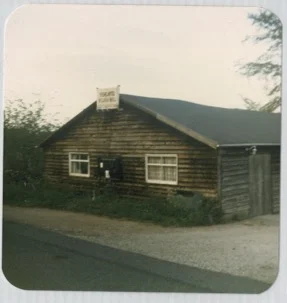
Blanche would recall that Frank learnt to walk in the first “village hall”. This was a wooden hut by the roadside near the Red Bank barn. It held about twenty to thirty people and was only eleven feet wide, a roof beam is in a nearby garage – and Blanche’s mother as well as Blanche herself were active in running it. From this group grew the Women’s Club which ran the village hall which was set up in 1920-21; it was well supported by Blanche, who busied herself in providing the refreshments. This second village hall was half an army hut from Carlisle; and it was Blanche’s father and uncle George (nicknamed ” Kruschen’ tor his liveliness and capacity for dancing) who transported the Yealand half from Borwick and helped to erect it. Both halves lasted over sixty years before having to be replaced.
Blanche became much involved in the running of the parish church of St John over many years, from ironing the church linen to being made the first woman churchwarden; she was very proud of this position, and was on the church council. She worked hard for the Yealand Manor, Beechfield, The Larches. Later, summer sales, held in different houses each year – newcomers with different ways of organising things came into St John’s and managed to offend Blanche so that she retired from the church.
She remained busy in many other directions, from her cake making to being on the committee of the almshouses at Warton. She also supported some of her neighbours in highly personal ways. When she was about sixty, she was a governor on the local school. She became a trustee of the village hall.
Frank, her son, won a scholarship to the George Fox school in Lancaster, and grew up to be a likeable youth; he worked for the Post Office in Lancaster. He became engaged, but he joined the Royal Marines and was killed while serving on the Gloucester off Crete. This was a time of prolonged suspense, since it was not till the end of the war that Ted and Blanche finally knew that Frank was presumed dead.
Frank’s fiancee Eileen married later in the war period; she and Blanche remained on close terms, and Blanche would stay with Eileen in Kendal. Blanche even made Eileen’s ruby wedding cake, and it must have been one of the latest cakes she made.
One of Blanche’s main characteristics was getting on with things; she was generally doggedly busy, and interested. She had a talent for telling a story, and was outspoken, though not aggressive, to those with whom she differed. She was very loyal to those she took to: “She was kindness itself” and “You were hers for evermore” were comments. When she was older, she could be opinionated, but chiefly over matters concerning the village. Thus, she was scornful about the numbering of houses and the naming of Eight Acre Lane: it had always been simply, “the lane”. She was particularly firm that all of Yealand Redmayne as far as “the lane” was really Yealand Storrs: this was technically true. Also, she objected to the village hall’s title as “Yealand Village Hall” – it should be “Yealands”, she felt.
Ted, after many years of ill-health, had died long before her; and one of his last remarks, “I must have been a pretty bad bugger to deserve all this,” would always bring a tear to her eye. She had lost Frank by war, but did take on an evacuee, who was seven at the time. He went back to Salford in the normal course, but returned to Blanche – he seems to have run away from home. She and Ted fostered him. When he was fourteen, he became deaf after meningitis. He married a deaf girl, and they often came to stay.
In age Blanche developed cataracts. After one early operation her left arm and her finger swelled so that her wedding ring stuck and the finger began to go purple. There was a late-night crisis, and neighbours arrived with inappropriate tools. Her brother Frank eventually took the ring off with a small saw. The ring, a broad, rounded band, was remade she’d felt naked without it.
Finally, after a later eye operation an infection developed, and she had an unhappy fright one fevered night when she thought she saw her dead brother Garnett by her bed, though she allowed herself to be jollied round. But the infection got worse, and she eventually died in the early autumn of 1985, a little short of her eighty-sixth year.
Information has come from various people, and especially from Mrs Florence Walker, Mrs Barbara Walker and Mrs A. Beck. There is room for correction in this note, and for a fuller account of her numerous activities in the village.
Published in Mourholme Magazines Issue 16 1991