
By John Findlater
Analysis of the Warton Parish Registers for the seventeenth century does show a monthly variation in the number of marriages.
It has been claimed by many researchers that the reason for this variation lay in the ecclesiastical “prohibited periods” set by the church. In fact, though the church discouraged rather than prohibited marriages at these times, the effect might be expected to be great, so powerful was its influence in those days. Perhaps the proverb “marry in Lent, live to repent” is a carry-over.
Without going far into the intricacies of church festivals one can equate the three periods with the ten weeks in spring between Septuagesima Sunday1 and Low Sunday2; the three weeks in early summer between Rogation Sunday3 and Trinity Sunday4 and the seven weeks in winter between Advent5 and Hilary6.
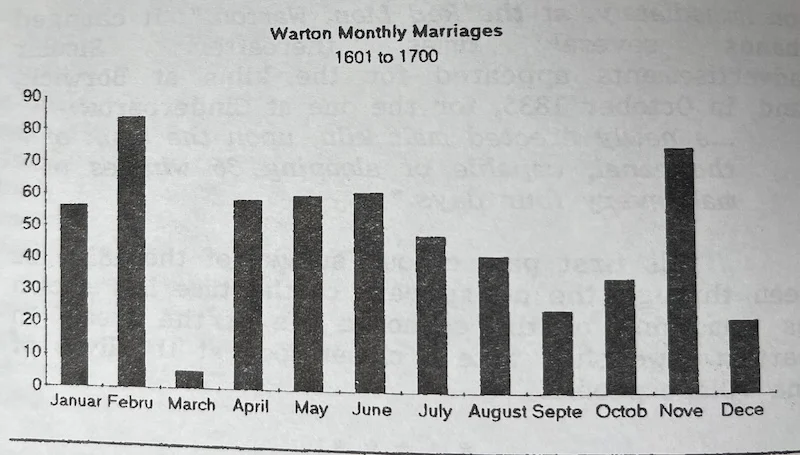
From the graph above (figur 1)it can be seen that over the whole century the March marriage figure is very low, and December the next lowest; the greater numbers in November might be explained as an attempt to get the marriage over before Advent, and the greater number in January/February to catch the window between Hilary and Septuagesima. However May’s figure, despite the two weeks prohibited period, is about average. Interpretation is very difficult because of the way some of these festivals move about7, but the match of low marriage figures and the whole of each “prohibited period” is not at all convincing.
It has been said that the ecclesiastical influence was of different intensity through the century. To achieve a more meaningful comparison the monthly variation in marriage has been shown in the graph below:
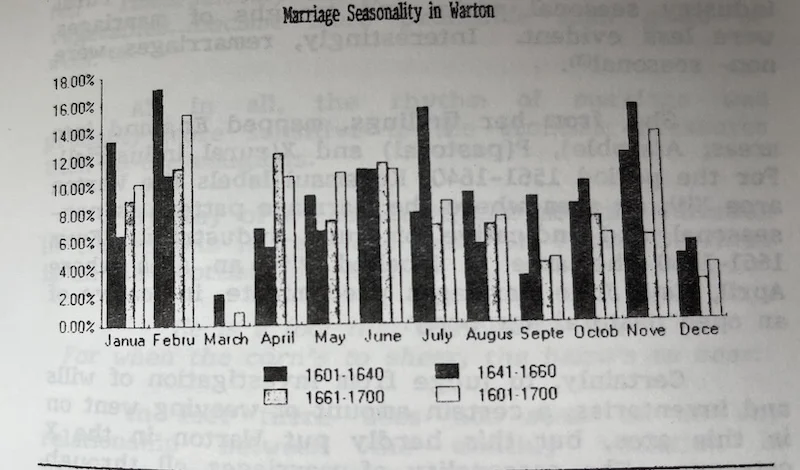
As a percentage of the yearly total for the whole century for the period before the civil war and the protectorate (1641-1660) and the restoration period (1661- 1700)8 This gives the data in Figure 1 in a different way From Figure 2 it does appear that marriages were commoner in March (a prohibited period) over the interregnum (1641-1660) than in the periods before and afterwards. By contrast marriages were much less common in May (another supposedly prohibited period) during the interregnum, and there was then a bursting of the dam in July. In December the differences were It would be foolish to read too much into these small variations.
Ann Kussmaul, who has done painstaking and exhaustive work on this facet of Parish Register demography, accepted that marriage avoidance obtained in Advent and Lent9 in the period before 1640, but was less evident in the interregnum, after which the tradition returned10, as is perhaps shown above. However, Kussmaul has interrogated the parish registers in a unique manner, using the assumption that, in rural England in earlier times, people married when they were not too busy with work. She postulated that there were three main patterns of work across English parishes – arable farming, pastoral farming and pastoral farming with rural industry. The idea was that the seasonality of marriages would reflect the seasonality of work (male primarily). In arable areas autumn-and-late-winter marrying after the harvest predominates, in pastoral areas spring-marrying (April, May, June) after lambing and calving. Where there was much rural industry seasonal peaks and troughs of marriages were less evident. Interestingly, remarriages were non- seasonal11.
She, from her findings, mapped England into areas; A(arable), P(pastoral) and X(rural industrial). For the period 1561-1640, Kussmaul labels the Warton area X12; an area where the marriage pattern is non- seasonal and indicative of rural industries. From 1661-1740 the area is labelled P13; an area where April, May, June marriages predominate, indicative of an open pastoral agronomy.
Certainly, to judge from investigation of wills and inventories, a certain amount of weaving went on in this area, but this hardly put Warton in the X category. The seasonality of marriages all through the seventeenth century in Warton parish suggests a mixed type of agriculture as the predominant economy. This fits with Warton Parish being classified as an arable vale area by Joan Thirsk. In such an area “Settlement was based on village communities with land farmed in common fields. A mixed corn-grass system was the result, in which cattle and sheep were used to fertilise the fields, and the farmer’s income derived from both grain and animal sales”14.
The marriage pattern over the whole century . is suggestive of mixed farming, perhaps affected to some extent by observance by observance of the Advent and Lent “prohibited periods”. However, in the period 1661 – 1700 the April/May/June marriages predominated more definitely over October, November, December marriages than in the 1601 -1640 period. It is as if, though still a mixed farming area, pastoral activities were to the fore. This change is explicable in the light of known economic and political change. In the first half of the century grain prices rose as the population increased, and so pasture was ploughed up. “After 1650 grain prices fell remorselessly … meat, dairy produce, fruit, vegetables … became more profitable than grain or wool”. 15
All in all, the rhythm of marriage was probably more sensitive to the economic pressures than to the religious. By way of a postscript, the monthly variation in conceptions is recorded below in Figure 3.
There is an old Scottish proverb: “He is a fool that marries at Yule For when the corn’s to shear, the bairn’s to bear. “ In fact there does not seem to be any relationship between the monthly variation in marriages and conceptions. Couples may have been too busy to marry in March and December, but not too busy to procreate. The most popular month for conception was June; there were more in the first half of the year than the second.
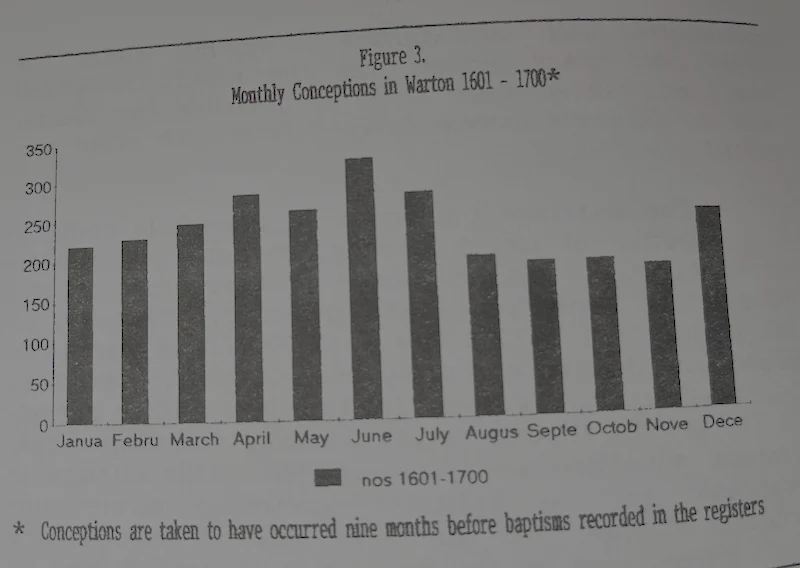
Conceptions are taken to have occurred nine months before baptisms recorded in the register
Notes
- Septuagesima Sunday. The third Sunday before Lent, (the 40 days preceding Easter) ↩︎
- Low Sunday, the first Sunday after Easter. ↩︎
- Rogation Sunday, the Sunday before Ascension Day i.e the 5th Sunday after Easter. ↩︎
- Trinity Sunday, the first Sunday after Whit Sunday i.e the 8th Sunday after Easter. ↩︎
- Advent, the four weeks preceding Christmas. ↩︎
- Hilary, January 13th ↩︎
- The spring and summer prohibited periods are fixed in relation to Easter Sunday, which is the first Sunday after the first full moon on or after the spring equinox and may fall anywhere between March 22nd and April 25th. ↩︎
- The figures for the decade 1641-1650 (civil war) and 1651-1660 (the Commonwealth) were not strikingly different from each other, but the numbers involved are small, the decadal totals less than 50. For that reason it seemed better to aggregate the two decades to create the three groups of Figure 2 and put them alongside the figures for the whole century. ↩︎
- Ann Kussmaul, A General View of the Rural Economy of England 1538-1840, 1990, p.36. ↩︎
- ibid, p.39. ↩︎
- ibid, p.42. ↩︎
- ibid, p.82 ↩︎
- ibid, p.82 ↩︎
- Joan Thirsk, England’s Agricultural Regions and Agrarian History 1500-1750, 1987, p.41. ↩︎
- ibid, p.9. ↩︎
Published in Mourholme Magazine Issue 26 1996