Jean Chatterley
Reports in local newspapers give an incomplete picture of any place at any stage in its history, but they are nonetheless valuable for the glimpses given of contemporary life and events. The picture of our local area which emerges from the Lancaster Gazettes of 1830-1840 is of a scene very different from the present one. Carnforth was a small hamlet, and the coming of the railway was three decades away. The Lancaster Canal was a newcomer to the area, and notices of property sales gave distances from the Canal, as well as from Warton and Burton, the two main settlements.
Most of the land, then as now, was devoted to livestock. Reports of annual agricultural shows reflect the importance of improving the breeding herds. This comes from the Gazette of November 9th, 1833 :-
The Burton-in-Kendal Agricultural Society held their first Annual Meeting … we now have the authority of several gentlemen farmers who attended the Manchester, Lancaster, Kendal and other meetings for stating that, in point of symmetry, beauty and excellence of breeding, the show at Burton-in-Kendal exceeded every show that has this year taken place in the West of England.
Two of the prizes given on that occasion were for rams of the Warton Crag breed. The Warton Lord of the Manor, John Bolden, specialised in short horned cattle: an auction of his “small but entire select herd” was advertised on September 1st, 1838. There was no dairying industry to speak of: most cottagers either had their own milk cow or took a can to a nearby farm. The Gazette of February 28th, 1835 reported some French experiments to preserve milk :-
It is nothing less than reducing milk to a solid state, so that an inhabitant of Paris may procure his supply from Normandy, or Auvergne, and preserve it in the same manner as sugar. This discovery … will make a great revolution in a part of our alimentary regimen and in a very considerable branch of agriculture.
Cattle were driven along the roads. October 1831 royal assent was given to a Bill :-
… to exempt cattle and other beasts from the payment of tolls when going to or from water or pasture, or to and from being shoed or farried, and not passing more than two miles on the road….
Sheep were also prominent, and wool sales an important source of income :-
The demand for ordinary wool continues brisk … the finest qualities, being scarce, go off at very good prices. (August 14th, 1830)
There was no weather forecasting, but every week the paper included paragraphs detailing the past week’s weather and its effect on farming and other aspects of local life. One of the most noticeable differences between life then and now is the extent to which all activity was controlled by the weather.The winter of 1830 was a severe one: this is from January 13th.
The frost, which lasted nine weeks, continued up to Saturday evening, when we had a heavy fall of snow, accompanied by a boisterous wind … a change of wind … took place on Sunday, in consequence of which the ships, which have been so long beating about in the Channel, have begun to arrive in considerable numbers. This circumstance will, happily, afford employment to many persons who have so long been out of work.
Summers could bring hardships, too. This extract is from August 14th, 1830:-
More rain has lately fallen than is convenient just at the commencement of the harvest. The storm … in its utmost violence, the hailstones … measured upwards of 62 ins. in circumference and did much damage.
1835 was also difficult weatherwise. This is from May 23rd:-
.. our country neighbours may at length begin to look forward to some relief from the heavy pressure that the past unfavourable season has occasioned. Great distress has been felt for want of provender … we have actually heard £3 mentioned as the daily cost to one large owner of stock. The cold dry winds too have had their effect upon the poor beasts, many being carried off by disease … a case of this kind has proved a sad calamity to a poor industrious man at Carnforth … [he] has lost his cow for which only a month ago he gave £8, and he has a wife and seven children … the reader can imagine how heavily such a loss must be felt.
The 1831 winter was hard. This is from February 5th:-
… the fall of snow in the north has been unusually heavy . .. the roads being impassible … the North and South mails, which arrive in this town [Lancaster] daily, have also been impeded in their progress, as have also the stage coaches.
It was not only the weather which affected travel. A section of the main turnpike road in Yealand was particularly prone to flooding. This appeared on February 15th, 1834.
… On Tuesday night last, as a servant of Mr Cowburn of Newby Bridge, was returning in a gig from Warton, upon the Ulverston and Carnforth turnpike road, instead of turning out of the road at Homer Tarn, into the road leading into Yealand Conyers … upon which the daily coaches pass, pursued his course along that part of the turnpike which has for some time been rendered impassable through the overflowing of Homer Tarn. The driver after discovering his error, attempted to turn the horse round, when it unfortunately got off the road and was almost immediately drowned, whilst the man remained in the high gig and was not rescued from his perilous situation for a considerable length of time. It is difficult to account for … the road which is covered has been railed off at each end to prevent accidents … a meeting of the Trustees of this road was held at Milnthorpe … a resolution was made to raise that part of the road.
Another turnpike was proposed in March 1837:-
…It is proposed to form a new line of road to Silverdale and over the Sands. It will be a diversion on the west side of the present road to commence at the 5th milepost near Bolton on the road between Lancaster and Burton, and will pass in a direct and level line to Leighton Moss, crossing the river Keer at a place called Galley Hall. To avoid the cost of application to Parliament, agreements have been entered into with proprietors of lands. When complete, the road is to be vested in the proprietors, and a toll gate is to be fixed. The principal outlay will be ther bridge over the river Keer … Capital £2500 in shares of £25 each … an excellent investment.
The work was put in hand straight away: by June 1837 they were ready to build the toll house :- To be let by tender, the building of a Toll House on the road from Lancaster to Silverdale … [but] … the letting of the bridge over the Keer is unavoidably postponed. As we know, the planned road over the Sands never left the drawing board.
There were, however, regular crossings :-
Charles Kelsall respectfully informs the public that a strong built covered car, driven by 7 two horses, carrying passengers and parcels, driven by Stephen Benson … will continue to run Over Sands on Tuesdays, Wednesdays, & Fridays from the Bear and Staff Lancaster to Ulverston … time of starting regulated by the tides; the distance 24 miles performed in 32 hours. (November 1st, 1834)
During 1835, sections of the Keer were modified, presumably in an attempt to reduce flooding. The work was “let by ticket” from Capernwray Hall. In April the:- … cutting of a new course for the river Keer about 150 yards in length, and the raising and puddling of an embankement with the earth” was advertised. In May came the “building of a rustic stone bridge 14 ft wide and 24 ft span. Also the forming and stoning of part of the new carriage road, and the deepening and widening of the Keer.
Trade on the new canal was booming: In May for example :- …
The inhabitants of the several Townships bordering on the Canal … are respectfully informed that, in consequence of the Transit of Road Material to the Township of Bulk, a more favourable opportunity will be offered, for several weeks, of conveyance of heavy carriage as stone, manure, timber etc, northwards, than generally exists … on very reasonable terms.
In 1833, traders and passengers were offered shorter jouney times on the new iron steam boats :-
The means of affording celerity in travelling is every day becoming more an object of emulation. Steam-boats, in this respect, have an indisputable claim to powerful advantages … no mode of travelling hitherto instituted is more justly entitled to preference than the iron swift canal passage boat … at the rate of 10 miles per hour … yesterday, a beautiful sheet iron gig of an improved construction. was shipped on board the John o’ Gaunt steamer for Lancaster; she is intended to ply between Preston and Kendal … she is fitted up with cabins spacious enough to accomodate 80 persons … she has been inspected by many nautical and scientific gentlemen who pronounce her beautifully modelled …
Every Monday, Wednesday and Friday a “swift packet boat” from Preston was timetabled to meet the “new packet, the Water Witch” which plied the Lancaster- Kendal stretch of the canal, until in July 1833 the Water Witch began to do the whole journey to Preston, leaving Kendal at 6am, arriving in Lancaster at 9.30, and:- …from there she proceeded full of passengers, at a beautiful rate, towards Preston, and performed the distance remarkably well.” In March 1834, a second “iron gig boat” was launched from the Lancaster Canal Company’s yard:- … ” she is called the ‘Swiftsure’ and is intended for a quick passage boat between Kendal and Preston. Some improvements have made the cabins very comfortable … ”
Apart from farming, the main economic activities of the 1830s were weaving, quarrying, timber trades and brewing. Cotton and linen weaving had long been important in the local villages, but by the 1830s there was a general trend towards mass production in factories. Whole families moved from their rural workshops to meet the demand and to find employment in the mills. This is from the Lancaster Gazette of April 4th:-
At a sale in this town a few days ago, lace frames that cost 10 years ago more than £300 each, sold at £3 – £4 each. This depression in the price of frames is attributed principally to the introduction of power machines, which have almost whooly superceded those on the old principle.
Quarrying was taking place on a large scale in the Warton, Silverdale, Capernwray and Kellet areas. In 1845 one of the large quarry owners, John Holgate, died, and his entire stock of quarrying machinery was auctioned at the Wegburgh Quarry at Capernwray over three days 18 – 20th March. The advertisement for the auction described the machinery as being enough to keep 200 men at work. It included a massive crane “which will raise 40 tons, and has machinery attached to it, by which it is made to revolve, with the stone suspended to the guy, a circular railway, 102ft in diameter”.” There were other massive cranes, chains, buckets, hammers, blocks, pulleys, “44 railway plates 12 ft each, with chairs (unused),” bellows, anvils and other smithy tools, three work horses, carts, and “stonework requisite for the entrance of a gentleman’s park … two square and two circular columns, handsomely fluted, with pedestals, tops and caps of very superior workmanship.” The quarry was by the canal, which as well as allowing access to the docks at Glasson, “affords the facility of moving the machinery at moderate expense.”
An advertisement for the auction of mining machinery at the mines at Warton Crag in September 1840, through its detailing of the items to be sold, gives a similarly vivid picture of the scale of operations. There was a cylinder condensing engine, cast iron pipes for 3 shafts, two “horse whims”, and 20 tons of red paint, red lead being the main product of the mines.
Timber and woodworking industries were other important economic activities. Areas of woodland frequently came up for sale by auction to local timber merchants or wood-turners and other craftsmen. For instance, this appeared on November 14th, 1840 :-
To be sold by auction, Wood, at Mr Joe Westron’s, the Red Lion, Warton, a large quantity of wood growing in part of plantations of Hyning, containing 55 statute acres of maiden oak, ash, elm, sycamore, birch, etc, of about 23 years’ growth, suitable for bobbin and chair makers, hoopers and wheelwrights. Marked with red paint….
Well managed woodlands were a valuable asset, and thefts of timber were taken seriously. In August 1834, there was an important court, case “an action to recover damages for an illegal entry into the premises of the plaintiff, and for cutting down and carrying away five oak trees and five ash trees … from the Scout Wood, in Warton”. The defendant, Fryer, a Warton carpenter, did not deny taking the timber, but said ” he was justified by immemorial right and custom, under which the inhabitants of the township of Warton had the right of cutting wood for various purposes in the said wood.” The present owner, Wilson, denied that this right existed, and the case revolved around whether the wood was common or not. Among the witnesses called was Thomas Walling, 86, who had lived nearly all his life in Warton. He had regularly collected wood for spelkes (thatch pegs), peasticks, mending carts, or anything else he wanted, and had once cut down a tree to make a stool. Under cross- examination it transpired that he had collected fallen timber, except for the one tree for the stool, but had climbed over a wall to get it and hoist it into a cart, all at a time when the previous owner lived in Lancaster. Mr Wilson lived only half a mile away. Similar stories were emerged from other Warton residents. It was argued by the prosecution that such evidence proved only “a custom of stealing wood”, and Wilson was awarded £5 costs. After a whole morning’s hearing, the judge commented that there was not a wood in the country, within half a mile of a village, that could not produce the same sort of evidence. The newspaper then added this :- “by this verdict the whole of the pretended custom of cutting either trees or underwood, is negatived and set aside, as contrary to the law.”
Another important trade centred on the village malt kilns. In October 1830, “a new and very substantially built malt kiln, drying kiln and granary” in Back Lane, Warton, was advertised for sale by auction. A Mr Carruthers of Lancaster bought it, and then in November, the same kilns were advertised as “To be let by ticket and entered on immediately, at the Red Lion, Warton.” It changed hands several times thereafter. Similar advertisements appeared for the kilns at Borwick, and, in October 1835, for the one at Cinderbarow :-
… a newly erected malt kiln, upon the bank of the canal, capable of sleeping 36 windles of malt every four days.”
This first part of our survey of the 1830s as seen through the newspapers of the time has shown us something of the economic life of the area.
We shall now take a closer look at the lives of the village people.
The decade saw major Parliamentary Acts which influenced the lives of the ordinary villagers just as much as the changes in farming and industry. First came the Reform Bill in 1832. Throughout the 1830s there was controversy over the Corn Laws which, by limiting the import of cheap grain, gave some protection to farmers: the Gazette reported, on April 19th, 1834, Sir Robert Peel’s speech describing the country, when, its agriculture ruined, it would present
” … nothing but vast congregations of steam- engines and factories, separated by morasses and rabbit warrens.1“
The same year saw negro emancipation. In Yealand :-
… a benevolent female, one of the Society of Friends … went round among the inhabitants of that place, rich and poor, on Friday last, the day on which the British Colonial Slaves were to be emancipated, and collected the sum of £9 … for supplying each liberated negro with a New Testament and Psalter. Reader, go and do likewise.” (August 9th, 1834)
In July 1837 compulsory registration of births deaths and marriages came into effect. Richard Whormby, of Warton Hall Farm, undertook these new duties for Warton, Yealand, Dalton, Borwick, Priest Hutton, Carnforth, Silverdale, Bolton-le-Sands and the Kellets.
In November 1834 came the Poor Law Amendment Act: the Gazette noted one of the effects this would have :-
“Henceforth, before the removal of a pauper, the Parish to which it [sic] has become chargeable will have to give 21 days notice to the Overseers of the place where it has gained a settlement before it can be forwarded there.” (November 15th, 1834)
The Act had many other effects on daily life: poverty was seen to be the result of a man’s own fault, and relief was, in theory, supposed to be given only in the Workhouse. At Christmas the Gazette reported that :-
“ … the poor and needy, according to custom, have partaken of public and private benevolence … at the Workhouse on Christmas Day, a regular John Bull dinner of good roast beef and plum pudding and ale was enjoyed by the dwellers in that establishment … the whole of the Crown prisoners in Lancaster Castle were, by the direction of the visiting Justices, regaled with bread and cheese.”
As under the old Poor Law, tramps and those on the roads in search of work were again treated as criminals, especially if their deserted families were left as chargeable to the parish:-
“On Saturday last, Richard Hodgson, late of Yealand Conyers, labourer, was convicted … of being a rogue and vagabond, leaving his wife and children whereby they had become chargeable to Yealand Conyers … He was committed to the House of Correction at Preston, to be kept to hard labour for two calendar months”. (September 17th, 1831)
Other crimes were reported and throw light on local life and events. In May 1832 James Metcalf, a labourer of Nether Kellet and George Metcalf, a stonemason and William Moore, a wheelwright, the last two both of Warton, were fined 40s each for assaulting John Hodgson of Carnforth:-
It appeared by evidence that Hodgson had purchased [purloined?] from a Mr Johnson the milk of a quantity of cows, which Mr Johnson was taking through Carnforth to Lancaster Fair, that the defendents … went into the field where the cows were then grazing, and began to milk them; and upon the complainant remonstrating with them for so doing, he was knocked down by James Metcalf, and whilst down was kicked about the head in a cruel manner – James Metcalf saying “let us lay to him” and some of the others, juggling stones together in their hands, said “There’s only one, we can do for him.” Moore paid the penalty, but the Metcalfs were, in default, committed to the Castle for two months, unless the money should be sooner paid.”
In August 1833 :-
… a fellow who, last week, adopted the disgraceful expedient of selling his wife … was afterwards lodged in Bath gaol for getting drunk with the money.
In January 1832 :-
“ … the pick-pocket fraternity had [not] abstained from their usual practices at our horse fair, since it appears … a man from Priest Hutton was plundered of 50 sovreigns, and, in the evening, another unlucky wight – a horse dealer too – lost a hundred sovereigns from his pocket.
In February 1832 :-
During the night of Wednesday last, some person broke into the warehouse of Mr Waithman, linen manufacturer, of Yealand, and stole a quantity of goods therefrom …
There were regular reports of sporting events, too. The Lancaster Union Harriers met two or three times a week in the local villages. Grouse and pigeon shooting were popular. In July 1836 there was a regatta at Poulton-le-Sands. As well as such sports, there is evidence of the early beginnings of sea-bathing and tourism:-
To Sea Bathers. Valuable property in Silverdale to be sold by auction at the Britannia Hotel, Lindeth … Lot 3. Three freehold inclosures called “Barkers Fields” … a short distance from the beach … worthy of attention of the Valetudinarian, the builder, or the Capitalist.
In November 1836, Gibraltar “recently erected for visitors” was put up for auction :-
The house is much resorted to in the summer season by families for sea bathing … walks command views of Morecambe Bay … convenient places for bathing.
In the same paper a farm in Lindeth called Waithman’s was also advertised for sale as “a dwelling house adapted for the accommodation of sea bathers … “
Every year there were ploughing matches. In 1830 a field belonging to Mr T. Jackson of Borwick Hall was used :-
There were 17 competitors, 15 men and 2 boys, who each had half a statute acre allotted to them, and the whole was finished in a workmanlike style in little more than three and a quarter hours.
Prizes ranged from 12/6d to £2 and a subscription was made and divided amongst the unsuccessful candidates, and then :-
… an excellent dinner was provided by Mrs Jackson, of which 54 persons partook, and the evening was spent with the greatest good humour and conviviality.
Sometimes the prizes or premiums were given by the Lancaster Agricultural Society. Usually the competing ploughmen drew lots to decide which part of the field they ploughed. They were allowed five hours for ploughing half a statute acre, and there was generally “ a very handsome subscription” for the unsuccessful competitors. In February 1835 the competition took place in a field called “Nineteen Acres” in Yealand Redmayne. The prize was a silver medal, but “the winner cannot compete again for 5 years.” The dinner was “at Marmaduke Clarke’s the New Inn at which the premium will be paid.” Local gentry seem to have taken great interest in these matches – George Wilson of Dallam Towers, Richard Atkinson of Ellel Grange, Marton George of Capernwray and Thomas Jackson of Borwick Hall are names which appear regularly.
It is obvious that the local gentry played a major part in many aspects of village life. As well as providing the the land and the prize money for sporting events, the same men appear as magistrates and jurors at the Lancaster Assizes, Poor Law Guardians, Church Wardens, Registrars etc. Occasionally one of them made news in his own right :-
At the Petty Sessions held in Chapel Street, Lancaster … Joseph Stoaker, the driver of the stagecoach called the Invincible, was convicted … for not keeping his coach on the left or near side of the turnpike road, in the township of Skerton … when meeting a coach belonging to John Bolden, Esq. of Hining, and thereby, and by negligence and misbehaviour, interrupting the free passage of the said carriage. Mr Bolden spoke in high terms of the general good conduct of Stoaker, as a coach driver, but in consequence of the many accidents which happen on the turnpike road … he considered that he was doing his duty to the public by causing this case to be brought forward.”
Local gentry were at the forefront of the Coronation celebrations for William IV in 1831 (September 10th and 17th, 1831). In Yealand, 72 children of the Sunday School were given a Testament, a medal and a bun, and the 120 men and 50 boys of the three Yealand villages met for gifts of bread, cheese and ale. The “Sunday Scholars” of Warton, Carnforth, Borwick and Priest Hutton were similarly treated. For them the celebrations included a day of bell- ringing in Warton, flags hoisted on all notable buildings, including the Summer House at Yealand, parties for the children and a procession in the evening :-
… in the evening, being fair, a procession was formed from school in the following order :- two musicians, a beautiful silk flag, the Standard of England, provided for the occasion by the proprietor of Beech Hill, borne by the oldest scholar in Warton School; girls of Warton School, two by two; girls of Carnforth school, two by two; silk flag on which was a crown and the letters WR and AR [William Rex and Adelaide Regina] and the word “constitution” borne by a Carnforth scholar; boys of Warton school … boys of Carnforth … inhabitants of Warton … The number of scholars was about 250, and after moving through the town the procession finally halted at the church gates, where the National Anthem was again sung by the whole multitude … ”
The Gazette carried advertisements for teaching posts. This appeared on October 12th, 1833 :-
Warton Free Grammar School. A Master Wanted … must be competent to teach reading, writing and arithmetic, and other branches of education in the English language, and also in the Classics and other learning usually and customarily taught in other Grammar Schools. The annual salary at present is £44, to which the Usher’s stipend will be added amounting yearly to the sum of Ten Guineas, the Trustees having decided not to elect an Usher at present. The Master will also receive such quarterage as the Trustees may think proper … testimonials of character and abilities to be sent (post paid) to the Rev. J. Barns, Vicar of Warton, near Burton, Westmorland …
In the issue of December 14th we learn that nine candidates “particularly distinguished themselves“, and from these the Trustees, “after mature deliberation“, chose Mr J.H. Steble as the “most likely by his abilities and experience in tuition to restore the school to its former utility and celebrity.”
Throughout the decade, and indeed the century, the newspapers reflected the fears and realities of epidemics. In July 1832, cholera was prevalent in Lancashire. Amongst measures taken to control its spread were these at Lancaster Castle :-
The High Sheriff and Visiting Magistrates have directed that no person be permitted to enter within the inner gate of the prison, except the Attorneys of the Insolvent Court, and each one clerk. Every care and attention is paid to cleanliness … which … under Divine Providence will prove an effective safeguard against the inroads of so grievous a disease, which has spread to so great and alarming extent …
By November 1832, cholera had been prevalent in Kendal for four months :-
“From Monday morning to Tuesday morning there were 4 deaths and 2 or 3 new cases. While the insidious foe is still among them the inhabitants are meeting in vestry and debating with much angry feeling whether the expense of the Board of Health is to be defrayed out of the Poor Rates or by private subscription.” (November 3rd, 1832)
Among the most interesting parts of the Gazette are notices for sale of land, houses and a deceased persons effects. This is just one example :-
“Delightful Residence at Yealand Conyers … to be sold by Auction, at the house of Miss Noon, the Royal Oak in Lancaster … all that modern and substantially built dwelling house with the orchard, garden, pleasure grounds, coach-house, stable and offices belonging thereto, also a good farmhouse with suitable outbuildings, and several inclosures of rich arable meadow and pasture land … late the property of Miss Wilson, deceased.
Details of rooms followed, including the butler’s and cook’s pantries, the cellars, and then the gardens and orchards.
“At the same time will be sold 2 parcels of Peat Moss, situate in Yealand Redmayne Moss … “(August 1st, 1835)
The sale of furniture, advertised a week later, included :-
“… mahogany 4 post and camp bedsteads … feather beds bolsters and pillows … mahogany and other chests of drawers, washstands, dressing tables, night commodes, set of mahogany dining tables … Brussels, Venetian and Kidderminster carpets … swing and pier looking glasses … tea and coffee urns, china dessert service, breakfast and tea-sets, chimney ornaments … a barouchette, calculated for one or two horses, and a gig … a large assortment of kitchen and brewing utensils, mangle, some implements of husbandry and gardening, a cart and wheels … “
Occasionally one finds a “treasure” while searching through the plethora of detail about court cases, house sales, Guardians’ meetings, sporting events, etc. This is one such from March, 1830 :-
Longevity – We lately mentioned the death of Miss Ann Shott at Borwick, at the very advanced age of 102 years … Her husband was drowned at Hest Bank and left her with the charge of 7 children … She used to relate … that in her youth … she carried an infant sister in her arms from Hatlacks, where she then lived, to Slyne, to see the rebel army pass through the village. As the rebels marched by, preceded by drums trumpets and flying colours, the infant seized the corner of one of the Scottish flags as it waved by, which was much noticed by the Standard Bearer.
I began these articles by saying that newspapers can give only a partial picture of our area in the 19th century. It is like doing an unusual jigsaw, knowing that one will never have all the pieces, but also being aware that each piece shows us either something new or reinforces the picture of the overall situation. The work is, admittedly, painstaking and time-consuming, as one scans each column for anything at all affecting “our” parishes, even if not actually taking place within their boundaries. In the 1800s, the Lancaster Guardians and Gazettes gave national and world news, too – just as did the Manchester Guardian – but after looking through a few issues, one soon learns where to find the most useful and interesting columns. The Lancaster Reference Library is a warm and pleasant place to work, and the Librarians helpful. All of which is leading to a plea for help!
Notes
- All quotations are from the Lancaster Gazette ↩︎
[Ed it is now possible to view newspaper articles at local libraries, using keywords to find items, check with your local library if they have British Newspapers online, alternatively you can buy a subscription].
Published in Mourholme Magazine Issues 26 1996 and 27 1996
By John Findlater
Analysis of the Warton Parish Registers for the seventeenth century does show a monthly variation in the number of marriages.
It has been claimed by many researchers that the reason for this variation lay in the ecclesiastical “prohibited periods” set by the church. In fact, though the church discouraged rather than prohibited marriages at these times, the effect might be expected to be great, so powerful was its influence in those days. Perhaps the proverb “marry in Lent, live to repent” is a carry-over.
Without going far into the intricacies of church festivals one can equate the three periods with the ten weeks in spring between Septuagesima Sunday1 and Low Sunday2; the three weeks in early summer between Rogation Sunday3 and Trinity Sunday4 and the seven weeks in winter between Advent5 and Hilary6.
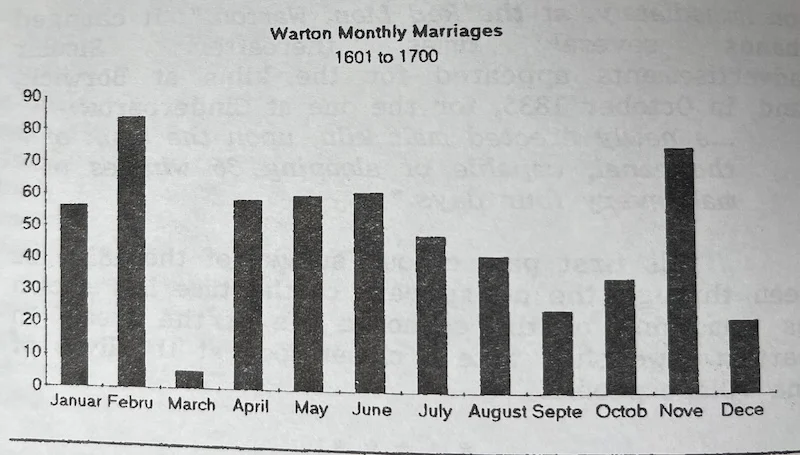
Figure 1 From the graph above (figur 1)it can be seen that over the whole century the March marriage figure is very low, and December the next lowest; the greater numbers in November might be explained as an attempt to get the marriage over before Advent, and the greater number in January/February to catch the window between Hilary and Septuagesima. However May’s figure, despite the two weeks prohibited period, is about average. Interpretation is very difficult because of the way some of these festivals move about7, but the match of low marriage figures and the whole of each “prohibited period” is not at all convincing.
It has been said that the ecclesiastical influence was of different intensity through the century. To achieve a more meaningful comparison the monthly variation in marriage has been shown in the graph below:
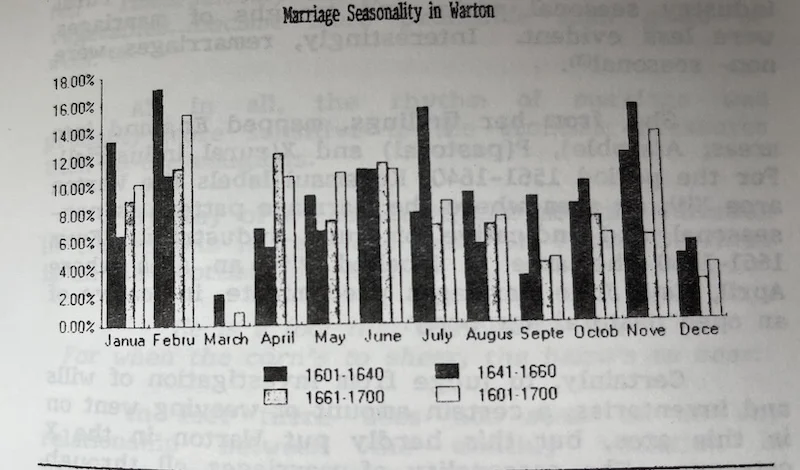
Figure 2 As a percentage of the yearly total for the whole century for the period before the civil war and the protectorate (1641-1660) and the restoration period (1661- 1700)8 This gives the data in Figure 1 in a different way From Figure 2 it does appear that marriages were commoner in March (a prohibited period) over the interregnum (1641-1660) than in the periods before and afterwards. By contrast marriages were much less common in May (another supposedly prohibited period) during the interregnum, and there was then a bursting of the dam in July. In December the differences were It would be foolish to read too much into these small variations.
Ann Kussmaul, who has done painstaking and exhaustive work on this facet of Parish Register demography, accepted that marriage avoidance obtained in Advent and Lent9 in the period before 1640, but was less evident in the interregnum, after which the tradition returned10, as is perhaps shown above. However, Kussmaul has interrogated the parish registers in a unique manner, using the assumption that, in rural England in earlier times, people married when they were not too busy with work. She postulated that there were three main patterns of work across English parishes – arable farming, pastoral farming and pastoral farming with rural industry. The idea was that the seasonality of marriages would reflect the seasonality of work (male primarily). In arable areas autumn-and-late-winter marrying after the harvest predominates, in pastoral areas spring-marrying (April, May, June) after lambing and calving. Where there was much rural industry seasonal peaks and troughs of marriages were less evident. Interestingly, remarriages were non- seasonal11.
She, from her findings, mapped England into areas; A(arable), P(pastoral) and X(rural industrial). For the period 1561-1640, Kussmaul labels the Warton area X12; an area where the marriage pattern is non- seasonal and indicative of rural industries. From 1661-1740 the area is labelled P13; an area where April, May, June marriages predominate, indicative of an open pastoral agronomy.
Certainly, to judge from investigation of wills and inventories, a certain amount of weaving went on in this area, but this hardly put Warton in the X category. The seasonality of marriages all through the seventeenth century in Warton parish suggests a mixed type of agriculture as the predominant economy. This fits with Warton Parish being classified as an arable vale area by Joan Thirsk. In such an area “Settlement was based on village communities with land farmed in common fields. A mixed corn-grass system was the result, in which cattle and sheep were used to fertilise the fields, and the farmer’s income derived from both grain and animal sales”14.
The marriage pattern over the whole century . is suggestive of mixed farming, perhaps affected to some extent by observance by observance of the Advent and Lent “prohibited periods”. However, in the period 1661 – 1700 the April/May/June marriages predominated more definitely over October, November, December marriages than in the 1601 -1640 period. It is as if, though still a mixed farming area, pastoral activities were to the fore. This change is explicable in the light of known economic and political change. In the first half of the century grain prices rose as the population increased, and so pasture was ploughed up. “After 1650 grain prices fell remorselessly … meat, dairy produce, fruit, vegetables … became more profitable than grain or wool”. 15
All in all, the rhythm of marriage was probably more sensitive to the economic pressures than to the religious. By way of a postscript, the monthly variation in conceptions is recorded below in Figure 3.
There is an old Scottish proverb: “He is a fool that marries at Yule For when the corn’s to shear, the bairn’s to bear. “ In fact there does not seem to be any relationship between the monthly variation in marriages and conceptions. Couples may have been too busy to marry in March and December, but not too busy to procreate. The most popular month for conception was June; there were more in the first half of the year than the second.
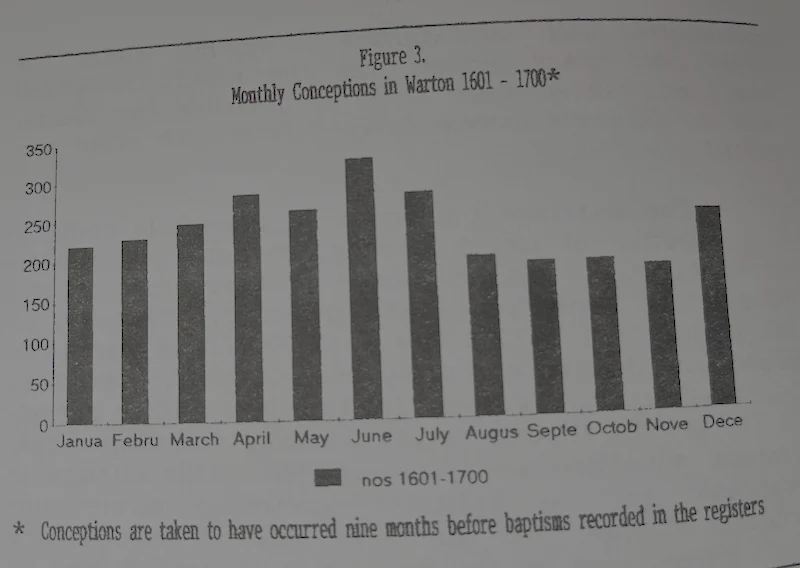
Figure 3. Monthly Conceptions in Warton 1601 – 1700 Conceptions are taken to have occurred nine months before baptisms recorded in the register
Notes
- Septuagesima Sunday. The third Sunday before Lent, (the 40 days preceding Easter) ↩︎
- Low Sunday, the first Sunday after Easter. ↩︎
- Rogation Sunday, the Sunday before Ascension Day i.e the 5th Sunday after Easter. ↩︎
- Trinity Sunday, the first Sunday after Whit Sunday i.e the 8th Sunday after Easter. ↩︎
- Advent, the four weeks preceding Christmas. ↩︎
- Hilary, January 13th ↩︎
- The spring and summer prohibited periods are fixed in relation to Easter Sunday, which is the first Sunday after the first full moon on or after the spring equinox and may fall anywhere between March 22nd and April 25th. ↩︎
- The figures for the decade 1641-1650 (civil war) and 1651-1660 (the Commonwealth) were not strikingly different from each other, but the numbers involved are small, the decadal totals less than 50. For that reason it seemed better to aggregate the two decades to create the three groups of Figure 2 and put them alongside the figures for the whole century. ↩︎
- Ann Kussmaul, A General View of the Rural Economy of England 1538-1840, 1990, p.36. ↩︎
- ibid, p.39. ↩︎
- ibid, p.42. ↩︎
- ibid, p.82 ↩︎
- ibid, p.82 ↩︎
- Joan Thirsk, England’s Agricultural Regions and Agrarian History 1500-1750, 1987, p.41. ↩︎
- ibid, p.9. ↩︎
Published in Mourholme Magazine Issue 26 1996