Francis Horner West (Archdeacon of Newark) (Illustrations by Alice M. West)
Extracts by John Findlater
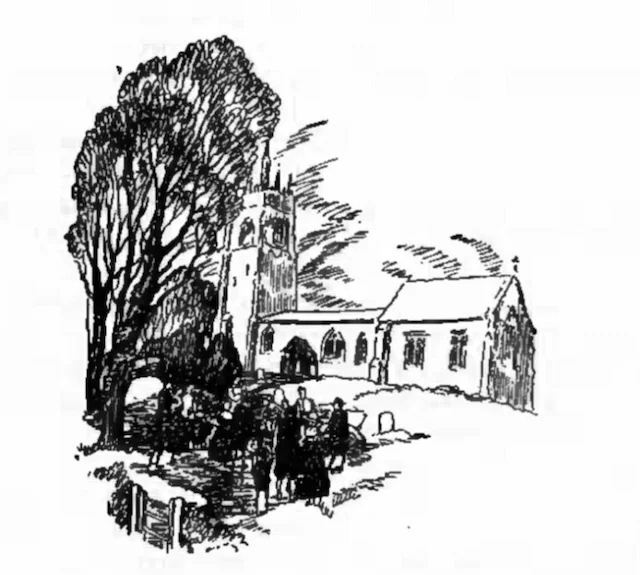
Beneath those rugged elms, that yew tree's shade
Where heaves the turf in many a mould'ring heap,
Each in his narrow cell for ever laid,
The rude forefathers of the hamlet sleep.
Gray's Elegy
In the Mourholme Society’s book, “How it Was“, we tried to give a picture of seventeenth century life in this ancient North Lancashire parish. Quite by chance, I came across a delightful, though battered, small black book with the intriguing title “Rude Forefathers”, which is about a Nottinghamshire village 1600-1666. In his introduction to the book (published in 1949), the writer quotes Macauley, “Nothing has yet been said of the great body of the people, of those who held the plough, who tended the oxen .. Nor can much be said. The most numerous class is precisely the class respecting which we have the most meagre information“. The little book helps to fill the gap using the “short and simple annals of the poor” contained in the Upton account books.
I thought I would let Arthur Penn have sight of it, and suggested that extracts from the little book would compliment our book. He returned the book with the short prefatorial piece given below. Small world!
by Arthur Penn
John Findlater recently acquired a little book of this title (from Gray’s Elegy) and consulted me about its suitability as a source of extracts for this magazine. It was written in 1949 by Francis West, the Archdeacon of Newark and Vicar of a country parish near there called Upton. It so happened that I had known him from 1945 until his death two years ago near his 90th birthday. He was, in 1945, Senior Army Chaplain in the Far East and was the first person I talked with about my vocation to the Ministry. He was later Archdeacon and then for many years Bishop of Taunton. He was a good historian and at Upton he had a remarkable resource, two ancient account books, one for the Churchwardens for 1601-42, and the other for the Constable for 1642 -66. These give a vivid picture of village life and of the effect of the Great Rebellion on the rustics of a small community. John and I both thought it merited the use of extracts in this magazine. On ‘phoning Frank’s widow, Beryl, she cordially agreed to this.
Extracts from Rude Forefathers
(These are made so far as possible using Francis West’s own words. Quotations from the account books are printed in italics)
Upton-by-Southwell, at the beginning of the seventeenth century was a small village, having a population of about 300. The market town of Newark lay about five or six miles to the east; Nottingham about 14 or 15 miles to the west. Upton was subject to the independent ecclesiastical jurisdiction of a Peculiar [i.e. A parish or church exempt from the jurisdiction of the archdeacon or bishop in whose diocese it lay] of Southwell, the competent authority being the Chapter of Southwell.
Jurisdiction in criminal cases and civil cases fell to the Assize Court in Nottingham and to the local courts presided over by the Justices of the Peace, the Quarter Sessions and the monthly Petty Sessions at Southwell: the village constable being the chief executive officer of the J.Ps in the village community.
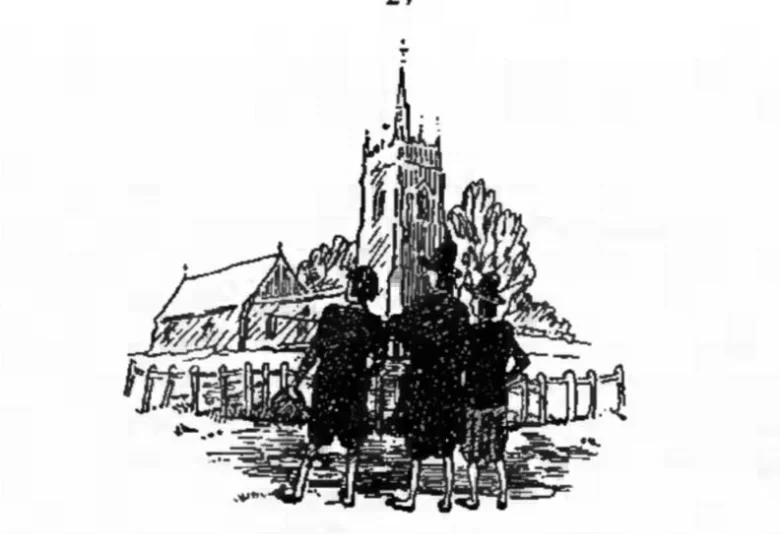
The Churchwarden and the Parish Church
The Upton churchwardens’ account books cover a surprising range of the activities. Sandwiched between items referring to the sale of the parish bull and the provision of a new church bible is a note of the wages paid to Daniel Coe the molecatcher and William Middop, the scourer of drains.
It was taken for granted, then, that England was a Christian realm; Englishmen should be Christian after the pattern which Queen Elizabeth and her advisors had decreed. From the earliest days the churchwardens had been the chief lay guardians of the the parish church. But in the course of time other duties were imposed upon these men who had proved themselves capable of managing the material affairs of the church. By the Act of 1601, along with the overseers of the poor, they were confirmed as official local civil servants; the secular and ecclesiastical affairs were fused together in the person of the churchwarden. Parishioners were obliged to pay tithes, the wardens were responsible for upholding Canon Law.
It was a time of turmoil in church life. William Laud who became Archbishop of Canterbury in 1633 did his best to reform abuses and set high standards. The churchwardens were elected at the annual meeting of the vestry, it may have fallen in rotation to the holders of certain tenements; after the decease of Matthew Parlthorpe warden in 1642 his widow succeeded him. The wardens’ responsibilities were heavy and often unwelcome. Refusal to serve was so frequent that it was punishable by fine. Their expenses were paid but they received no salary; unpaid amateurs were not always made for efficiency, but it introduced a measure of self-government into local affairs. These local officials were usually substantial villagers, whose one advantage over many neighbours was their comparative literacy. At Upton there must have been at any one time at least a score of men in the population who had served as warden or constable.
The first duty of the wardens was to attend the Vicar General’s April visitation. A second took place at Michaelmas. To both of these the wardens took the answers to a questionnaire, previously submitted to them, known as the book of Articles: paide at the visitation for our examination upon the articles .. 6d. At the same time they handed in a copy of all the entries which had been made since the previous visitation, also all church registers and copies made were handed in.
After handing in the articles and registers the wardens ‘presented’ those of their neighbours who had offended the laws of the church; fornicators, blasphemers, sabbath-breakers or persons who had refused to pay their church rate. Transgressors might be warned, or made to acknowledge guilt publicly before the congregation, or possibly face the most severe penalty – excommunication. There are several references in the account book, but no details of the offences; one about the warden himself: laid forth for my charges when I was ex-communicated … 2/6d. Amongst the social disabilities excommunication imposed was the denial to them of christian burial: 29th May 1758 Robert Wilson (ex-communicated) pitted. Some sabbath-breakers, or at the least parishioners who did not attend church, were catholics or ‘papists’ or recusants; they had a fine of 1/- imposed given to Mr Martiall’s man for ye bill making about Recusantes 6d (Mr Marshall the lawyer was registrar at the Chapter at Southwell in 1625). The names of all Roman Catholics in the county were sent to Nottingham. Only one appears to have lived at Upton during this period, the wife of Gervase Staveley.
After the visitation everyone concerned repaired to an inn in Southwell for dinner. April 9th 1615 Paid for foure churchwardens dinners with oure minister 4/2.
Typical of other references to the Visitations and to the activities of the Chapter Court are the two following: Payed to the court when the church porch was presented 8/- (The wardens were fined for letting the porch become dilapidated). Paide to the chapter courte when we went to satisfied the courte that the churchyard was made soficente 3/ -.
At whitsun all parishes of Nottinghamshire were required to send an offering to the Chapter at Southwell, Upton’s quota being assessed at 3/ -. It is said that the canons, in order to entertain the unusually large crowds which flowed into the quiet streets of their little town once a year, instituted an informal race meeting in a field nearby which later developed into the Southwell races.
At the beginning of the 17th century the church at Upton was in great need of repair. The accounts record almost ceaseless restoration between the years 1601 and 1640. 1613 Spent at setting forth the wood at the forest 5/4d. Pade for cordes for scaffolds for the church 1/ -. Spent at Winkebourne at fetching home the wood 2/ -. Pade for alle and breade at casting the leads 1/ -. It is interesting to note that in 1636 Upton church was paved, probably for the first time; the majority of country churches were still unpaved at the beginning of the 17th century. This is an instance of the Laudian reforms on the rural parishes. Pade to the masone for stones and for paveing the church and south porch £1 2s 6d. At an earlier date the earth floor was ankle deep in rushes which the feet of worshippers had trodden hard. The old ruinous porch was swept away, a new one of good Sherwood oak took its place. The rushes strewn about to give warmth now covered paving stones. The font is handsomely covered in oak. The rough benches disappear, replaced by box pews with doors, some tastefully carved. One handsome pew in the old chantry chapel, complete with carpet and cushions, is for Mr Owen Oglethorpe and his family from the Hall. In the pulpit is a handsome cushion with fringe and tassels. The cracks and chinks in the windows have been repaired and there is a new oak roof. The account books are full of detail.
As at Southwell a dog whipper was employed at Upton to keep the dogs quiet during the service and to remove them if they became too noisy. Given to John Baillie for whipping dogges forth of the church 6d. The bells were constantly being repaired. The church was heated by coal probably set in a brazier in the middle of the nave. Given for five shuvvellful of coals which was used in church 10d.
There are frequent references to the payment of visiting preachers for their services to Upton church. Some were strangers and described by the wardens according to their personal appearance: Given to a preacher with the flatt nose for preaching 2/6d; Given to the wrynecked preacher 2/ -. Almost the first action of Queen Elizabeth, after her accession, was to inhibit all clergy from preaching, and thereafter the bishops only permitted clergy who had received a special licence to preach. As a result the majority of parochial clergy was prevented from preaching. Mr Wilson’s parishioners never heard him deliver a sermon of his own composition in his 40 years as Vicar of Upton! In such cases the vicar was bound to read one of the authorised homilies, the titles of which appear in the 35th of the 39 articles.
One very common occurrence at Divine Service was the reading of a brief. Briefs were appeals for worthy causes; afterwards as people filed out the wardens waited at the door and invited collections. These briefs were generally unpopular. 1620. Given to a brefe that came from Bawick (Berwick) 23rd April 2/ -; given to a brefe for Benstebell (Barnstaple) in Devonshire which was all burnte 3/- 1626 Paid for a brief for the Palateneth country 2/8d. This last was for the Palatinate, overrun by the Catholic armies in the thirty years war, which was of especial enterest since the Elector, the champion of the Protestant cause, was married to Princess Elizabeth, the beautiful sister of King Charles. 1636 Given to a breefe for releeving the Palatinate ministers 3/ -. Of special interest perhaps was a brief in 1636 Paid towardes ye repairing of S. Poules church in London 6/8d. The reconstruction of St Paul’s was intended by Laud, when Bishop of London, to be symbolic of the revival of the Church of England. The King’s interest had been aroused and briefs were issued for raising the money. Another interesting brief was for the infant colony in Newfoundland : Given to a breefe at the request of the Lord Archbishop to the Captaine concerning newfoundlande 1/4d. The Privy Council issued letters patent authorising appeals: Paid to a letter patent for twenty five hundred captives under the Turks 2/6d. Justices of the Peace were also empowered to give testimonials to individuals who had suffered loss, authorising them to beg from place to place: Given to a pore man that came from Cornwell with testimony of losse by fire to the vallew of £200 being published in church August 27th 6d. Given to a man that had his tonge cote out of his mouth by the Torkes the 6th day of September and had a passe 4d.
The annual rogationtide procession is frequently mentioned in the accounts. Its origin was religious but in the 17th century it had become popular in the village, serving a secular purpose by making its way round the parish borders to make sure the neighbouring parishes were not encroaching; it became known as the Beating of the Bounds.1616 For breade and drinke at the perambulation about ye feildes. 6d
Civil War
The book contains much about the Civil War which had a direct impact on Upton. In 1643 Newark became a storm centre in the Civil War between King and Parliament. Rival armies infested the peaceful Midland countryside. Day by day the constable, who as chief executive officer of the parish, had to deal with this new situation recorded in his account book its effect.
Unconsciously he became an historian of the Civil War. The constables of Upton, over a period of five years, recorded eloquently what official historians have often neglected: the impact of war on Mary Kerby, whose hen was stolen by a trooper, on Thomas Kitchen whose mare disappeared during a raid from Newark, and on Mrs Robinson, whose husband was killed in a scuffle with the plunderers.
On February 9th, 1641, the constable noted in his book – Given to a linen draper of Newcastle which was deprived of all his goods by ye Scots to ye valew of two hundred pounds having a wife and six small children 4d. Provoked by King Charles’ attempt to impose the prayer book, the Scots crossing the Tweed over-ran the Border Country as far as Newcastle, which they reached in August 1640. Six months later the constable listened to his story and took pity.
The King left Oxford in the spring of 1642 to join his army in the North. At Upton the constable was obliged to supply two horses for the King’s retinue. As the summer wore on he was also obliged to find billets for the volunteers on their way to join the King. 16 April Given to a woman travelling to her husband he being in the King’s service in the northern parts of England 4d.
Sometimes deserters, wounded, sick and discharged soldiers flowed the other way. Given to two soldiers being sore maimed haveing their wives and many small children 4d. Given two drummers which were dismissed the King’s service 7d.
On the 12th August 1642 the King raised his Standard at Nottingham having left Lincoln and made his way there by way of Newark and Upton, though there is no reference to this in the constable’s book. Not finding great friendliness at Nottingham, it was abandoned by the Royalists who chose Newark as their centre. The constable was summoned to Newark and was called on to levy money for soldiers’ pay, eggs, butter, meat, oats, hay and pease. Horses and carts were requisitioned by quartermasters. Spent when I went to Newark with carriages with coles 6d.
Worse was to come. Parliamentary forces established themselves at Nottingham and laid siege to Newark, with counter-attacks by the Royalists and Upton militiamen were involved: Spent when we were at the battle of Newark £1. Queen Henrietta Maria arrived at Newark from Bridlington, where she had landed with re-inforcements from the continent, necessitating further exactions. Paid to George Wood and Richard Wood for going to Newark when the Queen was there 6d. When I went to carry provision for the Queen spent 4d. The Queen left for Oxford on July 3rd but not before levying a tax on Upton and Morton. Spent when Morton men came to Upton to consider with the neighbours about the draught to goe with the Queen 8d. For the rest of the year almost continuous exactions were made for the King and finding temporary billets for his men. Paid to John Chapell for his fether bed which went to Newark £1.2s5d. For lodging a captayne and two men and four horses. His troops lay in our town and nobody would lodge him. I having all my beds taken up before was fayne to lodge him in my bed 1/ -.
When earthworks were thrown up around Newark, and ditches dug, men were compelled to leave the fields and labour on this. For going with the ditchers to Newarke 6d. Payed for boting men over (the Trent) when they went to the workes 4d. When the King’s forces withdrew from Nottinghamshire in January 1644, though Newark still held out, the area was overrun by Parliamentary forces and the same assessments and payments went to the new masters. This altered temporarily when Prince Rupert relieved the garrison briefly but meant Upton was forced to help again. When assessments were thought excessive the constable courageously stood up to the quartermaster’s demands (as in fact did William Robinson, the churchwarden, who would later be killed). For going to Newark when Major Palmer would have quartered thirty men with us, spent 1/2d. Sometimes the oppressors were open to reason. The villagers kept a look-out so that they might attempt some precautions. Paid to Thomas Kitchin for watching one day upon the church steeple 1/ –
Then the Scots, under General Leslie, joined hands with the Parliamentary forces, who were forced to live entirely on the land, and whose depradations were therefore severe. After their departure in May 1646 the constable wrote assessment to the Scottish army from 4th February until 6th May 1646, being 13 weeks, sixty-nine pounds six and threepence, a rate of five pounds six and eight by the week. An enormous sum in so short a time for so small a village!
The King surrendered to the Scots on May 5th at Southwell. He was prevailed on to order the Newark garrison to capitulate. Life began to return to normal though for months distressed folk of one kind or another needed help. Given to two distressed cavaliers that had been prisoners in Wales traviling to Pomfrett (Pontefract) and being in great want 8d
With the coming of peace, opportunities were given to the villages which had suffered in the war for claiming compensation though this entailed tedious form filling. Payd when we did meet at Jarvis plowman concerening giveing in at Nottyngham a boke of our losses from the Scots and what other losses we did sustayne by any other soldiers. The town’s charge at the meeting was 1/8d. When Mr Ballard [the vicar] and I went to Mr Crumwell to knowe in what forme it might be put in. Spent 8d. The last entry of the period of strife was made a year later –Spent at Jervas plowmans when the shouldiers came to shurch for arms 6d (February 1650).
Published in the Mourholme magazine issues 40 between 2000 and