Francis Horner West (Archdeacon of Newark) (Illustrations by Alice M. West)
Extracts by John Findlater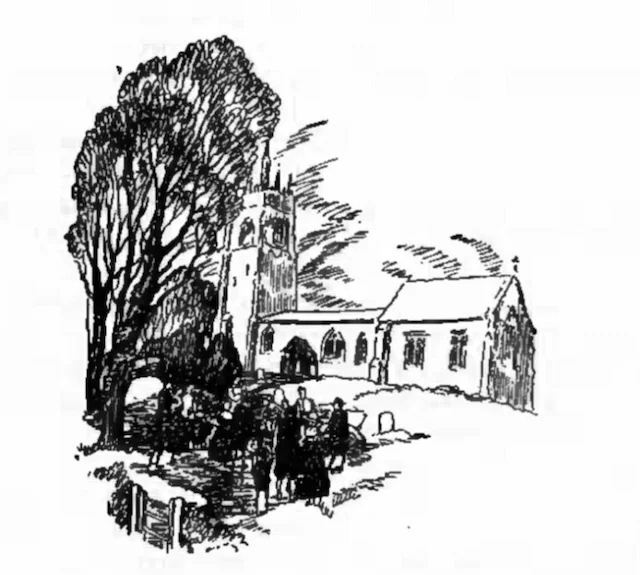
Beneath those rugged elms, that yew tree's shade
Where heaves the turf in many a mould'ring heap,
Each in his narrow cell for ever laid,
The rude forefathers of the hamlet sleep.
Gray's Elegy
In the Mourholme Society’s book, “How it Was“, we tried to give a picture of seventeenth century life in this ancient North Lancashire parish. Quite by chance, I came across a delightful, though battered, small black book with the intriguing title “Rude Forefathers”, which is about a Nottinghamshire village 1600-1666. In his introduction to the book (published in 1949), the writer quotes Macauley, “Nothing has yet been said of the great body of the people, of those who held the plough, who tended the oxen .. Nor can much be said. The most numerous class is precisely the class respecting which we have the most meagre information“. The little book helps to fill the gap using the “short and simple annals of the poor” contained in the Upton account books.
I thought I would let Arthur Penn have sight of it, and suggested that extracts from the little book would compliment our book. He returned the book with the short prefatorial piece given below. Small world!by Arthur Penn
John Findlater recently acquired a little book of this title (from Gray’s Elegy) and consulted me about its suitability as a source of extracts for this magazine. It was written in 1949 by Francis West, the Archdeacon of Newark and Vicar of a country parish near there called Upton. It so happened that I had known him from 1945 until his death two years ago near his 90th birthday. He was, in 1945, Senior Army Chaplain in the Far East and was the first person I talked with about my vocation to the Ministry. He was later Archdeacon and then for many years Bishop of Taunton. He was a good historian and at Upton he had a remarkable resource, two ancient account books, one for the Churchwardens for 1601-42, and the other for the Constable for 1642 -66. These give a vivid picture of village life and of the effect of the Great Rebellion on the rustics of a small community. John and I both thought it merited the use of extracts in this magazine. On ‘phoning Frank’s widow, Beryl, she cordially agreed to this.
Extracts from Rude Forefathers
(These are made so far as possible using Francis West’s own words. Quotations from the account books are printed in italics)
Upton-by-Southwell, at the beginning of the seventeenth century was a small village, having a population of about 300. The market town of Newark lay about five or six miles to the east; Nottingham about 14 or 15 miles to the west. Upton was subject to the independent ecclesiastical jurisdiction of a Peculiar [i.e. A parish or church exempt from the jurisdiction of the archdeacon or bishop in whose diocese it lay] of Southwell, the competent authority being the Chapter of Southwell.Jurisdiction in criminal cases and civil cases fell to the Assize Court in Nottingham and to the local courts presided over by the Justices of the Peace, the Quarter Sessions and the monthly Petty Sessions at Southwell: the village constable being the chief executive officer of the J.Ps in the village community.
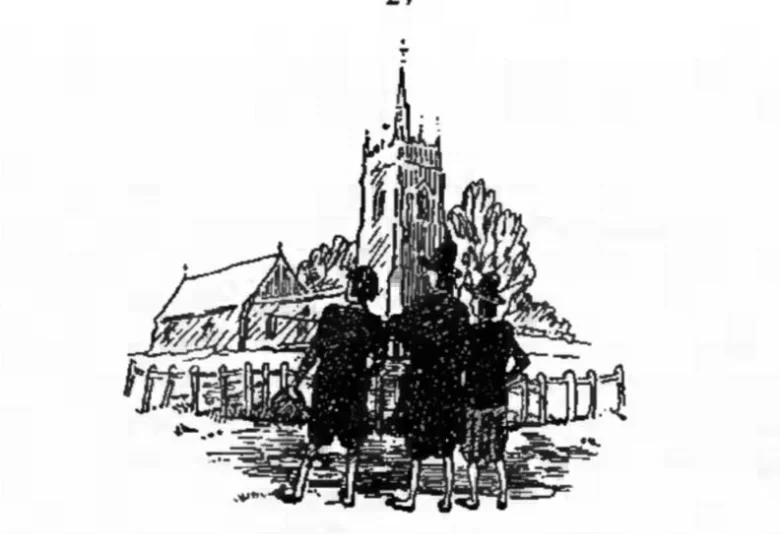
The Churchwarden and the Parish Church
The Upton churchwardens’ account books cover a surprising range of the activities. Sandwiched between items referring to the sale of the parish bull and the provision of a new church bible is a note of the wages paid to Daniel Coe the molecatcher and William Middop, the scourer of drains.It was taken for granted, then, that England was a Christian realm; Englishmen should be Christian after the pattern which Queen Elizabeth and her advisors had decreed. From the earliest days the churchwardens had been the chief lay guardians of the the parish church. But in the course of time other duties were imposed upon these men who had proved themselves capable of managing the material affairs of the church. By the Act of 1601, along with the overseers of the poor, they were confirmed as official local civil servants; the secular and ecclesiastical affairs were fused together in the person of the churchwarden. Parishioners were obliged to pay tithes, the wardens were responsible for upholding Canon Law.
It was a time of turmoil in church life. William Laud who became Archbishop of Canterbury in 1633 did his best to reform abuses and set high standards. The churchwardens were elected at the annual meeting of the vestry, it may have fallen in rotation to the holders of certain tenements; after the decease of Matthew Parlthorpe warden in 1642 his widow succeeded him. The wardens’ responsibilities were heavy and often unwelcome. Refusal to serve was so frequent that it was punishable by fine. Their expenses were paid but they received no salary; unpaid amateurs were not always made for efficiency, but it introduced a measure of self-government into local affairs. These local officials were usually substantial villagers, whose one advantage over many neighbours was their comparative literacy. At Upton there must have been at any one time at least a score of men in the population who had served as warden or constable.
The first duty of the wardens was to attend the Vicar General’s April visitation. A second took place at Michaelmas. To both of these the wardens took the answers to a questionnaire, previously submitted to them, known as the book of Articles: paide at the visitation for our examination upon the articles .. 6d. At the same time they handed in a copy of all the entries which had been made since the previous visitation, also all church registers and copies made were handed in.
After handing in the articles and registers the wardens ‘presented’ those of their neighbours who had offended the laws of the church; fornicators, blasphemers, sabbath-breakers or persons who had refused to pay their church rate. Transgressors might be warned, or made to acknowledge guilt publicly before the congregation, or possibly face the most severe penalty – excommunication. There are several references in the account book, but no details of the offences; one about the warden himself: laid forth for my charges when I was ex-communicated … 2/6d. Amongst the social disabilities excommunication imposed was the denial to them of christian burial: 29th May 1758 Robert Wilson (ex-communicated) pitted. Some sabbath-breakers, or at the least parishioners who did not attend church, were catholics or ‘papists’ or recusants; they had a fine of 1/- imposed given to Mr Martiall’s man for ye bill making about Recusantes 6d (Mr Marshall the lawyer was registrar at the Chapter at Southwell in 1625). The names of all Roman Catholics in the county were sent to Nottingham. Only one appears to have lived at Upton during this period, the wife of Gervase Staveley.
After the visitation everyone concerned repaired to an inn in Southwell for dinner. April 9th 1615 Paid for foure churchwardens dinners with oure minister 4/2.
Typical of other references to the Visitations and to the activities of the Chapter Court are the two following: Payed to the court when the church porch was presented 8/- (The wardens were fined for letting the porch become dilapidated). Paide to the chapter courte when we went to satisfied the courte that the churchyard was made soficente 3/ -.
At whitsun all parishes of Nottinghamshire were required to send an offering to the Chapter at Southwell, Upton’s quota being assessed at 3/ -. It is said that the canons, in order to entertain the unusually large crowds which flowed into the quiet streets of their little town once a year, instituted an informal race meeting in a field nearby which later developed into the Southwell races.
At the beginning of the 17th century the church at Upton was in great need of repair. The accounts record almost ceaseless restoration between the years 1601 and 1640. 1613 Spent at setting forth the wood at the forest 5/4d. Pade for cordes for scaffolds for the church 1/ -. Spent at Winkebourne at fetching home the wood 2/ -. Pade for alle and breade at casting the leads 1/ -. It is interesting to note that in 1636 Upton church was paved, probably for the first time; the majority of country churches were still unpaved at the beginning of the 17th century. This is an instance of the Laudian reforms on the rural parishes. Pade to the masone for stones and for paveing the church and south porch £1 2s 6d. At an earlier date the earth floor was ankle deep in rushes which the feet of worshippers had trodden hard. The old ruinous porch was swept away, a new one of good Sherwood oak took its place. The rushes strewn about to give warmth now covered paving stones. The font is handsomely covered in oak. The rough benches disappear, replaced by box pews with doors, some tastefully carved. One handsome pew in the old chantry chapel, complete with carpet and cushions, is for Mr Owen Oglethorpe and his family from the Hall. In the pulpit is a handsome cushion with fringe and tassels. The cracks and chinks in the windows have been repaired and there is a new oak roof. The account books are full of detail.
As at Southwell a dog whipper was employed at Upton to keep the dogs quiet during the service and to remove them if they became too noisy. Given to John Baillie for whipping dogges forth of the church 6d. The bells were constantly being repaired. The church was heated by coal probably set in a brazier in the middle of the nave. Given for five shuvvellful of coals which was used in church 10d.
There are frequent references to the payment of visiting preachers for their services to Upton church. Some were strangers and described by the wardens according to their personal appearance: Given to a preacher with the flatt nose for preaching 2/6d; Given to the wrynecked preacher 2/ -. Almost the first action of Queen Elizabeth, after her accession, was to inhibit all clergy from preaching, and thereafter the bishops only permitted clergy who had received a special licence to preach. As a result the majority of parochial clergy was prevented from preaching. Mr Wilson’s parishioners never heard him deliver a sermon of his own composition in his 40 years as Vicar of Upton! In such cases the vicar was bound to read one of the authorised homilies, the titles of which appear in the 35th of the 39 articles.One very common occurrence at Divine Service was the reading of a brief. Briefs were appeals for worthy causes; afterwards as people filed out the wardens waited at the door and invited collections. These briefs were generally unpopular. 1620. Given to a brefe that came from Bawick (Berwick) 23rd April 2/ -; given to a brefe for Benstebell (Barnstaple) in Devonshire which was all burnte 3/- 1626 Paid for a brief for the Palateneth country 2/8d. This last was for the Palatinate, overrun by the Catholic armies in the thirty years war, which was of especial enterest since the Elector, the champion of the Protestant cause, was married to Princess Elizabeth, the beautiful sister of King Charles. 1636 Given to a breefe for releeving the Palatinate ministers 3/ -. Of special interest perhaps was a brief in 1636 Paid towardes ye repairing of S. Poules church in London 6/8d. The reconstruction of St Paul’s was intended by Laud, when Bishop of London, to be symbolic of the revival of the Church of England. The King’s interest had been aroused and briefs were issued for raising the money. Another interesting brief was for the infant colony in Newfoundland : Given to a breefe at the request of the Lord Archbishop to the Captaine concerning newfoundlande 1/4d. The Privy Council issued letters patent authorising appeals: Paid to a letter patent for twenty five hundred captives under the Turks 2/6d. Justices of the Peace were also empowered to give testimonials to individuals who had suffered loss, authorising them to beg from place to place: Given to a pore man that came from Cornwell with testimony of losse by fire to the vallew of £200 being published in church August 27th 6d. Given to a man that had his tonge cote out of his mouth by the Torkes the 6th day of September and had a passe 4d.
The annual rogationtide procession is frequently mentioned in the accounts. Its origin was religious but in the 17th century it had become popular in the village, serving a secular purpose by making its way round the parish borders to make sure the neighbouring parishes were not encroaching; it became known as the Beating of the Bounds.1616 For breade and drinke at the perambulation about ye feildes. 6d
Civil War
The book contains much about the Civil War which had a direct impact on Upton. In 1643 Newark became a storm centre in the Civil War between King and Parliament. Rival armies infested the peaceful Midland countryside. Day by day the constable, who as chief executive officer of the parish, had to deal with this new situation recorded in his account book its effect.Unconsciously he became an historian of the Civil War. The constables of Upton, over a period of five years, recorded eloquently what official historians have often neglected: the impact of war on Mary Kerby, whose hen was stolen by a trooper, on Thomas Kitchen whose mare disappeared during a raid from Newark, and on Mrs Robinson, whose husband was killed in a scuffle with the plunderers.
On February 9th, 1641, the constable noted in his book – Given to a linen draper of Newcastle which was deprived of all his goods by ye Scots to ye valew of two hundred pounds having a wife and six small children 4d. Provoked by King Charles’ attempt to impose the prayer book, the Scots crossing the Tweed over-ran the Border Country as far as Newcastle, which they reached in August 1640. Six months later the constable listened to his story and took pity.
The King left Oxford in the spring of 1642 to join his army in the North. At Upton the constable was obliged to supply two horses for the King’s retinue. As the summer wore on he was also obliged to find billets for the volunteers on their way to join the King. 16 April Given to a woman travelling to her husband he being in the King’s service in the northern parts of England 4d.
Sometimes deserters, wounded, sick and discharged soldiers flowed the other way. Given to two soldiers being sore maimed haveing their wives and many small children 4d. Given two drummers which were dismissed the King’s service 7d.
On the 12th August 1642 the King raised his Standard at Nottingham having left Lincoln and made his way there by way of Newark and Upton, though there is no reference to this in the constable’s book. Not finding great friendliness at Nottingham, it was abandoned by the Royalists who chose Newark as their centre. The constable was summoned to Newark and was called on to levy money for soldiers’ pay, eggs, butter, meat, oats, hay and pease. Horses and carts were requisitioned by quartermasters. Spent when I went to Newark with carriages with coles 6d.
Worse was to come. Parliamentary forces established themselves at Nottingham and laid siege to Newark, with counter-attacks by the Royalists and Upton militiamen were involved: Spent when we were at the battle of Newark £1. Queen Henrietta Maria arrived at Newark from Bridlington, where she had landed with re-inforcements from the continent, necessitating further exactions. Paid to George Wood and Richard Wood for going to Newark when the Queen was there 6d. When I went to carry provision for the Queen spent 4d. The Queen left for Oxford on July 3rd but not before levying a tax on Upton and Morton. Spent when Morton men came to Upton to consider with the neighbours about the draught to goe with the Queen 8d. For the rest of the year almost continuous exactions were made for the King and finding temporary billets for his men. Paid to John Chapell for his fether bed which went to Newark £1.2s5d. For lodging a captayne and two men and four horses. His troops lay in our town and nobody would lodge him. I having all my beds taken up before was fayne to lodge him in my bed 1/ -.
When earthworks were thrown up around Newark, and ditches dug, men were compelled to leave the fields and labour on this. For going with the ditchers to Newarke 6d. Payed for boting men over (the Trent) when they went to the workes 4d. When the King’s forces withdrew from Nottinghamshire in January 1644, though Newark still held out, the area was overrun by Parliamentary forces and the same assessments and payments went to the new masters. This altered temporarily when Prince Rupert relieved the garrison briefly but meant Upton was forced to help again. When assessments were thought excessive the constable courageously stood up to the quartermaster’s demands (as in fact did William Robinson, the churchwarden, who would later be killed). For going to Newark when Major Palmer would have quartered thirty men with us, spent 1/2d. Sometimes the oppressors were open to reason. The villagers kept a look-out so that they might attempt some precautions. Paid to Thomas Kitchin for watching one day upon the church steeple 1/ –
Then the Scots, under General Leslie, joined hands with the Parliamentary forces, who were forced to live entirely on the land, and whose depradations were therefore severe. After their departure in May 1646 the constable wrote assessment to the Scottish army from 4th February until 6th May 1646, being 13 weeks, sixty-nine pounds six and threepence, a rate of five pounds six and eight by the week. An enormous sum in so short a time for so small a village!
The King surrendered to the Scots on May 5th at Southwell. He was prevailed on to order the Newark garrison to capitulate. Life began to return to normal though for months distressed folk of one kind or another needed help. Given to two distressed cavaliers that had been prisoners in Wales traviling to Pomfrett (Pontefract) and being in great want 8d
With the coming of peace, opportunities were given to the villages which had suffered in the war for claiming compensation though this entailed tedious form filling. Payd when we did meet at Jarvis plowman concerening giveing in at Nottyngham a boke of our losses from the Scots and what other losses we did sustayne by any other soldiers. The town’s charge at the meeting was 1/8d. When Mr Ballard [the vicar] and I went to Mr Crumwell to knowe in what forme it might be put in. Spent 8d. The last entry of the period of strife was made a year later –Spent at Jervas plowmans when the shouldiers came to shurch for arms 6d (February 1650).
Published in the Mourholme magazine issues 40 between 2000 and
by Mary A. Atkin
I have much enjoyed Ellis Peter’s “medieval who-dun-its” set in Shrewsbury during the upheavals of King Stephen’s reign, but often found myself wondering what was happening in our own area in the north west of England. There has recently been a good deal of research into the lordships and the happenings in the area which is modern Cumbria and in the regions around it. It is possible therefore to enquire into the impact that those happenings may have had on the Manor of Warton in the period from Domesday Book (1086) to the early years of Henry II’s reign (1154-1189) which nearly coincides with the lifetime of William de Lancaster, first Baron of Kendale and Lord of Warton and Garstang, who is thought to have been born c.1090 and died in 1170.
We are looking therefore at a period of just under a century from the Norman Conquest of 1066, a period which reaches into the reigns of five kings, William the Conqueror, and his two sons William II (Rufus 1087-1100) and Henry I (1100-1135). Under the two Williams the kingdom expanded in size and Henry’s reign saw a period of consolidation. On Henry’s death, his nephew, Stephen got himself crowned and anointed before Henry’s daughter, Matilda (Ellis Peter’s “Empress Maud”) could do so, thereby giving rise to a period of civil war which mainly affected south-west England, but inevitably caused some loss of control of parts of the kingdom. This civil war finally ended when Stephen died (in 1154) and Matilda’s son Henry became king; a strong king who won back and consolidated his grip on the kingdom.
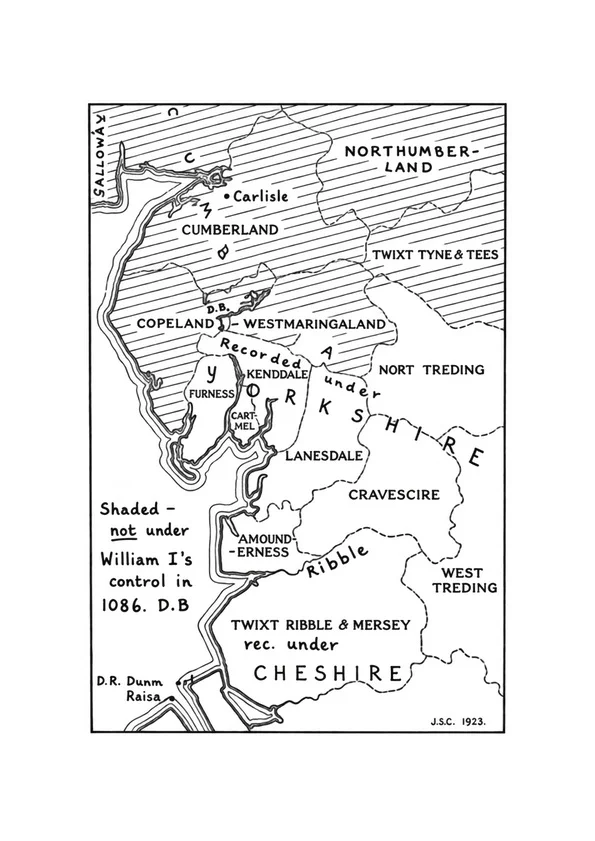
The North West in 1086 (William I) The map shows the land which William the Conqueror ruled at the time of Domesday Book, completed in 1086, only one year before he died. In our area there were no counties of Lancashire, Cumberland and Westmorland. What he held in our area was recorded under the heading of “Yorkshire”, that is the districts of Furness, Cartmel and Kendale (then called “Stirkeland” – the “district of cattle”) whose northernmost point was at the summit of Dunmail Raise, and eastward by the crest of the passes of Kirkstone and Gatescarth, and along the line of the Shap Fells to Low Borrow Bridge on the Lune. Warton (with Priest Hutton) was one of a scattered group of manors which were attached to the manor of Austwick and were also in the King’s hands, while Yealand (presumably both Yealands) with Borwick were grouped with Beetham and Heversham.
To the north lay lands which once formed the ancient British (i.e. Celtic) district of “Cumbria”, part of an old kingdom called Strathclyde, which now acknowledged the King of Scots. It included the district called “Westmaringaland”, later the north part of the county of Westmorland.
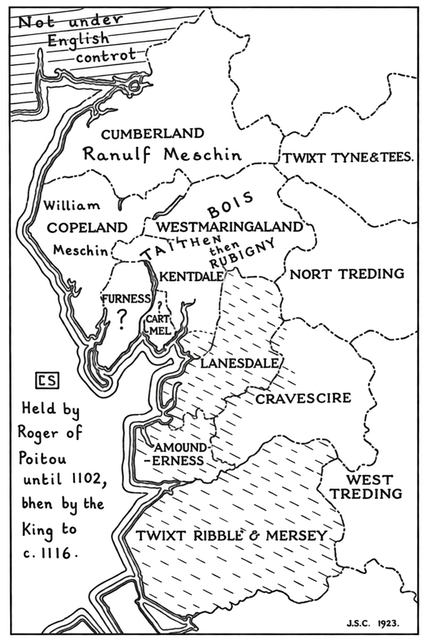
The North-West c. 1100 (William II/Henry I) His son, William Rufus (1087-1100) pushed the bounds of his kingdom northwards to roughly the line of the Solway Firth, (see map 2) and fortified Carlisle, giving it, and the districts of Cumberland, Copeland and “Westmaringaland” (W.Farrer’s term) to Ranulf Meschin I, and he in his turn granted out other parts to his knights, including his brother William Meschin who became lord of Copeland, centred on Egremont. New settlements were established and populated with peasants brought from the south-east and new Norman overlords to control the area. Further south Roger of Poitou became lord of most of Lancashire including Warton. And that is why Warton is in Lancashire!
William Rufus’s sudden (and suspicious) death brought the youngest son of William the Conqueror to the throne of England as Henry I. He had inherited much of his father’s character, being astute, able in warfare and ruthless. Having rapidly got himself crowned King of England he determinedly set about taking Normandy from his eldest brother Robert, to whom William the Conqueror had left it. At the battle of Tinchebrai in 1106 he routed Robert and his supporters and imprisoned Robert for the rest of his life. Inevitably this made him enemies who rallied to support Robert’s son. So Henry had to cope periodically with defending what he had won. Like his father and brother he understood the value of castles sited at strategic points and manned permanently with well-armed soldiers as a means of holding an area under control. Trusted followers were established in manors round about the castles holding their land by knight service, which meant that in return for their land they were to come to the aid of their overlord when required with a body of armed men.
These castles, at least at first, were the motte (a mound) and bailey (an enclosed courtyard) type often consisting of raised earthen platform with a higher, smaller mound built at one side of the platform, each crowned by a stockade of very solid timbers standing on earthen banks surrounding both the motte and the bailey. The earthworks of one are still readily visible at Kendal above and to the west of the town, and a better (because less modified) one at Burton in Lonsdale. There may have been a small motte at Warton too – the name Castle Dyke appears on the Tithe Award map on the old road to Silverdale, perhaps demanded by the King himself as overlord of the Honour of Lancaster after Roger of Poitou was sent into exile for yet another rebellion.
While such small castles could relatively easily be avoided by an enemy they served to overawe the local inhabitants, and could provide a ready body of armed men to watch and control important corridors of movement. Kendal lying at the junction of two Roman roads whose surfaces continued for centuries to preserve them as local routeways, was one such site, and one might speculate whether Warton’s role (the name means “guard settlement” from the Anglo-Saxon weard and tun) was to keep watch on the cross-Bay landing places as well as the crossing of the river Keer. The construction of these castles would be overseen by Norman lords and knights but the labourers would be drawn from the local peasants, who would have to delve the deep ditch which provided the earth for the mound, and haul the timbers into place.
There was not necessarily resentment between the new overlords and their tenants. In many of the villages of north-west England the new manors functioned using types of tenure and old customs which undoubtedly originated from long before the Norman Conquest and some of these were still being recorded as late as the 17th century. Furthermore many incoming Normans, whether aristocratic or simple soldiers, married themselves to native heiresses. Thus the ensuing generation could make some claim to an inherited continuity through their mothers.
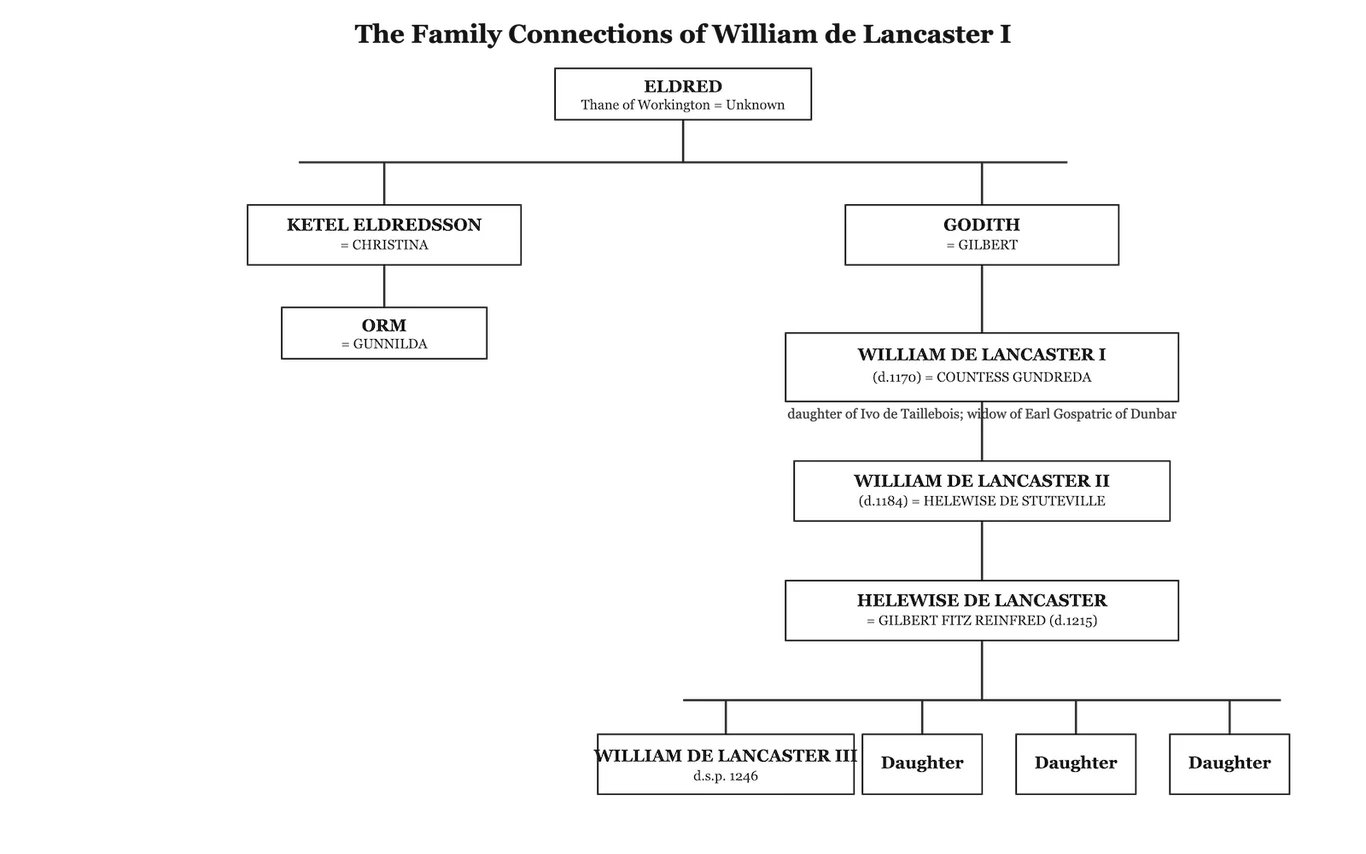
Note
1. William de Lancaster I’s daughter, Avice was married to the son (Richard) of Hugh de Morville, Constable of Scotland, lord of Westmoringaland and lifelong friend of David, King of Scotland
2. Gunnilda was the sister of half sister of Etheldreda, wife of King Duncan of Scotland and mother of William fitz Duncan.One such was Gilbert the father of William de Lancaster I. (see family tree). William was known at first simply as William fitz Gilbert, William the son of Gilbert. Nothing is known of Gilbert but he must have been well-regarded for he was married to a well-born native lady, probably with an Anglo-Scandinavian background, called Godith. She was the daughter of a thane (an English nobleman) called Eldred, who was the Lord of Workington and had very illustrious connections. His son Ketel appears to have been married to the daughter of an earlier Lord of Kendal called Ivo de Taillebois, and Ketel himself held land in Kirkby Kendal and a large part of the area north of Kendal, perhaps giving rise to the township-name of Strickland Ketel.
Farrer records William de Lancaster being enfeoffed by King Stephen as Lord of Warton and Garstang only as late as 1135, but I wonder whether Gilbert might himself have held Warton and Garstang, and that William acquired them by inheritance at his father’s death. William almost certainly acquired from his mother Godith, or from his Grandfather Eldred, the property called Swartahof (near Whitehaven) which he gave to the priory of St. Bees.
If Gilbert did indeed hold Garstang and Warton at this time, in 1116 he got a new overlord, a man who was to play a very important part in the future. This was Stephen, Count of Blois, King Henry’s nephew, who, (probably when he came of age) was given the newly created Honour of Lancaster, including both Furness and Cartmel. One of the lasting consequences of this was the establishment by Stephen of a colony of monks in Bekanesgill, which eventually became the Cistercian monastery of Furness Abbey. Another of King Henry’s protégés, who like Stephen, were to influence future events, was David, soon to be King of Scots, for whom Henry arranged an advantageous marriage with the heiress of the Earl of Huntingdon, and wide estates in that area.
Like any manorial lord of the time the Lord of Warton would obtain his living mainly from the agricultural produce of his manors, and for that, he depended on the labour of his tenants. Some of these would be freemen, free to leave the manor, but the great majority were bondmen, the property of their lord and tied to the land. This did not, however, mean that they were without rights. They were entitled to “the customary rights of the manor”, which meant a right (which could be passed to an heir, after payment of a heriot) to a share of arable land (usually in scattered strips in the “common fields”) for growing their own food. This arable land carried with it rights to meadow (also in strips) for hay; to common pasture for grazing their animals; to certain classes of timber for housing, tools and fuel; and, in much of the north, to turbary and rushes from the local peat mosses. In return the bondmen owed seasonal labour services (ploughing, harrowing, and harvesting the corn on the lord’s demesnes of Leighton,. Hyning, Tewitfield and Yealand Hall) and had to grind their corn at the lord’s mill at Whitebeck.
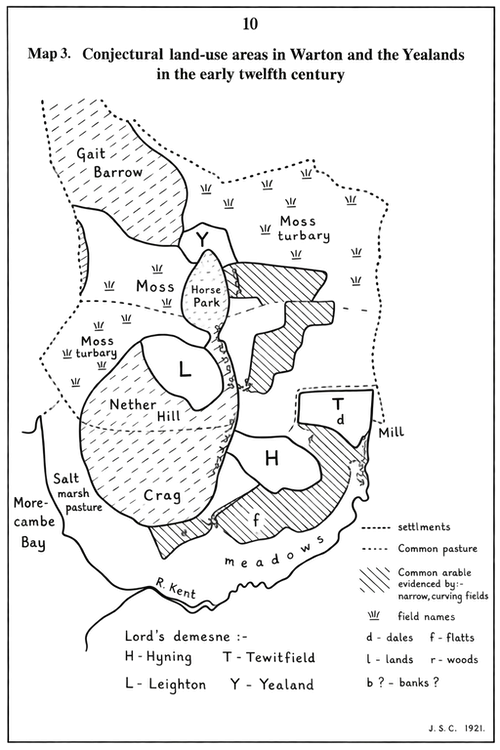
Warton and the Yealands early 20th century The map above shows the probable distribution of these types of land in Warton and the Yealands. The evidence for it comes from field-names (like land, flatt and dale) and other written records; from the landscape itself (like “ridge and furrow” and field shapes) and what the Orwins called “the common sense of farming practice”. Tradition was strong enough to preserve much of the medieval status quo until the 16th or 17th centuries, and some Westmorland Tithe maps show arable strips still unenclosed in the 19th century.
Disaster fell on Henry I and his kingdom in 1120. His only legitimate son with his retinue of young noblemen were all drowned on the voyage from Normandy to England when their vessel, the “White Ship” was destroyed in a violent storm. This left Henry with no legitimate male heir and only one other legitimate heir, his daughter Matilda. By her first marriage to the Holy Roman Emperor she had no children, but after his death (1125) she was married to the count of Anjou, by whom she had two sons. She preferred to retain her imposing first title and was known as the Empress. She was able, well-educated and courageous, and had played a full part with her first husband in the government of the Empire. She had however “a notoriously sour nature” perhaps a consequence of a harsh upbringing by a formidable aunt and her unsympathetic second marriage. Henry I determined that she should inherit the throne of England and made his barons take an oath of allegiance to her as his heir. Despite their reservations about a female sovereign most of them did.
But waiting in the wings and much of an age with Matilda, was another grandchild of William the Conqueror, a more likeable character and well-known to many of the barons, her cousin Stephen, Count of Blois, lord of the Honour of Lancaster, and endowed with many other titles and lands in England. No wonder that R.H.C. Davis (1990) said of the period after the loss of the “White Ship” that “waiting for the death of Henry I was like waiting for the Bomb.” It was clear to most of the leading barons and the King’s counsellors that the succession was going to cause trouble.
During his reign Henry I had “disinherited” members of the nobility who had opposed him in the course of his fight to obtain, and then keep, the throne. Furthermore in order to have loyal servants to help him govern he made several “New Men” and rewarded them with the lands of the “Disinherited”. Among these and their heirs there were understandable resentments which boded no good to the future monarch. There were other problems too, as there was economic inflation in the latter part of Henry’s reign, and in 1131 a widespread outbreak of an animal disease afflicting pigs and cattle caused not only a serious shortage of meat and dairy products, but also an acute loss of oxen to pull the ploughs.
Stephen was bound therefore to face difficulties and one arose immediately. David, now King of Scots since 1124, had not forgotten that the Earldom of Northumbria and the old kingdom of Strathclyde had, some forty years before, been part of the Scottish kingdom. His obligations to Henry I had presumably kept him quiescent until now, but when Stephen seized the throne in 1135 David immediately declared his support for his niece, the Empress Matilda, and invaded Northumbria. In reality, however, he was playing his own game, and it was largely successful during the years of Stephen’s reign. In 1136 Stephen ceded Carlisle to David with much of Cumberland and Westmorland north of the Dunmail -Tebay line, thus making the district of Kendale once more a border region, and agreed to recognise David’s son, Henry, as Earl of Huntingdon.
In these areas David pursued policies similar to those he had employed in the territories of Nithsdale and northward to the Clyde estuary of settling his Norman friends in those areas to pacify and develop them, and also to provide a bulwark against the wild Galwegians of Galloway. One life-long friend was Hugh de Morville, David’s Constable of Scotland, who was granted “Westmaringaland” and the district of Kendale. David also followed the example of his mother, Saint Margaret, wife of Malcolm, King of Scots, in making generous grants of land to already existing abbeys and monasteries and founding new ones. Under both lords and monastics his kingdom developed both culturally and economically, and came more firmly under his control. Like any king of the period David also arranged marriages of his own nobles to heiresses whose lands would extend his control beyond his existing territories. One such may have presented a dilemma to William de Lancaster I.
The heiress in question was Alice de Romilly, the unmarried daughter of William Meschin, Lord of Copeland, and his wife Cecily de Romilly, Lady of the Honour of Skipton and the wide lands belonging to it. William Meschin died about 1135 and the only male heir also died shortly after. Although Alice was the youngest of three daughters it seems she was the one who would inherit not only Copeland, but also the Honour of Skipton, making her a very desirable bride. Whether, as Paul Dalton suggests, she was the object of an abduction and forced marriage or not, the fact remains that shortly after he led a raid into Yorkshire, King David’s nephew, William fitz Duncan was married to Alice and in a position to influence both Alice and her mother Cecily, and he was later recognised as lord of both Copeland and the Honour of Skipton. The story as it was told by English monastic chroniclers of the period was as follows:
While King David was laying siege to Norham, he sent his nephew, William fitz Duncan back to Carlisle whence they went “with the Galwegians and part of his army on an expedition into Yorkshire … and they came thither and … . destroyed by sword and fire the possessions of a certain noble monastery which is situated in Furness, and the province which is called Craven.” They were “slaying and pursuing around Clitheroe” where they encountered a force of English knights, put them to flight and then proceeded to carry off “much spoil and a multitude of captives, sparing no rank, age or sex …. Many were slaughtered … children before the eyes of their parents … and husbands before the eyes of their wives .. and then alas! promiscuously with other women and with their spoil, they carried off as well the noble matrons and the chaste maidens … Stripped also, bound and fastened together in troops by cords and thongs, they drove them away before them, goading them with spears and arrows.”
Reading the account one gets the feeling that the chronicler (a monastic) was more appalled that the high-born were roped together with women of lower orders, than that women were carried off at all! Nevertheless, all the contemporary accounts of raids by the Galwegians whether in north-east England, or this (relatively rare) raid into the Ribble valley, express acute anxiety and horror at their brutal practices. These accounts were probably somewhat exaggerated, but nevertheless King David came under criticism even from his own Norman barons and knights for his use of the Galwegians for it was recognised that they were cattle raiders and slavers and were liable to be brutal when taking part in raiding. Occupying land west of the river Nith, they were only nominally part of the King of Scots realm. They were too poverty-stricken to afford armour and weapons other than light lances and their role was to move at speed, in small groups, to surprise and spread havoc and terror across a swathe of land in advance of the main body of armoured knights and cavalry. Since their own interests in any raid were in the capture of cattle and slaves (especially women, and children of working age) they inevitably lagged behind the main body of the army on the journey home and would normally return by a different route than that by which they had come.
That is the story as it was told at that time. It cannot be certain by what route William fitz Duncan and his army arrived at Clitheroe, but it seems very possible that he passed from Carlisle westward and through Copeland into Furness. Nor is it certain that they actually attacked Furness Abbey itself (though there might have been some satisfaction in doing so since it was King Stephen’s foundation) as the account merely says “possessions” were destroyed by sword and fire, which seems to imply at least that the countryside nearby was laid waste and some of the inhabitants put to the sword. If however that was the chosen route, it would seem certain that they then crossed Morecambe Bay making towards, or skirting, Lancaster en route for the Trough of Bowland. This would bring them down into the area around Clitheroe with a sufficient amount of surprise to overcome a body of mounted troops.
An alternative route might have been immediately southward from Carlisle, through the friendly territory of the Eden Valley and through “Westmaringaland” held by David’s friend and Constable of Scotland, Hugh de Morville. Either of these routes would bring the invasion into the lands of Kendale and past Warton, both of which may by then have been in the hands of William de Lancaster I.
What then would be the reaction of William de Lancaster to such an invasion and a further one in 1149? His overlord for Warton and Garstang was King Stephen, but he was enfeoffed as the first Baron of Kendale by Roger de Mowbray, who had apparently recovered his lands by entering into alliance with King David. Were William’s lands also friendly territory? Dalton says “if he was anybody’s man, he was probably for David, King of Scots, rather than Stephen”. Certainly, in his family connections he had close contacts with David’s subjects. His uncle Ketel was now dead and his cousin Orm, the Lord of Workington was married to Gunnhilda, daughter of Earl Gospatrick of Dunbar and she was half sister to the mother of William fitz Duncan. William de Lancaster’s daughter Avice, was the daughter-in-law of Hugh de Morville, Lord of “Westmaringaland” and David’s Constable.
There must have been many landholders in the North-West who found themselves facing similarly difficult decisions, but possibly they decided in favour of the power that was closest. Power in the North-west for much of Stephen’s reign was in the hands of David of Scotland as far south as the river Ribble, and chroniclers of the period concede that David kept the area largely peaceful. There was probably a considerable incentive to remain quiescent and wait on events (no doubt keeping a careful watch on one’s own cattle while the raiders went by!).
King David must have hoped to leave his son Henry as king of this enlarged “Scotland” but the year 1152 saw the death of Prince Henry, and David himself died the following year, leaving a young grandson as his heir. Stephen too, had the sorrow of losing his elder son a few months later, and pressure from the greater barons forced King Stephen to agree to accept the Empress’s son Henry as his heir, thus resolving the civil war at last. On Stephen’s death at the end of 1154 that heir was crowned as Henry II. The young grandson of David of Scots was no match for Henry II, a man as astute, firm and ruthless as his grandfather Henry I had been, and the border between England and Scotland. was soon pushed back to where it had been under William Rufus. The county of Lancashire was emerging, and the ancient British district of Cumbria was soon to vanish in the creation of the counties of Cumberland and Westmorland. Until of course, it was resurrected in 1974!
Note: I have used Farrer’s frontispiece from The Barony of Kendale as a base for maps 1 and 2.
Bibliography
A.O. Anderson, Early sources of Scottish History, Paul Watkins 1991 (first published 1922)
A.O. Anderson, Scottish annals from English Chronicles, Paul Watkins 1991 (first published 1908)
G.W.S. Barrow, The Kingdom of the Scots, 1973
J.Bradbury, “The early years of the reign of Stephen 1135-9” in England in the eleventh century, 1988 Harlaxton Symposium.
D.Crouch, The reign of King Stephen 1135-1154, Longman 2000
P.Dalton, Conquest, Anarchy and Lordship, CUP 1994
R.H.C.Davis, King Stephen, 3rd edition 1990
W.Farrer, Records of Kendale, Titus Wilson 1998 (first published 1923)
W.Farrer, Lancashire Inquests, extents and feudal aids, 1999
J.Rawlinson Ford, “The customary Tenant-right of the manors of Yealand”, in Trans.C.& W. n.s. ix. 147-160 (1909)
Judith Green, “Aristocratic loyalties on the N.W. Frontier”, in England in the eleventh century, 1988 Harlaxton Symposium.
D.Nicolle, Medieval Warfare Source Book, vol. 1 BCA 1996
G. Washington, “The parentage of William de Lancaster, Lord of Kendal.” In Trans. C. & W. n.s. Ixii 95-100. (1962)Published in Mourholme Magazine Issue 40 2000
Neil Stobbs
[Jill Mander of Main Street, Warton unearthed a diary for the year 1892, written by either William or James Whinnerah of Warton Hall Farm, Warton. They were noted Shire Horse Breeders. Jill made a good copy and passed it to the Mourholme]. The original is at Lancashire County Archives.
The diary of an unknown person provides considerable insight into the farming practices of the area in the late nineteenth century. It is thought that it was kept by a member of the Whinnerah family resident at Warton Hall Farm. The original transcriber thought that it may have been written by a James Whinnerah.
The family was not in the area in 1846, 1851 or 1881 from the various information available. They presumably moved into the area between 1881 and 1892 when the diary was written.
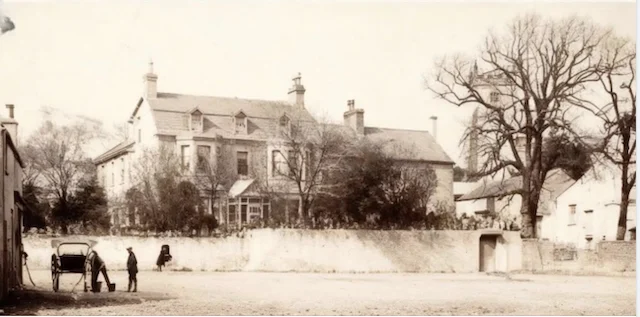
Warton Hall Farm An entry dated 1st February says, “William went to Liverpool“; an entry on 1st March, “James went to London, arrived 7.30 am“. Could suggest that the diary is not that of James but of his father William. Various other entries seem to indicate that William was certainly the author. It seems unlikely that a second son would make entries in the style that many of them are couched. Many entries referring to the family members in a way in which a brother would not have written. The entries referring to William surely point to the fact that they were written by William Senior. James would never have written about his father as William, and William Senior is unlikely to have said, “William went to Liverpool” if he was the one to travel. There are records of the hiring of farm hands at various Hiring Fairs at Ulverston and Kendal, something a second son was very unlikely to have done.
From the 1891 census William Whinnerah (60) was resident at Warton Hall Farm with his wife Elizabeth (59) and with their eldest son Edmond, aged 30, and James the second son, aged 28, and two daughters, Jennet (24) and Anne (21). All the children are single There are two grandchildren, Harry (3) and Lucy (1). There is no indication of parents for the grandchildren living at the farm on the day of the census.
In the 1881 census it was possible to trace the family to Nateby Hall, Nateby, still in Lancashire. In this census there is another son Thomas, aged 17, obviously now aged 27, whose occupation is listed as grocer’s assistant. He could be the father of the grandchildren. The grandson was born in Lancaster, and the granddaughter in Sheffield. The grandchildren are not listed as visitors, so they must be resident at the farm full time.
On a name search in the 1881 census, another William Whiner ( ?? ) Was found, aged 13. He was a boarder at The School House, Over Wyresdale, Lancashire, together with four other male boarders, aged between 9 and 18, and two sisters also boarders aged 10 and 13. They were under the care of Mr. and Mrs. Phizackerley and their niece Miss Hannah E. Phizackerley. The school is listed as an Endowed school, so presumably it was a Church school. It is interesting to note that Mr. P. Aged 53 in 1881 came from Ellel, the same village as Mr. And Mrs. Whinnerah then aged 50 and 49. It would seem that they were contemporaries in Ellel, and that may be why William Jnr. was sent to school with them. By 1891 William would be 23, and could have been the father of one of the grandchildren.
Edmond apparently travelled a lot to various places. On 3rd February Edmond went to Bolton ploughing, (Bolton-le-Sands?); 10th Feb. Edmond went to Lancaster and got paid for two cows from Mr. Turner £35.10s (£1280); 11th Feb. Edmond went to Caton and Hall Gowan sale; 12th Feb. Edmond went to Skipton; 13th & 20th Feb. Edmond went to Lancaster; and on the 22nd Edmond went to London at midnight and got back from London on 27th Feb.
In searching the 1846 Tithe Book returns it has been possible to trace one of the field names, ‘Eldrams’ quoted in the diary as 18 acres, 3 roods, 31 poles. In the 1846 returns it is given as five separate fields Nos. 509-514, the first two pasture, the second three as meadow, with a total acreage of 17.164 acres or 17 acres, 3 roods, and 5 poles. Some discrepancy but it would appear that the five parcels of land had been consolidated into one field by 1892. Shades of the 1950’s? William Jonson occupied the fields in 1846 and the Rev. Watson was the landlord.
It appears from the entries that William Snr. had a number of horses on the farm. It also seems as if he ran stallions, because there is some indication that he used to send various horses on ‘walks’ around various districts of the area, providing ‘service’ to farmers’ mares.
The entry for 25th June says, “Lonsdale started travelling again“. Prior to that Lonsdale is mentioned on 4th April, “Lonsdale shod on front fee“. One entry which at first sight seems strange is: “Engaged J. Askew to travel to Lonsdale £1 per week“. I assume this is William engaging Askew to travel with Lonsdale on his ‘Stallion Walk’.
There are also entries which show that mares were brought to the farm to be served. One entry says that a mare and foal arrived. “Memoranda Mr. Mackereth’s mare and foal came on Friday 24th“. Other entries mention at least eighteen other mares brought for service. It is common practice to put brood mares back to the stallion as early as possible after they have foaled, as the conception rate is higher the earlier they are served after foaling. This is still the practice today. William also hired out his stallions to other breeders: 23 June “Hired Druid to Mr. Foster”.
The entry 13 Feb. says, “Thorough-bred shod“. This seems to indicate that as well as keeping ‘heavy horses’ William also kept lighter types which he calls thoroughbred, which in present times indicated horses derived from racing stock. The “thorough-bred” is mentioned again on 26 Feb .: “had thoroughbred examined” but for what reason is not mentioned! This horse appears again on 5 Apr. “Through-bred shod”. There is also mention of a “blood horse”. It appears that the “Thorough-bred was a stallion that “travelled”.
“Memoranda. Thoroughbred horse finished travelling 2nd July.” Such a stallion would have been used on heavy horse mares to produce a ‘hunter’ type foal, or on hunter mares to produce a light faster hunter. It is noted that he was turned out to grass the next day. “Summer holidays?”
He also dealt, buying and selling horses. 5 Feb. “Sold Yankee mare to Mr. Cape for 50 guineas.” If this were translated into approximately today’s equivalent value, the mare would have been worth £2000! This is based on data in Munby L. 1996. How Much Is It Worth?, British Association of Local History (BALH). Yankee must have been one of the stallions standing at the farm.
There is also mention of “the black stallion” and “Jewel” as they were being sod the next day. By the number of horses mentioned in the diary one wonders if the farrier came to the farm or if horses were taken to him. A memo in October says, “Sold and delivered 4 years old Garnet gelding to Mr. Aspinall, Rochdale on Monday 26 (Sept.) for £40 (£1500). If he delivered the gelding to Rochdale from Warton, did he use the railway? Or how did he do it?
There are entries which show that there was also young stock on the farm part of a breeding program to produce animals for sale and to keep the stud going forward. “9 Mar “Two year old stallion shod“. 6 Apr. “G. Beck paid for foal pasturing in ‘Gales’, 7s” (£12.56).
It would appear that he also took his young female stock to other breeders’ stallions, presumably to prevent in-breeding which may have produced poor stock. 27 June “Took two yearling fillies to Docker Hall”. On 8 August he says, “Took Mr. Mackereth’s mare home and fetched two yearling fillies back, away six weeks“. This would indicate that they had been to a stallion for service and had been kept over to see if they returned to heat or held service. He mentions turning two yearling colts into “Caley seeds“.
There is also evidence that he showed his stock at various ‘Shows’ 7 Apr. “Garstang Show Lonsdale 3rd, Colonel 4th. ” Apr. “Kendal Show Lonsdale 1st and Silver Medal. Colonel 3rd. There is mention that the Kendal Show judges were nominated on 13 Feb. There are mentions of other shows, which he or ‘Edmond’ attended including Manchester, Liverpool, Barrow, Ulverston etc.
Towards the end of the year entries show that he started to break the black horse, “Druid” to working harness. 22 Nov. “put the black horse (Druid) into chains and cart“, two days later “put black horse into roller“. A great deal more information can be extracted from the diary about other aspects of the everyday work on a local farm towards the end of the nineteenth century. This has dealt mainly with some aspects of the “horse” side of the business and some derived information about the family. If it were possible to find out the breed of heavy horse that William Whinnerah specialised in, it would be possible to find more information from the Breed Society “Year Books” and “Lists of stallions”. Kendal Show Society records may also give some indication of the breed in which he specialised , as could records of the Garstang Show.
The second exploration of the Diary would hope to concentrate on the arable aspect of the farm, dates of operations, possible use of machinery, crops sown and harvested, and other details of the use of farm labour and resources for the use of the community.
There also seem to be notes on agricultural societies such as ploughing matches and agriculture shows.
Monday 18th Jan. Warton ploughing Committee arranged to hold the ploughing at Mr Thwaites.From the 1881 Census a John Thwaites farmed 240 acres at Lane End Farm. In the 1891 Census there is a Thomas Thwaites farming at Cotestones. Where the ploughing match was to be held is open to conjecture at the moment.
The rest of the entries for January tell of ploughing stubble and ley (sown grassland). During the month they carted manure onto the land, presumably before it was ploughed, or to be spread later on grass. There are also entries showing that the farm horses & carts were used for the good of the community.
Friday 22nd Jan. carting with 1 horse for township 1/2 day.
Monday 25th Jan 1 cart on highway 1/2 day.There are also entries showing the use the horses and carts were put to as the means of transport for various farm and household requirements.
Wednesday 27th Jan. Fetched a load of coal from Carnforth.
It must be assumed that he went to the Railway Coal yard for this load.Two entries indicate that they used ‘concentrates’ and other ‘imported foodstuffs’ as well as home-grown grain and roots to feed the stock.
Saturday 23rd Jan. Fetched provender.
Saturday 30th Jan. Fetched 4 sacks bran 2 sacks pea meal and 1 oil-dust.
Bran is used in feeding horses; pea meal is used, as a protein source, for most herbivorous livestock and oil-dust was a by-product of the ‘nut oil’ extraction process also used as a protein source. It is interesting to note that fetching of stock feed seemed to be a ‘Saturday job’ at least in January.February seems to have been occupied with ploughing and pulling turnips. The turnips were carted to the barn where they would be stored for feeding stock housed in the ‘steading’. Another interpretation of the entry of the 10th Feb. Sheep finished big bank turnips is that the big bank mentioned was a large clamp of turnips which had been ‘pulled’ and then stored in a heap which was covered in straw to protect the ‘roots’ from frost. This would make them available to the sheep whatever the weather. Frozen roots are not good food for ruminants.
There are also indications that the sheep were ‘folded’ on turnips, that is they protect the roots in to a restricted area by ‘sheep-nets’ or hurdles. There is no indication if it was nets or hurdles that were used. Considering the coppice woods which exist in the area, one may assume that it would be wooden hurdles that were used. Another entry further on shows that they did indeed use ‘sheep netting’ not hurdles.
During February it appears that there were various ploughing matches held in the local area and further afield. Warton Hall Farm seems to have been a centre for the local ploughing match.
Monday 15 Feb. Mackereth’s, Thompson’s, Clement’s, Hargreaves’s, Lawson’s, and Thompson’s, Overton teams land and stayed all night. If this was the horses or the men is not made clear.
Tuesday 16 Feb Warton Ploughing. Thompson, Hest Bank won for pair of horses with Lawson second and Clement third.
Wednesday 17th Feb Clements team went away. G and M Lawson, Thompson Hargreaves and self went to card at Mr. Burrow’s, Yealand.
Thursday 18th Feb. Hargreaves, Thompson and Messrs Lawson went home at noon should have gone ploughing at Milnthorpe but too hard.It would appear that the ‘ploughing’ was not the only activity in which this group participated. That is assuming that ‘card’ indicated the manipulation of pasteboards!! Ploughing was the most mentioned activity in the rest of February and early March.
The sons each made a journey to London.
Edmond on the 22nd Feb at Midnight, and
James on 1st March arriving at 7.30 a.m.
It appears they both went on the midnight train? An entry that is rather confusing to interpret.
Wednesday 3rd March Left London 4.30pm. Stayed at the Wrekin Hotel, Wellington all night … Was it James or the writer of the diary who stayed at Wellington? Why apparently break the journey at Wellington? This is one of the difficulties of trying to read the intentions of short entries in the diary. Obviously, the writer knew what he intended to convey, at a distance of nearly 110 years it is very difficult for anyone to know his exact intentions. Another point is that the railways have changed so much that one is not even sure if the line from here went through Wellington.There is mention of the usual mundane activities essential to running of a farm, collection of provender from the mill and station, collection of coals from Carnforth, returning 66 sacks to Dockray’s and bringing provender back. Apparently Dockray’s were a farm feed stuffs/provision merchants in this area. They had a depot in Kendal until the middle of the 20th century.
A considerable time seems to have been spent in dealing with Manure. Getting it out of various sheds and folds, carting on to the land spreading it and then ploughing it in. There is mention of putting tank on mangold rows in May. This would presumably be ‘liquid manure/urine’ collected in tanks from the cattle standings and then transferred to a mobile tank, and taken out to the fields. Something that we are familiar with, locally, these days but on grassland. I think that the farm was using some kind of ‘artificial manure’ as well as the more traditional organically produced type for on
Friday 20th May. Carting stones from seed field — Sowing manure and rolling seeds.
This seems to indicate that it was in a granular or powder form. The use of the word sowing rather than “spreading”, which is used elsewhere in connection to manure, gives the clue.There are also mentions of jobs being done that were not for the farm but for the community.
Collection of coals for school1,
Carted 3 and 7 loads of stone to Low Weir on different days.
This type of entry continues throughout the year.One odd entry is on
10th Feb. Mother paid Geo. Beck £5/10s for coals. (present value x35.5 £193). Who is mother? Is it the wife of the writer? From personal experience, this term is often applied to the wife of the farmer, by him, when talking to others. It could of course be the mother of the writer. From the 1881 census this seems unlikely.At the end of January there is a Memorandum: Dimensions of haystack Width 12ft, Height 8ft 3in. Length 23 ft. This gives it a volume of 2277 cubic feet or 253 cubic yards, if it were a cuboid in shape. It is unlikely to have been flat topped and would possibly have been shaped so that it looked like a building with a sloping roof, the peak of which was 8ft 3in. This would have reduced the total volume. The other possibility is that the height is to the eaves, thus the sloping top would add to the overall volume. Again, we have no way of knowing what the writer meant. Even so it was a fairly large stack, possibly, containing up to 200 tons of hay. There are various references to bringing hay in from the stack, presumably into a loft above the animal housing, thus allowing easier feeding of the housed stock.
One must remember that bales of hay were not common at this period, unless they were produced by hand. They were produced by cutting round a section of a stack, the size of the bale required, with a ‘Hay Knife’ and binding the resulting cube with wires. These bales were usually made when hay was being sold off the farm. It made the transportation of the hay easier than when it was loose. For moving hay around the farm, more often than not, the hay was forked from the stack, after a section was cut with a hay knife and onto a cart and moved to where it was needed.
There is also mention of the purchase of hay from outside sources on 2nd April. It is purchased by the wagonload. The price is given per stone, so it is possible to calculate the weight per wagonload. Price per stone is 4.5d. The cost of a wagonload is given as £6/18s or £6.9 (£244.95) This gives the weight of the load as 2 tons 6 cwt or 2.3 tons. Usually, a wagon is a vehicle with at least four wheels, pulled by two horses or more, whereas a cart usually has two wheels, and was pulled by one horse. By the end of the month the price being paid had risen to 6d, 7d and 8d per stone, on different occasions. This is usual as supplies run out at the end of the season.
If the farm was advanced technically, they could have had the machinery run by a steam engine at this time or they may have had an elevator and other ‘barn machinery’ run by a horse-driven mechanism in a ’round house’ or ‘gin-gan’. There is mention of buying and setting up a ‘new boiler’ towards the end of the year. Again, we do not know to what use the boiler was put. It could have been the source of steam for an engine. It could have been used to produce hot water, for various farm and or domestic uses. It could have been used for cooking potatoes or other roots for feeding to stock.
The first ewe lambed on 27th March. This date is typical of lambing times for many farms in various northern areas. It is timed to coincide with the growth of early grass, which has always been an economic decision, to provide good grazing for the ewes and hence allowing them to produce sufficient milk for the lambs. It saves on supplementary feeding. Later in the year the sheep were ‘cleaned’ (had adhering dung cut off the wool around the rear end), then washed and finally clipped sometime later.
From various entries it can be seen that the farm grew turnips, mangolds, oats, barley and potatoes as well as areas of ‘seeds’. The use of fallowing is mentioned a number of times, showing that the process was used as a means of weed control. There were also meadows and pastures that were treated in various ways with manure and fertilizers.
Many common farm operations are catalogued in the diary and it is possible to work out the work calendar for the year of 1892. This is beyond the scope of this article. There are also entries showing various purchases and other transactions that are necessary for the continuation of a farm business. Purchases of implements such as ploughs of various types and harrows are recorded. One of the implements purchased is called a ‘stitching-harrow’. Its function was to control weeds and the size of ‘ridges’ on which root crops were grown with the consequential improvement in crop growth. The use of harrows continued through June and most of July. The cleaning and weeding of turnips continued into August.
One other noted entry is that they replaced mangold plants in the gaps left in the rows possibly due to poor germination of the first sowings or poor singling!
A “suit of horse clothing”, presumably a full set of harness was ordered from a supplier in Kendal. There are other mentions of purchase of pieces of harness such as head collars. Also, a waterproof coat was purchased for one of the stallions. It would be used when the stallion was travelling around the district to serve other farmers’ mares.Seed potatoes were purchased from an outside source and ‘ware’ potatoes were sold to the Co-op in Carnforth.
There are entries indicating that the farm enterprise included the fattening of cattle for sale. Above all the horses were the main enterprise of the farm. It appears that the means of cutting grass for hay was in the process of change. Various entries tell of the use of scythes to cut grass.
1st July. Started Hay time
4th July Mowing bank tops.
5 July Finished mowing bank tops with scythes.There are other entries that show the existence of mowing machines.
29th June. Took mowing machine to Carnforth smithy.
2nd July Fetched mowing machine from Carnforth smithy.
5th July. Began mowing with machine in Keer Meadow.
They finished mowing this field the next day. The acreage given in the list at the front of the diary is 3 acres 2 roods 2 poles. The spelling of the meadow’s name is also different, ‘Keir’ as against “Keer” in the entry. By the 9th July they were working the hay in the Keer meadow. 15 loads of hay were carted from Keer Meadow on 11th July. They had made and carted the hay in six days, which must have been an indication of very good ‘Hay Weather’. Modern farmers would be pleased with such conditions to win what little hay they now make.Some of the fields are obvious from the listing at the beginning of the diary, but some are not so obvious. For example there are a number of entries referring to Dudley which does not appear in the listing. There are fields called Near Mill Head about, Far Mill head about, and Mill Head with a combined acreage of about 20 acres. “Dudley” was the name given locally to the Mill Head to accommodate the workers from the Midlands who came to work at the Iron Works at Carnforth. The various entries that mention Dudley seem to indicate that the land was sown to grass that was cut for grass seed production as well as hay.
Saturday 9th July. Began mowing seeds at Dudley.
Monday 11th July 6 Carts of seeds from Dudley. Finished mowing Dudley field.
Wednesday 12th July (Tuesday or 13th). Fetched 4 carts hay from Dudley.
Over the rest of the week 30 loads of hay were carted off Dudley including the ‘rakings’. There is also an indication that the grass was put into ‘cocks’ as a way of protecting them from the weather.
Friday 15th July. Cocking hay in Caley Land.
There were four field names containing the word “caley” amounting to about 11 acres approximately. 26 loads were brought out of Caley Land, a yield of 2.37 loads per acre.Another field called Big Meadow acreage 15.5 acres. The yield is difficult to calculate, as the entries are somewhat confusing.
Monday 18th July Began cutting Big Meadow
Thursday 21st July Strewing part of Big Meadow
Friday 22nd July Cutting grass in Big Meadow
Saturday 23rd July 11 Loads from Big Meadow. Finished mowing.
Monday 25 July Carted 25 loads hay out of Big Meadow. Finished stacks with 50 loads.
Tuesday 26th July Finished housing Big Meadow except rakings. 24 carts.
Wednesday 27th July Carted 3 loads rakings out of Big Meadow Finished haytime 171 carts.It could be possible to calculate the weight of hay produced on the farm, if it were possible to find what was meant by a load of hay, and from what acreage it was produced. There seems to have been an interchange between “loads” and “Carts”, which adds to the confusion.
As soon as hay time was finished, work on other crops and farm maintenance followed immediately.
Thursday 28th July. Stitch-harrowing turnips. Cleaning ditches out. Finished stacks out.
Stitch-harrowing as mentioned above, consisted of the use of a special type of harrow that was designed to run across and between ridges upon which the turnip seed was sown. Finished out the stacks refers to the need to build up the stack ridge to enable it to be thatched after the hay in the stack had settled. The settling could be due to the weight of hay gradually forcing out any trapped air, or because the stack had ‘heated’ due to natural fermentation producing heat and reducing the volume of hay on the stack. The fermentation could have been due to improperly ‘cured’ or partially dried grass being incorporated in the stack. Also, it could have been due to rainwater seepage into the stack setting up conditions suitable for growth of mould and bacteria.The work on the turnips and clearing ditches continued until the middle of August. Some change of task was introduced for the workers by having them “Cutting thistles”. Wilkinson, presumably one of the workers, thatched part of the clover stack on Monday 15th August. Thatching continued for a number of days, presumably until the stacks were all thatched.
Saturday 20th August Went to Kendal and Lancaster.
This involves a round journey of 15 miles to Kendal from Warton, and about 22 miles from Kendal to Lancaster and 7 miles from Lancaster to Warton. A total of at least 42 miles. If he rode a horse or had a light gig I should imagine he could not have done the journey in less than 5 hours. The horse would have been somewhat overstretched? Did he use the train? Which station did he go from, Carnforth? It would be possible to work this out from timetables. But why did he go, what did he do and how long did he spend in Kendal and Lancaster. What time did he leave and what time did he return? All questions raised by a simple entry in a diary. A further avenue for research?The beginning of autumn was the season for agricultural,
9th August Whinmarleigh,
16th Blackpool,
24th shows, Lancaster,
25th Skipton,
26th Barrow.
16th September K’by show (presumably Kirby Lonsdale).
20th Ulverston,
22nd Kendal.
Most of the shows seemed to only occupy one day, but the entries for 4th and 5th October show that they went to Chesterfield on the 4th to get ready for the show on the 5th. The entry finishes – got back at night.The more usual work on the farm is recorded, showing that despite the travels of the “Boss” and Edmond, away from Warton, normal everyday work continued.
Monday 22nd August, Cleaning ditches and turnips. Took 12 lambs to auction mart not sold.
Presumably the auction mart was Carnforth, and the trade for lambs must have been poor enough for William Sn. to have brought them home again. I am sure that a hired man or even a son would not have made such a decision. During the last week of August there were 5 days when a man and a horse were all day for the township also an additional one half day. Part of the continued commitment of resources to the good of the township. A social duty of an important citizen of the township.On Monday 29th August harvesting began. Began cutting oats behind the house with scythes. Very heavy rain. The weather seemed to be against the farmer even then!
Tuesday 30th August. Trimming hedges. Ploughing headlands. Heavy showers. Obviously heavy showers did not stop some work, but it must have stopped harvesting. The showers continued on the 31st.
1st September the weather apparently allowed corn to be cut with scythes. By the 2nd it was possible to begin mowing grain with machine.
They were also opening out in Caley land. Mowing with machine would seem to indicate that the machine being used was the same as was used to mow grass earlier in the season, not a ‘binder’. It is not at all clear if a binder was available and in use. Later entries say reaping rather than mowing. There is no indication of the necessary labour for hand tying of sheaves being available or being used. The corn crops mentioned specifically are barley and oats. There is no mention of wheat.The cut corn stayed in the field for 15 days (2nd to 17th Sept.) Presumably in ‘stooks’ of 6 to 8 sheaves, to allow time to dry out to a stage suitable for stacking. One saying about the length of time corn should stay in stook was that they should hear “three sets of church bells“. A minimum of fourteen days. The oat stacks were thatched on 20th September. The diary records this day as very wet. It seems odd to thatch a stack when this type of weather was about. It could have been the thought that the sooner it is covered the less damage may occur. There is mention of wet in the morning but with the proviso fine after 9 a.m., in another entry. What time constituted morning? Potatoes were a crop grown on the farm and harvesting of them began on Friday 7th October. The entry for
Wednesday 12th October indicates that the potato and fruit harvests are ended. The only earlier mention of fruit is on the 24th September that records getting pears.During the harvest season the business of livestock farming went on, lambs were being sold at market, horses came and went, calving cows were sold “with the calf back”.
Everyday tasks of maintenance proceeded some of them not particularly pleasant. Gas tarring sleepers, tarring loose box in paddock, cleaned out pigsty, collecting barrel of gas tar from Burton, cleaning loose boxes, carting manure into Nicholson Paddock.
By the middle of October, the farming year was progressing towards winter. Mangolds were being pulled and carted for winter stock feed. Trashing days were recorded. Oats were being cleaned in preparation for feeding stuffs. 40 lambs, 20 gimmers and 20 tups were sold. This indicated that a considerable number of sheep must have been part of the livestock on the farm. Gimmers are second season sheep that have not had a lamb. Tups are male sheep used for breeding. To have 20 tups for sale must indicate that one of the sheep enterprises must have been the breeding and rearing of tup lambs for sale. This was, and still is, a specialised type of sheep husbandry that requires considerable expertise, and good stock.
One of the typical social and neighbourly actions of the farming year is recorded in the entry for
Thursday 27th October. Sent 5 men to help Mr. Newby threshing and one horse. The following day records that the 5 men and a horse were at Mr. Newby’s till 10 o’clock a.m. This practice of sending workers from the surrounding farms to a ‘threshing day’ at a particular farm was common until the complete introduction of ‘combines’ in the late 1950s and early 1960s. Even then in the remoter areas where corn acreages were not large and farms small, threshing days continued for much longer. The use of contractors in such areas saw the end of the travelling threshing machines. The results of threshing days at Whinnerah’s according to various entries in November were transported to the station. Apparently 120 loads of barley were so disposed of. Barley was also taken to Bolton Mill on the 26th, where it was ground and collected on the 30th.During the rest of November and December the usual winter jobs were carried out pulling and carting turnips, carting manure to various fields, bringing in cattle and horses during the night, as the weather got colder. Riddling potatoes appears on the 3rd December. The sale of lambs at auction and to a private buyer occurs during the month. By 5th December there was 3 ins of snow reported and the sheep were being given turnips to supplement the grazing. The sheep that had been ‘boarded’ from Paint Mines for 5 weeks and 3 days were returned home, and it is recorded that they had the use of the ram, turnips and straw. There is a note on the 11th that Mr. Croft was paid for turnip cutter. This indicated that the turnips fed to the stock were prepared by chopping them into pieces, rather than feeding them whole. On the 31st it is recorded Put sheep on turnips, indicating that sheep were also folded on turnips as mentioned earlier in the year.
There are a number of entries concerning ‘turf’. It seems that the farm must have had turbary rights on one of the local ‘mosses’, and that the turf was used, presumably as fuel.
Preparations for Christmas are mentioned on the 20th plucked geese. Also, on 20th Got cheque for barley from Hull & Sons £96 (£3485 at present values). This gives a price per load of 16d. (5.68p) or at present values £29.
Sunday 25th December Warton Church re-opened after re-seating. It may be assumed that William Sn. and the rest of the family attended. Other Sunday entries refer to church attendance or the people who were visiting or where the family visited. So the year drew to a close and the family continued its life at Warton Hall Farm.
There is still a considerable amount of social history to be extracted from the diary. Many persons are named and it would be interesting to trace them and build up a picture of the social life of Warton and district in the late 1890’s. But that is for another day and possibly another researcher.
Published in the Mourholme Magazine Issues 40 2000 and 41 2001