By Nancy Thomas
Reading early inventories gradually makes one very wary. Things are not always what they seem, and the wise transcriber learns to keep a good historical dictionary at the ready. For example, swine are safely pigs, but pigs are baby swine, and hogs, of course, are sheep. Yeats are gates, but gates are roads. And saucers are for holding sauce, not tea cups. There are many words, common enough in our 17th century inventories and hence in the usage of the period, which have either vanished altogether from the language or passed into dialect usage.
Some of the items that could have been found in Warton houses are doublers, large plates or dishes cruses, drinking cups ream pots, pots for holding cream trustee or tristes, trestles to support the boards that made the table tops buffet stools, posh 3-legged stools, possibly joined or covered happings or happyns, coverlets or bed quilts coods or cods, pillows or cushions
There are a large number of words for containers made of various materials and used for various purposes. Among the wooden vessels are knops, very common tubs of assorted uses, usually unspecified. gathering knops, knops used in ale-making to hold the whole brew fats, vats, actually, or tubs whose purpose is often specified gile fats, vats used to hold the fermenting wort in ale-making salting fats, vats used for preserving neat whinocks, milk pails, a word of Celtic derivation skeeles, also milk pails, but Scandinavian Wicker or woven containers include swills, large shallow baskets made roughly with strips of oak or unpeeled willow scuttles or scootles, large baskets for winnowing grain mands, baskets with handles for moving grain in a granary or bam hotts, pack baskets for carrying manure, lime, sand containers and measures seem to overlap, containers probably coming to be used as local measures and often apparently associated with specific types of produce.
In this category might come wisketts, baskets often associated with wool windies, baskets used as corn measures fetlets, bags or sacks possibly for wool poaks, small sacks probably for holding grain (though more famous for holding pigs) strikes, wooden measuring vessels for grain hoops, measuring vessels possibly holding 1/4 strikes.
Husbandry tools present a bewildering array of strange terms: spittles, small spades hacks, hoe or pick-axe type tools hatches, hatchets gave locks, crowbars wombles or wimbles, augers, braces tixells or thixells, adzes stees, ladders. And a stee-even, a kind of step-ladder? flacks, wattled hurdles used as temporary gates.
Among the animals commonly kept were kye, cows whyes or quyes, heifers stotts, young castrated oxen speanings, weanling pigs.
Wearing apparel includes such items as – sarkes, garments worn next to the skin, chemises or shirts safeguards, outer skirts or petticoats worn by women when riding to protect their dress slopps, wide baggy breetches say aprons, fine-textured woollen aprons kelter hose, hose made of coarse cloth warde or warday suits, everyday or workaday as opposed to Sunday suits.
Finally, three miscellaneous items: reeing sieves, sieves for cleaning or sifting winnowed grain haircloths, not penitential shirt fabric but screens made of coarse woven hair on which sprouted barley was dried in malt kilns smowetinirands, smoothing irons. Still unsolved is the meaning of eIlers, Best guess to date, lids made of the wood of elder or alder used to cover the brewing fats. (All definitions from the Oxford English Dictionary)
Published in Mourholme Magazine Issue 4 Summer 1983
By N. Thomas
While I was reading the manuscript of a book based on the diaries of William Walker of Yealand Redmayne and Silverdale a few months ago, I was struck by the following reference to Leighton Hall:
‘We used to go to Church and Bible Class regularly and the scholars from Leighton Hall, which was now a private school for boys, used to fill a few pews and help to swell the congregation. They had to let Leighton Hall for a few years as the Gillows, now living at Holmere Bank in Yealand Conyers, were hard hit by having to pay two death duties near together…’
The date was about 1909. It caught my interest first, as a new element to be added to the history of education in our area (I for one, at least, had never heard of a boarding school at Leighton Hall), and second, as an addition to the history of Leighton Hall itself. I would be less than honest if I did not admit that I was also intrigued by what appeared to be a striking parallel between the Leighton Hall predicament then and now.
A search through newspapers identified that Yorkshire Post, Liverpool Daily Post and The Lancaster Guardian were advertising during 1909 with adverts such as this:
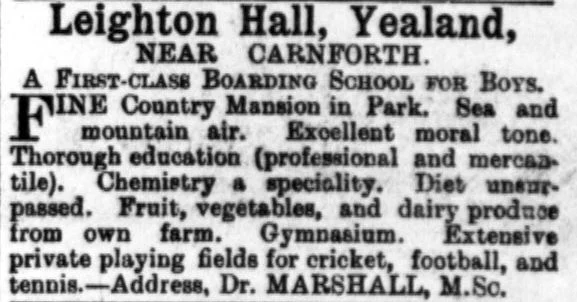
In the early months of 1909 a regular column appeared in The Lancaster Guardian written by Caroline Thursfeil of Carnforth. She is chiefly concerned with local history and quotes widely from Lucas, but in the issue of 29 May 1909 she turns her attention to the new school at Leighton Hall. It is a school for boys, she says, that has just been transferred from Morecambe, and the Principal is Dr J. Willis Marshall, Ph.D. (Marburg), M.Sc. Pupils are prepared for all examinations, for the commercial world as well as for the Universities, and the various Services, but the great feature of the School is the thorough training given in Physical Science, which is now so much demanded. No place could be better suited for the purpose than Leighton Hall, which is an old family mansion, renovated, almost to the extinction of the original fabric, but a fine old Hall even with this reservation…The Schoolroom, which was formerly the billiard room, is more than 30 feet long and 25 feet wide..The Chemical Laboratory is fitted with all apparatus, including a delicate chemical balance… Most of Miss Thursfeil’s account reads like a school brochure.
The Reference Department (and especially the Librarian) of the Morecambe Library uncovered some more information. The school that was transferred to Leighton Hall was the Lancaster College, established some-time before 1898 and situated at 6-7 Winterdyne Terrace, Marine Rd (the present site of the Clarendon Hotel). Advertisements for it appear in the Visitor from 1898 through 1909. Over the years different aspects of the school are advertised:
- 1901, an association with Owen’s College;
- 1905, ’successful results’, ’recognised by the Board of Education’, and ’Sanitation Perfect’.
On 15 January 1909 the staff are named and an ‘Illustrated Prospectus and Pass List’ offered. On the 10th of March the transfer to Leighton Hall is announced. The most important piece of information about the school, however, has only just come into my hands from a private source. It is the 50 page Illustrated Brochure published by the Leighton Hall School itself, obviously the source of most of Caroline Thursfeil’s article. It not only describes how the buildings have ‘recently been adapted to modern educational needs’, but in a series of most interesting photographs shows views of the Schoolroom, the dining Hall, the bedrooms, all adapted to the needs of schoolboys.
There are pictures of boys playing cricket, football, and tennis against a backdrop of the beautiful Leighton grounds and an excellent photo of about 40 boys ‘At Drill’ in the forecourt of the Hall itself. Academically, boys were prepared for the London Matriculation, the Oxford and Cambridge Local, and the Civil Service Examinations, ‘etc’, and an 80% success rate is claimed. There was a Preparatory School which stressed ‘Reading, Writing and Arithmetic’. Religious Training was based on ‘broad protestant and evangelical principles, common to both Church of England and Nonconformity’. Fees were from 45 to 60 guineas a year and boys might receive pocket money, threepence a week for under 12’s, sixpence for over 12’s.
I have not yet discovered how long the school lasted. It was still in existence when Bulmer’s 1912-1913 Directory of Lancaster & District was compiled, although no advertisements appear in the papers after 1909. The Directory also corroborates William Walker’s statement that the Gillows (Mr and Mrs Charles Richard Gillow) were living at Holmere Bank at this time. I would be very interested to hear from anyone who could add any more information about the Leighton Hall School.
[Ed: In 1914 it was commandeered like a lot of large buildings by the War Ministry].
Published in Mourholme Magazine Issue 4 Summer 1983
By Nancy Thomas
In his talk to the Mourholme Local History Society on 2 Dec 1982, Dr J. D. Marshall pointed out that literacy in the northwest was consistently high from at least the 17th century, dipping only in urban areas under the pressures of 19th century industrialization. High standards of literacy, he argued, were a reflection of the high value placed on education by society in the northern counties and were very often reflected by the high achievement of northern sons (and daughters, one ‘ hopes) who went to seek their fortunes in the south.
It seemed an interesting project to try to discover if Warton parish fit the pattern described by Dr. Marshall.
One measure of literacy is whether a person writes his name or makes his mark. It is an imperfect measure, of course, for although it is probably safe to say that a person who uses a mark is illiterate, it does not necessarily follow that a signature is a sign of reading ability. Nevertheless, it is an easy measure to use and probably does indicate at the very least a positive movement toward full literacy.
From 1754 onward the published registers for Warton parish indicate whether the men and women married in the church signed the register with a mark or a name. Between 1754 and 1800 inclusive, 442 marriages are recorded. Of the 442 men, 342 or 77.4% wrote their names. Of the 442 women, 243 or 55% wrote their names. Dr. Marshall noted that between 1660 and 1764 in Hawkshead parish 63% of the men could sign their names, and in sample parishes in North Lancashire between 1750 and 1760 80% of the men and 30% of the women could sign. The men of Warton, therefore, seem to fit the average, and the women to be considerably above the average.
Unfortunately, when the printed marriage registers begin to record marks and signatures, they stop recording residence by township. By using other records, however, especially baptism and burial records, it is possible to ‘locate’ couples. For the same years, 1754 through 1800, 43 couples are identifiable as Silverdale residents. Of the men, 42 or 97.6% and of the women, 28 or 65% wrote their names. Possibly these surprising figures point more to errors in the researcher’s methodology or the perverse nature of chance than to the excellence of the educational opportunities in Silverdale in the last half of the 18th century. And if so, the error is compounded by the fact that the one bridegroom who could not write his name was not a Silverdale native, but an out-of parish lad marrying a Silverdale girl, making 100% a truer literacy rate for Silverdale men.
There is other evidence for Silverdale. The Silverdale Manor Court Books have been preserved and date from 1671 to well into the present century. The written records of the Court proceedings are occasionally signed by the men who made up the Jury. At the Court held on 18 May 1698, a fine list of 13 names appears with carefully drawn marks beside 10 of them. Only 3 men wrote their names. The Court held on 10 June 1734 was a special occasion. By the General Consent of the inhabitants within the Township of Silverdale, Haweswater Moss was to be divided and equal shares were to be allotted to each tenant. Nineteen inhabitants were present, probably very nearly all the customary tenants of the Manor. Of these 19, only 7 made their marks whereas 12 wrote their names. In other words, in 1698 23% of the Jury could sign while in 1734 the figure was 63%. Another freak result? Or had something happened between 1698 and 1734 to account for this rise in literacy?
If a society values education, it supports schools and schoolteachers. From before 1600 Warton parish was provided with at least one formal school. In 1595 the Free Grammar School at Warton was founded and endowed by Matthew Hutton, then Archbishop of York. As is pointed out in another article in this magazine, the Quakers ran a school in Yealand throughout the 18th and 19th centuries. Both these schools were supported by gifts from 18th century benefactors. But it is doubtful if either school could have made a very dramatic impact on the ability of Silverdale children to write, given the geography of the parish. Silverdale may, in fact, offer a special illustration of a community’s attitude toward education – and the arrangements made to obtain it.
A few words of historical background are necessary. From ancient times Silverdale had had a chapel. Its function as a Chapel of Ease from medieval times was to provide the community a more convenient place for certain religious observances than the Mother Church at Warton, so many difficult miles away. From Lucas’s History of Warton we learn that it had suffered a long period of neglect and deterioration during the 17th century. ’Ancient inhabitants’ alive at the end of the century could remember a time when the Chapel had had £40 a year belonging to it which had been lost through ’iniquity and different Turns of the Times, and for want of looking after’. Both the pastoral care of the inhabitants and the physical care of the chapel fabric had eroded, so that by the end of the 1670’s dissention was rife within the flock and decay had ruined the building.
But at the end of the 1670’s a change occurred. The chapel was rebuilt in 1679, presumably by and at the expense of the inhabitants, a new young curate appeared on the scene in about 1682, and by 1687 the inhabitants of Silverdale and their curate, Mr James Atkinson, were resolutely engaged in a struggle with Mr Thomas Lawson, the Vicar of Warton. The Vicar was not pleased ty the developments in Silverdale. Not only did a well-supported Chapel of Ease threaten to divide his flock, he thought, it also threatened to diminish his income, by fees lost and by the amount of the £5 stipend he was being called upon to find for the Silverdale curate from his own pocket. The details of that struggle, interesting though they are, are not our subject here.
What is important is the person of Mr James Atkinson and the fact that he is referred to throughout the papers dealing with the dispute as ‘the Schoolmaster’ quite as often as he is called the Curate. It is probable that James Atkinson was a member of an ancient and important Silverdale family closely associated with Challan Hall and Waterslack, with connections in Beetham. It is certain that he was educated, possibly at Beetham School, that he was a qualified schoolmaster, and that he served the community in that capacity.
In 1722 in answer to a Diocesan questionnaire the Vicar of Warton stated that ’In Silverdale the Curate teaches in his own House English and Latin’. He died in 1727 after more than 40 years as curate and schoolmaster. To what degree he and his family were the driving force behind the resurgence of community spirit and determination in 1679 can only be guessed, but his presence in the community during those 40 or more years must have had a significant impact which the Manor Court literacy figures may in part reflect.
In 1728, one year after the death of the ‘Schoolmaster’, Joseph Burrow of Waterslack died. He founded in his will what the 19th century Charity Commissioners called the ‘Burrow’s Charity’. Their Reports describe it as a rent-charge of £3 on certain pieces of land to be disbursed annually, £1 to the poor of Silverdale and £2 to the Reader of Silverdale Chapel. It seems a routine enough endowment for the period. But when one examines the will itself and reads it in the context of events, it takes on a critical new significance. He provides:
‘a payment of £2 yearly to the reader of Silverdale Chapel provided said reader do live at Silverdale frequently and do qualify himself to execute the office of schoolmaster and teach boys and girls to read and write, and also grammar and other useful Books; and I order constitute and appoint (if the Reader for the time beeing doe conform to the rules sett down) that the Churchwarden for the time being there being and his successors forever do take care for the raising yearly of the said summe of two pounds and paying the same to such a reader and schoolmaster and not otherwise.’
This attempt to insure the continuation of a Schoolmaster/Curate is a clear indication of the value one member of the community at least placed on education. It should probably also be read as an acknowledgement of James Atkinson’s importance to the community. Whether Joseph Burrow’s hopes were realized or not can be discovered by a look at the credentials of the curates appointed to Silverdale Chapel during the rest of the 16th century.
In 1756 Mr Francis Haygarth, Schoolmaster of the Free Grammar School at Over Kellet, was appointed. He was succeeded in 1759 by Mr Thomas Turner. A letter survives from Mr Turner to the Bishop of Chester, a sort of 18th century C.V. It is dated March 17, 1759, from Silverdale and reads in part as follows: ‘I was born at Slyne in the parish of Bolton- Educated at the free Grammar School in Lancaster under the Care of the Rev’d William Johnson with whom I continued ’till I was elected Master of a Grammar School at upper Kellet from whence in November Last, (the time Mr. Haygarth was removed by your Lordship to Mobberley) I came hither; where I officiate as Lecturer, and employ myself in Teaching.’
In 1765 Richard Bailey, Schoolmaster at Beetham, succeeded Thomas Turner. Thomas Hest, Schoolmaster at the Free Grammar School at Warton, seems to have served at Silverdale at two different periods. Even into the 19th century Schoolmasters were serving as curates at Silverdale. Richard Knagg, Master of the Warton Free Grammar School, was appointed Curate in 1807 and served until 1820.’ However important James Atkinson and Joseph Burrow were in establishing the precedent, it is quite clear that throughout the 18th century Silverdale residents were served through their Chapel of Ease by an educated and fully qualified schoolmaster, and whatever measurements are used and however results may vary, the conditions did exist in Silverdale which could have produced high levels of basic literacy.
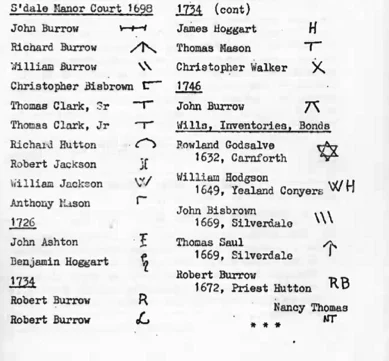
The marks used in earlier centuries are generally much more interesting than the simple crosses one might expect. Following are some of the ones used by local inhabitants.
Literacy In 19th Century Warton
By Jean Chatterley (Thanks are due to Rev. Oddy who allowed access to the registers.)
Following the article above on literacy in Silverdale in the 18th century, I thought readers might be interested in some research done on the Warton marriage registers for part of the 19th century. Between August 1837 and December 1875, 500 weddings were registered at Warton Parish Church. Of the 1000 brides and grooms, 225 made their mark, usually a simple cross, instead of signing their names. This would indicate a literacy rate of 78%. In more detail:
Date
- 1840-1849
- 1850-1859
- 1860-1869
- 1867-1876
Number Married
- 248
- 254
- 250
- 288
Numbers Marks and Approx Literacy
- 75 70%
- 49 81%
- 54 78%
- 50 83%
These figures show a steady improvement towards the second half of the century. Of the 500 weddings, 201 were of either groom or bride or both from the village of Warton itself, and of the 802 persons, only 79 could not sign their names (32 men, 47 women) a literacy rate of 80%, i.e. only slightly higher than for the 1000 persons sample, and moreover, remarkably little higher than for the literacy rate of 77% quoted in Mrs Thomas’s article for the parish in the previous century.
Some other comments on the 19th century marriage registers may be of interest. Many of the witnesses to the weddings were also illiterate. Very few of the 1000 persons were under 21. With occasional exceptions, most Warton men and women married partners from Warton or adjacent parishes. (The exceptions are mainly from the landed gentry or the children of professions which necessitated travel further afield.) Most girls married men in the same trade as their fathers, and cases of ’out of social class’ marriages are very few indeed!
The sources are listed in the order in which they are used.
- The Parish Registers of Warton, 1568-1812, 73,
- Lancashire Parish Register Society (1935)
- Silverdale Manor Court Books, Cumbria Record Office at Kendal, WD/D/S2.
- J.R. Ford and J.A. Fuller-Maitland (eds.), John Lucas’s History of Warton Parish (1931) PP- 49-50.
- Silverdale vs the Vicar of Warton, Lancashire Record Office (LRO), DRCh 37/122.
- Diocesan Questionnaire, LRO DRCh 35.
- Will of Joseph Burrow of Silverdale, LRO WRW DK/1728.
- Reports of the Charity Commissioners (1904). Silverdale Curates, LRO DRCh 37/122.
Lancashire Archives in Preston now hold most of the these records for more information contact them
Published in Mourholme Magazine Issue 3 Spring 1983 and Mourholme Magazine Issue 4 Summer 1983
by David Peter
Inspired by the excellent talk on the origin of place names, given to the Society in December 1982 by Mr J. Hughes of Kendal, the writer of this article was tempted to look more closely at place and other names in his own locality and to try to determine their origins and meanings.
The area selected, namely Silverdale, formed part of the ancient parish of Warton, and it is hoped that as a result of this exercise other members of the MLHS may become sufficiently interested as to ‘tackle’ the place names in their own neighbourhoods. Many of the explanations and origins given below are derived from the works of Professor Eilert Ekwall. It seems strange that he, a Scandinavian, should have been such an eminent authority on English place names. Many of the names, however, have too local a significance to have been considered by Ekwall. In a number of such cases the meanings are obvious, but where this is not so, possible explanations have been suggested.
Silverdale (together with Arnside) occupies a rocky peninsula bounded by a line of low cliffs. It is almost completely surrounded by water and marsh. In fact until relatively recent times it was to all intents and purposes an island. There is little or no evidence from its place names that it offered much attraction to the English (mainly Anglian) or later the Danish invaders who penetrated and settled in N.W. England in the centuries after the departure of the Romans, although their presence on the mainland of N.W, England is evidenced by the number of settlements in Lancashire and Cumbria with the following typical name endings:
English,
- -ton = town
- -ham = home
- -ing = people
Danish,
- -by = village
- -holm = small island
- -thorp = hamlet.
In the Warton area, for example, there are many examples of these:
- Warton
- Leighton
- Gressingham
- Heysham
- Melling
- Hyning
- Hornby
- Kirkby
- Mourholme
- Holme
- Milnthorpe
However, it was not until the invasion of N.W.. England, around 900 A.D., by peoples of Scandinavian origin, whose ancestors had much earlier rounded northern Scotland and settled in Ireland and the Isle of Man, that the place names suggest permanent settlements in the Silverdale peninsula, typical Norse words are
- Erg = hill pasture
- Saeter = hill pasture
- Thwaite = clearing
- Garth = enclosure
- Beck = stream
- Gill = stream
- Slack = shallow valley
- Scale = outlying farm
Names of Settlements
Silverdale
Popular theories as to the origin of this name are:
- a. that it derives from the colour of the exposed carboniferous limestone rocks which underlie the whole area, and
- b. that it relates to the silver birches, a common tree in the woodlands hereabouts.
It now appears certain, however, that it was the valley or dale (Old Norse, dalr) settled by one Selvers, a Norse personal name, which produced the name of the place. The earliest form of it (1199) was ‘Selredal’.
Arnside
Arnside was the summer pasture (Old Norse (ON), saetr) of a farmer called Arni
Lindeth
Lindeth may in fact be the oldest settlement. The earliest form of the name was ‘Lyndeheved’ (Old English (OE) linde = lime tree; OE heafod = hill summit).
Names of Natural Features
Barrow
There are four possible explanations of the origin of this word; OE burg = fort, OE bearu = grove or wood, OE beorg = tumulus or burial mound, and OE beorg = hill or mound.
In Silverdale, the fourth of these is the probable origin. Examples: Middlebarrow, Castlebarrow, Gait Barrow, Trowbarrow, and further afield, Cringlebarrow and Whitbarrow. The ’trow’ part of Trowbarrow is an abbreviation of ’trough’, and this refers to a natural trough or trench, varying in width and depth, which emerges from Leighton Moss, runs in a northerly direction across the face of Trowbarrow for four miles and then disappears into the Kent channel near Sandside. ’Brow’, as in Heald Brow, could be either a corruption of ‘barrow’ or possibly derived from OE bru = slope.
Slack
From ON slakki = shallow dell or valley. Examples, Waterslack, Elmslack, Slackwood, Dogslack (Well), Orchard Slack (near Cove), and further afield, Witherslack and Hazelslack.
Bottom
From OE botm or ON botn = valley or dell. Examples, Bottom’s Lane, Bottom’s Farm
Haweswater
From OE Earnwulf = a personal name or OE heafod = hill or ON hals = a col (pass between two hills) plus ‘water’.
This small lake was at one time referred to as Arnside Dub. ‘Dub’ = a small pool or pond.
Eaves
From OE efes = border, edge of wood (later also brow of hill). Eaves Wood is now National Trust property.
Know Hill
From OE knoll = hillock.
Cow’s Mouth
Possibly a landfall, provided by a break in the cliffs, for cattle drovers driving their herds across the Kent Sands to markets in industrial Lancashire.
Heald
From OE hielde = a slope. Example, Heald Brow.
Jack Scout From OE ac = oak, or ON eik = oak; and ON skuti = high rock or precipice.
Moss
From OE moss = marsh or bog’ or ON mose = marsh or bog
Examples, Leighton Moss, Haweswater Moss, Silverdale Moss, and Arnside Moss.
Jenny Brown’s Point
There are many fanciful explanations of the origin of this name. What is certain is that a man called Brown farmed in this area in the 17th century. It seems reasonable to assume that Jenny was a member of his family. Close to the farm (Dykes Farm) there is a row of several houses known as Brown’s Cottages.
Cove
From OE cofa = a recess or cove
Quick Sand Pool
The lower reach of the stream which drains Leighton Moss. The name is self explanatory.
Silverdale Green
‘Green’ was the name given to public grass land situated near to a village. The Enclosure Acts gradually swallowed them up. The name, however, persists in many places, as here.
Potter Hill
The Wallings Lane-Elmslack Lane area was the site of one or more potteries in mediaeval times. Much evidence of this in the form of shards and domestic utensil fragments has been unearthed whilst the gardens of new properties built here in recent years were being developed. The source of clay was the shoreline of Haweswater (fields called Clayholes). Markets were probably quite local, but may have included Cartmel and Conishead Priories and Furness Abbey across the sands.
Names of Roads
Gate
Probably from ON gata = road. Examples, Emesgate, Bradshaw Gate, Waterslack Gate, Ford Gate. ’Gait* as in Gait Barrow probably means ’goat’.
Stankelt Road
From OE stan = stone and ON kelda = spring or well Stankelt Road was formerly (1817 Enclosure Map) called Levens Field Road. Levens was the name of a fanner in Lindeth. His name is now preserved in Levens Way.
Park Lane
Either (a) a corruption of Parrock (enclosure)
or (b) so called because of the park-like appearance of the adjoining fields, created by the planting of many trees (mainly oaks), singly and in groups, by the Inman family who lived at Hill House and owned this land in the first half of the 18th century.
At one stage (1848 O.S. Map) it was called Mine Road. A field near Red Bridge Farm is called Mine Field. It has also been known as Chapel Lane.
Wallings Lane
Members of the Walling family at one time owned the land on both sides of this lane.
Inman’s Road
This is the main track through Eaves Wood. The Inman family for many years lived at Hill House (later Woodlands).
Hollins Lane
From OE holegn = holly
Emesgate
No ready explanation is forthcoming as to the meaning of the ‘Emes’ part of this word. Could it be a corruption of ‘Eaves’ and thus the road to Eaves Wood?
Red Bridge Road
So called after the colour of the soil in this area (copper or iron ore). Formerly (1817 Enclosure Map) it was Myers Road.
Lindeth Road
It was formerly Sand Lane (1848 O.S. Map).
The Row
OE raw = a row of houses, a street. Several groups of old cottages still exist. They now merge with modern housing.
Townsfield
This name survives, and is applied to an unadopted road/footpath which connects Cove Road and Emesgate. This was the name given in the north of England to the common arable land of the village, before it was enclosed. The common field was divided into strips among the villagers. Much of what was once the ‘Town’ field has now been built on, but two large fields remain under grass.
Names of Farms
Silverdale is an unusual village, in that it has not grown up around some central point, determined by natural advantages. Rather has it developed as a series of separate farmsteads. Over the years certain of these increased in size as more land was brought under cultivation, necessitating additional workers and therefore extra accommodation. More recently, modem housing developments have linked up certain of these early settlements to produce a village, to which shops and other facilities have been attracted. Possible explanations of the names of a number of the farms have already been given under previous headings; for example, Slackwood, Red Bridge, Waterslack, Bottoms, Bradshawgate, etc.
The following farms with interesting names have not so far been mentioned.
Green Farm
Now derelict, it is part of the Silverdale Green nucleus.
Bank House
Possibly from OE banke or ON bakki – sloping ground or hill. It could also be attributed to
- (a) Sand Bank, it overlooks the shore and the river Kent,
- or (b) Bank, the home of a banker (cf. Waithman).
Dyke Farm
Land drainage ditches and channels of streams running into the sea are known locally as Dykes.
Fleagarth Farm (site of)
From either Danish flaeg = flag (iris) and other water plants (many still grow in this area), or ON fla = a small ledge on a hill side, plus ’garth’ = enclosure.
Myers Farm
From ON myrr = marsh or bog or Mid. English mire = marsh or bog
Gibralter
Many attempts have been made to explain this name, by splitting the word into three syllables, producing something like ‘the home of the family of …’. The true explanation is probably something very much simpler. It was at the end of the 17th and the beginning of the 18th century that the farms in this area, previously built of wood, were replaced by stone buildings. In 1704 Sir George Rooke captured Gibraltar, and it is not unreasonable to assume that in a moment of intense patriotism the new farm buildings made of stone on this site were given the name ‘Gibraltar’. No doubt its position on top of a rocky eminence, overlooking the sea, was vividly reminiscent of the Rock of Gibraltar.
Challan Hall Possibly from OE cealc = chalk or limestone, or possibly Challan was a family name.
Ossliff
From OE Oslaf = a personal name or ON Oswulf = a personal name or ON Osmund = a personal name
Names of Houses
The names of houses, especially of older properties, can often provide valuable information about the local ’scene’. A few examples from Silverdale will serve to illustrate this point.
Tower House

Lindeth Tower This is sited close to Gibraltar Farm and was so called because of a three storey summer house erected in its grounds in 1842 by a Mr Henry Paul Fleetwood. It is one of the few of the many summer houses (Belvederes or Gazebos) built by the owners of the larger houses in Silverdale around the middle of the last century which survive and have been well maintained. It is of particular interest because in the 1850’s Elizabeth Gaskell, the Victorian novelist, came to Silverdale with her children for their summer holidays and stayed at the adjoining farm. It appears certain that some of her books were at least conceived and possibly written in Lindeth Tower.
Wolf House
Nearby is Lindeth Lodge, popularly known as the ‘Wolf House’. In recent years it and its outbuildings had been converted into a very successful Art and Crafts centre, but now is holiday lets. There is a local ‘theory’ that the name ‘Wolf House’ derives from the fact that from it, on the opposite side of the Kent estuary and some four miles distant, Humphry Head is visible. This is one of the several places where the last wolf in Britain is reputed to have been killed. Actually, the house is so described because over the front door the coat of arms of the Fleetwood family has been incorporated into the stone work. Above the coat of arms and part of the crest is the figure of a wolf, and below the family motto, ‘Homo Homini Lupus’ (Man is a wolf to his fellow men).
Waithman House
This is one of the oldest houses in the village. It was once owned and occupied by a Quaker business man and banker of that name. He was interested in the manufacture of linen (for example, mills at Holme based on locally grown flax), and he probably helped finance the drovers who landed their cattle at nearby Cow’s Mouth after crossing the Kent Sands.
Old Post Office
The reason for this name is obvious. It is now a private residence, having ceased to function as a post office about the turn of the century.
The Shieling
This house at Richmond Hill was built about 1880 by Mrs Gaskell’s daughters. The name means a ‘summer pasture’ or a ‘homestead used only in summer’. It could be interpreted as perpetuating their mother’s idea of escaping from the smoke and grime of industrial Manchester to this rural retreat. From 1914 to 1948 it was the home of Mr Gordon Bottomley, author and poet.
Windyridge
This house is situated on Wallings Lane. It was occupied for 55 years, from 1919 to 1952, by the novelist William Riley. It was so called after the title of his most successful book, which was actually written in 1912 before he came to live in Silverdale.
Gray Green
This is one of the older houses on the ‘Green’. No suggested origin of the word ‘Gray’ is forthcoming. It is just possible, however, that it is derived from ‘Crayke’ (Welsh craig = a rock) and that Gray Green is a corruption of Crayke Green. It is certainly built on a rocky eminence.
Pye Hall
Possibly from OE pie = gnat and OE hath – low lying ground beside a stream or at the edge of mosses. It is an old house built on a slight eminence in a low lying area. This was obviously once swampy and was possibly, therefore, infested by insects.
Castlebarrow (The ‘Pepper Pot’)
The summit of Castlebarrow, the highest point in Silverdale (250 feet), is marked by a solid stone circular tower some twenty feet high and known familiarly to the villagers as the ’Pepper Pot’. The original pinnacle was erected on this site in 1887 to mark the 50th Anniversary (Golden Jubilee) of Queen Victoria’s accession to the throne. It was struck by lightning shortly after its erection and it had to be re-built. It has been suggested on many occasions during the intervening years that a companion ‘Salt Cellar’ monument should be built, but so far this has not materialized.
Published in Mourholme Magazine Issue 4 Summer 1983
Silverdale Gate Names – Published in Mourholme Magazine Issue 5 Autumn 1983 in Notes and Queries
Mr Peter suggests that the ‘gate’ place names come from ON gata, ‘a road’. I think it is more likely that the Silverdale ‘gate’ names come from OE geat (Norn. pl. gatu), ’an opening, a gap’, often used to mean an opening in a fence and by implication a bander used to close it. In 17th century Silverdale documents the word appears as both ’yeat’ and ‘gate’ and refers unmistakably to gates or barriers. Ford Yeat and Winder/ Winter Gap Yeat were at Waterslack, the gate at the ford and the gate at the winder gap. The second element in ’winder/winter’ may be ON erg, *a summer hill pasture’, and ‘winder gap’ may have meant ‘the opening into the windy summer hill pasture’. The Bradshaws, who gave their name to Bradshaw Gate, were 16th century millers (a clue, perhaps, to the location of the Silverdale windmill). Emesgate, however, is a problem. Mr Peter suggests that the first element might be a corruption of ‘Eaves’, but the early documents have only various spellings of Emes (Eames, Emms). I wonder if it isn’t another ‘locating’ word like Ford and Winder Gap. OE efen, efn, emn meant ‘even, flat, level’. Whether it is possible that emn, which produced Emborough, could have produced Emesgate is a question I can’t answer, but it is easy to see why a gate here might have been identified as the gate ‘at the level place’. The terrain at Emesgate is certainly level; it is, in fact, the only really broad plateau-type area in Silverdale. NYT Source: A.H. Smith, English Place-Name Elements. Part I English Place-Name Society XXV (1956).