By N. Thomas
While I was reading the manuscript of a book based on the diaries of William Walker of Yealand Redmayne and Silverdale a few months ago, I was struck by the following reference to Leighton Hall:
‘We used to go to Church and Bible Class regularly and the scholars from Leighton Hall, which was now a private school for boys, used to fill a few pews and help to swell the congregation. They had to let Leighton Hall for a few years as the Gillows, now living at Holmere Bank in Yealand Conyers, were hard hit by having to pay two death duties near together…’
The date was about 1909. It caught my interest first, as a new element to be added to the history of education in our area (I for one, at least, had never heard of a boarding school at Leighton Hall), and second, as an addition to the history of Leighton Hall itself. I would be less than honest if I did not admit that I was also intrigued by what appeared to be a striking parallel between the Leighton Hall predicament then and now.
A search through newspapers identified that Yorkshire Post, Liverpool Daily Post and The Lancaster Guardian were advertising during 1909 with adverts such as this:
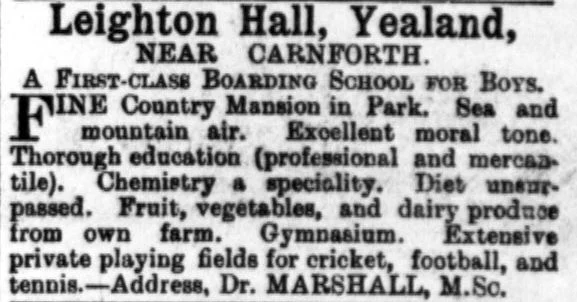
In the early months of 1909 a regular column appeared in The Lancaster Guardian written by Caroline Thursfeil of Carnforth. She is chiefly concerned with local history and quotes widely from Lucas, but in the issue of 29 May 1909 she turns her attention to the new school at Leighton Hall. It is a school for boys, she says, that has just been transferred from Morecambe, and the Principal is Dr J. Willis Marshall, Ph.D. (Marburg), M.Sc. Pupils are prepared for all examinations, for the commercial world as well as for the Universities, and the various Services, but the great feature of the School is the thorough training given in Physical Science, which is now so much demanded. No place could be better suited for the purpose than Leighton Hall, which is an old family mansion, renovated, almost to the extinction of the original fabric, but a fine old Hall even with this reservation…The Schoolroom, which was formerly the billiard room, is more than 30 feet long and 25 feet wide..The Chemical Laboratory is fitted with all apparatus, including a delicate chemical balance… Most of Miss Thursfeil’s account reads like a school brochure.
The Reference Department (and especially the Librarian) of the Morecambe Library uncovered some more information. The school that was transferred to Leighton Hall was the Lancaster College, established some-time before 1898 and situated at 6-7 Winterdyne Terrace, Marine Rd (the present site of the Clarendon Hotel). Advertisements for it appear in the Visitor from 1898 through 1909. Over the years different aspects of the school are advertised:
- 1901, an association with Owen’s College;
- 1905, ’successful results’, ’recognised by the Board of Education’, and ’Sanitation Perfect’.
On 15 January 1909 the staff are named and an ‘Illustrated Prospectus and Pass List’ offered. On the 10th of March the transfer to Leighton Hall is announced. The most important piece of information about the school, however, has only just come into my hands from a private source. It is the 50 page Illustrated Brochure published by the Leighton Hall School itself, obviously the source of most of Caroline Thursfeil’s article. It not only describes how the buildings have ‘recently been adapted to modern educational needs’, but in a series of most interesting photographs shows views of the Schoolroom, the dining Hall, the bedrooms, all adapted to the needs of schoolboys.
There are pictures of boys playing cricket, football, and tennis against a backdrop of the beautiful Leighton grounds and an excellent photo of about 40 boys ‘At Drill’ in the forecourt of the Hall itself. Academically, boys were prepared for the London Matriculation, the Oxford and Cambridge Local, and the Civil Service Examinations, ‘etc’, and an 80% success rate is claimed. There was a Preparatory School which stressed ‘Reading, Writing and Arithmetic’. Religious Training was based on ‘broad protestant and evangelical principles, common to both Church of England and Nonconformity’. Fees were from 45 to 60 guineas a year and boys might receive pocket money, threepence a week for under 12’s, sixpence for over 12’s.
I have not yet discovered how long the school lasted. It was still in existence when Bulmer’s 1912-1913 Directory of Lancaster & District was compiled, although no advertisements appear in the papers after 1909. The Directory also corroborates William Walker’s statement that the Gillows (Mr and Mrs Charles Richard Gillow) were living at Holmere Bank at this time. I would be very interested to hear from anyone who could add any more information about the Leighton Hall School.
[Ed: In 1914 it was commandeered like a lot of large buildings by the War Ministry].
Published in Mourholme Magazine Issue 4 Summer 1983