By Arthur Penn
In the early nineteenth century the method of financing the parish church was by a rate, levied at the annual vestry meeting, when the churchwardens presented their estimates of expenditure for the coming year. This method continued until compulsory church rates were abolished in 1868. In Warton the rate was levied in set proportions on the townships as follows:
Warton with Lindeth 3/9, Yealand Conyers, Yealand Redmayne, Carnforth, Borwick, Priest Hutton and Silverdale 1/9 each. There was, however, another source of finance. The rectorial rights of many churches were in the hands of cathedrals, colleges and land-owners, who had often received them when the monasteries were dissolved. They were in turn required (and still are) to pay for repairs to the chancel. The impropriators of Warton were the Dean and Chapter of Worcester Cathedral.In 1848 a serious crisis occurred which brought all this into play. The vicar of the time was Thomas Dean, who is commemorated in the window on the north of the sanctuary. On New Year’s Day he wrote to the Rural Dean of Tunstall, James Macreth, telling him that he was “fearfully apprehensive” as to the safety of the arches and clerestory of the church and asking him to come and examine them. He said he had not mentioned his apprehension to the churchwardens, lest unfounded alarm be caused in the parish. Macreth acted promptly by seeing an architect and asking him to make a thorough examination immediately. This was Mr Paley, of Sharpe and Paley of Lancaster. The firm was the most influential to work in the area. Sharpe designed Capernwray Hall, before taking Paley into partnership. Paley himself designed St Peter’s Roman Catholic Cathedral in Lancaster. He was later joined by H.J. Austin and the work of Paley and Austin was nationally important and continued well into the twentieth century. Mr Paley who was called in to advise on this potential disaster was twenty- five years old at the time.
Paley reported to the Rural Dean on January 17th. He began by an appraisal of the church’s history, claiming that it had been built in three periods – the south aisle in the 14th century, the chantry chapel at the east end of the aisle in the 16th century, and the chancel, north aisle, south porch and tower in the 17th century. (The dating is Paley’s own and does not altogether agree with that of the Victoria County History) . He also believed that “about 60 years ago” the whole roof had been stripped of lead and the proceeds applied to the construction of a new roof of ordinary design over the entire building. The failure, he believed, had started between the chantry chapel and the chancel and had extended to the whole south arcade. At one point the “total declination of the wall from the perpendicular” was 12½ inches in a total height of 17 feet. Considerable fissures had appeared and it seemed that collapse was only prevented by thrust of the roof against the outer wall. Owing to repeated and thick coatings of whitewash covering every part of the walls it was impossible to investigate adequately. He recommended a close watch on the fissures.
On June 2nd the churchwardens met and resolved that the pillars and arches be cleared of whitewash and on June 21st a contract was drawn up with Christopher Hoggarth Metcalf, stonemason of Warton, to do this, at a cost of £11. The work was to be done by July 15th, and on this date Paley carried out another inspection and reported.
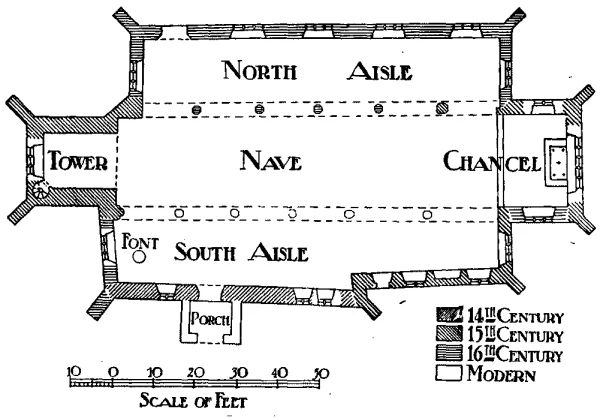
Plan of Warton Church from the Victoria County History of Lancashire Volume 8 The whole of the 14th century arcade had at some period suffered a remarkable declination towards the south and was now leaning outwards at 16 inches in a height of 16 feet. The stones were poor and soft sandstone from the neighbouring seashore and they had been split and crushed to a dangerous extent, so that it was surprising they had not fallen. The arches were “absolutely dangerous”. The only effective method of remedying the evil was by propping up the aisle and nave roof and rebuilding the arcade with new stone, taking great care to follow the exact proportion and moulding of the existing arches. He estimated the cost as £130. If the recommendation should not be followed, he earnestly trusted that steps would be taken immediately to secure the congregation from considerable danger by propping up the arches which, at any time, could fall and bring with them nearly the entire fabric.
On the same day, July 15th, Mr Thomas Dean wrote to Canon John Ryle Wood, of the Worcester Cathedral Chapter. Apparently Paley’s first report had been laid before the Dean and Chapter, and Mr Dean now brought him up to date. An experienced workman, named Storey, had visited the church with Paley and given an estimate. They urged that a strong wind or thunderstorm would endanger the whole fabric. He asked if the Dean and Chapter would meet half the estimated £130, the rest to be raised by a rate. He pointed out that the parishioners had already expended nearly £400 in improvements, and he thought if an adequate answer were not received they would probably delay the matter “till more serious consequences ensue and the cost of £130 be increased tenfold.”
Wood replied on July 18th that a Mr Price was coming to examine and report. He said “every disposition on the part of the Chapter was to cooperate as far as in their power.” The Parish Meeting, on July 20th, read the various reports and adjourned till August 3rd.
On July 29th Wood wrote to say that Price had reported (he spoke in warm terms of the kindness and attention received during his visit). He was in agreement with Paley’s recommendations, and the Chapter were prepared to find £65. The Parish Meeting on August 3rd resolved to proceed with the work, thanking the Chapter, and imposing a rate of £110 in the usual proportions.
The alarm was not so great as to prevent a Confirmation being held in the church on September 26th. Bishop James Prince Lee, first Bishop of Manchester, confirmed 193 candidates, 123 from Warton, 19 from Yealand Conyers, 1 from Burton, 17 from Silverdale and 33 from Over Kellet.
The following August, 1849, the Parish Meeting received a report from the committee for the improvement of Warton Church, which consisted of four churchwardens, John Jenkinson, John Thompson Kew, W. Lawson and Thomas Garnett, the vicar and Richard Hodgson. They stated that they had the great gratification of reporting that Mr John Storey, builder of Bolton-le-Sands, who had contracted with Sharpe and Paley for work on the pillars and arches and the “superincumbent wall” between chancel and chapel, had executed it in a complete and satisfactory manner. They stressed that the new work was in exact conformity with the ancient work, supposed to have been built in the reign of King Edward II, about the year 1325. New stone from a Kellet quarry had been used, except for the two arches between chancel and chapel which were made of old material on the old foundations, but raised a little to correspond with the nave arches. The work had been completed in January, and Storey had been paid £131-5-0. (i.e Dean and Chapter £65, Warton parish rate £65 and 25 shillings from the subscription fund).
At this period improvement seems to have been in the air and £32-8-0 was spent on plastering; there was flagging of the floor also, and a committee of Church Ladies raised £39-3-4 for church decoration. A subscription list shows in all £247-14-6 raised with contributions from far and near, including Cambridge, Eton, Halifax, Liverpool, Ledbury, Hereford, Tewkesbury, Rochdale and Lincoln’s Inn. By the next year things seemed to be returning to normal, for the estimate of Church rate had fallen to £45.
Looking at the south arcade to-day it is apparent that the work is new compared with the north one. However it is clear that Paley, Storey and their men did their work well and that it is an accurate renewal of the 14th century work.
Notes
This article is based on information in the Churchwardens Accounts and Vestry Minutes, 1739-1865 (Lancashire Record Office, PR 572.) A copy was made some years ago and placed in the Society’s archives. It was feared that the dedicated work of the copyist – nearly 150 pages of handwriting – might have to remain unacknowledged as the work was unsigned. Fortunately Mrs Jean Chatterley was able to recognise the handwriting as probably that of Mrs Gwen Phillips. Mrs Phillips has confirmed this, and expressed herself delighted that her work has been made use of in this article.
Another Danger to the Church
Letter to Archdeaconry of Richmond, 1718
“I James Jackson Churchwarden of Warton within the Archdeaconry aforesd doe hereby present John Harris now of Warton for teaching scholars to write in the Church of Warton aforesd without any lawfull Authority to the great prejudice of the Seats of the sd Church which are often pulled up to make writing Tables & for refuseing to desist when discharged by the Churchwardens or Some of them & getting into the sd Church by means unknown to me who kept the key.
(Lancashire Record Office DRCh/37)In the seventeenth century writing tended to be seen as outside the Grammar School curriculum and was often taught by specially hired masters. It was taught only after reading had been acquired. John Harris was presumably teaching in the Church with some local support. In 1718 it was still technically necessary for a teacher to have a licence from the bishop, though the law was not as strictly enforced as it had been earlier.
Published in Mourholme Magazines Issue 22 1994
By Joan Clarke
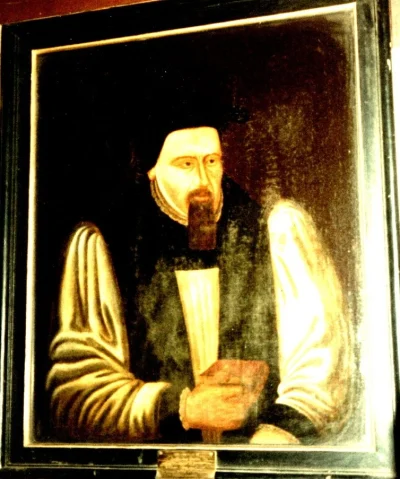
The portrait hangs in Archbishop Hutton’s School, Warton. Permission to reproduce it hare has been given by the present Headmaster, Mr David Ingram.
Information from Mr M. Dilley, former Head Master. The portrait was presented to the school in 1860 by Timothy Hutton of Bedale. On the back of the canvas is an undated note saying that the portrait was “copied from the back of the canvas” The artist of the original is unknown.The painting is crude, but the represented face does closely resemble other known portraits of the archbishop. It is therefore, of interest to have it locally, though when valued it was not held to be of any artistic or financial worth.
The approach of the quarter centenary of Archbishop Hutton’s School in Warton seems an appropriate time to write of the life of the school’s founder, Matthew Hutton. It is one thing, however, to seek out such facts as are known of his life, but quite another to embark on any discussion of his religious views, or his standing within the Elizabethan church. The religious controversies of the time are very confusing to the non-expert. Yet Hutton was a man deeply and sincerely involved in these controversies, so that without some attempt to consider them it is impossible to convey the quality of the man.
Because this is a Warton-based account it is perhaps necessary to start with the story that still persists here; that Matthew Hutton was a foundling, and given the name of Hutton after Priest Hutton, the township of his birth. There is no evidence that the story was current in Hutton’s life time. Fuller in his “Lancashire Worthies“, published 60 years after Hutton’s death, had not heard the story. The first biographer of Hutton, Dr Ducarel1, writing in 1756, blamed the invention of the story on a Mr Torr, a contemporary of his, who wrote a History of York in which he said that the Archbishop was born at Warton, in Lancashire and “as he has heard, it is the common tradition of that place, that he was a foundling there2“.
Lucas, whose history of Warton was compiled between 1710 and 1740, knew the story, since he took care to contradict it; “…he was not a Foundling Child, as some have falsely published; but he was born… of honest, poor Parents in this Town… “3. The most telling reason for rejecting the story is that Matthew Hutton was not a lone foundling, but had brothers and relations in Warton. One of his brothers, Robert, became the Rector of Houghton-le-Spring (Tyne and Wear, England) and a Prebendary of Durham. In his will Matthew Hutton left “to my brother Robert Hutton £20” and “to my Brother Robert Hutton’s wyfe (if she survive her husband) iiiilib yearly“. He also left “to my cosin, Robert Davson of Warton £10″. Nothing seems known of the third brother, Edmund, mentioned by Ducarel. He is left nothing in Matthew Hutton’s will. There was an Edmund Hutton, of Priest Hutton, whose will was proved in 1594; a modestly well-to-do husbandman who owned £40 worth of goods, including a yoke of oxen, 6 cows and thirty sheep. There is nothing in the will to indicate whether he was the lost brother, and Hutton was a fairly common name at the time. Hutton also had relations in Cambridgeshire able to advance his career.
Hutton began his education in Warton. Lucas says that “…being blessed with pregnant parts and the Advantage of a good Master who gave him his learning at a private School at Warton, he became an excellent scholar…In the 17th year of his Age, a Yorkshire gentleman, with whom he then lived, taking Notice of his fine Genius, sent him as Sizar with his Son to the University of Cambridge’4’ . Nothing is known of this “private school“. When Hutton was born, England was still a catholic country and there was a chantry attached to Warton Church at the Altar of the Blessed Mary, with a chantry priest up as late as 15485, but no evidence that there was a school attached to the chantry as was sometimes the case. In any case a “private school” does not suggest a chantry school. The Dictionary of National Biography confirms, however, that Hutton went up to Cambridge as a sizar. This in itself throws some light on the standing of Hutton’s family. The Oxford English Dictionary defines a sizar as an undergraduate receiving an allowance from the college to enable him to study and that in the 16th and 17th centuries a sizar “performed certain duties now discharged by college servants“.
The sizarship, with its implications of poverty, adds likelihood to an anecdote told by Whitaker in his History of Richmondshire which he published in 1823. He says that at a time when Hutton was Bishop of Durham, i.e. sometime between 1589 and 1594, as he was travelling over the Cam, he dismounted, walked to a particular place at some distance from the highway and there knelt in prayer. When a servant ventured to ask why he had done so he replied that “…when he was a poor boy, without shoes or stockings, traversing this cold and bleak mountain on a frosty day, he remembered that be had disturbed a red cow on that identical place, in order to warm his feet and legs on the spot6“ . The Cam Beck is an eastern tributary of the Ribble, which is crossed by the “Pennine Way” about a dozen miles north-west of Ingleton. Whitaker suggests that, so far west of the road to and from Durham, Hutton was probably re-visiting Warton in connection with the founding of the school.
Whitaker attributes this story to Hutton’s “biographer”, apparently meaning Lucas, though this is not entirely clear. If so, Whitaker presumably read the story in Lucas’s original manuscript, since the first printed edition of the text appeared in 1931. The story of the cow does not appear there.There is only a note to say that “5 pp. on the life of the Archbishop are here omitted7“. I have not so far been able to find what happened to the manuscript. Unless it surfaces one cannot know what else was in the missing pages. This is particularly disappointing as Whitaker introduces his anecdote by saying “gleanings of his [Archbishop Hutton’s] life, some of which are original, were, carefully collected by Lucas.
Hutton was entered at Trinity College, Cambridge in 1546 and was soon drawn into a group of moderately radical protestant thinkers there. It is not known whether Hutton took these protestant views up to University with him from his family, or acquired them there8. The North West is conventionally viewed as clinging to catholic ways. It would be of interest to learn of a strongly protestant family in Warton as early as 1546.
Hutton’s University career began the year before Henry VIII died. He took his B.A in 1551 three years before Edward VI died. His graduate and early post-graduate years were therefore spent in the protestant reign of Edward VI. Then in 1554 Mary I came to the throne. In December of that year three old statutes against heretics were revived and in the next three and a half years “nearly 300 people, high, low, rich and poor, were burnt as Protestant heretics9, among them, as Hutton later recalled with honour, “the reverend Archbishop Cranmer, learned Bishop Ridley and grave Bishop Latimer who at one time yielded their bodies to be burned..”10. Others, like Hutton’s friend and patron, the future Archbishop Grindal, took refuge abroad. Hutton himself stayed on in Cambridge. He was not yet important enough to be sought out, and presumably simply kept his head down. In Cambridge, with its strong protestant tradition, there would be many colleagues doing the same. Trinity College made him a fellow in 1555.
The advent of the protestant Elizabeth to the throne in 1558 naturally made a difference to Hutton’s prospects. He was thirty years old, unmarried and free to follow an academic career. He remained at Cambridge for the next ten years. He became, it seems, a respected scholar, though for this we have to rely on the praises of his contemporaries. He is only known to have gone into print once; a sermon preached in York Minster in 1575. In 1595 he sought publication of a short treatise on predestination, though it was not in fact published till after his death in 1613. His contemporaries certainly honoured him as a thinker and a preacher. In 1564 he was selected by the University to dispute before Queen Elizabeth on the occasion of her visit to Cambridge. He won golden opinions for his learned disquisitions on that occasion. He was chosen to preach at St Paul’s Cross by Edmund Grindal, the Bishop of London, who wrote him a most flattering letter on the occasion. A contemporary Jesuit, in condemning English students for not studying ancient authorities excepted Hutton “who is one of the few who searcheth the Father11” .
Hutton was steadily advancing in his career. In 1561 he became chaplain to Bishop Grindal, and the same year was appointed the Lady Margaret Professor of Divinity. The next year he was Regius Professor of Divinity. (Rather confusingly to modern eyes he became professor before he became even a Bachelor of Divinity; he did not take his Doctorate till 1565). In 1562 Bishop Grindal resigned the Mastership of Pembroke College which he had held till then. He saw to it that Hutton was appointed to succeed him. At this point in his career Hutton made his first marriage. In 1562 he had obtained a prebend in Ely cathedral, and the next year married Catherine Fulmesby, niece of the Bishop of Ely. It was at this point that his relation, John Hutton, procured him the living of Boxworth in Cambridgeshire. Perhaps Hutton had planned some change in his career, but Catherine died shortly after the marriage. There were no children.
There was one hitch in his career, superficially minor, but possibly of import. This was the “vestiarian controversy” of the mid-sixties. Among the many things at which protestant consciences jibbed was the wearing of a surplice. It seemed an undesirable and misleading remnant of popish superstition. Archbishop Parker and the government insisted it must be worn, militant puritans refused. The controversy split the University of Cambridge. Hutton was for playing it down. “Hutton hath written nothing of this unhappy controversy for minister’s apparel but that little he spake in two lectures only was to repress the fond dealing of rash young men.12“. In 1555 six leading University men, Matthew Hutton among them, signed a studiously moderate letter to Lord Burghley (who happened to be Chancellor of the University at the time). It only asked that the surplice might not be enforced “not because of anything inherently unlawful [in the practice] “but to preserve the unity and peace of the church13. The government ignored the plea and insisted on conformity. Later Hutton saw this failure to reach compromise as the beginning of the irredeemable differences between established church and puritan reformers “which with wisdom and good policy they could have been avoided then…At the beginning it was but a cross and a surplice…but now it is growed to the Queen’s Majesty’s authority in causes ecclesiastical14“
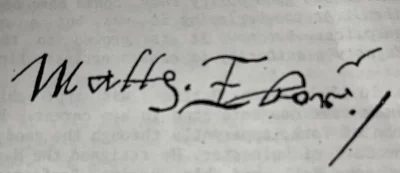
Matthew Hutton’s Signature as Archbishop of York In 1567, when Hutton was approaching forty, there came one more step in his career. He was made dean of York, apparently through the good offices of the Earl of Leicester. He resigned the Mastership of Pembroke Hall and his Regius Professorship. He resigned the prebends in Ely and Westminster that he had held. He left Cambridge for York and until his death in 1606, lived and worked in the north of England. It is impossible to know for certain what motivated this change of direction in Hutton’s career. It may, in part, have been personal. In the same year that he moved to York he took a second wife, Beatrix, daughter of Sir Thomas Fincham of Ely. There were almost certainly other reasons.
Hutton’s decision to move north may have taken him out of a difficult dilemma. He was a sincere supporter of the Elizabethan church, but not uncritical. Along with others in the church, Hutton thought there was still room for further reform. The Elizabethan settlement was however a precarious one. In other countries religious wars still raged. It is perhaps not surprising that criticism was sometimes confused with disloyalty to the crown.
The fate of Hutton’s friend and patron, Edmund Grindal was a warning of how easy it was to offend. Grindal’s downfall came through his apparently meritorious attempt to supply the church with preachers. By preachers he meant ministers sufficiently learned and well-trained to preach and expound the Scriptures from the pulpit. Grindal set up what were called “Exercises”; or as we might now say “Seminars’ to instruct ministers and help them to preach.
Preaching was not only seen as an unusual skill in those days, it was even viewed with disfavour, as likely to encourage egalitarian ideas of ordinary people thinking for themselves. The Queen expressed herself as quite content with a ministry of “such as can read the scriptures and homilies15 veil unto the people16“. In 1574 she ordered Grindal to discontinue the “Exercises’’. He refused. To do so, he said, would be against his conscience. Rashly, he went on to remind the Queen she was not the highest authority. “Bear with me, I beseech you, Madam, if I choose rather to offend your earthly Majesty than to offend the heavenly majesty of God17“. It was not well received. Grindal was placed under virtual house arrest in his own palace. He died nine years later, still unforgiven.
In the North the strength of popish recusancy made it seem necessary to harness preaching fervour, not fight it. The “Exercises” which were forbidden in the South were encouraged in the North. In 1583 it was actually made obligatory on ministers in the Diocese of Chester (which at that time included Lancashire) to attend monthly Exercises – excluding the months from November to February, presumably as a concession to the barbarities of the northern climate. Failure to attend could be heavily fined18. It might be noted here that in 1604 the incumbent of “Warton was described as “a preacher19“.
The North, then, was likely to prove a safer field of work for Hutton with his reformist leanings. He spent the last forty years of his life there, as Dean of York from 1567 to 1589, as Bishop of Durham from 1589 to 1595, and as Archbishop of York from 1595 till his death in 1606. As well as all his ecclesiastical responsibilities he was, from the start, an active member of the Council of the North under its Lord President, the Earl of Huntingdon, the Queen’s vice-regent in the North.The two men thought alike in religious matters, and worked together to suppress recusancy and promote godly, Protestant values.
Meanwhile there was a growing family of children. In the fifteen years before his second wife, Beatrix’s, death in 1582, eight children were born, of whom six lived to adult life. The children were not long left motherless for in 1583 Hutton married a widow, Frances Bowes. She survived him by many years. It is not known what sort of family man Hutton made. A few letters to his eldest son Timothy survive. They are almost entirely devoted to business, though one does show a little fatherly anxiety. In 1598 Timothy was due in York on government business, but it was a “time of infection”. Hutton added at the bottom of the letter. “PS More safetie not to coome, but more present credit to come…Yf you coome you shall be welcome; yf you come not, I will not take it in evill part20. “
What was the character of the man who was to become Archbishop of York? We have his own description of the sort of man he thought right for this high office. In 1568, when there was a vacancy at the see of York, the newly made dean wrote to Lord Cecil to beg it might be quickly filled. He described the type of man he wanted. Let him be “a teacher, because the country is ignorant, a virtuous and godly man because the country is given to sift a man’s life, a stout and courageous man in God’s cause because the country will otherwise abuse him, and yet a sober and discreet man21”
How far did Hutton live up to his own high standards? His own good standing as “a teacher” was shown above. He also encouraged teaching in others, in particular during his early years as dean, when his friend Edmund Grindal was Archbishop of York. Hutton was the only active resident dean of York for a century and a half…Between them, Grindal and Hutton would conspire to bring competent theologians and preachers on to the staff, as vacancies occurred22.
“Stout and courageous” he also was. He was prepared to stand up even to the Queen and her ministers if he thought it right. In 1568, for instance, a certain Mr Gibson had persuaded the Queen to recommend that he should receive the emoluments of a Canon Residentiary at York, even though he was not resident. Dean Hutton refused, and despite an ominous warning that”…her Majestie…thoghte it [Hutton’s refusal] strange…” continued to refuse. He said the money would have to be found from the livings of other residentiaries “some being not well hable to spare it23”
Towards the end of Queen Elizabeth’s life he told her that she ought, for the good of her kingdom, to choose her successor. To us this may seem nothing; to an Elizabethan it was pure foolhardiness. Noone must ever mention to the Queen that one day she must die and be succeeded.
There is a delightful account of how the Queen dealt with her outspoken Archbishop. Hutton gave out his text “The kingdomes of the earth are mine, and I do give them to whom 1 will“. There followed “…first so generall a murmur of one friend whispering to another…lastly so quiet a silence and attention in expectance…as I have never observed before or since.” At the end of the sermon every one looked to see the Queen annihilate the preacher. Instead she opened the window of the closet in which she sat and “…very kindly and calmly, without show of offence (as if she had but waked out of some sleepe) she gave him thanks for his very learned sermon”. But he did not get away with it entirely, for afterwards She sent two councellors to him with a sharp message, to which he was glad to give a patient answer.24
Could Hutton be considered a “sober and discreet man”! It seems so. It is true he quarrelled very fiercely with Archbishop Sandys on a number of matters, and had ultimately to apologise to him publicly and admit that he had used “some very violent and unguarded expressions25“.however, as the Dictionary of National Biography puts it, “The biographies of Sandys are filled with accounts of his squabbles”, so perhaps not much should be argued from Hutton’s impatience with him.
In other ways Hutton seems to have been a patient and caring man. This is shown particularly in his relationship with catholic recusants. Hutton saw the fight against Catholicism as central to his work in the north, but he preferred always to try persuasion. His patient attempts at conversion were noted with approval by central government. “God contynew his graces in you“, wrote Lord Burghley in 1577, “by which your liff and actions ar reported very good of all your neighbours, and in sekying to reform those that ar out of the waye, the ordinary waye to reduce them which I heare you use is, by gentle instruction of them first to se and fele their palpable errors, and so to prepare them to see the truth26“. Though, if one story is to be believed, not all catholics appreciated his efforts. It was said that the Catholics in Yorkshire were commanded by the Queen to be present at fifty sermons in York Cathedral. “Our Archbishop preached the last to a very numerous audience…but the Papists that were forced to be there, stopped their ears or talked aloud, to make his Grace give over the sermon27“
Hutton could also be compassionate. As acting Lord President of the North, after the death of the Earl of Huntingdon, he sometimes had prisoners put in his care. A number of surviving letters show his care for then. In 1598 he got the irons taken off Scottish prisoners. He treated another Scottish prisoner so well that he received a letter of thanks from King James VI. The Lady Margaret Neville, daughter of the exiled Earl of Westmorland, was committed to his care when she had put her own life in danger by giving shelter to a Catholic priest. Hutton went to much trouble to get her pardoned and obtain a pension for her. In 1595 her uncle, Lord Henry Howard, wrote a letter of thanks. “I ever honoured your learninge…and nowe I love unfainedlie that mild and temperate disposition which many recommende that speak of your dealings without partiality, for happie is that province which is subjecte to a pastore no less by nature than profounde in understandinge28” . Flattery possibly, but in view of what is known of Hutton, basically a believable portrait.
Hutton’s last requirement of the ideal man to be Archbishop of York was that he should be “virtuous and godly”. Certainly no breath of scandal attached to him in his day. The worst that was said of him was that he amassed a surprising amount of property. He had a large income from the church of York alone, and in addition he was also a considerable pluralist, having a prebend at St. Paul’s, another at Southwell in Nottinghamshire and a rectory at Settrington in Yorkshire29. He was able to leave his eldest son Timothy an estate of £500 p.a. and a further estate to his second son, Thomas30.
Hutton died in 1606. He had been ailing for some time. To some extent his world was failing him by that time. The establishment was growing more and more suspicious of hidden and treacherous recusancy. Demands for conformity spread to the North, and Hutton’s attempts to persuade before punishing recusants no longer received praise. In 1599 the Queen’s letter releasing him on the grounds of ill-health from duties of acting Lord President carried a sting in its tail. It commented on the growth of recusancy and imputed this “partly to over much tolleracion used to recusants and such other parsones who have bene presented for their offences…and have escaped without punishment31“. In the same year Archbishop Whitgift wrote “…here hath bene informations gyven that recusants are of late increased in that province, and that you are too milde with them. – Some of your ministers doe also affirme the same to be trewe32“.
Not only was the Government asking for greater severity towards Catholics, it was also growing less tolerant of any “Puritan” criticism of the established church. Hutton did not escape criticism in this direction either. A letter from Archbishop Whitgift in 1597, laudatory in general tone, contained an unpleasant needle-prick. Hutton’s language, it seemed, was tainted. “In one of your letters there was putt Christes-tyde for Christenmass, which because of the noveltie thereof…was by some of your best frends misliked; and I marvel how it escaped you…33”.
When James I came to the throne Hutton received a letter from the King’s secretary “that the puritanes be proceeded against according to the lawe, except they conforme themselves…” To a man who had spent his life fighting Catholicism this seemed to him to be attacking the wrong enemy. “I wishe with all my heart that the order were given not only to bishops, but to all magistrates and justices of the peace, &c. to proceed against papists and recusants, who of late…have grown mightily in number, courage and insolencie34“
Then he added a last testimony to his life-long views. “The puritanes, whose fantastical zealle I mislike, though they differ in ceremonies and accidents yet they agree with us in substance of religion and 1 thinke all or most of them love his majestie…but the papists are…opposite and contrary in substantially of religion and cannot but wishe the pope’s authoritie and popish religion to be established35”.
Two years later he was dead.
It would be pleasing to finish with an account of Hutton’s relationship with the parish of his birth and his motives for setting up a grammar school there. Unfortunately almost nothing is known. In 1595 he obtained a charter from Queen Elizabeth for the school he had set up the year before, while still Bishop of Durham. It is almost purely a business document. The only hint of his motive comes in the second paragraph and this is phrased too conventionally to reveal much. The Archbishop, it says, “greatly desires to erect and found a certain free school and hospital or alms house in the town of Warton… in the parish of which the same Archbishop was born, to the Glory of God, the promotion of good learning and the support and relief of the poor” The charter gave the Archbishop power to make “suitable and beneficial statutes” for the school36. These statutes, if he made them, have not survived.
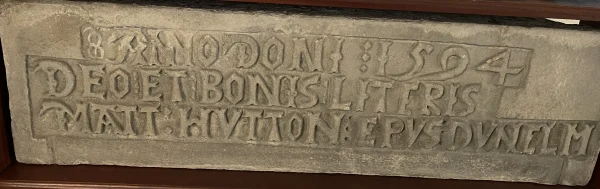
The stone originally at the Free School now in the modern Archbishop Hutton Primary School in Warton In his will, written in 1605, Hutton made further financial arrangements for “the Free Grammar School (which I do erect at Warton, wheare I was borne…37“, but says nothing else about it. Apart from this documentary evidence we only have a few scattered hints; the still extant stone plaque from the old school dedicating it to God and good learning (Deo et bonis Uteris); the fact that Hutton was enough in touch with Warton to remember his cousin there in his will; and the probability that he was on his way to visit Warton on the memorable occasion, recorded by Lucas, when he recalled his bare-foot childhood.
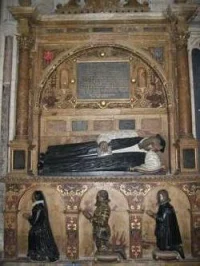
The grave of Archbishop Hutton in York Minster Notes and References
Four main sources have been used in this and the following article. For the main facts of Hutton’s career, the entry in the Dictionary of National Biography and also the account, already referred to, of Matthew Hutton’s life written in 1756 by Dr Ducarel. For a modern view of Hutton’s religious opinions, the article published in 1979 by Peter Lake of Clare College, Cambridge. For an overview of the religious controversies of the time, Professor Collinson’s work on the Elizabethan Puritan Movement 1967.
- For the main facts of Hutton’s career, the entry in the Dictionary of National Biography and also the account, already referred to, of Matthew Hutton’s life written in 1756 by Dr Ducarel. Librarian at Lambeth Palace. In 1756 he wrote a life of Matthew Hutton at the request of the then Archbishop of Canterbury, another Matthew Hutton and a direct descendant of our Archbishop. ↩︎
- Published in “The Correspondence of Dr Matthew Hutton”, Surtees Society, Vol.17, 1843. (Vol.17 is hereafter referred to as “The Correspondence”) ↩︎
- eds. J. Rawlinson Ford & J.A. Fuller-Maitland, Lucas’s History of Warton, 1931, p.106. (referred to hereafter as Lucas’s History.) ↩︎
- Lucas’s History, p.106 ↩︎
- Victoria County History of Lancashire, Vol.VIII, 1914, p.160. ↩︎
- T.D. Whitaker, An History of Richmondshire, 1823, Vol II, p.315 (Dr Whitaker was the vicar of Whalley, and also from 1813-1819, the Rector of Heysham) ↩︎
- A copy of the original Lucas book is now in the Lancashire County Archives in Preston reference DDX2743/MS2 and 3 ↩︎
- Peter Lake, “Matthew Hutton – a Puritan Bishop?”, History, Vol. 64, No.211, 1979, p.183 ↩︎
- Owen Chadwick, The Reformation, 1972, p.125 ↩︎
- Peter Lake, “Matthew Hutton – a Puritan Bishop?”, History, Vol. 64, No.211, 1979, p.183 ↩︎
- Sir John Harrington, Briefe Viev of the State of the Church of England, 1653, p.191,(Quoted in “The Correspondence”, p.27) ↩︎
- Letter from the vice-chancellor to Lord Burghley December 6th, 1565. ( Quoted in Peter Lake, “Matthew Hutton – a Puritan Bishop?”, History, Vol. 64, No.211, 1979, p.184. ↩︎
- Peter Lake, “Matthew Hutton – a Puritan Bishop?”, History, Vol. 64, No.211, 1979, p.184 ↩︎
- Letter from Hutton to Lord Burghley, 1575 (quoted ibid., p.185) ↩︎
- Homilies, in this case referring to the edifying and approval discourses contained in the Books of Homilies issued in 1563 for use in Parish churches ↩︎
- Patrick Collinson, The Elizabethan Puritan Movement, 1967, p.191 ↩︎
- Patrick Collinson, The Elizabethan Puritan Movement, 1967, p.242 ↩︎
- Christopher Haigh, Reformation and Resistance in Tudor Lancaster, 1975, p.302 ↩︎
- Kenyon MSS p-721 ↩︎
- The Correspondence of Dr Matthew Hutton, Surtees Society, Vol.17, 1843 ↩︎
- P. Collinson, Archbishop Grindal 1519-1585, 1979, p. 37 (quoting letter to Cecil, 13 Nov. 1568) ↩︎
- P. Collinson, Archbishop Grindal 1519-1585, 1979, p. 200 ↩︎
- The Correspondence of Dr Matthew Hutton, Surtees Society, Vol.17, 1843 ↩︎
- Sir John Harrington, Briefe Review of the State of the Church of England, 1653, p.186 ↩︎
- The Correspondence of Dr Matthew Hutton, Surtees Society, Vol.17, 1843 ↩︎
- The Correspondence of Dr Matthew Hutton, Surtees Society, Vol.17, 1843 ↩︎
- Thoresby Vicar. Leod p.144, 145 ↩︎
- The Correspondence of Dr Matthew Hutton, Surtees Society, Vol.17, 1843 ↩︎
- The Correspondence of Dr Matthew Hutton, Surtees Society, Vol.17, 1843 ↩︎
- The Correspondence of Dr Matthew Hutton, Surtees Society, Vol.17, 1843 ↩︎
- The Correspondence of Dr Matthew Hutton, Surtees Society, Vol.17, 1843 ↩︎
- The Correspondence of Dr Matthew Hutton, Surtees Society, Vol.17, 1843 ↩︎
- The Correspondence of Dr Matthew Hutton, Surtees Society, Vol.17, 1843 ↩︎
- T.D. Whitaker, An History of Richmondshire, 1823, Vol II, p.316 ↩︎
- T.D. Whitaker, An History of Richmondshire, 1823, Vol II, p.316 ↩︎
- John Blundell, Translation of Latin Charter (seen by courtesy of Mr Dilley, ex-head master of Archbishop Hutton’s School) ↩︎
- The Correspondence of Dr Matthew Hutton, Surtees Society, Vol.17, 1843 ↩︎
Published in the Mourholme Magazine Issue 21 1993
By Neil Stobbs
During work for the seventeenth century research group of the Mourholme Society I have had cause to delve into the accounts of the Shuttleworth family of Gawthorpe Hall1. One interesting entry in 1585 is:- “towe hundrethe and a halffe of lycores settes,iiijs “.
The editor of the printed accounts translates the entry to read “250 liquorice sets”. This seems to indicate that liquorice was grown in Lancashire, at this time, from “sets”, the vegetative parts of a plant used to produce new plants. The term is still used today, in reference to potatoes and onions. Two hundred and fifty sets seems to have been a considerable number for use at only two places, Smithils and Gawthorpe, to which the accounts apply. This raises the question, did the Shuttleworths grow it as a commercial crop? If so, for what purpose? Medicinal or culinary, or both?
Culpeper’s Herbal, first written in the seventeenth century, has the following entry:-
Description
Our English Liquorice riseth up with divers woody stalks, whereon are set at several distances many narrow, long, green leaves, set together on both sides of the stalk, and an odd one at the end, very well resembling a young ash tree springing up from seed. This by many years continuance in a place without removing, and not else, will bring forth flowers, many standing together, spike fashion, one above the other on the stalk, of the form of pease blossom, but of a very pale blue colour, which turn into long, somewhat flat and smooth pods, wherein is contained a small, round hard seed…Government and virtues.
It is under the dominion of Mercury, Liquorice boiled in fair water, with some maiden-hair and figs maketh a good drink for those that have a dry cough, or hoarseness, wheezing or shortness of breath…the juice distilled in rose-water, with some green tragacanth, is a fine licking medicine2 for hoarseness, wheezing etc3.Culpeper then goes on to claim value for liquorice in many diseases, not only of the lungs, but of the bladder, kidneys and the eyes. “The fine powder of liquorice blown through a quill into the eyes that have a pin and web4 (as they call it)…doth cleanse and help them.“
A 1984 herbal5 adds further information about the liquorice plant; it was recorded on Assyrian tablets and Egyptian papyri; its old names glycyrrhiza or radix dulcis reflect the sweet taste of the root; the plant occurs wild in eastern Europe, but does not appear to have been cultivated in central or western Europe until the fifteenth century; it was first introduced into the Pontefract district of England by the Dominican Black Friars. The herbal confirms Culpeper’s account of its cultivation, saying that the plant is propagated by root division in autumn, and harvested from 3-4 year old plants in early winter.
Its medical uses are given in more modern, but essentially equivalent terms. The active principles are glycyrrhizin and certain other glycosides. Glycyrrhizin is “demulcent”, “expectorant” and “spasmolytic”, that is to say, a substance which is soothing to inflamed surfaces, promotes the expulsion of phlegm from the lungs, and relaxes muscle spasm. All are actions likely to be helpful to “those that have a dry cough, or hoarseness, wheezing or shortness of breath…”
The 1984 herbal also claims, like Culpeper’s, that liquorice acts on organs other than the lungs; claims which have some support from main stream medical opinion. It is laxative, a property which all those who have eaten Pontefract cakes must surely know. It has been used in the treatment of gastric ulcers. It also has a steroid-like action, in that it is anti-inflammatory and helps to restore mineral balance in Addison’s disease, a condition in which the body’s own power to produce steroids is damaged. Indeed, it has a sufficiently powerful action to make its over-use dangerous by producing sodium retention, with hypertension and headache.
Today the main uses of liquorice are other than medicinal, though it is still used pharmaceutically for sweetening. It is used to flavour some beers, such as Guinness. Large quantities are used in tobacco flavouring (some tobaccos contain 10% of liquorice). It is used in snuff manufacture, and the root pulp is incorporated in insulating millboard. It is also, of course, extensively used in the sweet trade. I remember during sweet rationing, in and after the 1939-1945 war, being given pieces of “liquorice root” to chew as a substitute for sweets. After this time the hard “Spanish liquorice” re-made its appearance, and we used to put a number of pieces of it, about half an inch long, in water in a bottle and shake it up for quite a long time to produce a drink called, obviously, Liquorice Water. There is also a vague recollection of a rhyme, something to do with a “pin”. Does anyone remember? This was in north-east England and may not have been part of childhood culture in the North-West or elsewhere.
It seems that the growing of liquorice had already ceased in Lancashire by the end of the eighteenth century. In 1795 it was said of Liquorice “It is not cultivated in this country, in any sufficient quantity, as an object of profit; although upon many grounds it might flourish, and be worthy of attention”6. The writer, who lived at Walton near Liverpool, added that he grew a number of plants in his own garden and found it “as well- flavoured, rich, and juicy, as the Pontefract”. It is remarkable that the modern uses of liquorice are so similar in many ways to those expounded by Culpeper, three hundred years ago. As it had been in use for so long a period before Culpeper’s time, one may expect that, by trial and error, its uses would have been refined and passed on to the herbalists and doctors of his time. Modern chemical analysis has isolated the active ingredients, but the older herbalists seemed to know what they were doing (except perhaps for the practice of blowing powdered liquorice into a patient’s eyes), even if they presented its “virtues” in a way which looks unfamiliar to us.
Notes
- Ed. John Harland, “The Shuttleworth Accounts” Pts 1&2, Chetham Society, 1861 ↩︎
- licking medicine = any medicine made up to a paste with syrup, honey etc (Oxford English Dictionary (OED)) ↩︎
- Ed. Gleaves, Culpepper’s Complete Herbal and English Physician, facsimile of the 1826 edition, 1979. (Original edition 1653) ↩︎
- pin and wheel = an obsolete name for any disease of the eye leading to pin head lesions and general inflammation. (OED) ↩︎
- Ed. M. Stuart, The Encyclopaedia of Herbs and Herbalism, 1984 (original edition 1979) ↩︎
- John Holt, General View of the Agriculture of the County of Lancaster, 1795 ↩︎
Published in Mourholme Magazines Issue 22 1994