
By Arthur Penn
In the early nineteenth century the method of financing the parish church was by a rate, levied at the annual vestry meeting, when the churchwardens presented their estimates of expenditure for the coming year. This method continued until compulsory church rates were abolished in 1868. In Warton the rate was levied in set proportions on the townships as follows:
Warton with Lindeth 3/9, Yealand Conyers, Yealand Redmayne, Carnforth, Borwick, Priest Hutton and Silverdale 1/9 each. There was, however, another source of finance. The rectorial rights of many churches were in the hands of cathedrals, colleges and land-owners, who had often received them when the monasteries were dissolved. They were in turn required (and still are) to pay for repairs to the chancel. The impropriators of Warton were the Dean and Chapter of Worcester Cathedral.
In 1848 a serious crisis occurred which brought all this into play. The vicar of the time was Thomas Dean, who is commemorated in the window on the north of the sanctuary. On New Year’s Day he wrote to the Rural Dean of Tunstall, James Macreth, telling him that he was “fearfully apprehensive” as to the safety of the arches and clerestory of the church and asking him to come and examine them. He said he had not mentioned his apprehension to the churchwardens, lest unfounded alarm be caused in the parish. Macreth acted promptly by seeing an architect and asking him to make a thorough examination immediately. This was Mr Paley, of Sharpe and Paley of Lancaster. The firm was the most influential to work in the area. Sharpe designed Capernwray Hall, before taking Paley into partnership. Paley himself designed St Peter’s Roman Catholic Cathedral in Lancaster. He was later joined by H.J. Austin and the work of Paley and Austin was nationally important and continued well into the twentieth century. Mr Paley who was called in to advise on this potential disaster was twenty- five years old at the time.
Paley reported to the Rural Dean on January 17th. He began by an appraisal of the church’s history, claiming that it had been built in three periods – the south aisle in the 14th century, the chantry chapel at the east end of the aisle in the 16th century, and the chancel, north aisle, south porch and tower in the 17th century. (The dating is Paley’s own and does not altogether agree with that of the Victoria County History) . He also believed that “about 60 years ago” the whole roof had been stripped of lead and the proceeds applied to the construction of a new roof of ordinary design over the entire building. The failure, he believed, had started between the chantry chapel and the chancel and had extended to the whole south arcade. At one point the “total declination of the wall from the perpendicular” was 12½ inches in a total height of 17 feet. Considerable fissures had appeared and it seemed that collapse was only prevented by thrust of the roof against the outer wall. Owing to repeated and thick coatings of whitewash covering every part of the walls it was impossible to investigate adequately. He recommended a close watch on the fissures.
On June 2nd the churchwardens met and resolved that the pillars and arches be cleared of whitewash and on June 21st a contract was drawn up with Christopher Hoggarth Metcalf, stonemason of Warton, to do this, at a cost of £11. The work was to be done by July 15th, and on this date Paley carried out another inspection and reported.
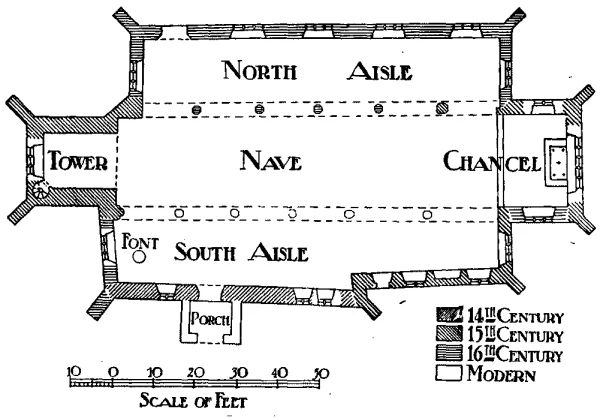
The whole of the 14th century arcade had at some period suffered a remarkable declination towards the south and was now leaning outwards at 16 inches in a height of 16 feet. The stones were poor and soft sandstone from the neighbouring seashore and they had been split and crushed to a dangerous extent, so that it was surprising they had not fallen. The arches were “absolutely dangerous”. The only effective method of remedying the evil was by propping up the aisle and nave roof and rebuilding the arcade with new stone, taking great care to follow the exact proportion and moulding of the existing arches. He estimated the cost as £130. If the recommendation should not be followed, he earnestly trusted that steps would be taken immediately to secure the congregation from considerable danger by propping up the arches which, at any time, could fall and bring with them nearly the entire fabric.
On the same day, July 15th, Mr Thomas Dean wrote to Canon John Ryle Wood, of the Worcester Cathedral Chapter. Apparently Paley’s first report had been laid before the Dean and Chapter, and Mr Dean now brought him up to date. An experienced workman, named Storey, had visited the church with Paley and given an estimate. They urged that a strong wind or thunderstorm would endanger the whole fabric. He asked if the Dean and Chapter would meet half the estimated £130, the rest to be raised by a rate. He pointed out that the parishioners had already expended nearly £400 in improvements, and he thought if an adequate answer were not received they would probably delay the matter “till more serious consequences ensue and the cost of £130 be increased tenfold.”
Wood replied on July 18th that a Mr Price was coming to examine and report. He said “every disposition on the part of the Chapter was to cooperate as far as in their power.” The Parish Meeting, on July 20th, read the various reports and adjourned till August 3rd.
On July 29th Wood wrote to say that Price had reported (he spoke in warm terms of the kindness and attention received during his visit). He was in agreement with Paley’s recommendations, and the Chapter were prepared to find £65. The Parish Meeting on August 3rd resolved to proceed with the work, thanking the Chapter, and imposing a rate of £110 in the usual proportions.
The alarm was not so great as to prevent a Confirmation being held in the church on September 26th. Bishop James Prince Lee, first Bishop of Manchester, confirmed 193 candidates, 123 from Warton, 19 from Yealand Conyers, 1 from Burton, 17 from Silverdale and 33 from Over Kellet.
The following August, 1849, the Parish Meeting received a report from the committee for the improvement of Warton Church, which consisted of four churchwardens, John Jenkinson, John Thompson Kew, W. Lawson and Thomas Garnett, the vicar and Richard Hodgson. They stated that they had the great gratification of reporting that Mr John Storey, builder of Bolton-le-Sands, who had contracted with Sharpe and Paley for work on the pillars and arches and the “superincumbent wall” between chancel and chapel, had executed it in a complete and satisfactory manner. They stressed that the new work was in exact conformity with the ancient work, supposed to have been built in the reign of King Edward II, about the year 1325. New stone from a Kellet quarry had been used, except for the two arches between chancel and chapel which were made of old material on the old foundations, but raised a little to correspond with the nave arches. The work had been completed in January, and Storey had been paid £131-5-0. (i.e Dean and Chapter £65, Warton parish rate £65 and 25 shillings from the subscription fund).
At this period improvement seems to have been in the air and £32-8-0 was spent on plastering; there was flagging of the floor also, and a committee of Church Ladies raised £39-3-4 for church decoration. A subscription list shows in all £247-14-6 raised with contributions from far and near, including Cambridge, Eton, Halifax, Liverpool, Ledbury, Hereford, Tewkesbury, Rochdale and Lincoln’s Inn. By the next year things seemed to be returning to normal, for the estimate of Church rate had fallen to £45.
Looking at the south arcade to-day it is apparent that the work is new compared with the north one. However it is clear that Paley, Storey and their men did their work well and that it is an accurate renewal of the 14th century work.
Notes
This article is based on information in the Churchwardens Accounts and Vestry Minutes, 1739-1865 (Lancashire Record Office, PR 572.) A copy was made some years ago and placed in the Society’s archives. It was feared that the dedicated work of the copyist – nearly 150 pages of handwriting – might have to remain unacknowledged as the work was unsigned. Fortunately Mrs Jean Chatterley was able to recognise the handwriting as probably that of Mrs Gwen Phillips. Mrs Phillips has confirmed this, and expressed herself delighted that her work has been made use of in this article.
Another Danger to the Church
Letter to Archdeaconry of Richmond, 1718
“I James Jackson Churchwarden of Warton within the Archdeaconry aforesd doe hereby present John Harris now of Warton for teaching scholars to write in the Church of Warton aforesd without any lawfull Authority to the great prejudice of the Seats of the sd Church which are often pulled up to make writing Tables & for refuseing to desist when discharged by the Churchwardens or Some of them & getting into the sd Church by means unknown to me who kept the key.
(Lancashire Record Office DRCh/37)
In the seventeenth century writing tended to be seen as outside the Grammar School curriculum and was often taught by specially hired masters. It was taught only after reading had been acquired. John Harris was presumably teaching in the Church with some local support. In 1718 it was still technically necessary for a teacher to have a licence from the bishop, though the law was not as strictly enforced as it had been earlier.