1800 26 January
“Edwin, a negro boy, servant to Mr Law of the Island of Barbados, baptised at Mr Bishop’s of Yealand on Sunday evening about 13 years old”
The name Law occurs in connection with the Lancaster slave trade in the eighteenth century (Melinda Elder, The Slave Trade and the Economic Development of 18th Century Lancaster, 192 p.214) but who was Mr Bishop? Does anyone know?
In the Spring 1993 issue of Keer to Kent there is an interesting article, by Michael Jackson about the “Leighton Furnace” which, in the 18th century produced pig-iron from charcoal fired furnaces. The site, on the Yealand Storrs to Arnside road is now marked by a plaque. The Society would be interested to hear of
- cast-iron items bearing any reference to Leighton or Wilkinson
- pieces of pig-iron found on the shore near Know Hill (that is the little ‘cliff’ to the south of the shore at Silverdale), where the iron ore from Furness was brought ashore
By Joan Clarke
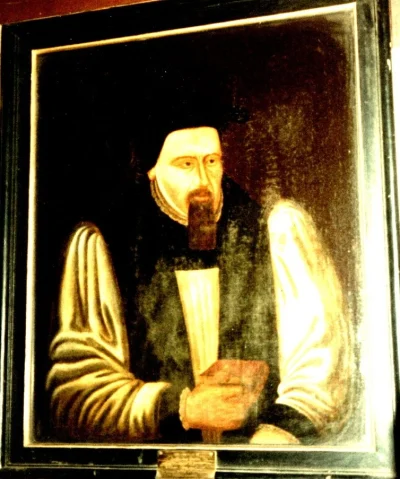
The portrait hangs in Archbishop Hutton’s School, Warton. Permission to reproduce it hare has been given by the present Headmaster, Mr David Ingram.
Information from Mr M. Dilley, former Head Master. The portrait was presented to the school in 1860 by Timothy Hutton of Bedale. On the back of the canvas is an undated note saying that the portrait was “copied from the back of the canvas” The artist of the original is unknown.The painting is crude, but the represented face does closely resemble other known portraits of the archbishop. It is therefore, of interest to have it locally, though when valued it was not held to be of any artistic or financial worth.
The approach of the quarter centenary of Archbishop Hutton’s School in Warton seems an appropriate time to write of the life of the school’s founder, Matthew Hutton. It is one thing, however, to seek out such facts as are known of his life, but quite another to embark on any discussion of his religious views, or his standing within the Elizabethan church. The religious controversies of the time are very confusing to the non-expert. Yet Hutton was a man deeply and sincerely involved in these controversies, so that without some attempt to consider them it is impossible to convey the quality of the man.
Because this is a Warton-based account it is perhaps necessary to start with the story that still persists here; that Matthew Hutton was a foundling, and given the name of Hutton after Priest Hutton, the township of his birth. There is no evidence that the story was current in Hutton’s life time. Fuller in his “Lancashire Worthies“, published 60 years after Hutton’s death, had not heard the story. The first biographer of Hutton, Dr Ducarel1, writing in 1756, blamed the invention of the story on a Mr Torr, a contemporary of his, who wrote a History of York in which he said that the Archbishop was born at Warton, in Lancashire and “as he has heard, it is the common tradition of that place, that he was a foundling there2“.
Lucas, whose history of Warton was compiled between 1710 and 1740, knew the story, since he took care to contradict it; “…he was not a Foundling Child, as some have falsely published; but he was born… of honest, poor Parents in this Town… “3. The most telling reason for rejecting the story is that Matthew Hutton was not a lone foundling, but had brothers and relations in Warton. One of his brothers, Robert, became the Rector of Houghton-le-Spring (Tyne and Wear, England) and a Prebendary of Durham. In his will Matthew Hutton left “to my brother Robert Hutton £20” and “to my Brother Robert Hutton’s wyfe (if she survive her husband) iiiilib yearly“. He also left “to my cosin, Robert Davson of Warton £10″. Nothing seems known of the third brother, Edmund, mentioned by Ducarel. He is left nothing in Matthew Hutton’s will. There was an Edmund Hutton, of Priest Hutton, whose will was proved in 1594; a modestly well-to-do husbandman who owned £40 worth of goods, including a yoke of oxen, 6 cows and thirty sheep. There is nothing in the will to indicate whether he was the lost brother, and Hutton was a fairly common name at the time. Hutton also had relations in Cambridgeshire able to advance his career.
Hutton began his education in Warton. Lucas says that “…being blessed with pregnant parts and the Advantage of a good Master who gave him his learning at a private School at Warton, he became an excellent scholar…In the 17th year of his Age, a Yorkshire gentleman, with whom he then lived, taking Notice of his fine Genius, sent him as Sizar with his Son to the University of Cambridge’4’ . Nothing is known of this “private school“. When Hutton was born, England was still a catholic country and there was a chantry attached to Warton Church at the Altar of the Blessed Mary, with a chantry priest up as late as 15485, but no evidence that there was a school attached to the chantry as was sometimes the case. In any case a “private school” does not suggest a chantry school. The Dictionary of National Biography confirms, however, that Hutton went up to Cambridge as a sizar. This in itself throws some light on the standing of Hutton’s family. The Oxford English Dictionary defines a sizar as an undergraduate receiving an allowance from the college to enable him to study and that in the 16th and 17th centuries a sizar “performed certain duties now discharged by college servants“.
The sizarship, with its implications of poverty, adds likelihood to an anecdote told by Whitaker in his History of Richmondshire which he published in 1823. He says that at a time when Hutton was Bishop of Durham, i.e. sometime between 1589 and 1594, as he was travelling over the Cam, he dismounted, walked to a particular place at some distance from the highway and there knelt in prayer. When a servant ventured to ask why he had done so he replied that “…when he was a poor boy, without shoes or stockings, traversing this cold and bleak mountain on a frosty day, he remembered that be had disturbed a red cow on that identical place, in order to warm his feet and legs on the spot6“ . The Cam Beck is an eastern tributary of the Ribble, which is crossed by the “Pennine Way” about a dozen miles north-west of Ingleton. Whitaker suggests that, so far west of the road to and from Durham, Hutton was probably re-visiting Warton in connection with the founding of the school.
Whitaker attributes this story to Hutton’s “biographer”, apparently meaning Lucas, though this is not entirely clear. If so, Whitaker presumably read the story in Lucas’s original manuscript, since the first printed edition of the text appeared in 1931. The story of the cow does not appear there.There is only a note to say that “5 pp. on the life of the Archbishop are here omitted7“. I have not so far been able to find what happened to the manuscript. Unless it surfaces one cannot know what else was in the missing pages. This is particularly disappointing as Whitaker introduces his anecdote by saying “gleanings of his [Archbishop Hutton’s] life, some of which are original, were, carefully collected by Lucas.
Hutton was entered at Trinity College, Cambridge in 1546 and was soon drawn into a group of moderately radical protestant thinkers there. It is not known whether Hutton took these protestant views up to University with him from his family, or acquired them there8. The North West is conventionally viewed as clinging to catholic ways. It would be of interest to learn of a strongly protestant family in Warton as early as 1546.
Hutton’s University career began the year before Henry VIII died. He took his B.A in 1551 three years before Edward VI died. His graduate and early post-graduate years were therefore spent in the protestant reign of Edward VI. Then in 1554 Mary I came to the throne. In December of that year three old statutes against heretics were revived and in the next three and a half years “nearly 300 people, high, low, rich and poor, were burnt as Protestant heretics9, among them, as Hutton later recalled with honour, “the reverend Archbishop Cranmer, learned Bishop Ridley and grave Bishop Latimer who at one time yielded their bodies to be burned..”10. Others, like Hutton’s friend and patron, the future Archbishop Grindal, took refuge abroad. Hutton himself stayed on in Cambridge. He was not yet important enough to be sought out, and presumably simply kept his head down. In Cambridge, with its strong protestant tradition, there would be many colleagues doing the same. Trinity College made him a fellow in 1555.
The advent of the protestant Elizabeth to the throne in 1558 naturally made a difference to Hutton’s prospects. He was thirty years old, unmarried and free to follow an academic career. He remained at Cambridge for the next ten years. He became, it seems, a respected scholar, though for this we have to rely on the praises of his contemporaries. He is only known to have gone into print once; a sermon preached in York Minster in 1575. In 1595 he sought publication of a short treatise on predestination, though it was not in fact published till after his death in 1613. His contemporaries certainly honoured him as a thinker and a preacher. In 1564 he was selected by the University to dispute before Queen Elizabeth on the occasion of her visit to Cambridge. He won golden opinions for his learned disquisitions on that occasion. He was chosen to preach at St Paul’s Cross by Edmund Grindal, the Bishop of London, who wrote him a most flattering letter on the occasion. A contemporary Jesuit, in condemning English students for not studying ancient authorities excepted Hutton “who is one of the few who searcheth the Father11” .
Hutton was steadily advancing in his career. In 1561 he became chaplain to Bishop Grindal, and the same year was appointed the Lady Margaret Professor of Divinity. The next year he was Regius Professor of Divinity. (Rather confusingly to modern eyes he became professor before he became even a Bachelor of Divinity; he did not take his Doctorate till 1565). In 1562 Bishop Grindal resigned the Mastership of Pembroke College which he had held till then. He saw to it that Hutton was appointed to succeed him. At this point in his career Hutton made his first marriage. In 1562 he had obtained a prebend in Ely cathedral, and the next year married Catherine Fulmesby, niece of the Bishop of Ely. It was at this point that his relation, John Hutton, procured him the living of Boxworth in Cambridgeshire. Perhaps Hutton had planned some change in his career, but Catherine died shortly after the marriage. There were no children.
There was one hitch in his career, superficially minor, but possibly of import. This was the “vestiarian controversy” of the mid-sixties. Among the many things at which protestant consciences jibbed was the wearing of a surplice. It seemed an undesirable and misleading remnant of popish superstition. Archbishop Parker and the government insisted it must be worn, militant puritans refused. The controversy split the University of Cambridge. Hutton was for playing it down. “Hutton hath written nothing of this unhappy controversy for minister’s apparel but that little he spake in two lectures only was to repress the fond dealing of rash young men.12“. In 1555 six leading University men, Matthew Hutton among them, signed a studiously moderate letter to Lord Burghley (who happened to be Chancellor of the University at the time). It only asked that the surplice might not be enforced “not because of anything inherently unlawful [in the practice] “but to preserve the unity and peace of the church13. The government ignored the plea and insisted on conformity. Later Hutton saw this failure to reach compromise as the beginning of the irredeemable differences between established church and puritan reformers “which with wisdom and good policy they could have been avoided then…At the beginning it was but a cross and a surplice…but now it is growed to the Queen’s Majesty’s authority in causes ecclesiastical14“
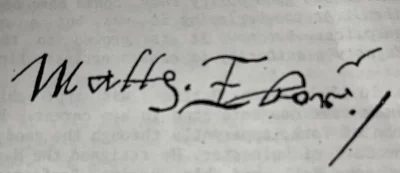
Matthew Hutton’s Signature as Archbishop of York In 1567, when Hutton was approaching forty, there came one more step in his career. He was made dean of York, apparently through the good offices of the Earl of Leicester. He resigned the Mastership of Pembroke Hall and his Regius Professorship. He resigned the prebends in Ely and Westminster that he had held. He left Cambridge for York and until his death in 1606, lived and worked in the north of England. It is impossible to know for certain what motivated this change of direction in Hutton’s career. It may, in part, have been personal. In the same year that he moved to York he took a second wife, Beatrix, daughter of Sir Thomas Fincham of Ely. There were almost certainly other reasons.
Hutton’s decision to move north may have taken him out of a difficult dilemma. He was a sincere supporter of the Elizabethan church, but not uncritical. Along with others in the church, Hutton thought there was still room for further reform. The Elizabethan settlement was however a precarious one. In other countries religious wars still raged. It is perhaps not surprising that criticism was sometimes confused with disloyalty to the crown.
The fate of Hutton’s friend and patron, Edmund Grindal was a warning of how easy it was to offend. Grindal’s downfall came through his apparently meritorious attempt to supply the church with preachers. By preachers he meant ministers sufficiently learned and well-trained to preach and expound the Scriptures from the pulpit. Grindal set up what were called “Exercises”; or as we might now say “Seminars’ to instruct ministers and help them to preach.
Preaching was not only seen as an unusual skill in those days, it was even viewed with disfavour, as likely to encourage egalitarian ideas of ordinary people thinking for themselves. The Queen expressed herself as quite content with a ministry of “such as can read the scriptures and homilies15 veil unto the people16“. In 1574 she ordered Grindal to discontinue the “Exercises’’. He refused. To do so, he said, would be against his conscience. Rashly, he went on to remind the Queen she was not the highest authority. “Bear with me, I beseech you, Madam, if I choose rather to offend your earthly Majesty than to offend the heavenly majesty of God17“. It was not well received. Grindal was placed under virtual house arrest in his own palace. He died nine years later, still unforgiven.
In the North the strength of popish recusancy made it seem necessary to harness preaching fervour, not fight it. The “Exercises” which were forbidden in the South were encouraged in the North. In 1583 it was actually made obligatory on ministers in the Diocese of Chester (which at that time included Lancashire) to attend monthly Exercises – excluding the months from November to February, presumably as a concession to the barbarities of the northern climate. Failure to attend could be heavily fined18. It might be noted here that in 1604 the incumbent of “Warton was described as “a preacher19“.
The North, then, was likely to prove a safer field of work for Hutton with his reformist leanings. He spent the last forty years of his life there, as Dean of York from 1567 to 1589, as Bishop of Durham from 1589 to 1595, and as Archbishop of York from 1595 till his death in 1606. As well as all his ecclesiastical responsibilities he was, from the start, an active member of the Council of the North under its Lord President, the Earl of Huntingdon, the Queen’s vice-regent in the North.The two men thought alike in religious matters, and worked together to suppress recusancy and promote godly, Protestant values.
Meanwhile there was a growing family of children. In the fifteen years before his second wife, Beatrix’s, death in 1582, eight children were born, of whom six lived to adult life. The children were not long left motherless for in 1583 Hutton married a widow, Frances Bowes. She survived him by many years. It is not known what sort of family man Hutton made. A few letters to his eldest son Timothy survive. They are almost entirely devoted to business, though one does show a little fatherly anxiety. In 1598 Timothy was due in York on government business, but it was a “time of infection”. Hutton added at the bottom of the letter. “PS More safetie not to coome, but more present credit to come…Yf you coome you shall be welcome; yf you come not, I will not take it in evill part20. “
What was the character of the man who was to become Archbishop of York? We have his own description of the sort of man he thought right for this high office. In 1568, when there was a vacancy at the see of York, the newly made dean wrote to Lord Cecil to beg it might be quickly filled. He described the type of man he wanted. Let him be “a teacher, because the country is ignorant, a virtuous and godly man because the country is given to sift a man’s life, a stout and courageous man in God’s cause because the country will otherwise abuse him, and yet a sober and discreet man21”
How far did Hutton live up to his own high standards? His own good standing as “a teacher” was shown above. He also encouraged teaching in others, in particular during his early years as dean, when his friend Edmund Grindal was Archbishop of York. Hutton was the only active resident dean of York for a century and a half…Between them, Grindal and Hutton would conspire to bring competent theologians and preachers on to the staff, as vacancies occurred22.
“Stout and courageous” he also was. He was prepared to stand up even to the Queen and her ministers if he thought it right. In 1568, for instance, a certain Mr Gibson had persuaded the Queen to recommend that he should receive the emoluments of a Canon Residentiary at York, even though he was not resident. Dean Hutton refused, and despite an ominous warning that”…her Majestie…thoghte it [Hutton’s refusal] strange…” continued to refuse. He said the money would have to be found from the livings of other residentiaries “some being not well hable to spare it23”
Towards the end of Queen Elizabeth’s life he told her that she ought, for the good of her kingdom, to choose her successor. To us this may seem nothing; to an Elizabethan it was pure foolhardiness. Noone must ever mention to the Queen that one day she must die and be succeeded.
There is a delightful account of how the Queen dealt with her outspoken Archbishop. Hutton gave out his text “The kingdomes of the earth are mine, and I do give them to whom 1 will“. There followed “…first so generall a murmur of one friend whispering to another…lastly so quiet a silence and attention in expectance…as I have never observed before or since.” At the end of the sermon every one looked to see the Queen annihilate the preacher. Instead she opened the window of the closet in which she sat and “…very kindly and calmly, without show of offence (as if she had but waked out of some sleepe) she gave him thanks for his very learned sermon”. But he did not get away with it entirely, for afterwards She sent two councellors to him with a sharp message, to which he was glad to give a patient answer.24
Could Hutton be considered a “sober and discreet man”! It seems so. It is true he quarrelled very fiercely with Archbishop Sandys on a number of matters, and had ultimately to apologise to him publicly and admit that he had used “some very violent and unguarded expressions25“.however, as the Dictionary of National Biography puts it, “The biographies of Sandys are filled with accounts of his squabbles”, so perhaps not much should be argued from Hutton’s impatience with him.
In other ways Hutton seems to have been a patient and caring man. This is shown particularly in his relationship with catholic recusants. Hutton saw the fight against Catholicism as central to his work in the north, but he preferred always to try persuasion. His patient attempts at conversion were noted with approval by central government. “God contynew his graces in you“, wrote Lord Burghley in 1577, “by which your liff and actions ar reported very good of all your neighbours, and in sekying to reform those that ar out of the waye, the ordinary waye to reduce them which I heare you use is, by gentle instruction of them first to se and fele their palpable errors, and so to prepare them to see the truth26“. Though, if one story is to be believed, not all catholics appreciated his efforts. It was said that the Catholics in Yorkshire were commanded by the Queen to be present at fifty sermons in York Cathedral. “Our Archbishop preached the last to a very numerous audience…but the Papists that were forced to be there, stopped their ears or talked aloud, to make his Grace give over the sermon27“
Hutton could also be compassionate. As acting Lord President of the North, after the death of the Earl of Huntingdon, he sometimes had prisoners put in his care. A number of surviving letters show his care for then. In 1598 he got the irons taken off Scottish prisoners. He treated another Scottish prisoner so well that he received a letter of thanks from King James VI. The Lady Margaret Neville, daughter of the exiled Earl of Westmorland, was committed to his care when she had put her own life in danger by giving shelter to a Catholic priest. Hutton went to much trouble to get her pardoned and obtain a pension for her. In 1595 her uncle, Lord Henry Howard, wrote a letter of thanks. “I ever honoured your learninge…and nowe I love unfainedlie that mild and temperate disposition which many recommende that speak of your dealings without partiality, for happie is that province which is subjecte to a pastore no less by nature than profounde in understandinge28” . Flattery possibly, but in view of what is known of Hutton, basically a believable portrait.
Hutton’s last requirement of the ideal man to be Archbishop of York was that he should be “virtuous and godly”. Certainly no breath of scandal attached to him in his day. The worst that was said of him was that he amassed a surprising amount of property. He had a large income from the church of York alone, and in addition he was also a considerable pluralist, having a prebend at St. Paul’s, another at Southwell in Nottinghamshire and a rectory at Settrington in Yorkshire29. He was able to leave his eldest son Timothy an estate of £500 p.a. and a further estate to his second son, Thomas30.
Hutton died in 1606. He had been ailing for some time. To some extent his world was failing him by that time. The establishment was growing more and more suspicious of hidden and treacherous recusancy. Demands for conformity spread to the North, and Hutton’s attempts to persuade before punishing recusants no longer received praise. In 1599 the Queen’s letter releasing him on the grounds of ill-health from duties of acting Lord President carried a sting in its tail. It commented on the growth of recusancy and imputed this “partly to over much tolleracion used to recusants and such other parsones who have bene presented for their offences…and have escaped without punishment31“. In the same year Archbishop Whitgift wrote “…here hath bene informations gyven that recusants are of late increased in that province, and that you are too milde with them. – Some of your ministers doe also affirme the same to be trewe32“.
Not only was the Government asking for greater severity towards Catholics, it was also growing less tolerant of any “Puritan” criticism of the established church. Hutton did not escape criticism in this direction either. A letter from Archbishop Whitgift in 1597, laudatory in general tone, contained an unpleasant needle-prick. Hutton’s language, it seemed, was tainted. “In one of your letters there was putt Christes-tyde for Christenmass, which because of the noveltie thereof…was by some of your best frends misliked; and I marvel how it escaped you…33”.
When James I came to the throne Hutton received a letter from the King’s secretary “that the puritanes be proceeded against according to the lawe, except they conforme themselves…” To a man who had spent his life fighting Catholicism this seemed to him to be attacking the wrong enemy. “I wishe with all my heart that the order were given not only to bishops, but to all magistrates and justices of the peace, &c. to proceed against papists and recusants, who of late…have grown mightily in number, courage and insolencie34“
Then he added a last testimony to his life-long views. “The puritanes, whose fantastical zealle I mislike, though they differ in ceremonies and accidents yet they agree with us in substance of religion and 1 thinke all or most of them love his majestie…but the papists are…opposite and contrary in substantially of religion and cannot but wishe the pope’s authoritie and popish religion to be established35”.
Two years later he was dead.
It would be pleasing to finish with an account of Hutton’s relationship with the parish of his birth and his motives for setting up a grammar school there. Unfortunately almost nothing is known. In 1595 he obtained a charter from Queen Elizabeth for the school he had set up the year before, while still Bishop of Durham. It is almost purely a business document. The only hint of his motive comes in the second paragraph and this is phrased too conventionally to reveal much. The Archbishop, it says, “greatly desires to erect and found a certain free school and hospital or alms house in the town of Warton… in the parish of which the same Archbishop was born, to the Glory of God, the promotion of good learning and the support and relief of the poor” The charter gave the Archbishop power to make “suitable and beneficial statutes” for the school36. These statutes, if he made them, have not survived.
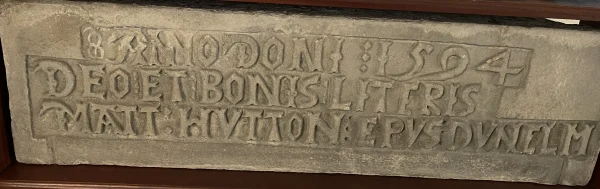
The stone originally at the Free School now in the modern Archbishop Hutton Primary School in Warton In his will, written in 1605, Hutton made further financial arrangements for “the Free Grammar School (which I do erect at Warton, wheare I was borne…37“, but says nothing else about it. Apart from this documentary evidence we only have a few scattered hints; the still extant stone plaque from the old school dedicating it to God and good learning (Deo et bonis Uteris); the fact that Hutton was enough in touch with Warton to remember his cousin there in his will; and the probability that he was on his way to visit Warton on the memorable occasion, recorded by Lucas, when he recalled his bare-foot childhood.
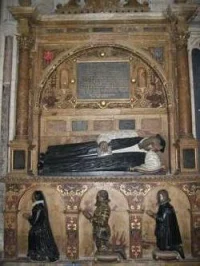
The grave of Archbishop Hutton in York Minster Notes and References
Four main sources have been used in this and the following article. For the main facts of Hutton’s career, the entry in the Dictionary of National Biography and also the account, already referred to, of Matthew Hutton’s life written in 1756 by Dr Ducarel. For a modern view of Hutton’s religious opinions, the article published in 1979 by Peter Lake of Clare College, Cambridge. For an overview of the religious controversies of the time, Professor Collinson’s work on the Elizabethan Puritan Movement 1967.
- For the main facts of Hutton’s career, the entry in the Dictionary of National Biography and also the account, already referred to, of Matthew Hutton’s life written in 1756 by Dr Ducarel. Librarian at Lambeth Palace. In 1756 he wrote a life of Matthew Hutton at the request of the then Archbishop of Canterbury, another Matthew Hutton and a direct descendant of our Archbishop. ↩︎
- Published in “The Correspondence of Dr Matthew Hutton”, Surtees Society, Vol.17, 1843. (Vol.17 is hereafter referred to as “The Correspondence”) ↩︎
- eds. J. Rawlinson Ford & J.A. Fuller-Maitland, Lucas’s History of Warton, 1931, p.106. (referred to hereafter as Lucas’s History.) ↩︎
- Lucas’s History, p.106 ↩︎
- Victoria County History of Lancashire, Vol.VIII, 1914, p.160. ↩︎
- T.D. Whitaker, An History of Richmondshire, 1823, Vol II, p.315 (Dr Whitaker was the vicar of Whalley, and also from 1813-1819, the Rector of Heysham) ↩︎
- A copy of the original Lucas book is now in the Lancashire County Archives in Preston reference DDX2743/MS2 and 3 ↩︎
- Peter Lake, “Matthew Hutton – a Puritan Bishop?”, History, Vol. 64, No.211, 1979, p.183 ↩︎
- Owen Chadwick, The Reformation, 1972, p.125 ↩︎
- Peter Lake, “Matthew Hutton – a Puritan Bishop?”, History, Vol. 64, No.211, 1979, p.183 ↩︎
- Sir John Harrington, Briefe Viev of the State of the Church of England, 1653, p.191,(Quoted in “The Correspondence”, p.27) ↩︎
- Letter from the vice-chancellor to Lord Burghley December 6th, 1565. ( Quoted in Peter Lake, “Matthew Hutton – a Puritan Bishop?”, History, Vol. 64, No.211, 1979, p.184. ↩︎
- Peter Lake, “Matthew Hutton – a Puritan Bishop?”, History, Vol. 64, No.211, 1979, p.184 ↩︎
- Letter from Hutton to Lord Burghley, 1575 (quoted ibid., p.185) ↩︎
- Homilies, in this case referring to the edifying and approval discourses contained in the Books of Homilies issued in 1563 for use in Parish churches ↩︎
- Patrick Collinson, The Elizabethan Puritan Movement, 1967, p.191 ↩︎
- Patrick Collinson, The Elizabethan Puritan Movement, 1967, p.242 ↩︎
- Christopher Haigh, Reformation and Resistance in Tudor Lancaster, 1975, p.302 ↩︎
- Kenyon MSS p-721 ↩︎
- The Correspondence of Dr Matthew Hutton, Surtees Society, Vol.17, 1843 ↩︎
- P. Collinson, Archbishop Grindal 1519-1585, 1979, p. 37 (quoting letter to Cecil, 13 Nov. 1568) ↩︎
- P. Collinson, Archbishop Grindal 1519-1585, 1979, p. 200 ↩︎
- The Correspondence of Dr Matthew Hutton, Surtees Society, Vol.17, 1843 ↩︎
- Sir John Harrington, Briefe Review of the State of the Church of England, 1653, p.186 ↩︎
- The Correspondence of Dr Matthew Hutton, Surtees Society, Vol.17, 1843 ↩︎
- The Correspondence of Dr Matthew Hutton, Surtees Society, Vol.17, 1843 ↩︎
- Thoresby Vicar. Leod p.144, 145 ↩︎
- The Correspondence of Dr Matthew Hutton, Surtees Society, Vol.17, 1843 ↩︎
- The Correspondence of Dr Matthew Hutton, Surtees Society, Vol.17, 1843 ↩︎
- The Correspondence of Dr Matthew Hutton, Surtees Society, Vol.17, 1843 ↩︎
- The Correspondence of Dr Matthew Hutton, Surtees Society, Vol.17, 1843 ↩︎
- The Correspondence of Dr Matthew Hutton, Surtees Society, Vol.17, 1843 ↩︎
- The Correspondence of Dr Matthew Hutton, Surtees Society, Vol.17, 1843 ↩︎
- T.D. Whitaker, An History of Richmondshire, 1823, Vol II, p.316 ↩︎
- T.D. Whitaker, An History of Richmondshire, 1823, Vol II, p.316 ↩︎
- John Blundell, Translation of Latin Charter (seen by courtesy of Mr Dilley, ex-head master of Archbishop Hutton’s School) ↩︎
- The Correspondence of Dr Matthew Hutton, Surtees Society, Vol.17, 1843 ↩︎
By Jean Chatterley and John Findlater
Preface
Any observant person crossing the River Keer, going from Carnforth to Warton, might speculate on the origins of the settlement bordering the eastern side of the road. Local people, of course, are well aware of the connection between these terraces of Victorian houses and the now vanished Ironworks, which functioned in nearby Carnforth from 1865 to 1929.
Two members of the Mourholme Society independently, have become intrigued by Millhead. We hope to offer a few articles on various aspects of this settlement, which grew up in the second half of the nineteenth century. It will inevitably involve consideration of Carnforth as a whole, though our primary interest is in the Ironworks/Millhead area.
There are already useful publications on the maturation of Carnforth, which are listed in the bibliography at the end of this article. We hope to complement these publications in this and future articles.
The Growth of Carnforth in the Nineteenth Century
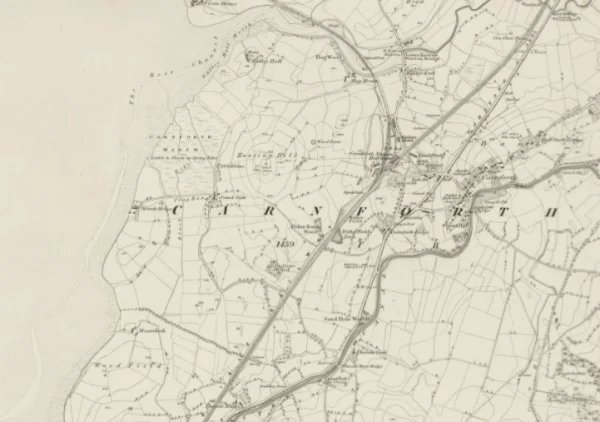
The Ordnance Survey (OS) 6″ map shows Carnforth in 1848, two years after the opening of the Lancaster-Carlisle railway; a sparse collection of limestone cottages and farmhouses along the old coaching road near the Lancaster-Kendal canal. It is now a minor road (North Road) and even in 1848 had been superseded as a through road by the turnpike road (the Garstang and Heronsyke Trust on the map), which roughly followed the line of the present A6. The small settlement lay in the south-eastern part of the largely agricultural parish of Warton. A few craft industries, wool and linen weaving and small-scale quarrying and mining made a modest contribution to the local economy. Millhead, to the north of the River Keer, was merely a bare hillside where once grain from a nearby mill had been threshed.
Over the next few decades the area was changed beyond recognition.
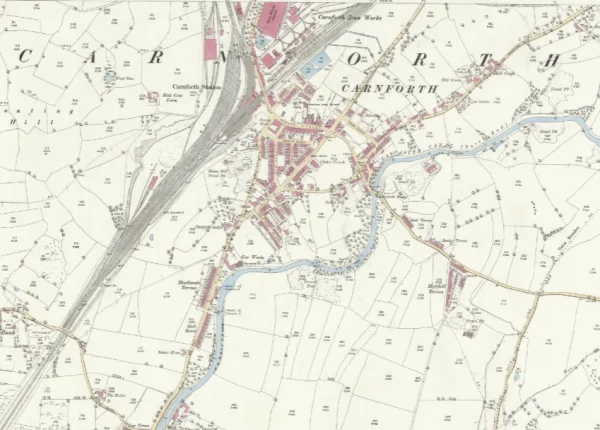
Reproduced with the permission of the National Library of Scotland The OS map shows how matters stood in 1891. Carnforth had become a township with the Ironworks occupying a substantial area beside the River Keer, within the triangle made by railway lines going North, South, East and West; Millhead had become a compact little housing development. On the 1904 map, it is called Dudley, for reasons that will be gone into in a later article.
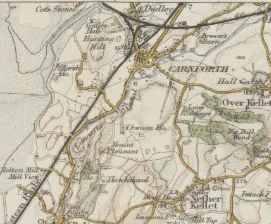
Reproduced with the permission of the National Library of Scotland In the years we are talking about, Britain was in a ferment and upheaval. Laissez-faire economics, Chartist agitation and the successful Anti-Corn Law League campaign had stirred up the body politic, though without the revolutions which afflicted other European countries in 1848, the year of the Communist Manifesto. The enormous socio-spatial rearrangement called “urbanisation” was underway, driven by industrialisation and by a great population increase; the population of England and Wales went from 9 million in 1801 to 18 million in 1851, and to over 32 million by 1901. Eighty percent of the increase was in the towns (an eightfold increase). By the mid-nineteenth century the process of industrialisation was at the end of its revolutionary phase, (if you believe in the idea of an industrial “revolution” that is), settling into sustained growth and maturity.
The Great Exhibition in 1851 announced to the world Britain’s primacy, and imperial ambitions were strong; wars (the Crimean War, 1853-6; the Indian Mutiny, 1857 and the American Civil War, 1861-65) were about to erupt. Complex domestic, social, economic and political processes were at work producing change. These included electoral reform, factory legislation, sanitary and housing developments, with Victorians on the move (literally) as never before. Profound alterations in social relationships resulted. Equally disturbing to people of those times, since it impinged on fundamental ideas and beliefs, was the publication in 1859 of Charles Darwin’s “Origin of Species”.
All this “froth” of history which we read about in history books was at work. Blowing this froth away and focussing on local matters, we may usefully consider the Millhead/ Ironworks area as an example of what Dr J. D. Marshall has called a “colony”, (though he hastens to reject any pejorative connotations in the use of this word). A colony in his usage “stands for a small social unit (village or settlement) of a homogeneous nature, e.g consisting of people working in the same industry, perhaps in one local unit. Its nature as a ‘colony’ may mean that it contains other occupations, say of a service nature, and buildings like chapels and churches, clubs, institutes and shops”1 .
He suggested that this nineteenth century urban settlement pattern, – “colonisation” – resulted, in the case of Carnforth, in a pre-existing agricultural community on a main route being largely supplanted by “capitalist industrial development. ” Dr Marshall gives it as an example of a colony which resulted in the formation of a “distinct town” Carnforth, “with a central function and widespread amenities”; it became “a central place for up to six surrounding or nearby villages, and … a shopping centre intermediate between Lancaster and Kendal.” over a few decades. However Dr Marshall does say that this variant of the pattern (a colony providing the basis for the formation of a distinct town with a central function) is somewhat rare; more usually a colony “becomes the nucleus of a suburb, or is absorbed by more haphazard urban spread”. Probably the reason for this rarer pattern was the important place of the railway industry in Carnforth.
The Lancaster and Carlisle railway line was opened in 1846, during the second boom in Britain’s railway expansion, sometimes referred to as the era of “railway mania” [There was a hundredfold increase in railway line mileage between 1830 and 1879]. The line was leased to the London and North Western Railway company in 1859 and later taken over altogether by the bigger company. The Carnforth/Ulverston line opened in 1857, (and was absorbed in 1862 by the Furness Company), so linking the whole Furness area with the north-south line. Carnforth’s importance as a junction increased when in 1867 the Furness company, jointly with the Midland Company, built a link line to the West Riding of Yorkshire via Wennington. In addition, the important South Durham and Lancashire Railway Line from the North East had already in 1861 made a link with the Lancaster/Carlisle line at Tebay.
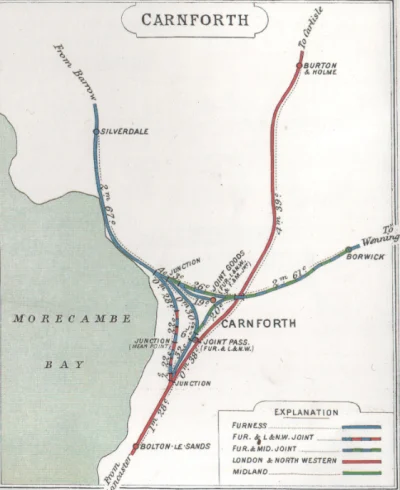
Carnforth’s Railway Network in 1870 This rail network was the crucial precondition for the establishment of the Ironworks in Carnforth. Then, partly because of the synergy between the ironworks and the railways, but also because of Carnforth’s importance as a mainline junction, the railway industry grew rapidly in the town. Three motive power depots were built (one for each of the companies, the London and North-Western, the Furness, and the Midland), each with offices, stores, fitting shops, blacksmith shops, coaling plant, sheds and marshalling yards.
In 1851 the stationmaster (born in Hayton, Cumberland) and one inspector lived in Carnforth; by 1861, besides the stationmaster, (born in Sedgwick, Westmorland) there were four engine drivers, all Lancashire men (one born in Barrow, one in Dalton and one in Preston), a fireman, one guard and one porter (all born in Cumberland), and one engineer from Scotland. The railway development pre-dated the ironworks (which were not established till 1864,) and remained (in terms of numbers employed) the more important of the two, as shown below in the table. The number of household heads in the two industries is taken from the censuses for 1871 and 1881.
Employment: Railways and Ironworks (Warton/Carnforth) Employment: Number of Household Heads 1871 1881 Railwaymen 68 (19.32%) 147 (26.11% Ironworkers 69 (19.60% 109 (19.36% Development of Carnforth town took place between the old settlement around North Road and the new railway station down by the River Keer. There was a new town centre of millstone grit shops, terraced houses, a few “villa” type houses, hotels, church, chapels and schools with an influx of all manner of tradesmen and occupations. But it has to be noted that this was occurring even before the Ironworks started up. For example, the Lancaster Gazette of 24th October 1863 rejoices that eight first class houses are being built near Robin Hill, one to be a grocer’s shop and another a clothier and tailor’s which will greatly “add to the beauty of the town”, and notes what a boon the General Post Office is; the same issue also announces that the Carnforth “Newsroom and Library of the Young Men’s Improvement Society” is being opened.
Details of the population changes which accompanied this development will be gone into in a future article. Here it can be pointed out that from the 1850’s Carnforth’s population rapidly increased, first overhauling and then outstripping the increase in the once larger settlement of Warton; rather as if Carnforth was a cuckoo in Warton’s nest. (though the comparisons are complicated by the simultaneous growth of Millhead, which housed mainly railway and iron workers, but remained part of Warton. ) No doubt the establishment of the Ironworks provided a great stimulus to Carnforth’s development, but it was already underway. On the whole, it is perhaps fairest to call Carnforth the child of both the railway and the ironworks.
Establishment and Growth of the Carnforth Ironworks
The Carnforth Haematite (Iron) Company was born in 1864; with registered capital of £100,000 in five hundred £200 shares. There were no local names among the shareholders who were, in the main, business and professional men from Manchester, Birmingham and the North East. Amongst them was Henry Bessemer2 with two shares.
Iron working was not new to the area; the monks of Furness Abbey had worked iron. By the early 19th century, Furness was exporting iron ore (182,000 tons in 1849), and by the 1860’s, Barrow had the world’s largest steel complex with three blast furnaces. Carnforth’s works can indeed be seen as a natural growth point for the region’s iron industry when new factors, which with hindsight we call the Industrial Revolution, came into play.During the mid-nineteenth century demands for wrought iron worldwide were becoming insatiable; for buildings, bridges, boats, but above all for railways, especially rails, where Britain was the world’s chief supplier3. Everything essential for manufacturing iron either existed at Carnforth in the 1860’s, or could be easily brought there by various railway company lines which converged on the area.
- Iron ore plentiful in nearby Furness.
- Good quality coke from the Durham coalfield.
- Limestone used as flux in the furnaces from the [Warton] Crag.
- Water from the Keer.
- The saltings of Warton and ideal area for dumping slag.
- A large flat cheap site for the works, in the triangle of land produced by the junction of the railway lines.
A railway line, or tramline as it was called on contemporary maps, was built to run from the works to the Scout Quarry, with a branch out to the tip on the sands. The remains of it can still be traced in the fields and roadside verges alongside the toll road to Crag Foot and out to the sands past the present tip at Cotestones. There were many accidents, especially to children, during the building of this quarry railway link. The accidents frequently involved amputation or surgery under chloroform at the “Lancaster Dispensary”. There seems to have been a total absence of some rudimentary safety measures let alone compensation or benefit for the disabled.
In March 1865 the Lancaster Gazette reported that the site was a chaotic scene: “Here a number of huge stones thrown anyhow in a heap … here a steam engine pounding away. . . masons at work in one quarter, bricklayers in another … “
A Mr Edward Barton was appointed by the owners to oversee the founding of the iron works and the hiring of labour. In May his wife laid the foundation stone of the engine house chimney – 210ft high and 19ft across at the base, and the town’s landmark for some 60 years. Five furnaces were planned at first (and a sixth added later). It was anticipated that there would be employment for 200-500 men. In 1866 two of the furnaces were “blown in” and the first pig-iron – produced. Blowing in meant starting up the furnace with blasts of hot air through the first loading of ore, coke and limestone. It was a serious matter after that to allow the furnace to “blowout” again – the contents could solidify, and the furnace develop cracks and other expensive damage.
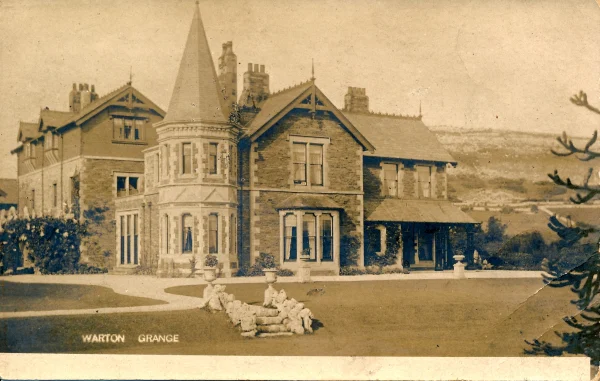
In 1867 Edward Barton was appointed Chief Engineer, and was later to become Manager. Although only in his thirties, he was experienced in iron-making techniques from his time in the industry on Teeside and in West Cumbria. Warton Grange, on Sand Lane in Warton, was built for him and his family, and it was his home from 1873.
In the initial phase of establishing an ironworks, there would have been an influx of construction workers. But once established, labour demand would be for skilled and unskilled4 iron workers. Tradition has it that these men came from Dudley -the Dudley/Bilston/Wednesbury area of Staffordshire. Some support is given to this idea, among other things, by the fact that the maps of the time call the Millhead area “Dudley”.
By 1870 four furnaces were each producing 300-400 tons of pig-iron per week, and the decision was made to make steel as well. Two Bessemer converters were installed and in 1873 three plate and rail rolling mills were added. By 1876 the capitalisation of the company had risen to £240,000 in two thousand four hundred £100 shares, 166 of which were held by Bessemer.
In February 1879 however, “after 12 years of expansion and prosperity, came the first hint of trouble; the local papers reported a “stoppage” because ”remunerative prices cannot be obtained.” The plant was idle for some months. There followed a period of ups and downs, with gradually falling prices. The newspapers of 1880-1882 reported regularly that only four, then three of the furnaces were operating.
In 1883 a scheme to revive the industry was proposed, that of having a puddling works, employing 150 men. Puddling was an arduous manual operation, stirring and turning molton iron in a reverberatory furnace to convert it into malleable iron. It did not revive the industry, and the following year the paper reported that; “The company intends to put their large converting plant which has lain idle since its construction to profitable use. It was realised that it was a waste of money sending pig iron from Carnforth to Sheffield to be made into steel. ”The report is quoted just as it stands in the newspaper. It is odd, however, since it seems to imply that, despite the installation of Bessemer Convertors some fourteen years before, the company had never used them, but had continued to send their pig-iron elsewhere for conversion to steel.
By December 1884, plans for reorganising the steel works to produce steel wire were reported. However, none of these plans were enough to keep more than 3 of the furnaces alive, and in June 1886 a fourth was “blown out” and some 40-50 men were given notice. The strike of 1886 saw the works closed completely for a while.
The story of the further decline and the end of the venture will be told later. Meanwhile, what was the lot of the 300 or so men who were employed by the company for those first 20 years of growth? A few were local labourers, but most came into the area with skills acquired in other iron and steel works. There were great distinctions between workers in the various stages of iron production. “Fillers” loaded the ore, coke and limestone into barrows which were then raised to the “bell” at the furnace top. Here the “Bridge Stocker” had a gang of “Chargers” who loaded the material into the bell, a cone-shaped canopy which, when lowered, allowed the load to drop into the furnace. 35 cwt of ore, 10 cwt of limestone and 21 cwt of coke were hoisted up for every ton of pig iron produced. The lower furnace was in charge of a “Stock Taker” helped by a “Keeper” who decided when the furnace was ready for tapping, and he in turn had “Helpers” and “Slaggers”. Twelve men worked a shift at each furnace. Some of these “men” were 12 year old lads.
In the early days, especially, problems of industrial relations were many. The following case (Lancaster Guardian March 9th 1867) illustrates the worker-manager divide, as well as the legal system of the times.
Fifteen employees of the company were up before the magistrates for alleged breach of contract some of them were employed as ore fillers, others as coke fillers, and the remainder as labourers.
Representatives for the two sides agreed that the case arose over a new method of filling a furnace with mixed ore which was being tried out. Extra men were put on to help, but about midday Williams, the foreman, sent the extra men elsewhere. Those remaining said they could not manage without help.
…. Mr Barton the General Manager, was not at the works, so Williams sent to his home in Warton. . . according to Williams the men refused even to speak to him; he said that he told them to return to work. . . even if they could not keep up with the loading it would make no difference to them as they would still get paid. But, he said,the men still ignored him. . . packed up and left for home
The men’s story was that Williams had just said they could do the work, or take their money and go. They had taken this to mean that they were dismissed. They had not known that only the absent Mr Barton had the power to dismiss anyone. The men themselves did not hear their case since:
“All these arguments were heard before the men came into court. The magistrate felt the men might be tempted to alter their story to fit the arguments if they were present in court all the time. When the men were brought into court, four of them pleaded guilty. This settled the case rather quickly; the others were also judged guilty. Those who had pleaded guilty were sentenced to seven days hard labour at Lancaster Castle; the others got 21 days.”
The newspapers of the period also gave graphic accounts of the numerous and horrific accidents associated with the iron works. A small sample will suffice. Between 1866 and 1881 :-
John Barrow, son of Warton’s grocer, fell 70 ft from a plank at the top of a furnace;
a man was buried alive under 14 tons of sand in the pit at Robin Hill (sand was used in making the pig-iron beds);
William Butler fell while putting coals on a furnace and broke both arms;
Thomas Edmondson of the Ironworks Cottages was taken to Lancaster Infirmary after bogies passed over both his legs.The accident that brought the works to a standstill came as late as the 1890’s: –
“About midnight on Thursday last occurred at the Carnforth Ironworks the most shocking fatal accident … John Hodgson was following his ordinary work on top of the furnaces, which consisted in charging No.2 furnace. Shortly after midnight Hodgson gave the customary signal to the men in charge of the “bell” … to lower it before Hodgson had tipped his barrow. To the horror and intense grief of his fellow labourers Hodgson fell into the burning furnace and was no more seen. The gases which escape from the furnace would render him insensible and this fact will be some consolation to his sorrowing widow and children, as well as his parents who reside in Warton and are very respectable people … not a particle of the unfortunate man’s body remains…
Between 1 and 2 a.m (sic) Friday all the men at the Ironworks were hoisted up to the mouth of the furnace, where the Church of England Burial Service – was impressively read by Rev. J. H. Fidler, Mr Barton and others being present. .. Work stopped for some hours.”
During this time Carnforth grew rapidly. The total population of Carnforth and Warton rose from 974 to 3,350 (roughly 244% increase). Consequently, there was urgent demand for housing. The first company houses were built in Millhead – 20 alongside Warton Rd., called Bessemer Cottages (later demolished to make way for expansion of the works). The built up area in Warton and Carnforth expanded rapidly as gaps between cottages were filled and the fields were covered with rows of terraced houses. Most of “Dudley” was company owned or sponsored (119 workers’ houses were listed for Sale when the works were finally dismantled). Elsewhere in Carnforth they were not company property even if company inspired. The period of rapid building lasted well into the 1890’s for a decade after the Ironworks had begun to decline such was the momentum of the town’s expansion.
The growth was reflected in land prices. The Lancaster Guardian for April 11th 1874 comments on this “extraordinary increase”, giving as example a sale at Carnforth when a small field purchased for £60 thirty years before realised £350.
Thus there was a great impact on the landscape, townscape and economy of the area. In twenty years, the long-settled population saw the arrival of the ironworks, the 210ft chimney, blast furnaces, rapidly built terrace houses, railway lines, slag heaps and all their accompanying dirt, smoke and smells. The quarrying would have added its own specialities to the rural environment. There are many older Warton residents who, when interviewed for the Society’s oral history researches, recalled how the sky was lit up by the furnaces and by the wagons of still burning slag as they travelled along the line to the tip on the sands.
The Initial Colonisation of Millhead
Between 1861 and 1871, the population of Warton township increased from 579 to 1061 Warton with Lindeth in the 1871 Census is composed of District 3 (which includes Millhead) and District 45. that is an increase of 83.25%. This was almost entirely due to the influx of the new industrial workers for the Carnforth Ironworks. Whereas the workers in the growing railway industry over this period (and beyond) were mostly housed the other side of the River Keer in Carnforth, there was a concentration of ironworkers at Millhead to the north of the Keer. In the 1861 census the only property enumerated at Millhead was Keer Bridge House, housing Robert Stainton, a yeoman, aged 61, from Troutbeck in Westmorland, with his wife, unmarried daughter and unmarried niece.
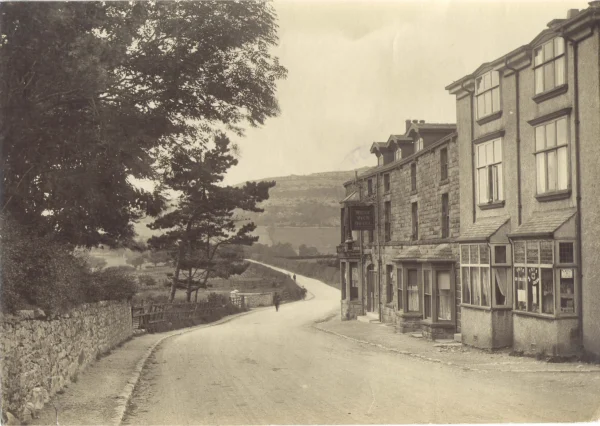
West View Hotel In the 1871 census, Robert Stainton was still there, but now features as a widowed and retired farmer with his unmarried niece and a 15 year old domestic servant. In addition, Robert Clark, a landowner, lived at Hazelmount, with his groom and gardener Isaac Robinson living at Hazelmount Lodge. There was a beerhouse called “West View Hotel” (at other times called “The Nib”6 ) kept by Thomas Swarbrick, an unmarried man of 28, with a housekeeper and 13 year old domestic servant. There was an unoccupied house and then Joseph Whiles, a builder and bricklayer, lived at West View with a household totalling eight, which included three bricklayers lodging with him, one of whom was an apprentice, also a glass stainer. Next was the house of John Lithgow a plasterer from Wigan with his wife and two sons (the first born in Cumberland and the year old in Warton), together with his “musician” father-in-law and his wife. Joseph Jackson, a 54 year old from Westmorland, is given as a quarry master employing 29 men; in his own household of eight was a 17 year old son who was a clerk at the ironworks.
However the bulk of the Millhead population lived in two rows of terrace houses, Albert Street and William Street, running north to south down a gentle slope towards the River Keer. There were 52 houses in all, which had been built for the Ironworks and housed 284 people (169 males, 115 females). Possibly Mr Whiles’ and Mr Jackson’s business were thriving from all the building work associated with the Ironworks, the houses and the infrastructure. Certainly there was a report in the Lancaster Guardian on 14 November 1866 that the surveyor of roads was summoned to the Judges’ Lodgings at Lancaster because of the poor repair of roads between Jackson’s quarry and the Ironworks, indicative of overuse.
Virtually all the household heads in Albert Street and William Street were Ironworks employees, the only exception being W. Sharp, an agricultural labourer who lived in William Street. There were 53 household heads. One house in William Street had two households within it (David Child a “steel blower” with a wife, and James Slater an “iron furnace labourer” with wife and two children).
Of the household heads there were 34 ironwork labourers, 12 others were more skilled iron workers (“Pig lifters”, “steel blowers etc.), and amongst these was an iron furnace manager, Mr Evans7. The remainder included 2 bricklayers, a plasterer, 2 stonemasons, a blacksmith and 2 engine drivers, besides Mr Sharp the agricultural labourer. It is assumed that these men were, in fact, employed at the ironworks. In these households some family members – sons, nephews or brothers – were also employed at the ironworks; there were 9 ironworks labourers, a bricklayer son and an engine driver son. In addition there were 27 lodgers, 21 of whom were ironworks labourers, and 5 skilled ironworkers besides a bricklayer, a waller and a mason who might be presumed employed at the ironworks; perhaps there is less certainty about a key maker and a lock maker who may have been self-employed, perhaps not.
According to the occupations column of the 1871 census Edward D. Barton, the Manager of the Ironworks (who, when he first came to oversee the construction of the ironworks and for the first years of his time as manager, lived at Warton Hall Farm with two servants) employed 300 men. The number in these two streets in Millhead, Albert Street and William Street, working at the Ironworks amounted to 64 labourers, 17 skilled and 13 others making 94 in all or about 1/3 of the total workforce. The rest were scattered about Carnforth – notably a concentration at Bessemer Row on Lancaster Road now called Hall Street.
Of the whole population in Warton District 3 in the 1871 census, of 678 souls (361 male and 317 female), 319 (186 male, 133 female) lived at Millhead.
Examination of the birthplace of the Millhead household heads shows that none were born within the parish, and only 3 were from nearby: J. Hall from Bolton-le-Sands, J. Hunter from Skerton and M. Mason from Hornby, all ironworks labourers. The others came from far and wide; 2 came from the Isle of Man, 3 from Ireland, 5 from Wales and 1 from Belgium and 5 from Bradford, but 17 came from the area around Dudley in the West Midlands. When the lodgers are taken into account a further 15 came from the Dudley area, 2 from Wales and 2 from Bradford.
The preponderance of the workers originating from the West Midlands may be explained by the fact that work in the Earl of Derby’s works in that area was in decline, whereas Carnforth offered opportunity. Jon Raven, who has done many years of research into the lives of the industrial workers of the Dudley area, and who now runs a museum there, was contacted to ascertain whether any recruitment drive was known to have occurred. He writes :-
“. . . at the time 1868-71, the Dudley Ironworks would have been much in decline, I believe, as were some coal mines. The district was investing its labour and skills in the up and coming engineering industry and many workers were retraining to this end. No doubt the failure of the industry in this area was known to those opening the Ironworks and I imagine an agent was sent down to attract people … “
It is very likely also that since the new employers were looking for workers with former ironworks experience, they would encourage men in teams, the skilled accompanied by their accustomed labourers.
It is interesting, and significant, to note from the 1871 census that, in Millhead, only children aged 3 or under were born in Warton, indicating that the main period of growth in housing in Millhead had begun around 1868.
However, it is well known that people usually migrate in a “steplike” fashion. By studying the birthplaces of the older children in these recently arrived families it is possible to trace in a fair way the movements of the parents. William Ainsworth, Abraham Bettany and Benjamin Evans are good examples of families where the father was born in the West Midlands area, his older children were born there, and his very youngest was born in Warton/Carnforth. Others had been born and bred elsewhere, moved to Staffordshire and then, after perhaps a year or two, to Warton/Carnforth. Some examples show this: Thomas Patterson a 36 year old iron furnace labourer, was born in County Down, Ireland, and had 2 children born in Tunstall and Hanley (the Potteries) before moving to Carnforth. Joseph Waite, 32, an ironworks labourer was born in Hastings, Northants and had come to Carnforth via Golgreen in Staffs. John Venables had a son, John of 9 years, born in Bilston and another, Thomas, aged 1, born in Warton. Less can be deduced with certainty in cases like John Ellias and Francis Northall who were both born in Wales, and Benjamin Pugh, born in Belgium, all of whom married women from the Dudley area and had young children born in Warton/Carnforth. Almost certainly they had worked and married in the Dudley area, but moved on to Carnforth. William Iniff 31 years old, a blacksmith, was born in Rochdale and had children born in Workington, before he came to Millhead. Samuel Lunn, also 31, a steelmaker, was born in Bradford and had children born in Oldham and Manchester before his last two in Warton.
Not only does the 1871 pyramid show a great increase in the Warton population, compared with 1861, but the pyramid is noticeably different in shape with a broader base reflecting the great influx of younger people into the parish (181 children were 9 years or less, 17% of the total population). Immigrants into any community are usually the younger and therefore potentially child- bearing section of the population; certainly the census details show this to be the case here.
Apart from one unmarried household head – William Coyner of William Street, aged 20, the rest had wives (Farmer Stainton was a widower, and beerkeeper Swarbrick was unmarried). When household composition is averaged out, the average size was 6.3; 2.57 children, 0.33 kin, and 0.48 lodgers. The average age of the household heads was 33.2 years, but if the ages of working sons, kin and lodgers is taken into account the working population had an average age of 29.75. Families were still large but not particularly so. However, with parents still young the family would no doubt soon increase.
Albert Street and William Street consisted of small terrace houses, with a living room, kitchen and pantry, two bedrooms, a small box room and a cupboard under the stairs. The front door opened on to the street. In the kitchen was a brown slop stone and a cold water tap, also a bricked-in set boiler for washing, heated by a coal fire. Large tin baths were used for bathing. In the living room the iron fireplace had an oven and a boiler at the other side for heating the water. The fireplace was black- leaded, and often had a bright steel fender and fire irons. The houses were lit by paraffin hanging or table lamps. These were often made of brass, candles were often used. There were outside privies or ash pits, which were always a source of sanitary concern.
These houses must have been crowded with an average household size of 6.3. Perhaps a more revealing picture is given by presenting the situation as below.
Millhead 1871, House Occupation.
No. of persons in Household 2 3 4 5 6 7 8 9 10 11 No. of houses so inhabited 3 7 14 9 12 4 11 0 0 1 In some houses, there were not only several children, but often lodgers also. Some of these lodgers were married men, sometimes relatives of the householders, who were presumably waiting for more housing to be built before moving their families to the area. In William Street, Benjamin and Katherine Evans, an iron furnace labourer and his wife, both in their twenties with 3 daughters aged 5, 3 and 1, all from Wednesfield, Staffs, took in six unmarried male lodgers, all ironworks labourers in their early twenties except for one man of 45, a key maker, and all but one of them coming from the “home area” of Wednesfield, Willenhall and Bilston. At one house in William Street, David and Elizabeth Child, a couple in their early fifties, lived with the Slaters, a young family of four.
In his study of Cleator Moor Dr J.D. Marshall comments on the ” dubious reputation” of the newcomers, many Irish and given to “excessive drinking8“. Even before the Fenian troubles in 1884 there was internecine strife there. It is a melancholy fact that the sudden arrival of industrial newcomers concentrating as they did at Millhead almost inevitably produced friction which continued even into times remembered by people alive today.
There were incidents coming to court indicating that alcohol was something of a problem amongst ironworkers at Carnforth. For example, the Lancaster Guardian of 10th September 1870, reports that William Darby, a charger at the Ironworks had been charged with beating his wife because he wanted money for drink. She had saved him from imminent confinement; he was reprimanded and cautioned.
However there are other reports which suggest that perhaps the workforce was rather better behaved than that. For example, the Lancaster Guardian of 10th July 1869 comments on a £7 gift from the workmen to Warton Church, showing that “instead of workers being rabble as ‘natives’ had imagined, many were warm-hearted Christians; they had been some of the first to suggest the project“. Indeed, the foundation stone for a Primitive Methodist chapel (now a garage workshop) was laid in 1873 by James Williamson (later Lord Ashton), pretty solid evidence that many of the families were Methodists. In addition as reported in the Lancaster Guardian, December 4th 1869 there were “readings” and programme of songs given at the “Ironworks Reading Room”.
No doubt conditions were ameliorating because this was a time of increasing prosperity in Carnforth. On the 4th of May 1872 the Lancaster Guardian reported that Carnforth was very busy. All furnaces were in full blast. “Foundations of a steel works have already been laid which should provide employment for 200-300 additional men”. On the 2nd of March of that year, there had been a report of the proposed erection of 36 concrete houses for Carnforth Haematite Iron Company. It is a moot point whether there is greater social harmony in boom times or in depression, but it looked as though Carnforth/Warton was in for boom.
The Cuckoo Outgrows Its Nest
The years 1873 to 1896 are often called the years of the “Great Depression”. Hobsbawm9 describes it as “a new state of mind of uneasiness and gloom“, with a “spectacular 20 year deflation which reduced price levels by a third“. Saul10 claims that closer investigation shows the depression to have been a fiction. Webb11 agrees that there was no depression in the sense of a general contraction of the economy. There was tougher competition, some lower prices and capital flooding abroad (Hobsbawm believed that this was a factor which led to imperialism).
In particular for our purposes we should note that Scotch pig iron prices, 54s/6d in 1867-1871 and 117s/3d in 1873, dropped to 56s/5d per ton in 1876-7. This would be bad news for the Carnforth Ironworks and Millhead. By contrast, grain prices dropped by a third between 1876 and 1886 which, though depressing agriculture especially in the south, would help the food bills of industrial workers. It is true that dairy, meat and market gardening prices held up well, but probably these items were less a feature in the diet of industrial workers than grain.
To judge from contemporary newspaper reports, the ironmaking industry in our area was subject to short term ups and downs. The Lancaster Guardian (February 15th, 1879) reported a stoppage of the Carnforth Ironworks, the works standing idle for some months, an indication of slack trade. It reported that a large quantity of iron had been produced, but “remunerative prices cannot be obtained“. This was followed on March 8th, 1879 by the Carnforth Haematite Iron Co. contradicting the closure report; one furnace remained in blast. Later in the year, according to the newspaper on September 3rd, there was a revival of the Iron Trade and another furnace was to be put into blast. On September 3rd, 1881 the Lancaster Gazette reported that “Messrs. W&J Galloway of Manchester have in hand a pair of large blowing engines for Carnforth blast furnace“, and that the Ironworks had made a very satisfactory profit for the year; the dividend payments amounted to £37,146, equalling a 10% return. All the same, half the smelting plant was idle and the steel plant was not in operation. The position was thought encouraging to shareholders and people interested in the haematite trade. A further report in the Lancaster Gazette on September 17th, 1881 by H.J. Walduck of Silverdale regarding the capital of Carnforth Haematite Iron Co. Ltd, revealed that, in 1870, £30,000 had been raised for erection of Bessemer Steel Works. The money had been spent having the works built, but they had never been put in operation. The company continued to be prosperous, with profits from the manufacture of pig iron and, in the Lancaster Gazette of October 18th, 1882, it was reported that “another furnace was put into blast last week making four at work”. In 1884 as reported in the Lancaster Gazette (February 23rd) it was planned to put the large steel converting plant, lying idle since construction, to profitable use. It was a waste of money sending pig iron from Carnforth to Sheffield to be made into steel. This was followed on December 13th, 1884 by a report stating that “a steelworks at Carnforth will be opened in January next under management of Mr B. Pemberton of Albion Ironworks, Barrington”. As was suggested in the last article, in 1873 it appeared that Carnforth/Warton viewed the future optimistically. All the indications pointed to increased prosperity. The account of developments given above show that, with some fluctuations, this hope was justified.
Consequently, it is no surprise to discover from the decennial censuses that the population of Warton-with-Lindeth increased from 1,035 in 1871 to 1,471 in 1881 (a 36% rise). The Millhead population had increased from 284 to 544 (a 92% increase). In the census of 1881 several new terraces of houses had appeared at Millhead to accommodate this in-migration: Mary Street, Stainton Street, Jackson Terrace and Carlisle Terrace (see Map p.10).
It is hard to believe these were the houses of “a peculiar cement construction brought to Carnforth in a ‘piece form'”, as reported in the newspaper. Whereas Mary Street and Stainton Street (see photograph ) resemble the already existent Albert and William Streets, houses in Jackson Terrace are rather more imposing (most of these houses were occupied by railway men), and in Carlisle Terrace (see photograph) the houses definitely represent a step up. Each house had a little garden in front with a gate. One of the surprising things to emerge from examination of the census returns is to note the unusually high number of uninhabited houses there appear to have been in William Street, unlike the other rows. In the census numbers 6,7,12,14,16,17,21,25,26,28,33 and 35 were all recorded as uninhabited.
Millhead 1891
It was mentioned in the article above that there was an Ironworks reading room. We have been told it was definitely in William Street; one person is quite sure it was the front room of number 23, the front room which was later used as a Sunday school. According to the census, T. Sandham, an ironworks labourer, lived at this address. When the households are investigated, it is surprising to find that only four household heads of those living in Albert Street and William Street in 1871 can be found in 1881 (they might be called “persisters”). William Iniff, previously entered as aged 31, a blacksmith from Rochdale living in Albert Street, who had previously lived in Workington, is now an ironworks labourer aged 46(!) and living at 12 Carlisle Terrace. His wife Elizabeth, born in Carlisle, who was 24 in 1871, is now 37. The eldest daughter, Margaret Elizabeth, has left home as has son Francis. Nicholas, aged 12, and Thomas, aged 10, have now been joined by Jane, aged eight; Mary, aged five, and Lancelot, aged four.
Abraham Bellamy, an ironworks labourer, who had originated in Tipton, Staffordshire is still living at 24 William Street. His eldest daughter; Mary Ann, has left home, as well as the third daughter, Martha, who would have been 18. Sarah, now 21 and living at home, is a housemaid; son William, aged 17, is an ironworks labourer and has been joined by John aged 14, Joseph aged 11 (the first to be born in Warton) besides twins Esther and Mathilda, aged 7, Edward aged 4 and Lizzie, one month old12.
Joshua Hall, an ironworks labourer, is a “persister” who remains at number 1 William Street. He is now 42, this time giving his birthplace as Skerton whereas it was Bolton-le-Sands in 1871. Sarah, his Overton born wife, is still alive. Like the Iniffs and the Bellamys they have a large family. Their son William has gone, as have daughters Elizabeth, who would have been 19 and Margaret, who would have been 16; James 15, Joseph 13 and John 11 are still at home, but William Thomas aged 8, Robert aged 5 and Sarah aged 2 have come along.
William Evans, an ironworks labourer, originally from Wales, who lived in William Street in 1871 is now 58, and lives at 7 Carlisle Terrace. His wife is still with him aged 55, daughter Elizabeth has gone, but son William, aged 18, an ironworks labourer and Thomas aged 15, a labourer in a wool shed are still unmarried and living at home. Just as surprising is the fact that only one son who was adult and employed in 1871 is a “persister”; James Brazington, aged 24, an engine driver at the Ironworks in 1881, having been an unskilled ironworks labourer in 1871 when he lived in William Street in the household of his father George Brazington. James is now married with a one year old daughter and lives at 5 Stainton Street. None of the 1871 lodgers has remained or become a householder in Millhead. You might have thought that some of these men of 1871 might have taken lodgings hoping to find houses and settle their families in Millhead, but they had all cleared out, possibly to Carnforth, Warton or more likely further afield. It does seem that ironworkers tended to move on from one ironworks area to another.
This would occur in the Carnforth/Millhead area especially if the future there looked uncertain. Perhaps it is worth noting here that this mobility was not confined to ironworkers. The late Anne Morley, trying to trace the history of “Warton Families” found that few “non-ironworkers” could be traced from one census to the next. When the birthplace of the Millhead residents of 1881 are examined there was no preponderance of people originating in the West Midlands as there had been in 1871. Immigrants came from all over and ironworks labourers were recruited locally as they had not been previously (see bar chart). Bar Graph
* Stainton St **** CARLISLE TERRACE (Photograph 1993) *** BACK OF CARLISLE TERRACE (Photograph 1993) * The Lodging House * (Photograph 1993)
When the average household composition in 1881 is examined it varies a little from that of 1871. The average age of the household head is 37.07 instead of 33.2. The average total size is 5.13 instead of 6.3; the average number of children at home 2.67 instead of 2.57; 0.27 kin instead of 0.33, and 0.23 lodgers instead of 0.48. In other words, slightly older men headed slightly smaller households, with a slightly higher proportion of children, but smaller proportion of kin and lodgers. The house occupation in 1881 can be set out in comparison with that of 1871; ***
Whereas in 1871 the householders were with one exception ironworkers, in 1881 there was more variation. By far and away the largest proportion of non-ironworkers were railway personnel. There were dressmakers, Miss Lunn at 11 Albert Street and Miss Lynn, 4 Mary Street; a seamstress, Mary Almond (a widow) at 8 Jackson Terrace; a tailor, P. Metcalfe, from Yorkshire, at 36 William Street; a master clogger, W.R. Vipond, from Kendal, at 14 Mary Street. In other words people in service occupations were increasing.
The lodgers also had more varied occupations than in 1871. A significant development had taken place along the Main Road between Carnforth and Warton, where the new town houses have recently replaced the slipper factory, viz: Hartley’s Grocery and Provision business. In the 1881 census, John Hartley aged 40 from Kendal, the household head, is given as “senior partner” employing 17 hands. His wife was born in Orton and they have three sons and two daughters – ages from 14 to 3 years. There were two apprentices, William Postlethwaite, 19 and unmarried, from Cumberland and William Edmonson, 16 and unmarried, also two servants, a domestic servant and a 24 year old nurse girl.
The big house, Hazelmount, was occupied by John Jennings a farmer and maltster, aged 68 and widowed, who had previously lived in Main Street, Warton. His unmarried son of 16 and daughter of 12 lived with him together with two servants. At West View was the household of William Coward, a Preston born tailor. His wife, from Ambleside, is given as a dressmaker; they have one daughter and three sons. William Anderson aged 46, also at West View is a blacksmith from Ulverston whose household consists of a wife, also from Ulverston, with three sons and three daughters; the older five children were all born in Carnforth, but the youngest, 11 months old, was born in Warton – so did they occupy only within the last three years? They shared the house with an ironworks labourer born in Warton, in the census recorded as the household head – married to a woman from Ulverston.
Then there remains the beerhouse at West View, the keeper of which was Titus Wilson, born in Morecambe. He and his wife had four children and one servant. There is some doubt about its situation. Could it have been the building subsequently known as the “lodging house” (see photographs), rather than the West View Hotel recently renamed the Nib? Mr Chalmers, former owner of the West View Garage, who incorporated this building into his garage complex as the stores building, is convinced by the layout he found that it had been a beer-house. He suggests it was called the “Kibble and Clink”. Millhead had become quite a self-contained community, but like the cuckoo we compared it to at the beginning, it was becoming an overwhelming influence in Carnforth’s development; So much so that despite our firm intention to attempt a circumscribed study we will be obliged to extend our investigation into the affairs of Carnforth.
Acknowledgements
In preparation of this article, use has been made of notes left to the Society’s archives by David Peter, Sylvia Myall and others.Bibliography
Alan Harris: Carnforth, 1840-1900: The Rise of a North Lancashire Town Transactions of the Historic Society of Lancashire and Cheshire. Vol. 112, 1960.
John Easter Roberts: The Changing Face of Carnforth [ 1974 Mayoh Press, Carnforth]
David Peter: Warton with Lindeth, A History. Part One. Lancashire Library 1985
Jean Chatterley: To Dudley … From Dudley Mourholme Magazine
Jean Chatterley Carnforth’s Public Health Crisis Mourholme MagazineNotes
- J.D. Marshall Urban –related Colonies in the North West Unpublished Paper ↩︎
- Henry Bessemer patented in 1856 an economical process by which molten pig iron disturbed by a current of air is turned directly into steel. He was knighted in 1879 (Chambers Biographical Dictionary) ↩︎
- Production of wrought iron in Britain grew from 300,000 tons between 1830 and 1870. ↩︎
- We would probably call them semi-skilled now, but they described themselves as “labourers” in census returns. ↩︎
- The summary for District 3 gives 678 persons and District 4, 357 which makes a total of 1,035, but one of us (J.C.) counted the entries and made 1,061 which is the figure used in this article. ↩︎
- Why the Nib? Two answers have been offered. First, ‘The Nib’ is short for a longer nickname, ‘The Nibble and Clink.’ The second answer turns on the pub being a Boddington’s house. The front door of the hotel, so the story goes, had a glass panel on which was written ‘Boddington’s.’ As you entered the pub, you read ‘Boddington’s,’ naturally enough, but as you came out, the letters in the centre of the reverse side of the name seemed to spell ‘nibb’, especially, it may be imagined, if there had been any impairment of one’s peripheral vision.
Any other suggestions? ↩︎ - In the enumeration book it is given as “Evehs from Bettws, Montgomeryshire”, but this is almost certainly a mistake: Evans seems most likely. The census clerk would write down what he thought he had heard and obviously his knowledge of strange dialects and names added to the confusion found in the place of birth” column. Some knew their birth town but not county so Willenhall appears in both Staffordshire and Shropshire in various places. Some of the place names given are not traceable because of being obviously names of houses or farms and the names have long since disappeared. ↩︎
- J.D. Marshall “Cleator and Cleator Moor: some aspects of the social & urban development in the mid-nineteenth century” p. 168, T.C.W.A.A.S, Vol.LXXVIII, 1978 ↩︎
- E.J Hobsbawm, Industry and Empire, Penguin Books Ltd, 1968, pp.127, 128. ↩︎
- S.B. Saul, The Myth of the Great Depression 1873- 1895, 1968 ↩︎
- R.K. Webb, Modern England, 1980 ↩︎
- The Iniffs and Bellamys show that quite a false impression of family size is given when individual census returns are used. ↩︎
A website has several photographs and the history of the Carnforth Ironworks.
By J.D. Marshall
Dr Marshall, the President of the Mourholme Society, is at present working on a book on the study of Local History. Here he gives the Society a preview of some of his thoughts on the subject.
Local historians are unlike most historians in that they take responsibility for a very definite tract of territory – and apparently, for everything that has happened within that territory over many centuries. This means that we might be responsible for the history of gardens or postal services or watering cans, as well as social or economic history, within the old parish of Warton and its townships – a positively enormous demand on our time!
It is this sheer variety of often novel subject-matter that attracts some members, of course, and the list seems inexhaustible. Unfortunately, this very attractiveness and variety is based on one dangerous idea, that everything in the past is somehow equal in value to everything else. We soon learn, indeed, that history cannot be written unless the writers select topics and have priorities. Then, of course, life becomes more eventful as we debate and have arguments. Every really worthwhile local history society must have its own priorities, in order that it can somehow spiral forward (or upwards).
In this short contribution I shall try to suggest what these might be. Once we establish a local history society, we take on responsibility for interpreting the local past for everyone else in our area – and that includes young people at school. So, whether we are amateurs or not, we have to establish the very highest standards of which we are capable. There is nobody else to do the work for us, although we can use the services of professionals wherever possible.
At first, the task must appear impossible. It must seem to resemble the disentanglement of a jungle. Perhaps I may be permitted to shine a torch into the shadows. First of all, we have to think of our public or audience. They will be deeply indebted to us if we can throw light on recent history, the story and scene of their own lives. They will all be able to tell us about their own lives. They will be able to tell us about their own experiences, and we can hope to provide some background. Then as we inch back into earlier periods, we shall be proceeding from the known to the unknown, and from generation to generation. It is generations that represent “real” historical experience, not centuries – for centuries are the artificial construction of historians.
Of course, we need the wisdom of historians as well, and thanks to them, most of us have an idea what “Victorian” or “mediaeval” mean. It is also perfectly in order to produce booklets on “the seventeenth century”, or the “nineteenth century” in our area. As a Society, we have one great advantage over the academic historian – we can work unblushingly in teams. Professional historians have to publish books in their own names in order that they can keep their professional reputations. We need not worry about protocol of that kind (though members may wish to take responsibility for part of a book, let us say), and indeed teamwork can mean “team discussion”, and be very rewarding. Alternatively, one person may do most of the writing, and others do much of the research, but all share in the end product. Very few societies are as bold as the Mourholme in wishing to publish a series of books on different “ages” or centuries, but such a programme can be beneficial if it is handled by’ distributing reasonable and personally interesting tasks to as many people as is feasible.
Seven people can make a good research and discussion team, and if the Society can create three such teams (a fifth of the membership) it will have done well. Competition of a friendly kind can supplement cooperation, and there should be no sense that members of research or publishing teams are also members of an élite. We are all learners in something. Meanwhile, the natural individualists will do their histories of lime-kilns or water-troughs, and bring colour and variety to our magazine.
What about the larger priorities?
It is possible, with reading, discussion and hard work, to see the major outlines of history in each period or century, and we can then decide that some topics really are more important than others. But our topics do not always follow the Outlines of the history books, and we must be on our guard. Carnforth was a product of a second “industrial revolution” based on railways and steel; our open fields did not follow the “three-field system”, but quite a different one. (Children are often not taught local peculiarities like this.)
Then, having got our bearings, we have to tell an absorbing story in an absorbing way. It is our responsibility to reach out to as many people as possible without pandering to nostalgic anti-quarianism (facts for their own sake, rose-tinted views of the past), and if we are unreadable, we shall defeat our object.
A.J.P. Taylor remarked of some professional writers of history “That they have no tale to tell, Sir”, and we need not imitate these authors. Equally we don’t have to be superficial and disjointed. The Mourholme Society has a great deal of varied talent, and we shall do well to bring the latter into play.
Just one or two further points. Our Society is responsible for half a dozen places, settlements and townships, and it has a microcosm of the rural north at its disposal; let us make sure that we study the histories of all our townships comparatively. We shall then bring in members from all of them, in greater numbers. All the same, the most populous place in our area is Carnforth! Let us make sure that Carnforth’s story is even more fully told.
Chairman’s Note
The Mourholme Society owes its foundation to a small group of local researchers, and from its inception there have been research groups active in the society. An early research group consisted of eight or nine members who concerned themselves with transcribing wills and inventories from the greater parish of Warton from the 16th and 17th centuries. They learnt how to read “secretary hand”; they discovered the meaning of delightful words like hattocks and brandreths and rackencrookes and quishions; and they found out quite a lot about local people of three or four centuries ago, how they lived, and died, and provided for their descendants. From their work on wills this research group has gone on to further study of the 17th century. Other members of the society are studying old newspapers, or their local township in the 19th and 20th centuries, or their own houses. If any member is interested in embarking on research why not get in touch with the Society can offer any help or, just as importantly, whether your research can help the Society.