By Jean Chatterley and John Findlater
Preface
Any observant person crossing the River Keer, going from Carnforth to Warton, might speculate on the origins of the settlement bordering the eastern side of the road. Local people, of course, are well aware of the connection between these terraces of Victorian houses and the now vanished Ironworks, which functioned in nearby Carnforth from 1865 to 1929.
Two members of the Mourholme Society independently, have become intrigued by Millhead. We hope to offer a few articles on various aspects of this settlement, which grew up in the second half of the nineteenth century. It will inevitably involve consideration of Carnforth as a whole, though our primary interest is in the Ironworks/Millhead area.
There are already useful publications on the maturation of Carnforth, which are listed in the bibliography at the end of this article. We hope to complement these publications in this and future articles.
The Growth of Carnforth in the Nineteenth Century
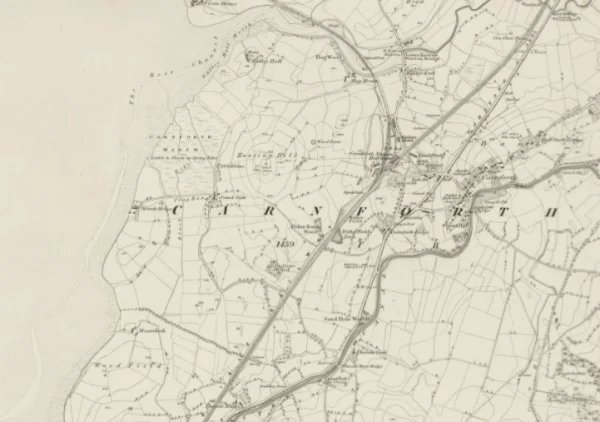
The Ordnance Survey (OS) 6″ map shows Carnforth in 1848, two years after the opening of the Lancaster-Carlisle railway; a sparse collection of limestone cottages and farmhouses along the old coaching road near the Lancaster-Kendal canal. It is now a minor road (North Road) and even in 1848 had been superseded as a through road by the turnpike road (the Garstang and Heronsyke Trust on the map), which roughly followed the line of the present A6. The small settlement lay in the south-eastern part of the largely agricultural parish of Warton. A few craft industries, wool and linen weaving and small-scale quarrying and mining made a modest contribution to the local economy. Millhead, to the north of the River Keer, was merely a bare hillside where once grain from a nearby mill had been threshed.
Over the next few decades the area was changed beyond recognition.
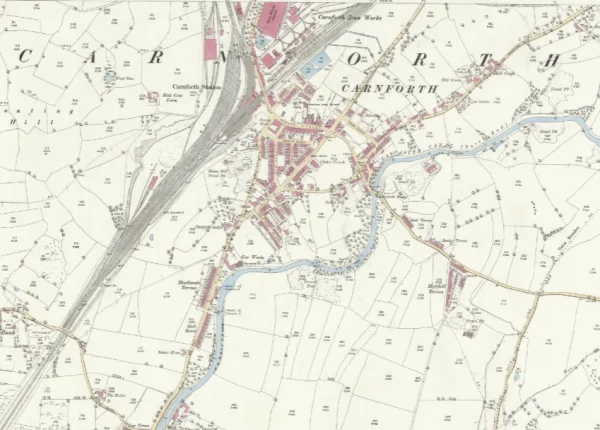
Reproduced with the permission of the National Library of Scotland The OS map shows how matters stood in 1891. Carnforth had become a township with the Ironworks occupying a substantial area beside the River Keer, within the triangle made by railway lines going North, South, East and West; Millhead had become a compact little housing development. On the 1904 map, it is called Dudley, for reasons that will be gone into in a later article.
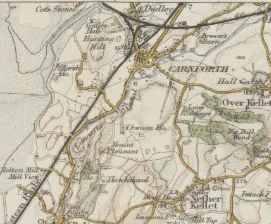
Reproduced with the permission of the National Library of Scotland In the years we are talking about, Britain was in a ferment and upheaval. Laissez-faire economics, Chartist agitation and the successful Anti-Corn Law League campaign had stirred up the body politic, though without the revolutions which afflicted other European countries in 1848, the year of the Communist Manifesto. The enormous socio-spatial rearrangement called “urbanisation” was underway, driven by industrialisation and by a great population increase; the population of England and Wales went from 9 million in 1801 to 18 million in 1851, and to over 32 million by 1901. Eighty percent of the increase was in the towns (an eightfold increase). By the mid-nineteenth century the process of industrialisation was at the end of its revolutionary phase, (if you believe in the idea of an industrial “revolution” that is), settling into sustained growth and maturity.
The Great Exhibition in 1851 announced to the world Britain’s primacy, and imperial ambitions were strong; wars (the Crimean War, 1853-6; the Indian Mutiny, 1857 and the American Civil War, 1861-65) were about to erupt. Complex domestic, social, economic and political processes were at work producing change. These included electoral reform, factory legislation, sanitary and housing developments, with Victorians on the move (literally) as never before. Profound alterations in social relationships resulted. Equally disturbing to people of those times, since it impinged on fundamental ideas and beliefs, was the publication in 1859 of Charles Darwin’s “Origin of Species”.
All this “froth” of history which we read about in history books was at work. Blowing this froth away and focussing on local matters, we may usefully consider the Millhead/ Ironworks area as an example of what Dr J. D. Marshall has called a “colony”, (though he hastens to reject any pejorative connotations in the use of this word). A colony in his usage “stands for a small social unit (village or settlement) of a homogeneous nature, e.g consisting of people working in the same industry, perhaps in one local unit. Its nature as a ‘colony’ may mean that it contains other occupations, say of a service nature, and buildings like chapels and churches, clubs, institutes and shops”1 .
He suggested that this nineteenth century urban settlement pattern, – “colonisation” – resulted, in the case of Carnforth, in a pre-existing agricultural community on a main route being largely supplanted by “capitalist industrial development. ” Dr Marshall gives it as an example of a colony which resulted in the formation of a “distinct town” Carnforth, “with a central function and widespread amenities”; it became “a central place for up to six surrounding or nearby villages, and … a shopping centre intermediate between Lancaster and Kendal.” over a few decades. However Dr Marshall does say that this variant of the pattern (a colony providing the basis for the formation of a distinct town with a central function) is somewhat rare; more usually a colony “becomes the nucleus of a suburb, or is absorbed by more haphazard urban spread”. Probably the reason for this rarer pattern was the important place of the railway industry in Carnforth.
The Lancaster and Carlisle railway line was opened in 1846, during the second boom in Britain’s railway expansion, sometimes referred to as the era of “railway mania” [There was a hundredfold increase in railway line mileage between 1830 and 1879]. The line was leased to the London and North Western Railway company in 1859 and later taken over altogether by the bigger company. The Carnforth/Ulverston line opened in 1857, (and was absorbed in 1862 by the Furness Company), so linking the whole Furness area with the north-south line. Carnforth’s importance as a junction increased when in 1867 the Furness company, jointly with the Midland Company, built a link line to the West Riding of Yorkshire via Wennington. In addition, the important South Durham and Lancashire Railway Line from the North East had already in 1861 made a link with the Lancaster/Carlisle line at Tebay.
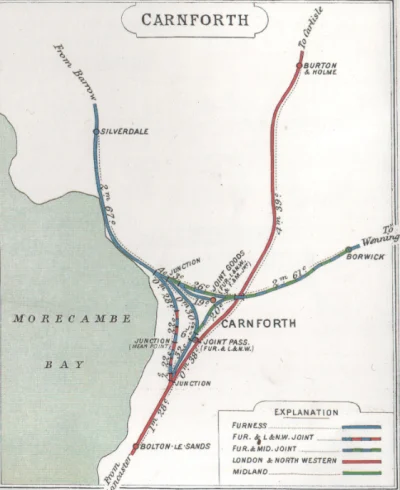
Carnforth’s Railway Network in 1870 This rail network was the crucial precondition for the establishment of the Ironworks in Carnforth. Then, partly because of the synergy between the ironworks and the railways, but also because of Carnforth’s importance as a mainline junction, the railway industry grew rapidly in the town. Three motive power depots were built (one for each of the companies, the London and North-Western, the Furness, and the Midland), each with offices, stores, fitting shops, blacksmith shops, coaling plant, sheds and marshalling yards.
In 1851 the stationmaster (born in Hayton, Cumberland) and one inspector lived in Carnforth; by 1861, besides the stationmaster, (born in Sedgwick, Westmorland) there were four engine drivers, all Lancashire men (one born in Barrow, one in Dalton and one in Preston), a fireman, one guard and one porter (all born in Cumberland), and one engineer from Scotland. The railway development pre-dated the ironworks (which were not established till 1864,) and remained (in terms of numbers employed) the more important of the two, as shown below in the table. The number of household heads in the two industries is taken from the censuses for 1871 and 1881.
Employment: Railways and Ironworks (Warton/Carnforth) Employment: Number of Household Heads 1871 1881 Railwaymen 68 (19.32%) 147 (26.11% Ironworkers 69 (19.60% 109 (19.36% Development of Carnforth town took place between the old settlement around North Road and the new railway station down by the River Keer. There was a new town centre of millstone grit shops, terraced houses, a few “villa” type houses, hotels, church, chapels and schools with an influx of all manner of tradesmen and occupations. But it has to be noted that this was occurring even before the Ironworks started up. For example, the Lancaster Gazette of 24th October 1863 rejoices that eight first class houses are being built near Robin Hill, one to be a grocer’s shop and another a clothier and tailor’s which will greatly “add to the beauty of the town”, and notes what a boon the General Post Office is; the same issue also announces that the Carnforth “Newsroom and Library of the Young Men’s Improvement Society” is being opened.
Details of the population changes which accompanied this development will be gone into in a future article. Here it can be pointed out that from the 1850’s Carnforth’s population rapidly increased, first overhauling and then outstripping the increase in the once larger settlement of Warton; rather as if Carnforth was a cuckoo in Warton’s nest. (though the comparisons are complicated by the simultaneous growth of Millhead, which housed mainly railway and iron workers, but remained part of Warton. ) No doubt the establishment of the Ironworks provided a great stimulus to Carnforth’s development, but it was already underway. On the whole, it is perhaps fairest to call Carnforth the child of both the railway and the ironworks.
Establishment and Growth of the Carnforth Ironworks
The Carnforth Haematite (Iron) Company was born in 1864; with registered capital of £100,000 in five hundred £200 shares. There were no local names among the shareholders who were, in the main, business and professional men from Manchester, Birmingham and the North East. Amongst them was Henry Bessemer2 with two shares.
Iron working was not new to the area; the monks of Furness Abbey had worked iron. By the early 19th century, Furness was exporting iron ore (182,000 tons in 1849), and by the 1860’s, Barrow had the world’s largest steel complex with three blast furnaces. Carnforth’s works can indeed be seen as a natural growth point for the region’s iron industry when new factors, which with hindsight we call the Industrial Revolution, came into play.During the mid-nineteenth century demands for wrought iron worldwide were becoming insatiable; for buildings, bridges, boats, but above all for railways, especially rails, where Britain was the world’s chief supplier3. Everything essential for manufacturing iron either existed at Carnforth in the 1860’s, or could be easily brought there by various railway company lines which converged on the area.
- Iron ore plentiful in nearby Furness.
- Good quality coke from the Durham coalfield.
- Limestone used as flux in the furnaces from the [Warton] Crag.
- Water from the Keer.
- The saltings of Warton and ideal area for dumping slag.
- A large flat cheap site for the works, in the triangle of land produced by the junction of the railway lines.
A railway line, or tramline as it was called on contemporary maps, was built to run from the works to the Scout Quarry, with a branch out to the tip on the sands. The remains of it can still be traced in the fields and roadside verges alongside the toll road to Crag Foot and out to the sands past the present tip at Cotestones. There were many accidents, especially to children, during the building of this quarry railway link. The accidents frequently involved amputation or surgery under chloroform at the “Lancaster Dispensary”. There seems to have been a total absence of some rudimentary safety measures let alone compensation or benefit for the disabled.
In March 1865 the Lancaster Gazette reported that the site was a chaotic scene: “Here a number of huge stones thrown anyhow in a heap … here a steam engine pounding away. . . masons at work in one quarter, bricklayers in another … “
A Mr Edward Barton was appointed by the owners to oversee the founding of the iron works and the hiring of labour. In May his wife laid the foundation stone of the engine house chimney – 210ft high and 19ft across at the base, and the town’s landmark for some 60 years. Five furnaces were planned at first (and a sixth added later). It was anticipated that there would be employment for 200-500 men. In 1866 two of the furnaces were “blown in” and the first pig-iron – produced. Blowing in meant starting up the furnace with blasts of hot air through the first loading of ore, coke and limestone. It was a serious matter after that to allow the furnace to “blowout” again – the contents could solidify, and the furnace develop cracks and other expensive damage.
In 1867 Edward Barton was appointed Chief Engineer, and was later to become Manager. Although only in his thirties, he was experienced in iron-making techniques from his time in the industry on Teeside and in West Cumbria. Warton Grange, on Sand Lane in Warton, was built for him and his family, and it was his home from 1873.
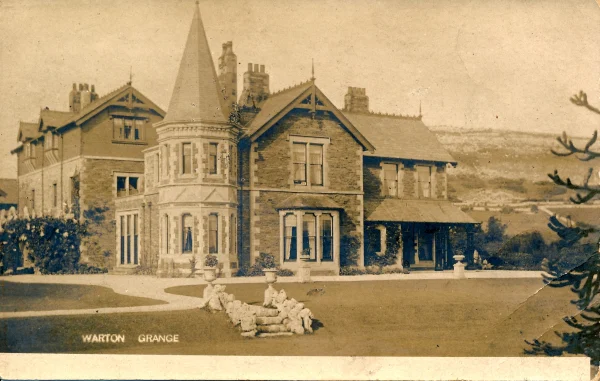
In the initial phase of establishing an ironworks, there would have been an influx of construction workers. But once established, labour demand would be for skilled and unskilled4 iron workers. Tradition has it that these men came from Dudley -the Dudley/Bilston/Wednesbury area of Staffordshire. Some support is given to this idea, among other things, by the fact that the maps of the time call the Millhead area “Dudley”.
By 1870 four furnaces were each producing 300-400 tons of pig-iron per week, and the decision was made to make steel as well. Two Bessemer converters were installed and in 1873 three plate and rail rolling mills were added. By 1876 the capitalisation of the company had risen to £240,000 in two thousand four hundred £100 shares, 166 of which were held by Bessemer.
In February 1879 however, “after 12 years of expansion and prosperity, came the first hint of trouble; the local papers reported a “stoppage” because ”remunerative prices cannot be obtained.” The plant was idle for some months. There followed a period of ups and downs, with gradually falling prices. The newspapers of 1880-1882 reported regularly that only four, then three of the furnaces were operating.
In 1883 a scheme to revive the industry was proposed, that of having a puddling works, employing 150 men. Puddling was an arduous manual operation, stirring and turning molton iron in a reverberatory furnace to convert it into malleable iron. It did not revive the industry, and the following year the paper reported that; “The company intends to put their large converting plant which has lain idle since its construction to profitable use. It was realised that it was a waste of money sending pig iron from Carnforth to Sheffield to be made into steel. ”The report is quoted just as it stands in the newspaper. It is odd, however, since it seems to imply that, despite the installation of Bessemer Convertors some fourteen years before, the company had never used them, but had continued to send their pig-iron elsewhere for conversion to steel.
By December 1884, plans for reorganising the steel works to produce steel wire were reported. However, none of these plans were enough to keep more than 3 of the furnaces alive, and in June 1886 a fourth was “blown out” and some 40-50 men were given notice. The strike of 1886 saw the works closed completely for a while.
The story of the further decline and the end of the venture will be told later. Meanwhile, what was the lot of the 300 or so men who were employed by the company for those first 20 years of growth? A few were local labourers, but most came into the area with skills acquired in other iron and steel works. There were great distinctions between workers in the various stages of iron production. “Fillers” loaded the ore, coke and limestone into barrows which were then raised to the “bell” at the furnace top. Here the “Bridge Stocker” had a gang of “Chargers” who loaded the material into the bell, a cone-shaped canopy which, when lowered, allowed the load to drop into the furnace. 35 cwt of ore, 10 cwt of limestone and 21 cwt of coke were hoisted up for every ton of pig iron produced. The lower furnace was in charge of a “Stock Taker” helped by a “Keeper” who decided when the furnace was ready for tapping, and he in turn had “Helpers” and “Slaggers”. Twelve men worked a shift at each furnace. Some of these “men” were 12 year old lads.
In the early days, especially, problems of industrial relations were many. The following case (Lancaster Guardian March 9th 1867) illustrates the worker-manager divide, as well as the legal system of the times.
Fifteen employees of the company were up before the magistrates for alleged breach of contract some of them were employed as ore fillers, others as coke fillers, and the remainder as labourers.
Representatives for the two sides agreed that the case arose over a new method of filling a furnace with mixed ore which was being tried out. Extra men were put on to help, but about midday Williams, the foreman, sent the extra men elsewhere. Those remaining said they could not manage without help.
…. Mr Barton the General Manager, was not at the works, so Williams sent to his home in Warton. . . according to Williams the men refused even to speak to him; he said that he told them to return to work. . . even if they could not keep up with the loading it would make no difference to them as they would still get paid. But, he said,the men still ignored him. . . packed up and left for home
The men’s story was that Williams had just said they could do the work, or take their money and go. They had taken this to mean that they were dismissed. They had not known that only the absent Mr Barton had the power to dismiss anyone. The men themselves did not hear their case since:
“All these arguments were heard before the men came into court. The magistrate felt the men might be tempted to alter their story to fit the arguments if they were present in court all the time. When the men were brought into court, four of them pleaded guilty. This settled the case rather quickly; the others were also judged guilty. Those who had pleaded guilty were sentenced to seven days hard labour at Lancaster Castle; the others got 21 days.”
The newspapers of the period also gave graphic accounts of the numerous and horrific accidents associated with the iron works. A small sample will suffice. Between 1866 and 1881 :-
John Barrow, son of Warton’s grocer, fell 70 ft from a plank at the top of a furnace;
a man was buried alive under 14 tons of sand in the pit at Robin Hill (sand was used in making the pig-iron beds);
William Butler fell while putting coals on a furnace and broke both arms;
Thomas Edmondson of the Ironworks Cottages was taken to Lancaster Infirmary after bogies passed over both his legs.The accident that brought the works to a standstill came as late as the 1890’s: –
“About midnight on Thursday last occurred at the Carnforth Ironworks the most shocking fatal accident … John Hodgson was following his ordinary work on top of the furnaces, which consisted in charging No.2 furnace. Shortly after midnight Hodgson gave the customary signal to the men in charge of the “bell” … to lower it before Hodgson had tipped his barrow. To the horror and intense grief of his fellow labourers Hodgson fell into the burning furnace and was no more seen. The gases which escape from the furnace would render him insensible and this fact will be some consolation to his sorrowing widow and children, as well as his parents who reside in Warton and are very respectable people … not a particle of the unfortunate man’s body remains…
Between 1 and 2 a.m (sic) Friday all the men at the Ironworks were hoisted up to the mouth of the furnace, where the Church of England Burial Service – was impressively read by Rev. J. H. Fidler, Mr Barton and others being present. .. Work stopped for some hours.”
During this time Carnforth grew rapidly. The total population of Carnforth and Warton rose from 974 to 3,350 (roughly 244% increase). Consequently, there was urgent demand for housing. The first company houses were built in Millhead – 20 alongside Warton Rd., called Bessemer Cottages (later demolished to make way for expansion of the works). The built up area in Warton and Carnforth expanded rapidly as gaps between cottages were filled and the fields were covered with rows of terraced houses. Most of “Dudley” was company owned or sponsored (119 workers’ houses were listed for Sale when the works were finally dismantled). Elsewhere in Carnforth they were not company property even if company inspired. The period of rapid building lasted well into the 1890’s for a decade after the Ironworks had begun to decline such was the momentum of the town’s expansion.
The growth was reflected in land prices. The Lancaster Guardian for April 11th 1874 comments on this “extraordinary increase”, giving as example a sale at Carnforth when a small field purchased for £60 thirty years before realised £350.
Thus there was a great impact on the landscape, townscape and economy of the area. In twenty years, the long-settled population saw the arrival of the ironworks, the 210ft chimney, blast furnaces, rapidly built terrace houses, railway lines, slag heaps and all their accompanying dirt, smoke and smells. The quarrying would have added its own specialities to the rural environment. There are many older Warton residents who, when interviewed for the Society’s oral history researches, recalled how the sky was lit up by the furnaces and by the wagons of still burning slag as they travelled along the line to the tip on the sands.
The Initial Colonisation of Millhead
Between 1861 and 1871, the population of Warton township increased from 579 to 1061 Warton with Lindeth in the 1871 Census is composed of District 3 (which includes Millhead) and District 45. that is an increase of 83.25%. This was almost entirely due to the influx of the new industrial workers for the Carnforth Ironworks. Whereas the workers in the growing railway industry over this period (and beyond) were mostly housed the other side of the River Keer in Carnforth, there was a concentration of ironworkers at Millhead to the north of the Keer. In the 1861 census the only property enumerated at Millhead was Keer Bridge House, housing Robert Stainton, a yeoman, aged 61, from Troutbeck in Westmorland, with his wife, unmarried daughter and unmarried niece.
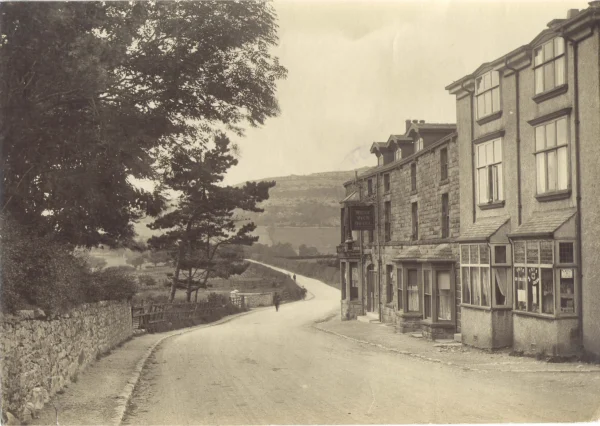
West View Hotel In the 1871 census, Robert Stainton was still there, but now features as a widowed and retired farmer with his unmarried niece and a 15 year old domestic servant. In addition, Robert Clark, a landowner, lived at Hazelmount, with his groom and gardener Isaac Robinson living at Hazelmount Lodge. There was a beerhouse called “West View Hotel” (at other times called “The Nib”6 ) kept by Thomas Swarbrick, an unmarried man of 28, with a housekeeper and 13 year old domestic servant. There was an unoccupied house and then Joseph Whiles, a builder and bricklayer, lived at West View with a household totalling eight, which included three bricklayers lodging with him, one of whom was an apprentice, also a glass stainer. Next was the house of John Lithgow a plasterer from Wigan with his wife and two sons (the first born in Cumberland and the year old in Warton), together with his “musician” father-in-law and his wife. Joseph Jackson, a 54 year old from Westmorland, is given as a quarry master employing 29 men; in his own household of eight was a 17 year old son who was a clerk at the ironworks.
However the bulk of the Millhead population lived in two rows of terrace houses, Albert Street and William Street, running north to south down a gentle slope towards the River Keer. There were 52 houses in all, which had been built for the Ironworks and housed 284 people (169 males, 115 females). Possibly Mr Whiles’ and Mr Jackson’s business were thriving from all the building work associated with the Ironworks, the houses and the infrastructure. Certainly there was a report in the Lancaster Guardian on 14 November 1866 that the surveyor of roads was summoned to the Judges’ Lodgings at Lancaster because of the poor repair of roads between Jackson’s quarry and the Ironworks, indicative of overuse.
Virtually all the household heads in Albert Street and William Street were Ironworks employees, the only exception being W. Sharp, an agricultural labourer who lived in William Street. There were 53 household heads. One house in William Street had two households within it (David Child a “steel blower” with a wife, and James Slater an “iron furnace labourer” with wife and two children).
Of the household heads there were 34 ironwork labourers, 12 others were more skilled iron workers (“Pig lifters”, “steel blowers etc.), and amongst these was an iron furnace manager, Mr Evans7. The remainder included 2 bricklayers, a plasterer, 2 stonemasons, a blacksmith and 2 engine drivers, besides Mr Sharp the agricultural labourer. It is assumed that these men were, in fact, employed at the ironworks. In these households some family members – sons, nephews or brothers – were also employed at the ironworks; there were 9 ironworks labourers, a bricklayer son and an engine driver son. In addition there were 27 lodgers, 21 of whom were ironworks labourers, and 5 skilled ironworkers besides a bricklayer, a waller and a mason who might be presumed employed at the ironworks; perhaps there is less certainty about a key maker and a lock maker who may have been self-employed, perhaps not.
According to the occupations column of the 1871 census Edward D. Barton, the Manager of the Ironworks (who, when he first came to oversee the construction of the ironworks and for the first years of his time as manager, lived at Warton Hall Farm with two servants) employed 300 men. The number in these two streets in Millhead, Albert Street and William Street, working at the Ironworks amounted to 64 labourers, 17 skilled and 13 others making 94 in all or about 1/3 of the total workforce. The rest were scattered about Carnforth – notably a concentration at Bessemer Row on Lancaster Road now called Hall Street.
Of the whole population in Warton District 3 in the 1871 census, of 678 souls (361 male and 317 female), 319 (186 male, 133 female) lived at Millhead.
Examination of the birthplace of the Millhead household heads shows that none were born within the parish, and only 3 were from nearby: J. Hall from Bolton-le-Sands, J. Hunter from Skerton and M. Mason from Hornby, all ironworks labourers. The others came from far and wide; 2 came from the Isle of Man, 3 from Ireland, 5 from Wales and 1 from Belgium and 5 from Bradford, but 17 came from the area around Dudley in the West Midlands. When the lodgers are taken into account a further 15 came from the Dudley area, 2 from Wales and 2 from Bradford.
The preponderance of the workers originating from the West Midlands may be explained by the fact that work in the Earl of Derby’s works in that area was in decline, whereas Carnforth offered opportunity. Jon Raven, who has done many years of research into the lives of the industrial workers of the Dudley area, and who now runs a museum there, was contacted to ascertain whether any recruitment drive was known to have occurred. He writes :-
“. . . at the time 1868-71, the Dudley Ironworks would have been much in decline, I believe, as were some coal mines. The district was investing its labour and skills in the up and coming engineering industry and many workers were retraining to this end. No doubt the failure of the industry in this area was known to those opening the Ironworks and I imagine an agent was sent down to attract people … “
It is very likely also that since the new employers were looking for workers with former ironworks experience, they would encourage men in teams, the skilled accompanied by their accustomed labourers.
It is interesting, and significant, to note from the 1871 census that, in Millhead, only children aged 3 or under were born in Warton, indicating that the main period of growth in housing in Millhead had begun around 1868.
However, it is well known that people usually migrate in a “steplike” fashion. By studying the birthplaces of the older children in these recently arrived families it is possible to trace in a fair way the movements of the parents. William Ainsworth, Abraham Bettany and Benjamin Evans are good examples of families where the father was born in the West Midlands area, his older children were born there, and his very youngest was born in Warton/Carnforth. Others had been born and bred elsewhere, moved to Staffordshire and then, after perhaps a year or two, to Warton/Carnforth. Some examples show this: Thomas Patterson a 36 year old iron furnace labourer, was born in County Down, Ireland, and had 2 children born in Tunstall and Hanley (the Potteries) before moving to Carnforth. Joseph Waite, 32, an ironworks labourer was born in Hastings, Northants and had come to Carnforth via Golgreen in Staffs. John Venables had a son, John of 9 years, born in Bilston and another, Thomas, aged 1, born in Warton. Less can be deduced with certainty in cases like John Ellias and Francis Northall who were both born in Wales, and Benjamin Pugh, born in Belgium, all of whom married women from the Dudley area and had young children born in Warton/Carnforth. Almost certainly they had worked and married in the Dudley area, but moved on to Carnforth. William Iniff 31 years old, a blacksmith, was born in Rochdale and had children born in Workington, before he came to Millhead. Samuel Lunn, also 31, a steelmaker, was born in Bradford and had children born in Oldham and Manchester before his last two in Warton.
Not only does the 1871 pyramid show a great increase in the Warton population, compared with 1861, but the pyramid is noticeably different in shape with a broader base reflecting the great influx of younger people into the parish (181 children were 9 years or less, 17% of the total population). Immigrants into any community are usually the younger and therefore potentially child- bearing section of the population; certainly the census details show this to be the case here.
Apart from one unmarried household head – William Coyner of William Street, aged 20, the rest had wives (Farmer Stainton was a widower, and beerkeeper Swarbrick was unmarried). When household composition is averaged out, the average size was 6.3; 2.57 children, 0.33 kin, and 0.48 lodgers. The average age of the household heads was 33.2 years, but if the ages of working sons, kin and lodgers is taken into account the working population had an average age of 29.75. Families were still large but not particularly so. However, with parents still young the family would no doubt soon increase.
Albert Street and William Street consisted of small terrace houses, with a living room, kitchen and pantry, two bedrooms, a small box room and a cupboard under the stairs. The front door opened on to the street. In the kitchen was a brown slop stone and a cold water tap, also a bricked-in set boiler for washing, heated by a coal fire. Large tin baths were used for bathing. In the living room the iron fireplace had an oven and a boiler at the other side for heating the water. The fireplace was black- leaded, and often had a bright steel fender and fire irons. The houses were lit by paraffin hanging or table lamps. These were often made of brass, candles were often used. There were outside privies or ash pits, which were always a source of sanitary concern.
These houses must have been crowded with an average household size of 6.3. Perhaps a more revealing picture is given by presenting the situation as below.
Millhead 1871, House Occupation.
No. of persons in Household 2 3 4 5 6 7 8 9 10 11 No. of houses so inhabited 3 7 14 9 12 4 11 0 0 1 In some houses, there were not only several children, but often lodgers also. Some of these lodgers were married men, sometimes relatives of the householders, who were presumably waiting for more housing to be built before moving their families to the area. In William Street, Benjamin and Katherine Evans, an iron furnace labourer and his wife, both in their twenties with 3 daughters aged 5, 3 and 1, all from Wednesfield, Staffs, took in six unmarried male lodgers, all ironworks labourers in their early twenties except for one man of 45, a key maker, and all but one of them coming from the “home area” of Wednesfield, Willenhall and Bilston. At one house in William Street, David and Elizabeth Child, a couple in their early fifties, lived with the Slaters, a young family of four.
In his study of Cleator Moor Dr J.D. Marshall comments on the ” dubious reputation” of the newcomers, many Irish and given to “excessive drinking8“. Even before the Fenian troubles in 1884 there was internecine strife there. It is a melancholy fact that the sudden arrival of industrial newcomers concentrating as they did at Millhead almost inevitably produced friction which continued even into times remembered by people alive today.
There were incidents coming to court indicating that alcohol was something of a problem amongst ironworkers at Carnforth. For example, the Lancaster Guardian of 10th September 1870, reports that William Darby, a charger at the Ironworks had been charged with beating his wife because he wanted money for drink. She had saved him from imminent confinement; he was reprimanded and cautioned.
However there are other reports which suggest that perhaps the workforce was rather better behaved than that. For example, the Lancaster Guardian of 10th July 1869 comments on a £7 gift from the workmen to Warton Church, showing that “instead of workers being rabble as ‘natives’ had imagined, many were warm-hearted Christians; they had been some of the first to suggest the project“. Indeed, the foundation stone for a Primitive Methodist chapel (now a garage workshop) was laid in 1873 by James Williamson (later Lord Ashton), pretty solid evidence that many of the families were Methodists. In addition as reported in the Lancaster Guardian, December 4th 1869 there were “readings” and programme of songs given at the “Ironworks Reading Room”.
No doubt conditions were ameliorating because this was a time of increasing prosperity in Carnforth. On the 4th of May 1872 the Lancaster Guardian reported that Carnforth was very busy. All furnaces were in full blast. “Foundations of a steel works have already been laid which should provide employment for 200-300 additional men”. On the 2nd of March of that year, there had been a report of the proposed erection of 36 concrete houses for Carnforth Haematite Iron Company. It is a moot point whether there is greater social harmony in boom times or in depression, but it looked as though Carnforth/Warton was in for boom.
The Cuckoo Outgrows Its Nest
The years 1873 to 1896 are often called the years of the “Great Depression”. Hobsbawm9 describes it as “a new state of mind of uneasiness and gloom“, with a “spectacular 20 year deflation which reduced price levels by a third“. Saul10 claims that closer investigation shows the depression to have been a fiction. Webb11 agrees that there was no depression in the sense of a general contraction of the economy. There was tougher competition, some lower prices and capital flooding abroad (Hobsbawm believed that this was a factor which led to imperialism).
In particular for our purposes we should note that Scotch pig iron prices, 54s/6d in 1867-1871 and 117s/3d in 1873, dropped to 56s/5d per ton in 1876-7. This would be bad news for the Carnforth Ironworks and Millhead. By contrast, grain prices dropped by a third between 1876 and 1886 which, though depressing agriculture especially in the south, would help the food bills of industrial workers. It is true that dairy, meat and market gardening prices held up well, but probably these items were less a feature in the diet of industrial workers than grain.
To judge from contemporary newspaper reports, the ironmaking industry in our area was subject to short term ups and downs. The Lancaster Guardian (February 15th, 1879) reported a stoppage of the Carnforth Ironworks, the works standing idle for some months, an indication of slack trade. It reported that a large quantity of iron had been produced, but “remunerative prices cannot be obtained“. This was followed on March 8th, 1879 by the Carnforth Haematite Iron Co. contradicting the closure report; one furnace remained in blast. Later in the year, according to the newspaper on September 3rd, there was a revival of the Iron Trade and another furnace was to be put into blast. On September 3rd, 1881 the Lancaster Gazette reported that “Messrs. W&J Galloway of Manchester have in hand a pair of large blowing engines for Carnforth blast furnace“, and that the Ironworks had made a very satisfactory profit for the year; the dividend payments amounted to £37,146, equalling a 10% return. All the same, half the smelting plant was idle and the steel plant was not in operation. The position was thought encouraging to shareholders and people interested in the haematite trade. A further report in the Lancaster Gazette on September 17th, 1881 by H.J. Walduck of Silverdale regarding the capital of Carnforth Haematite Iron Co. Ltd, revealed that, in 1870, £30,000 had been raised for erection of Bessemer Steel Works. The money had been spent having the works built, but they had never been put in operation. The company continued to be prosperous, with profits from the manufacture of pig iron and, in the Lancaster Gazette of October 18th, 1882, it was reported that “another furnace was put into blast last week making four at work”. In 1884 as reported in the Lancaster Gazette (February 23rd) it was planned to put the large steel converting plant, lying idle since construction, to profitable use. It was a waste of money sending pig iron from Carnforth to Sheffield to be made into steel. This was followed on December 13th, 1884 by a report stating that “a steelworks at Carnforth will be opened in January next under management of Mr B. Pemberton of Albion Ironworks, Barrington”. As was suggested in the last article, in 1873 it appeared that Carnforth/Warton viewed the future optimistically. All the indications pointed to increased prosperity. The account of developments given above show that, with some fluctuations, this hope was justified.
Consequently, it is no surprise to discover from the decennial censuses that the population of Warton-with-Lindeth increased from 1,035 in 1871 to 1,471 in 1881 (a 36% rise). The Millhead population had increased from 284 to 544 (a 92% increase). In the census of 1881 several new terraces of houses had appeared at Millhead to accommodate this in-migration: Mary Street, Stainton Street, Jackson Terrace and Carlisle Terrace (see Map p.10).
It is hard to believe these were the houses of “a peculiar cement construction brought to Carnforth in a ‘piece form'”, as reported in the newspaper. Whereas Mary Street and Stainton Street (see photograph ) resemble the already existent Albert and William Streets, houses in Jackson Terrace are rather more imposing (most of these houses were occupied by railway men), and in Carlisle Terrace (see photograph) the houses definitely represent a step up. Each house had a little garden in front with a gate. One of the surprising things to emerge from examination of the census returns is to note the unusually high number of uninhabited houses there appear to have been in William Street, unlike the other rows. In the census numbers 6,7,12,14,16,17,21,25,26,28,33 and 35 were all recorded as uninhabited.
Millhead 1891
It was mentioned in the article above that there was an Ironworks reading room. We have been told it was definitely in William Street; one person is quite sure it was the front room of number 23, the front room which was later used as a Sunday school. According to the census, T. Sandham, an ironworks labourer, lived at this address. When the households are investigated, it is surprising to find that only four household heads of those living in Albert Street and William Street in 1871 can be found in 1881 (they might be called “persisters”). William Iniff, previously entered as aged 31, a blacksmith from Rochdale living in Albert Street, who had previously lived in Workington, is now an ironworks labourer aged 46(!) and living at 12 Carlisle Terrace. His wife Elizabeth, born in Carlisle, who was 24 in 1871, is now 37. The eldest daughter, Margaret Elizabeth, has left home as has son Francis. Nicholas, aged 12, and Thomas, aged 10, have now been joined by Jane, aged eight; Mary, aged five, and Lancelot, aged four.
Abraham Bellamy, an ironworks labourer, who had originated in Tipton, Staffordshire is still living at 24 William Street. His eldest daughter; Mary Ann, has left home, as well as the third daughter, Martha, who would have been 18. Sarah, now 21 and living at home, is a housemaid; son William, aged 17, is an ironworks labourer and has been joined by John aged 14, Joseph aged 11 (the first to be born in Warton) besides twins Esther and Mathilda, aged 7, Edward aged 4 and Lizzie, one month old12.
Joshua Hall, an ironworks labourer, is a “persister” who remains at number 1 William Street. He is now 42, this time giving his birthplace as Skerton whereas it was Bolton-le-Sands in 1871. Sarah, his Overton born wife, is still alive. Like the Iniffs and the Bellamys they have a large family. Their son William has gone, as have daughters Elizabeth, who would have been 19 and Margaret, who would have been 16; James 15, Joseph 13 and John 11 are still at home, but William Thomas aged 8, Robert aged 5 and Sarah aged 2 have come along.
William Evans, an ironworks labourer, originally from Wales, who lived in William Street in 1871 is now 58, and lives at 7 Carlisle Terrace. His wife is still with him aged 55, daughter Elizabeth has gone, but son William, aged 18, an ironworks labourer and Thomas aged 15, a labourer in a wool shed are still unmarried and living at home. Just as surprising is the fact that only one son who was adult and employed in 1871 is a “persister”; James Brazington, aged 24, an engine driver at the Ironworks in 1881, having been an unskilled ironworks labourer in 1871 when he lived in William Street in the household of his father George Brazington. James is now married with a one year old daughter and lives at 5 Stainton Street. None of the 1871 lodgers has remained or become a householder in Millhead. You might have thought that some of these men of 1871 might have taken lodgings hoping to find houses and settle their families in Millhead, but they had all cleared out, possibly to Carnforth, Warton or more likely further afield. It does seem that ironworkers tended to move on from one ironworks area to another.
This would occur in the Carnforth/Millhead area especially if the future there looked uncertain. Perhaps it is worth noting here that this mobility was not confined to ironworkers. The late Anne Morley, trying to trace the history of “Warton Families” found that few “non-ironworkers” could be traced from one census to the next. When the birthplace of the Millhead residents of 1881 are examined there was no preponderance of people originating in the West Midlands as there had been in 1871. Immigrants came from all over and ironworks labourers were recruited locally as they had not been previously (see bar chart). Bar Graph
* Stainton St **** CARLISLE TERRACE (Photograph 1993) *** BACK OF CARLISLE TERRACE (Photograph 1993) * The Lodging House * (Photograph 1993)
When the average household composition in 1881 is examined it varies a little from that of 1871. The average age of the household head is 37.07 instead of 33.2. The average total size is 5.13 instead of 6.3; the average number of children at home 2.67 instead of 2.57; 0.27 kin instead of 0.33, and 0.23 lodgers instead of 0.48. In other words, slightly older men headed slightly smaller households, with a slightly higher proportion of children, but smaller proportion of kin and lodgers. The house occupation in 1881 can be set out in comparison with that of 1871; ***
Whereas in 1871 the householders were with one exception ironworkers, in 1881 there was more variation. By far and away the largest proportion of non-ironworkers were railway personnel. There were dressmakers, Miss Lunn at 11 Albert Street and Miss Lynn, 4 Mary Street; a seamstress, Mary Almond (a widow) at 8 Jackson Terrace; a tailor, P. Metcalfe, from Yorkshire, at 36 William Street; a master clogger, W.R. Vipond, from Kendal, at 14 Mary Street. In other words people in service occupations were increasing.
The lodgers also had more varied occupations than in 1871. A significant development had taken place along the Main Road between Carnforth and Warton, where the new town houses have recently replaced the slipper factory, viz: Hartley’s Grocery and Provision business. In the 1881 census, John Hartley aged 40 from Kendal, the household head, is given as “senior partner” employing 17 hands. His wife was born in Orton and they have three sons and two daughters – ages from 14 to 3 years. There were two apprentices, William Postlethwaite, 19 and unmarried, from Cumberland and William Edmonson, 16 and unmarried, also two servants, a domestic servant and a 24 year old nurse girl.
The big house, Hazelmount, was occupied by John Jennings a farmer and maltster, aged 68 and widowed, who had previously lived in Main Street, Warton. His unmarried son of 16 and daughter of 12 lived with him together with two servants. At West View was the household of William Coward, a Preston born tailor. His wife, from Ambleside, is given as a dressmaker; they have one daughter and three sons. William Anderson aged 46, also at West View is a blacksmith from Ulverston whose household consists of a wife, also from Ulverston, with three sons and three daughters; the older five children were all born in Carnforth, but the youngest, 11 months old, was born in Warton – so did they occupy only within the last three years? They shared the house with an ironworks labourer born in Warton, in the census recorded as the household head – married to a woman from Ulverston.
Then there remains the beerhouse at West View, the keeper of which was Titus Wilson, born in Morecambe. He and his wife had four children and one servant. There is some doubt about its situation. Could it have been the building subsequently known as the “lodging house” (see photographs), rather than the West View Hotel recently renamed the Nib? Mr Chalmers, former owner of the West View Garage, who incorporated this building into his garage complex as the stores building, is convinced by the layout he found that it had been a beer-house. He suggests it was called the “Kibble and Clink”. Millhead had become quite a self-contained community, but like the cuckoo we compared it to at the beginning, it was becoming an overwhelming influence in Carnforth’s development; So much so that despite our firm intention to attempt a circumscribed study we will be obliged to extend our investigation into the affairs of Carnforth.
Acknowledgements
In preparation of this article, use has been made of notes left to the Society’s archives by David Peter, Sylvia Myall and others.Bibliography
Alan Harris: Carnforth, 1840-1900: The Rise of a North Lancashire Town Transactions of the Historic Society of Lancashire and Cheshire. Vol. 112, 1960.
John Easter Roberts: The Changing Face of Carnforth [ 1974 Mayoh Press, Carnforth]
David Peter: Warton with Lindeth, A History. Part One. Lancashire Library 1985
Jean Chatterley: To Dudley … From Dudley Mourholme Magazine
Jean Chatterley Carnforth’s Public Health Crisis Mourholme MagazineNotes
- J.D. Marshall Urban –related Colonies in the North West Unpublished Paper ↩︎
- Henry Bessemer patented in 1856 an economical process by which molten pig iron disturbed by a current of air is turned directly into steel. He was knighted in 1879 (Chambers Biographical Dictionary) ↩︎
- Production of wrought iron in Britain grew from 300,000 tons between 1830 and 1870. ↩︎
- We would probably call them semi-skilled now, but they described themselves as “labourers” in census returns. ↩︎
- The summary for District 3 gives 678 persons and District 4, 357 which makes a total of 1,035, but one of us (J.C.) counted the entries and made 1,061 which is the figure used in this article. ↩︎
- Why the Nib? Two answers have been offered. First, ‘The Nib’ is short for a longer nickname, ‘The Nibble and Clink.’ The second answer turns on the pub being a Boddington’s house. The front door of the hotel, so the story goes, had a glass panel on which was written ‘Boddington’s.’ As you entered the pub, you read ‘Boddington’s,’ naturally enough, but as you came out, the letters in the centre of the reverse side of the name seemed to spell ‘nibb’, especially, it may be imagined, if there had been any impairment of one’s peripheral vision.
Any other suggestions? ↩︎ - In the enumeration book it is given as “Evehs from Bettws, Montgomeryshire”, but this is almost certainly a mistake: Evans seems most likely. The census clerk would write down what he thought he had heard and obviously his knowledge of strange dialects and names added to the confusion found in the place of birth” column. Some knew their birth town but not county so Willenhall appears in both Staffordshire and Shropshire in various places. Some of the place names given are not traceable because of being obviously names of houses or farms and the names have long since disappeared. ↩︎
- J.D. Marshall “Cleator and Cleator Moor: some aspects of the social & urban development in the mid-nineteenth century” p. 168, T.C.W.A.A.S, Vol.LXXVIII, 1978 ↩︎
- E.J Hobsbawm, Industry and Empire, Penguin Books Ltd, 1968, pp.127, 128. ↩︎
- S.B. Saul, The Myth of the Great Depression 1873- 1895, 1968 ↩︎
- R.K. Webb, Modern England, 1980 ↩︎
- The Iniffs and Bellamys show that quite a false impression of family size is given when individual census returns are used. ↩︎
A website has several photographs and the history of the Carnforth Ironworks.
By Arthur Penn
One of the most startling changes in the history of the church in England has been that from the apparently single church of the first millennium to the multiple sect pattern of today. Throughout most of the centuries of Christianity in Warton there seems to have been only one church with perhaps the odd chantry or private chapel connected with it. In the same area today, on a rough count, there are eight denominations and some sixteen places of worship. The seventeenth century saw the beginning of this change. Of course, the united nature of Christianity in its early centuries is something of an illusion, but heresy had never taken institutional form. After the earthquake of the sixteenth century Reformation, the seventeenth century saw the development of institutional expressions of religious points of view.
How did all this express itself in the local scene? Our main informant is John Lucas in his remarkable History of Warton Parish1, compiled in the early eighteenth century but unpublished till the twentieth. He apparently knew little, if anything, about how the Reformation had affected local life. We have to guess at how the various changes took place, on the basis of more general history. In Warton terms the denominational beginnings took three forms. First a very considerable number of the gentry families of Lancashire remained attached to the pre-Reformation order. Papists, or Popish Recusants, were the terms used for them, and Lucas gives a long list of those who in 1629 compounded2 for their annual rents. Among them are :-
Thomas Middleton Esq. of Leighton (£100),
Robert Chernley of Yealand Conyers (£1-10s)
and Leonard Washington of Warton (£1-10s).The Middletons of Leighton Hall remained recusant throughout the period and must have been the real centre of Catholicism in the area. This did not mean however, a complete divorce from the parish church. They retained their large pew there, with “8 Escocheons” and a marble monument that testified that “Here lies the Body of Sr. George Midleton of Leighton Kt. and Bart, who died the 27th of Feb. in the Year of our Lord God 1673 and in the 74th of his Age”. (133)
The second form of denominational change was the arrival of Presbyterianism. Although the Church of England had adopted a good deal of the teaching of Calvin and the Geneva church, there were many who saw its reformation as incomplete, and sought a full Calvinist church. Whether such were to be found in Warton is not known, but when during the Civil War, Parliament was in control a Presbyterian Order was established, and the diocese was replaced by the “Classis3“. Lancashire had nine classes of which the eighth was centred on Lancaster and included Warton. The Lancaster classis had nine ministers, one of whom was Richard Walker of Warton, and eighteen elders. Three of these elders came from Kellet, but none from Warton. Whether James Smorthwaite B.A., who had been instituted to the living of Warton in 1632 was ejected is uncertain, but Richard Walker, mentioned above as a member of the classis, was instituted vicar of Warton by order of the House of Lords in 1647 and remained until 1654. His successor Francis Jackson M.A. was presented by Oliver, Lord Protector, in August 1655. In 1660 Jackson conformed to the revived Anglican order and was instituted again, this time on the presentation of the Dean and Chapter of Worcester.
The third denominational expression in the Warton area was Quakerism, but their story, it is hoped, will be taken up in a later issue of the magazine.
The Parish Church
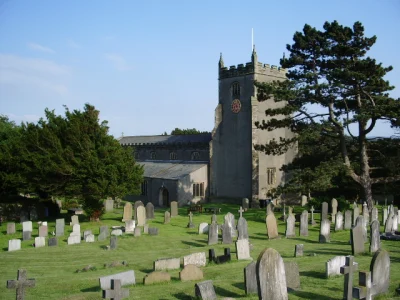
This cannot have changed much in its general outward appearance since Lucas wrote, or indeed since the early 17th century. Its fabric is largely 15th and 16th century. Lucas describes the church walls as strong and roughcast with lime and very small blue pebbles from the sea shore, and the roof entirely covered with lead. In his time a change in the course of the River Kent had revealed a quarry near Cotestones, from which the stone to build the church was believed to have come.
But if the outward appearance has changed little the interior must be very different. Lucas tells us that all the windows
” are very proportionate and agreeable to the exact Cimmetry of the whole Fabrick,” and that they all contain small fragments of painted glass ” .. . and yet not one Figure or Inscription entire or so much of them left that Conjecture can be made what they have been … ” (67)
He would have liked to see them taken down and the whole “new glazed“. No doubt he ” meant with clear glass, and such must have happened until nineteenth century taste replaced them with stained glass.
When he comes to describe the Quire he notes that before the Reformation no seats were allowed in the church
” … but the whole Body of the Church was Common, the whole Assembly in the more becoming Postures of Kneeling or Standing were promiscuous and intermixed”
Lucas supposed that the seating of the church had taken place soon after the removal of the “superstitious Ornaments“. He describes the seating in his day, when clearly the segregation of sexes was practised;
” The Seats for the Men (a few Pews excepted) have only a Board or Plank at the Back, but those for the Women are but one single Plank without any thing at Back, and are therefore certainly the properest Sort to prevent Lolling or other indecent Postures in Church”. (132)
Lucas speculates on what the church might have been like before the reformation; fine paintings, chalices, Patins, Crosses of silver,
“spoiled, embezled and made away with by Persons who. . . thought they had a Right to whatever Church Goods they could lay their hands on … “(75) .
In his day the rood loft remained, but in poor condition with its paintings largely defaced (119). In many churches no font survived the Commonwealth period, so Warton is typical in having a font dated 1661.
Lucas’s description of the altar arrangements, both in his time and as they had changed over earlier years is as follows;
“In the time of our happy Reformation King Edw. VI appointed that one decent Table should be provided for every Parish to be set in the Body of the Church, where they remained until Archbishop Laud’s time when it was removed to the East End of the Choir and enclosed with Rails, but the factious Party soon after prevailing they broke the Rails down and levelled the place with rest of the Church, at the Restoration 1660 the Altar Table was set in its place again, and the Rails set up within my remembrance”. (70)
“The Communion Table in this Church stands upon an Eminence (ascended by three Steps) that takes up the entire Breadth of the Quire, and was secured according to ancient Custom from the rude Approach of Dogs &c. by decent Rails and Banisters about the year 1699. It is covered with green Cloth, and at the celebration of the Holy Eucharist with fine linen … ” (71).
Lucas records the existence of the Arms of Washington (Arg. 2 bars Gul, in Chief 3 Mullets of the 2d) well cut in stone with a crescent for difference on the tower (238). He suggests that this means that the family (in his time represented in Warton by the Revd. Mr Laurence Washington) had been large contributors towards the building of the fabric. It is interesting in these days when this object, now placed in the interior of the tower, is a place of pilgrimage for citizens of the USA, that this was written before the birth of the first President.
Lucas describes three bells, one dated 1578, and notes that they were rung every Sunday morning at 7 o’clock to give the parishioners notice to prepare themselves by prayer for the public offices of the Church. The largest was tolled at the death of a parishioner (243).
One can assume that in his day the services followed the Book of Common Prayer exactly, and that on Sunday morning they were; Morning Prayer, followed by the Litany, followed by the Ante-Communion, with the sacrament only a few times a year. There was no organ in Lucas’ time, but a tradition that there had been one led him to suggest that it had been destroyed along with the Rood, Images, Paintings etc. circa 1570 (130).
In Lucas’ day the church was dedicated to St. Oswald, King of Northumbria, as it is today, though it seems at some periods to have been given a Holy Trinity dedication.
” … the Feast of Dedication … is now annually observed on the Sunday nearest to the first Day of August: and the vain Custom of Dancing, excessive Drinking &c. on that Day being, many years since, laid aside, the Inhabitants and Strangers spend that Day in duely attending the Service of the Church and making good Cheer, within the Rules of Sobriety, in private Houses, and the next in several Kinds of Diversions… ” (58) .
Two of the activities of the church are described by Lucas. The first is rush-bearing in connection with this feast of dedication. On that day there was;
” .. . usually a Rush-bearing, which is on this Manner. They cut hard Rushes from the Marsh. which they make up into long Bundles, and then dress them in fine Linen, Silk, Ribbands, Flowers, &c. Afterwards the Young Women of the Village which performs the Ceremony that Year, take up the Burdens erect upon their Heads and begin the Procession (Precedence being always given to the Churchwarden’s Burden) which is attended not only with Multitudes of People, but with Musick, Drums, Ringing of Bells, and all other Demonstrations of Joy they are able to express. When they arrive at the Church, they go in at the West End (the only publick use that ever I saw the door put to) and setting down their Burdens in the Church, strip them of their Ornaments, and strow the Rushes in the Seats leaving the Heads or Crowns of them deck’d with Flowers, cut Paper &c. in some Part of the Church, generally over the Cancelli. Then the Company returns to the Town from whence they came, and chearfully partake of a plentifull Collation provided for that Purpose; and spend the remaining Part of the Day and frequently a great Part of the Night also, in Dancing (if the Weather permits) about a May-Pole, adorned with Greens, Flowers &c. or else in some other convenient place.” (58)
Lucas’ description of funeral rites is less curious than one might have expected. First he mentions the great entertainment for all who came to the funeral, adding elsewhere “and this they call an Arval4” (265).
“The Heir of the Deceased plentifully furnishes One, two or more Tables, according to his Ability, of which the whole Company partake, everyone according to his liking. And afterwards there is distributed to everyone a Penny Wheaten loaf, and a large Shive of Cheese (which they take away with them) … I think I have heard that of late years, some have omitted the Cheese. Nor, whilst the Guests are thus feasted, are the Poor forgotten, but all that come (and great Numbers I have seen upon this Occasion, many whereof would rather go 7 or 8 Miles to a Penny-Dole, than earn Six Pence in the Time by a more laudable Industry) are put into some large Barn or Yard, and as they come out receive every one a Penny or more according to the Charity or Circumstances of the Giver. . . ” (261)
“Most of the Householders of this Parish were furnished with a finely wrought Coverlet which was used to be thrown over the Bier, when the Corps of any of the Family was carried to the Church: but of late they, the richer Sort especially, have made use of a black Pall … ” (262)
He describes how when the funeral party arrives they enter by the gate on the north side of the church, go round the east end, and carry the corpse beyond a thorn bush where formerly a yew tree stood, and only then enter the porch (272). The corpse is then placed in the quire while the vicar reads the funeral office, “and if the Deceased was the Master of a Family, and of moderate Circumstances, he usually preaches a Funeral Service” (264)
Less attractive activities, are also touched upon.
“First … a beastly Custom of unclean and irreverent Persons to pollute and bedaube the Walls (and sometimes the very Doors) of the Place where Almighty God is to be worshipped, with Piss or other more nasty Excrements; … Secondly, it was here (as in too many other Places) a scandalous Practice or Custom for those who despised or did not know or consider the great Benefits and Advantages of the publick Service of our Church, to loiter away their time in the fields, in the Church-Yard, or in the Ale House perhaps, till the greatest Part of it was over and then come into Church. And Sunday Afternoons were generally (by the younger sort especially) spent in idle Sports or Pastimes” (272)
Lucas tells us that Thomas Lawson who was the vicar from 1681 to 1710 set about reforming such abuse and providing music in Church, with great success in improving the parishioners churchgoing.
Notes
- J. Rawlinson Ford & J.A. Fuller-Maitland John Lucas’s History of Warton Parish, 1931 Reference numbers after quotations in this article refer to the paragraphs in the above edition ↩︎
- compound = “to accept terms of settlement in lieu of prosecution”. Oxford English Dictionary (OED). ↩︎
- Classis = “the elders or pastors of the parishes or churches of a district; a presbytery” O.E.D. ↩︎
- For the derivation of the word “arval” and a fuller discussion of funeral rites see J.D. Marshall’s A Funereal Topic ↩︎
By S.B. MeyerBurtt and Mary Meyer were estate manager and housekeeper at Yealand Manor when it was an evacuation school during the Second World War, and after that ran the Manor as a guest house for about ten years. The article that follows is thought to have been written sometime during those years, but has only just come to light. There are a few minor points, mentioned in notes at the end, on which one would like to have been able to consult the author, but it seemed a pity not to give the Society the benefit of this careful piece of work, so it was judged best just to print it in its entirety.
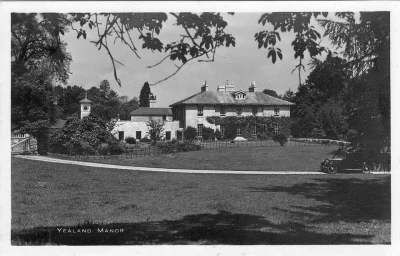
Yealand Manor
Yealand Manor occupies, without doubt, one of the finest sites in the three villages bearing the name of Yealand – Conyers, Redmayne and Storrs. These cling to the eastward side of a limestone ridge which terminates to the south in Warton Crag. The most reliable derivation of the name Yealand is from the Anglo-Saxon geahland, meaning “steep land”. In Domesday Book, and much later, it is called Jalant. The lordship of Conyers was never a large one, and was early linked with that of nearby Leighton by marriage. In later years it passed, by sale, into various hands.The original manor house, of which all trace is lost, is known to have stood in the park at a little distance from the lodge. The site is marked by a yard pump in the shade of a group of beech trees, and it seems probable that the ancient track, called Crag-gate, which can be traced leading down from Summerhouse Hill to the village below, past the former manor house. This may well have been little more important in size than some of the larger farm houses to be seen in the district today.
The present system of roads in the village is very different to that of former days. Up to the early nineteenth century there was little wheeled traffic and the so called Coach Road from Warton which enters the village down Peter Hill dates from that time only. Other roadways were widened during that century and their sides secured by retaining walls, as may be seen along the Manor boundary.John Ford, a ship-owner and builder of Lancaster, whose family came there in the eighteenth century from fforde Green in Staffordshire, bought the manor land at Yealand about 1800 and on it built the new mansion soon after. A great part of the stone was quarried locally, but the pillars and the steps of the portico, and possibly the casing of the main walls, came from further afield.
Two engraved stones – one above a side door and the other over a gateway in the garden – were brought from the family home in Lancaster, the site of which is now occupied by the Judge’s Lodging1. The Latin motto on one stone suggests that wealth may prove an incumbrance. The large bell, inscribed “Lady Cathcart” is reputed to have come from a sailing vessel of that name belonging to the family. Updated Mrs R. Greaves has found further information about these stones in Cross Fleury’s “Time-Honoured Lancaster”. The stones came, not from the Judges Lodgings at the top of Church Street, but from a house in St. Leonardsgate, now demolished, where at one time it is said, the Judges
used to lodge. Cross Fleury records the inscription on the stones.
One reads
Distribuendo Suum Cuique Neminem Timeas (by distributing his own to everyman you need fear no-one).
The other is a typical local date stone: L. I. R. 1756 The letters stand for Robert and Jane Lawson, great great grandparents of J. Rawlinson Ford the last to occupy Yealand Manor as a private house.The striking clock in the turret is probably of composite origin, as one of the three faces does not match the other two in size. Beneath the clock is a deep well, hewn from the solid rock. Formerly this supplied all drinking water to the house; for other purposes water was piped from catchments on the hillside. Later, the large covered reservoir, to the north side of the house, was constructed. In the distant past, smaller wells were sunk at many points on the estate, emphasising the extreme difficulty of maintaining a water supply on this rock foundation.
The manor walls themselves rise on solid rock, and in the surrounding pastures the soil is rarely of any depth. To gain such depth is doubtless the reason why the kitchen garden was made at such a distance from the house. This garden is contemporary with the house, but the rock garden was developed by the late Rawlinson Ford and his wife, who were the last to occupy the Manor as a private house. It subsequently became a guest house and, during the last war, a school.

The Summerhouse on Summerhouse Hill, Yealand Conyers mid 18th to mid 20th century (from MLHS Archives) It is known that the Summerhouse was at one time used as a club house by the Yealand Cricket Club, and that during the war the scouts were allowed to use it. Its history would repay further research.
Rising sharply above the manor is Summerhouse (formerly Barrow) Hill, on the summit of which John Ford built his gazebo2, with a clearance in the trees towards Ingleborough and a view, then
unobstructed, of the port of Lune3 to the south. With a telescope the family could identify ships at the quayside. An interesting feature hereabouts is a number of massive boulders of Shap granite
which were left in the path of the ice-age glacier.Alongside the primitive Crag-gate (referred to above) is an early grave site, marked by an old thorn bush, which was excavated by John Ford in the second decade of the last century and from which he took a clay urn containing bones and ashes. Tradition has it that this urn was later purposely destroyed by a superstitious house-maid. Many other signs of burial and tribal gathering from earliest times are in evidence; notably a few remaining stones of what is held to have been a circle4. The name Cringlebarrow, which is applied to the northern end of the ridge, is derived from Old English kringla, a circle.
Several ancient rights-of-way cross the Manor lands; one coming along Little Deepdale at the back of the Rock Garden and known as the “corpse road” was the quickest route from Far Yealand to the then parish church at Warton. Beyond this track is the real Deepdale, an impressive basin caused by rock faulting, and nearby are to be seen many specimens of the native yew tree. Those yews were accompanied formerly by a thin growth of alder, ash, birch and thorn. Later, coppice woods were developed to feed the charcoal industry and to provide material for bobbin making and other crafts. A century and a half ago the magnificent beech and other standard trees, including some fine conifers, were planted around the Manor and there are now more than forty varieties of tree on the estate.
Notes
- The Judge’s Lodgings date back to the seventeenth century. Perhaps the text should have read “near” the site of the Judge’s Lodgings. ↩︎
- Gazebo. The “Summer House” is older than this. Mr Tom Clare (personal letter) dates it to c.1750. ↩︎
- Port of Lune. Presumably Sunderland Point, or Glasson Dock, rather than Lancaster. ↩︎
- The idea of a stone circle on Summerhouse Hill has not been supported by later work. ↩︎
Published in Mourholme Magazines Issue 19 1992