By Arthur Penn
One of the most startling changes in the history of the church in England has been that from the apparently single church of the first millennium to the multiple sect pattern of today. Throughout most of the centuries of Christianity in Warton there seems to have been only one church with perhaps the odd chantry or private chapel connected with it. In the same area today, on a rough count, there are eight denominations and some sixteen places of worship. The seventeenth century saw the beginning of this change. Of course, the united nature of Christianity in its early centuries is something of an illusion, but heresy had never taken institutional form. After the earthquake of the sixteenth century Reformation, the seventeenth century saw the development of institutional expressions of religious points of view.

How did all this express itself in the local scene? Our main informant is John Lucas in his remarkable History of Warton Parish1, compiled in the early eighteenth century but unpublished till the twentieth. He apparently knew little, if anything, about how the Reformation had affected local life. We have to guess at how the various changes took place, on the basis of more general history. In Warton terms the denominational beginnings took three forms. First a very considerable number of the gentry families of Lancashire remained attached to the pre-Reformation order. Papists, or Popish Recusants, were the terms used for them, and Lucas gives a long list of those who in 1629 compounded2 for their annual rents. Among them are :-
Thomas Middleton Esq. of Leighton (£100),
Robert Chernley of Yealand Conyers (£1-10s)
and Leonard Washington of Warton (£1-10s).
The Middletons of Leighton Hall remained recusant throughout the period and must have been the real centre of Catholicism in the area. This did not mean however, a complete divorce from the parish church. They retained their large pew there, with “8 Escocheons” and a marble monument that testified that “Here lies the Body of Sr. George Midleton of Leighton Kt. and Bart, who died the 27th of Feb. in the Year of our Lord God 1673 and in the 74th of his Age”. (133)
The second form of denominational change was the arrival of Presbyterianism. Although the Church of England had adopted a good deal of the teaching of Calvin and the Geneva church, there were many who saw its reformation as incomplete, and sought a full Calvinist church. Whether such were to be found in Warton is not known, but when during the Civil War, Parliament was in control a Presbyterian Order was established, and the diocese was replaced by the “Classis3“. Lancashire had nine classes of which the eighth was centred on Lancaster and included Warton. The Lancaster classis had nine ministers, one of whom was Richard Walker of Warton, and eighteen elders. Three of these elders came from Kellet, but none from Warton. Whether James Smorthwaite B.A., who had been instituted to the living of Warton in 1632 was ejected is uncertain, but Richard Walker, mentioned above as a member of the classis, was instituted vicar of Warton by order of the House of Lords in 1647 and remained until 1654. His successor Francis Jackson M.A. was presented by Oliver, Lord Protector, in August 1655. In 1660 Jackson conformed to the revived Anglican order and was instituted again, this time on the presentation of the Dean and Chapter of Worcester.
The third denominational expression in the Warton area was Quakerism, but their story, it is hoped, will be taken up in a later issue of the magazine.
The Parish Church
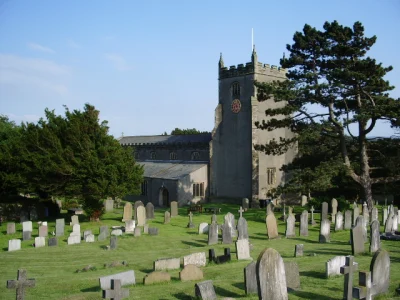
This cannot have changed much in its general outward appearance since Lucas wrote, or indeed since the early 17th century. Its fabric is largely 15th and 16th century. Lucas describes the church walls as strong and roughcast with lime and very small blue pebbles from the sea shore, and the roof entirely covered with lead. In his time a change in the course of the River Kent had revealed a quarry near Cotestones, from which the stone to build the church was believed to have come.
But if the outward appearance has changed little the interior must be very different. Lucas tells us that all the windows
” are very proportionate and agreeable to the exact Cimmetry of the whole Fabrick,” and that they all contain small fragments of painted glass ” .. . and yet not one Figure or Inscription entire or so much of them left that Conjecture can be made what they have been … ” (67)
He would have liked to see them taken down and the whole “new glazed“. No doubt he ” meant with clear glass, and such must have happened until nineteenth century taste replaced them with stained glass.
When he comes to describe the Quire he notes that before the Reformation no seats were allowed in the church
” … but the whole Body of the Church was Common, the whole Assembly in the more becoming Postures of Kneeling or Standing were promiscuous and intermixed”
Lucas supposed that the seating of the church had taken place soon after the removal of the “superstitious Ornaments“. He describes the seating in his day, when clearly the segregation of sexes was practised;
” The Seats for the Men (a few Pews excepted) have only a Board or Plank at the Back, but those for the Women are but one single Plank without any thing at Back, and are therefore certainly the properest Sort to prevent Lolling or other indecent Postures in Church”. (132)
Lucas speculates on what the church might have been like before the reformation; fine paintings, chalices, Patins, Crosses of silver,
“spoiled, embezled and made away with by Persons who. . . thought they had a Right to whatever Church Goods they could lay their hands on … “(75) .
In his day the rood loft remained, but in poor condition with its paintings largely defaced (119). In many churches no font survived the Commonwealth period, so Warton is typical in having a font dated 1661.
Lucas’s description of the altar arrangements, both in his time and as they had changed over earlier years is as follows;
“In the time of our happy Reformation King Edw. VI appointed that one decent Table should be provided for every Parish to be set in the Body of the Church, where they remained until Archbishop Laud’s time when it was removed to the East End of the Choir and enclosed with Rails, but the factious Party soon after prevailing they broke the Rails down and levelled the place with rest of the Church, at the Restoration 1660 the Altar Table was set in its place again, and the Rails set up within my remembrance”. (70)
“The Communion Table in this Church stands upon an Eminence (ascended by three Steps) that takes up the entire Breadth of the Quire, and was secured according to ancient Custom from the rude Approach of Dogs &c. by decent Rails and Banisters about the year 1699. It is covered with green Cloth, and at the celebration of the Holy Eucharist with fine linen … ” (71).
Lucas records the existence of the Arms of Washington (Arg. 2 bars Gul, in Chief 3 Mullets of the 2d) well cut in stone with a crescent for difference on the tower (238). He suggests that this means that the family (in his time represented in Warton by the Revd. Mr Laurence Washington) had been large contributors towards the building of the fabric. It is interesting in these days when this object, now placed in the interior of the tower, is a place of pilgrimage for citizens of the USA, that this was written before the birth of the first President.
Lucas describes three bells, one dated 1578, and notes that they were rung every Sunday morning at 7 o’clock to give the parishioners notice to prepare themselves by prayer for the public offices of the Church. The largest was tolled at the death of a parishioner (243).
One can assume that in his day the services followed the Book of Common Prayer exactly, and that on Sunday morning they were; Morning Prayer, followed by the Litany, followed by the Ante-Communion, with the sacrament only a few times a year. There was no organ in Lucas’ time, but a tradition that there had been one led him to suggest that it had been destroyed along with the Rood, Images, Paintings etc. circa 1570 (130).
In Lucas’ day the church was dedicated to St. Oswald, King of Northumbria, as it is today, though it seems at some periods to have been given a Holy Trinity dedication.
” … the Feast of Dedication … is now annually observed on the Sunday nearest to the first Day of August: and the vain Custom of Dancing, excessive Drinking &c. on that Day being, many years since, laid aside, the Inhabitants and Strangers spend that Day in duely attending the Service of the Church and making good Cheer, within the Rules of Sobriety, in private Houses, and the next in several Kinds of Diversions… ” (58) .
Two of the activities of the church are described by Lucas. The first is rush-bearing in connection with this feast of dedication. On that day there was;
” .. . usually a Rush-bearing, which is on this Manner. They cut hard Rushes from the Marsh. which they make up into long Bundles, and then dress them in fine Linen, Silk, Ribbands, Flowers, &c. Afterwards the Young Women of the Village which performs the Ceremony that Year, take up the Burdens erect upon their Heads and begin the Procession (Precedence being always given to the Churchwarden’s Burden) which is attended not only with Multitudes of People, but with Musick, Drums, Ringing of Bells, and all other Demonstrations of Joy they are able to express. When they arrive at the Church, they go in at the West End (the only publick use that ever I saw the door put to) and setting down their Burdens in the Church, strip them of their Ornaments, and strow the Rushes in the Seats leaving the Heads or Crowns of them deck’d with Flowers, cut Paper &c. in some Part of the Church, generally over the Cancelli. Then the Company returns to the Town from whence they came, and chearfully partake of a plentifull Collation provided for that Purpose; and spend the remaining Part of the Day and frequently a great Part of the Night also, in Dancing (if the Weather permits) about a May-Pole, adorned with Greens, Flowers &c. or else in some other convenient place.” (58)
Lucas’ description of funeral rites is less curious than one might have expected. First he mentions the great entertainment for all who came to the funeral, adding elsewhere “and this they call an Arval4” (265).
“The Heir of the Deceased plentifully furnishes One, two or more Tables, according to his Ability, of which the whole Company partake, everyone according to his liking. And afterwards there is distributed to everyone a Penny Wheaten loaf, and a large Shive of Cheese (which they take away with them) … I think I have heard that of late years, some have omitted the Cheese. Nor, whilst the Guests are thus feasted, are the Poor forgotten, but all that come (and great Numbers I have seen upon this Occasion, many whereof would rather go 7 or 8 Miles to a Penny-Dole, than earn Six Pence in the Time by a more laudable Industry) are put into some large Barn or Yard, and as they come out receive every one a Penny or more according to the Charity or Circumstances of the Giver. . . ” (261)
“Most of the Householders of this Parish were furnished with a finely wrought Coverlet which was used to be thrown over the Bier, when the Corps of any of the Family was carried to the Church: but of late they, the richer Sort especially, have made use of a black Pall … ” (262)
He describes how when the funeral party arrives they enter by the gate on the north side of the church, go round the east end, and carry the corpse beyond a thorn bush where formerly a yew tree stood, and only then enter the porch (272). The corpse is then placed in the quire while the vicar reads the funeral office, “and if the Deceased was the Master of a Family, and of moderate Circumstances, he usually preaches a Funeral Service” (264)
Less attractive activities, are also touched upon.
“First … a beastly Custom of unclean and irreverent Persons to pollute and bedaube the Walls (and sometimes the very Doors) of the Place where Almighty God is to be worshipped, with Piss or other more nasty Excrements; … Secondly, it was here (as in too many other Places) a scandalous Practice or Custom for those who despised or did not know or consider the great Benefits and Advantages of the publick Service of our Church, to loiter away their time in the fields, in the Church-Yard, or in the Ale House perhaps, till the greatest Part of it was over and then come into Church. And Sunday Afternoons were generally (by the younger sort especially) spent in idle Sports or Pastimes” (272)
Lucas tells us that Thomas Lawson who was the vicar from 1681 to 1710 set about reforming such abuse and providing music in Church, with great success in improving the parishioners churchgoing.
Notes
- J. Rawlinson Ford & J.A. Fuller-Maitland John Lucas’s History of Warton Parish, 1931 Reference numbers after quotations in this article refer to the paragraphs in the above edition ↩︎
- compound = “to accept terms of settlement in lieu of prosecution”. Oxford English Dictionary (OED). ↩︎
- Classis = “the elders or pastors of the parishes or churches of a district; a presbytery” O.E.D. ↩︎
- For the derivation of the word “arval” and a fuller discussion of funeral rites see J.D. Marshall’s A Funereal Topic ↩︎
Published in the Mourholme Magazine Issue 20 1993