(The following article under the above title appeared in the Lancaster Gazette, 13 September 1873, reprinted from the Liverpool Albion. In the interest of space, a few passages have been omitted, either prose ‘embellishments’ or technical details.)
Carnforth would be nothing without its railway and smelting works; in truth, it was the former which called it into existence. Just like Crewe, no one ever heard of Carnforth until the place was fixed upon by the railway companies as a convenient site for a “junction;” and now, just as every London train stops at Crewe, so each train bound for the North is brought to a stand at Carnforth… With the exception of a few agriculturalists, the population at this little town—sprung up where a few years back were waving tree-groves, pasture-land, and cornfields…—is composed entirely of persons connected with the blast furnaces, and persons connected with the London and North-Western, the Furness, and the Midland Railway Companies.
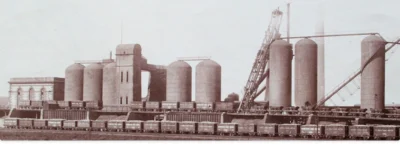
Carnforth Iron Works at its height of production The aristocracy is made up of the manager of the ironworks, the doctors, and the clergyman, for which latter personage a small chapel has been built, since Carnforth in old times never possessed a church. Next comes the middle-class society, comprising the railway clerks and inspectors, the clerks at the smelting establishment, and others. The third grade of Carnforthians is the most numerous; it embraces almost the whole population, to wit, the iron-workers and the railway porters. The town, or village, or hamlet, whichever it be, has its older houses, built of limestone from Warton Crag, a mountain that guards the entrance to Furness scenery; the newer ones are of ordinary quarry-stone, together with a large timber lately put up by the owners of the blast furnaces which are, we believe, of a peculiar cement construction, and were brought to Carnforth in a “piece form.” The names given to the ranges of dwellings are characteristic enough; we have, for instance, Bessemer-terrace, Free-trade Buildings, and Pig Iron Row. The house accommodation is quite inadequate to the number of inhabitants, so that many of the workmen employed at Carnforth have to seek lodgement in the pretty fishing village of Bolton-le-Sands, two miles to the south, or else at Warton and Yealand Conyers.
The country around is luxurious in appearance; two small rivers, the Keer and the Beela, wind down to a flat swamp that forms a continuation of the waste of sands in Morecambe Bay. The blast furnaces here are five in number, another being in course of erection; they belong to the Carnforth Haematite Iron Company, who commenced building the works in the latter part of 1864, fixing upon the present situation as being convenient for the procural of haematite ore by means of the Furness Railway, of lime as a flux from the adjacent Warton kilns, and of coal and coke from the colliery districts but five and twenty miles away…(section on collecting and using waste combustible gases);
Let us now glance at the workers themselves. First there are a number of men styled “fillers;” these shovel the ore and limestone in proper proportion into one iron-plated barrow, and the coke into another, and wheel them on to the “lift” to be raised to the galleries at the summit of the furnaces. This, of course, proves mere labourer’s work, and receives ordinary labourer’s pay. Upon arriving at the top of the lift-tower, the burrows are taken in hand by another set of workers, the “chargers.” These men at proper intervals, of which it is their business to be judges, wheel the material to the openings into each furnace and empty it into the funnel shaped hollow at the top; the “hell” which covers a hole at the bottom of the hollow is then lowered by the charger within the furnace, the smelting mixture being swallowed in as well. Every time that the bell is lowered in this way a large volume of choking gas rushes our enveloping the workman, who hurries away to escape breathing it. We were told that some three or four men each day were rendered insensible by the sulphurous fumes, and had to be carried away for restoration from this temporary suffocation…
It may be mentioned that the bell in use at the Carnforth works appears to be of hardly so improved a construction as that employed at furnaces of the Wigan Coal and Iron Company, since an escape of gas is continually issuing from beneath that at the former establishment, which has to be burned by the expedient of hanging a basket of lighted charcoal just above the bell; if there be a high wind the flaming vapour is being continually extinguished and the unburned gas being blown into the workers’ faces…
Turning now to the workers employed at the foot of the blast furnace, in the front where the hearth, the tapping-hole, and the casting-bed are situated, we have three persons to each furnace, namely, the “keeper,” the “helper,” and the “stagger.” The keeper is the principal man: he judges of the proper moment when the metal shall be run out, forms the rows of sand-moulds on the casting bed in front, and taps the furnace. In all his labours the helper assists; while it is the duty of the stagger to remove and direct in a right channel the scoriae and slag continually oozing out from an opening behind a stone called the “dam,” which lies above the tapping-hole. The stagger is a lad of thirteen or fourteen; from a stagger he will become a helper, and thence in a few years may rise to the position of keeper.
The visitor should walk in front of the furnaces at the time of casting. He will notice the long bed of sand with the wider channel leading from the furnace and communicating with the series of rows of moulds, each of them the size and shape of what the “pigs” will be; he will notice the keeper working away with a long-handled spade on a lever and throwing aside the slag, disclosing the bright orange liquid beneath, which rises and falls like the human pulse, and steams away, and makes the atmosphere above it swim and pant. Then all at once from without the opening the flames will be seen to burst forth, hissing and lolling out their great tongues, end licking in the crinkled air; but the keeper eludes them and plies his huge lever steadily. And now the helper brings a sharp-fanged pike, which is driven with heavy blows into the clay-stuffed tap-hole beneath the dam; three or four men take turns to hammer the stopping in, and at last the tank of metal within is reached, the pike is withdrawn, then forth gushes the red-hot stream pure-looking as syrup. All of the workmen connected with the actual manufacture of the metal are paid wages which vary with the quantity and quality of the metal produced.
The earnings of a keeper or a charger averages 8s per day; 5s 9d is certain, while the remainder depends upon circumstances which a good workman can materially govern. There are always some instances of industrious men to be pointed out at every establishment; accordingly, it was told us here how one keeper, scarcely more than a youth, had drawn that day as his fortnightly’ wage the sum of £7 10s. The men here, as at all blast- furnaces, work Sundays as well as week days. There is no change—night and day, year after year- the same routine goes on.
At the Wigan Coal and Iron Company’s works there are two shifts in twenty-four hours instead of three as here, and on every Sunday the gang who have worked during the day in the past week change to night men by continuing at their posts from 6 a.m. on the Sunday to 6 o’clock on the Monday morning. Thus one set gain a holiday every other Sunday, but to compensate for this once in each fortnight they have so lengthy a stretch of labour as one twenty- four hours’ duration.
The shifts of work at Carnforth are 6 a.m. to 2 p.m.; 2 p.m. to 10 p.m.; and 10 p.m. to 6 a.m., the night-work thus being labours in length. The ironworkers at Carnforth are not at all a dissipated class of persons. It is surprising, too, to see how soon they can sober themselves. A few hours before a man’s gang have to take their turn of toil, you will see him. incapably drunk; and. yet when the time arrives he presents himself as steadily and staidly as ever at the gates; perhaps it is the consciousness that, according to the agreements which he, in common with all employed at these works, has signed, half-a-crown will be the forfeit of absence which enables him to waken up just at the proper time. Should any workman absent himself, he whose spell of labour has just ended continues at his post during the defaulter’s turn besides, and receives an extra eight hours’ pay. The half-crown fine goes to the doctor’s fund, he asked whether there was much ill-usage of wives among the men; no such case was recollected, but we were informed that a few weeks before a strapping Carnforth wife had been sent to Lancaster Castle for beating her husband.
For more history on the Carnforth Ironworks, there is a website with its history and photographs.
Published in Mourholme Magazine Issue 2 Winter 1982
By David Peter
The following is a precis of a paper read at the last AGM of the Mourholme Local History Society on the 25th of March, 1982. The intention is to illustrate the value of diaries to students of local history.
This particular diary was written by a certain Edward Parker, who lived in Warton and worked in Carnforth. Unfortunately, it related to one year only (1887), but it was kept in considerable detail and in copper plate handwriting. It was ‘discovered after much research in the possession of one of his descendants now resident in South Wales.
It was written in a Dugdales Commercial Scribbling Diary, published by R. C. Dugdale, Printer and Stationer, Weekly News Office, Carnforth – price 1/-, now the premises of the Carnforth Book Shop. It closely resembled today’s Boots’ Desk Diary. The pages are interleaved with pink blotting paper and it contains much interesting information relating, for example, to Eclipses, bank holidays, the British Empire, the Royal Family, and many advertisements for patent medicines, amongst many other items of useful information. For example, did you know that ‘Common lodging houses have to be whitewashed in the first week in October?
Where did Edward Parker live?
There is no definite information in the diary, but he refers frequently to neighbour Mason at Toll Bar house. The only other houses in 1887 near to the Toll Bar (at the junction of Sand Lane and the low road to Silverdale) were Howard Cottages, built in 1885, and which still exist.
His papers included an Indenture which showed that on 11 December 1866 (when he was 14) he was apprenticed to a joiner and builder at Holbeck (Leeds). His wage initially was 4/- a week. In 1887 therefore he was 35 years old.
What Of His Family?
His wife is invariably referred to as Mrs Parker, Mrs P. or singly Mrs. We do not know her Christian name. They had 4 children – Master Harry (11), Beattie (9), Clara (8), and finally Arthur Edward born in 1887. He records in the diary that ‘Mrs P. was safely delivered of a fine son’, and adds ‘I am in much need of a rest’. Apart from odd colds, sore throats etc, the family enjoyed good health, although on one occasion, after visiting Settle, Edward recalls ‘I called for a glass of beer at the Craven Heifer, and whatever had been in the glass before I cannot say, but I was fairly drugged, and was not at all myself during the day’.
Where was he employed?
In 1887 he was in charge of the Wagon Repair shop at the Midland Railway shed at Carnforth station. This involved him in frequent visits to places on the line including Clapham, Ingleton, Bentham, Wennington, Ribblehead, Arkholme, Lancaster, etc. He was visited and ‘inspected’ frequently by a Mr. Haigh from Derby, and he describes in detail these encounters, e.g. ‘Mr. Haigh…spoke very strongly upon many points which caused me much grief and annoyance, especially so because I didn’t consider myself to blame in the least’. But the visitor could be pleasant, e.g. ‘he was more agreeable this time which is certainly more pleasant in every way. Bad economy is the root of all the evil which is worse than no economy at all’. On another occasion ‘he left at 4.30 p.m. He was very nice considering’ . On a third visit ‘he was very agreeable, which I felt was so different and made one’s heart feel light. His visit was a pleasure in a sense’.
Although employed by the Midland Railway Company Mr. Parker offered comments on the other two Railway companies operating through Carnforth. For example three men were summonsed for stealing goods from the Furness yard, and he notes in his diary, ‘I called for the first time in my life at the Castle (Lancaster) where the sessions were being held, and heard three railway men from Carnforth committed to twelve months each with hard labour for felony’. Relative to the London and Northwestern Railway he records on 20th May that ‘the Queen [Victoria] passes through at 3.20 a.m. in the morning for Balmoral’ On 28th October he saw ‘the Duke of Devonshire’s special through from Holker to Chatsworth. Lord Edward was with him’. In May he ‘went to East Junction to see the first Isle of Man boat train through. It was an excellent train and well filled’.
What Were His Outside Interests?
It is not clear in what capacity he served the local Co-operative Society, whether as Chairman, Secretary or Treasurer, but he was certainly a leading figure. He seemed to attend there most evenings, as frequent diary entries show. These were usually quite brief, such as ‘Co-operative at night’, ‘stock taking’, ‘Auditing accounts’, ‘amongst the books, re. alteration in rates’ ‘dividend declared at 2/6 in the £’ . Occasionally there is more to report, e.g. A lot of members present. Some three or four whose conduct was disgraceful. The meeting continued till a late hour. The work was got through. There was both amusement and great annoyance’. In the year of the diary it was decided to build a new office and shop for the Carnforth Co-operative Society at the top of New Street. The decision was taken on the 7th of May. Five days later the architect (a Mr. Walker) was told to ‘prepare specifications…cost not to exceed £2000’. Tenders were invited at the end of May and opened on 13th June. On 17th June ‘Thomas Pool’s tender was accepted for the whole work…for £1908’. Building work started early in July, and a month later the first payment on account, for £50, was made to the builder. It took only four months from the decision to build to the start of the building work.
The only jarring note in this story is the entry on 20th June when Mr. Parker ‘met Mr…. who was very insulting to me because he had not got the Coop, job’.
Had He Any Leisure Time Pursuits?
He was a keen gardener, growing especially fruit and vegetables, as the following diary entries show: ‘finished planting potatoes’, ‘sowed Veitch’s Perfection peas’. ‘went on Cragg for pea sticks’ ‘made up a hot frame’. His interest was mainly in soft fruits, illustrated by ‘gathering gooseberries’ and ‘shifting strawberry plants’. He was also keen on rearing poultry, e.g. ‘fetched broody hen from Haythornthwaite’s’, ‘bought a sitting of minorca eggs and sat the hen at night’, ‘made chicken coop in afternoon’, and later ‘eight chickens were hatched today and fine ones’, ‘sat thirteen eggs under a hen tonight’ ‘whitewashed poultry house and made it clean’.
Sundays
He was a very keen walker, especially on Sundays, e.g. ‘along with Thomas Mason we had a walk round Silverdale, which we thoroughly enjoyed’, ‘had a walk round Cragg in afternoon’, ‘walked to Warton at night for a bottle of stout for Mrs. P.’, ‘had a walk with Mr. Mason before noon up the Cragg to see the new paint mines where the oxide red is mined at a short depth’. Some of his Sunday walks had a religious significance, e.g. ‘Mrs. P. and I walked round the Cragg in the morning, and – thence to church, where she was prayed for’ ‘called at the Red Lion where there was a lot of young men who played and sang some nice sacred music’, ‘called at the revival service being held in a tent at Warton, and very nice it was to listen to the preacher, who was an exceeding kind hearted man’, ‘heard Mr. Shevill preach a beautiful sermon, and we sang some nice Sankey hymns and we enjoyed it much’.
Leisure time – Evenings
‘Mrs. and I had a walk as far as Thirkell’s…we arrived home late, a little before 9 p.m. Children had locked themselves in and fallen asleep and it was with some difficulty that we awoke them’. They did not learn from this experience, however, for on Christmas Day ‘Mrs. P. and myself went to Thirkell’s in afternoon to tea etc…late home… children so fast asleep it took us 3/4 hour to wake them…a splendid day’; ‘on New Years Eve…went to Mr. Hyte’s where I stopped until morning, and let the New Year in and a little Dunville’s…home about 1 a.m.’. By way of variety on May 20th they went to Dugdale’s ‘where we had a seance and did not get away till 12 midnight’. He frequently visited his friend and neighbour Mason at the Toll Bar where they had ‘several games of draughts which proved good battles’ and on another occasion ‘had a few downright good games of draughts… I proved the winner most decidedly’.
Longer Excursions – Holidays
Several of these merit reporting fully.-
5th June: ‘Up at 3 a.m. to catch the 4.15 train to Windermere where myself Mr. Haythornthwaite, Coulson, Hague, Masters, Williams, Boden, Wilkinson, Bland, and Salkeld were bound for a day’s outing. Arrived at Windermere at 5.15 a.m. and had a splendid breakfast at Rigg’s Hotel. Then took a charabang to Keswick, passing through Ambleside, Grasmere and alongside Thirlmere lake where the Manchester Corporation is making a reservoir for their water supply. Arrived at Keswick at 10.50 a.m. and put up at Sharman’s, the Station Hotel, and then had a short walk around Keswick. Had dinner at 11.50 a.m. and started the return journey at 12.30 noon, arriving at Windermere at 4.30 p.m. Had a good wash and a good tea at Rigg’s, then took the train home to Carnforth, where we arrived all safe after one of the most pleasant day’s outings that even I had in my life, and comparatively speaking to the long day we had I was not very tired. Children were pleased to see me on my return. Weather today was simply magnificent, not too hot’.
7th August: ‘To the station where Mr. Haythornthwaite, his brother Peter and a Miss Austin and myself took a trap and had a splendid drive to Ingleton, where we saw some of the finest scenery in England and thoroughly enjoyed ourselves. We set off to return home about 7 p.m. All went well till we got to the Red Well public house. Soon after passing there both shafts of the trap broke and pitched all four of us out of the trap – done in an instant. It was dark and we all escaped with little or no damage to ourselves. I was in a very dangerous position at one time, and it was a miracle we were not killed. The horse ran away with the broken shafts fast to it, and we caught it half a mile away. Horses knees were cut a little and the trap is a wreck. We had to walk remainder of the journey, and carry part of the things, which made it very late. I do not feel much hurt’.
10th – 17 September: Holiday with the whole family at Leeds, staying with, and visiting relatives and friends, Mr. Parker spent much time with the children at the ‘Feast’. On the 15th they had a trip to Scarborough. ‘It was miserably wet. Myself and Mrs, Webster went into the Aquarium and enjoyed ourselves there’.
Queen Victoria’s Golden Jubilee 13th June: Sold W. Miller esq. of Hillwood House, Grange, a tone of firewood to make Jubilee bonfire of’ (probably scrap from the wagon repair shop). 21st June: ‘All men that can be spared today have a day’s holiday given them and pay for same in commemoration of the fifty year’s reign our Queen. There is arches erected and bunting in abundance. All the children had a tea and a jug given then. Old people over 60 had a good dinner. It was splendid weather and everyone seemed to thoroughly enjoy the day. Large bonfire was lit on the Cragg. Magnificent in Lancaster at night – torchlight procession’, The following paragraph was written in red ink: This summer has been the driest known by anyone at present living. Villages without water. Towns nearly so, and at Silverdale and Yealand it has had to be carried from the canal. We have had to get Farmer Thwaites to cart water for us. In some parts of the country works have stopped for lack of water, and there has been quite a famine’ Apart from an occasional slight shower the country was in the ‘grip’ of a heat wave for fifty one days.
Notes
Certain important pieces of information are omitted from the diary, such as his wife’s Christian name, the exact position of his home, the precise location of the new Co-op buildings, his own position in that organisation, etc, but as the diary was obviously intended as a personal record such details were no doubt considered unnecessary. But the surprising thing is that there is no reference at all to the Carnforth Iron Works which in 1887 was well established, when it is considered that his house was within 1/4 mile, as the crow flies, and in full view of the Iron Works and its furnaces that the mineral line which carried limestone from the Scout Quarry to the works, passed close to his house, and that the line along which slag was taken to be tipped on the Warton sands also passed closely by, it seems remarkable that over the period of a year it did not qualify even for a passing mention.
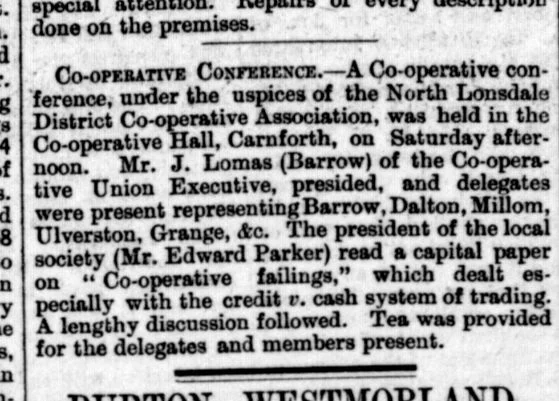
[Ed Further research has confirmed the following: The 1891 census for Howard Cottages shows Edward (39) born in Leeds is living with Mary (37) also born in Leeds, all the children are born in Carnforth Beatrice (Beattie) (12), Clara (11), Harry (8), Ernest (6), Arthur (4) and is employed as a chief inspector of railway rolling stock. Edward and are are still living at Howard Cottages on the 1901 census with only their three sons living with them. Edward Parker was the President of the Carnforth Co-operative Society – 8th December 1893 Lancaster Standard and County Advertiser
Published in Mourholme Magazine Issue 2 Winter 1982
By Jean Chatterley
An 1890 map of Carnforth shows a compact area of houses, within the parish of Warton, separated from Carnforth and the Ironworks by the railway and the River Keer, and labelled ’Dudley’ – the area we now call Millhead. Local lore has it that the earlier name, Dudley, was born as a nickname, many of the residents having come from the Dudley area of the West Midlands to work in the Iron works. This account is a brief investigation into this local lore.
Certainly at the time of the 1861 census the settlement did not exist1. In fact, of all the residents registered in Warton in that year, there were only eight to represent the beginnings of that rapid change which brought the Industrial Revolution to the heart of our parish. These were five railway labourers, a railway porter, a signalman, and one lady, Margaret Heigham, who in the space allocated for ’occupation, rank or status’ on the census, is described as ’A Railway Shareholder’, doubtless a status symbol of some importance, to her at least!
By 1871, the population of the parish had increased by nearly 77%, from 579 in 1861 to 1060. Analysis of the census data reveals that the intervening decade had seen a great influx of young people, mostly under 40 (single men and couples with large families), and that nearly all of them lived in Millhead rather than in old Warton village. Of the newcomers, about 180 were children under 10 years old. The census returns give place of birth, and it is interesting to note that in Dudley, only children of 5 or under are shown as being born in Warton parish, from which we can assume that the parents had been there only since 1867 or 1868. The Ironworks had opened in 1864. A study of the birthplaces of the older children reveals where the parents had lived before moving to work here. Some of them, like their parents, were born in the Dudley-Bilston-Wednesbury area of the West Midlands, giving basis to the general idea that many of Dudley’s people were from the Midlands Dudley, Many, however, were not only born elsewhere, but had travelled around with their parents from one industrial area to another, often gaining a baby brother or sister at each stop. In fact, it would seem that for many families, migration from one coalfield to another in search of work, perhaps spending a couple of years in each place, was the accepted pattern of life.
Thomas Patterson, for instance, was listed in 1871 as a 36 year old iron furnace labourer, born in County Down, Ireland, with two children born in Tunstall and Hanley (the Potteries, Staffordshire).
William Iniff, 31, a blacksmith, was born in Rochdale, and of his four children, two were born in Workington, and two in Warton.
Samuel Lunn, 31, a steelmaker, was born in Bradford, married and had one child in Oldham, and another in Manchester, before moving to Dudley.
Joseph Waite, 32, another ironworks labourer, was born in Northamptonshire and had come via Coldsgreen in the West Midlands.
Others had come from the Midlands via Barrow-in-Furness, from Ireland via County Durham, from Monmouthshire via Cumberland, and so on. If one plotted the birthplaces of these new families on a map, it would show that they had made their way to Dudley from every coalfield in Britain, but that a large proportion had come from or through the West Midlands. The houses in Dudley must have been crowded indeed.
The census shows us that many workers had large, young families, and also took in boarders or lodgers. These Lodgers were often relatives, and/or single men from the same home town as the ‘head of Household’. Sometimes the lodger is described as a married man, presumably working and waiting for a house to which he could move his own family. In William Street, for example, lived Benjamin and Katherine Evans, an iron furnace labourer and his wife, both in their 20’s, with three daughters aged 5, 3 and 1 all fron Wednesfield, and six unmarried men, all labourers in their early 20’a except for one, a 45 year old key-maker, and all but one from Wednesfield, Willenhall, and Bilston. Sometimes two complete families shared one house. The census also gives us the occupations of the workers. ‘Pig lifters’ and ‘steel blowers’ were not to be confused with the general ‘Iron Works Labourers’ who formed the largest occupational group in Dudley. It is remarkable now few jobs were given to local lads. Joseph Jackson, 17, the son of the quarrymaster, and John Newby, 54, a farmer’s son were taken on as clerks in the Ironworks, but only John Atkinson, the 19 year old son of a carter, was employed as a labourer from Warton itself. The employers were presumably after men with experience.
Jon Haven, who has researched into the everyday lives of workers of this period in the West Midlands and who has a folk museum there, told me that ‘at the time you mention, ‘1868-’71, the Dudley iron mines would have been very much in decline ….as were some of the coal mines. The district was investing its labour and skills in the upcoming engineering industry, and many workers were retraining…no doubt the failure of industry in this area was known to those opening the Ironworks, and I imagine an agent was sent down to attract people.’ Any such agent would have been sent by Mr Edward Barton. He was the Ironworks’ Managing Director, and had been engaged to a group of Manchester businessmen, originally as engineer in charge. In 1871 we know that he was living at Warton Hall Farm, with servants but without his family. The company later built what is now Warton Grange Hotel [Ed. now demolished] as his private residence, a measure of their opulence and of the status of the Ironworks in our part of Victorian England. Mr Barton is recorded in the census as employing 300 men. Although the census returns are a valuable source of facts and figures, they seem ‘dry and dusty* compared with the newspapers of these decades.

Warton Grange It is from these that we are learning much about the living and working conditions of those 300 men and their families, I refer readers to other pages in this magazine, and to the papers themselves. We are still seeking the answers to some of our questions, and perhaps you can help. For instance, when did the name ‘Dudley’ stop being used? And do you know anything about Mr Barton’s family? (One of his descendants, now living in the USA, has made a particular request for any details.) We understand that some men walked from Dudley to Dudley—do you know of any such? And we would welcome any songs, rhymes, or customs associated with the Dudley men.
Notes
- The census returns are housed at the Lancashire County Record Office in Preston and most libraries in the UK as well as Ancestry.co.uk and findmypast.co.uk ↩︎
Published in Mourholme Magazine Issue 2 Winter 1982
by Gordon Bottomley
When you destroy a blade of grass
You poison England at her roots
Remember no man’s foot can pass
Where evermore no green life shoots.You force the birds to wing too high
Where your unnatural vapours creep:
Surely the living rocks shall die
When birds no rightful distance keep.You have brought down the firmament
And yet no heaven is more near;
You shape Huge deeds without event,
And half made men believe and fear.Your worship is your furnaces,
Which, like old idols, lost obscenes,
Have molten bowels; your vision is
Machines for making more machines.0, you are busied in the night.
Preparing destinies of rust;
Iron misused must turn to blight
And dwindle to a tattered crustThe grass, forerunner of life, has gone,
But plants that spring in ruins and shards
Attend until your dream is done:
I have seen hemlock in your yards.The generation of the worm
Know not your loads piled on their soil;
Their knotted ganglions shall wax firm
Till your strong flagstones heave and toil.When the old hollowed earth is cracked.
And when, to grasp more power and feasts,
Its ores are emptied, wasted, lacked,
The middens of your turning beastsShall he raked over till they yield
Last priceless slags for fashionings high,
Ploughs to wake grass in every field,
Chisels men’s hands to magnify.Notes
Gordon Bottomley, poet and playwright, lived at ‘The Shelling in Silverdale from 1914 until his death in 1948. Like so many others, he was drawn to this area by the beauty of its landscape and the simplicity of its traditional way of life. It is not certain that the Carnforth Ironworks inspired this poem -he was living in Cartmell in 1908 when the poem was written- but it is probable.
Extracted from ‘Gordon Bottomley, Thirty Years of Poetry (1927) pp 4-5
Thanks to Helen Phillips of the English Department, Lancaster University, for helping locate the poem.Published in Mourholme Magazine Issue 2 Winter 1982