
(The following article under the above title appeared in the Lancaster Gazette, 13 September 1873, reprinted from the Liverpool Albion. In the interest of space, a few passages have been omitted, either prose ‘embellishments’ or technical details.)
Carnforth would be nothing without its railway and smelting works; in truth, it was the former which called it into existence. Just like Crewe, no one ever heard of Carnforth until the place was fixed upon by the railway companies as a convenient site for a “junction;” and now, just as every London train stops at Crewe, so each train bound for the North is brought to a stand at Carnforth… With the exception of a few agriculturalists, the population at this little town—sprung up where a few years back were waving tree-groves, pasture-land, and cornfields…—is composed entirely of persons connected with the blast furnaces, and persons connected with the London and North-Western, the Furness, and the Midland Railway Companies.
The aristocracy is made up of the manager of the ironworks, the doctors, and the clergyman, for which latter personage a small chapel has been built, since Carnforth in old times never possessed a church. Next comes the middle-class society, comprising the railway clerks and inspectors, the clerks at the smelting establishment, and others. The third grade of Carnforthians is the most numerous; it embraces almost the whole population, to wit, the iron-workers and the railway porters. The town, or village, or hamlet, whichever it be, has its older houses, built of limestone from Warton Crag, a mountain that guards the entrance to Furness scenery; the newer ones are of ordinary quarry-stone, together with a large timber lately put up by the owners of the blast furnaces which are, we believe, of a peculiar cement construction, and were brought to Carnforth in a “piece form.” The names given to the ranges of dwellings are characteristic enough; we have, for instance, Bessemer-terrace, Free-trade Buildings, and Pig Iron Row. The house accommodation is quite inadequate to the number of inhabitants, so that many of the workmen employed at Carnforth have to seek lodgement in the pretty fishing village of Bolton-le-Sands, two miles to the south, or else at Warton and Yealand Conyers.
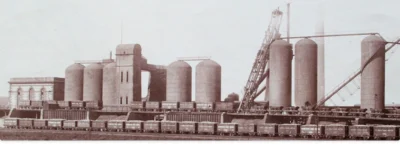
The country around is luxurious in appearance; two small rivers, the Keer and the Beela, wind down to a flat swamp that forms a continuation of the waste of sands in Morecambe Bay. The blast furnaces here are five in number, another being in course of erection; they belong to the Carnforth Haematite Iron Company, who commenced building the works in the latter part of 1864, fixing upon the present situation as being convenient for the procural of haematite ore by means of the Furness Railway, of lime as a flux from the adjacent Warton kilns, and of coal and coke from the colliery districts but five and twenty miles away…(section on collecting and using waste combustible gases);
Let us now glance at the workers themselves. First there are a number of men styled “fillers;” these shovel the ore and limestone in proper proportion into one iron-plated barrow, and the coke into another, and wheel them on to the “lift” to be raised to the galleries at the summit of the furnaces. This, of course, proves mere labourer’s work, and receives ordinary labourer’s pay. Upon arriving at the top of the lift-tower, the burrows are taken in hand by another set of workers, the “chargers.” These men at proper intervals, of which it is their business to be judges, wheel the material to the openings into each furnace and empty it into the funnel shaped hollow at the top; the “hell” which covers a hole at the bottom of the hollow is then lowered by the charger within the furnace, the smelting mixture being swallowed in as well. Every time that the bell is lowered in this way a large volume of choking gas rushes our enveloping the workman, who hurries away to escape breathing it. We were told that some three or four men each day were rendered insensible by the sulphurous fumes, and had to be carried away for restoration from this temporary suffocation…
It may be mentioned that the bell in use at the Carnforth works appears to be of hardly so improved a construction as that employed at furnaces of the Wigan Coal and Iron Company, since an escape of gas is continually issuing from beneath that at the former establishment, which has to be burned by the expedient of hanging a basket of lighted charcoal just above the bell; if there be a high wind the flaming vapour is being continually extinguished and the unburned gas being blown into the workers’ faces…
Turning now to the workers employed at the foot of the blast furnace, in the front where the hearth, the tapping-hole, and the casting-bed are situated, we have three persons to each furnace, namely, the “keeper,” the “helper,” and the “stagger.” The keeper is the principal man: he judges of the proper moment when the metal shall be run out, forms the rows of sand-moulds on the casting bed in front, and taps the furnace. In all his labours the helper assists; while it is the duty of the stagger to remove and direct in a right channel the scoriae and slag continually oozing out from an opening behind a stone called the “dam,” which lies above the tapping-hole. The stagger is a lad of thirteen or fourteen; from a stagger he will become a helper, and thence in a few years may rise to the position of keeper.
The visitor should walk in front of the furnaces at the time of casting. He will notice the long bed of sand with the wider channel leading from the furnace and communicating with the series of rows of moulds, each of them the size and shape of what the “pigs” will be; he will notice the keeper working away with a long-handled spade on a lever and throwing aside the slag, disclosing the bright orange liquid beneath, which rises and falls like the human pulse, and steams away, and makes the atmosphere above it swim and pant. Then all at once from without the opening the flames will be seen to burst forth, hissing and lolling out their great tongues, end licking in the crinkled air; but the keeper eludes them and plies his huge lever steadily. And now the helper brings a sharp-fanged pike, which is driven with heavy blows into the clay-stuffed tap-hole beneath the dam; three or four men take turns to hammer the stopping in, and at last the tank of metal within is reached, the pike is withdrawn, then forth gushes the red-hot stream pure-looking as syrup. All of the workmen connected with the actual manufacture of the metal are paid wages which vary with the quantity and quality of the metal produced.
The earnings of a keeper or a charger averages 8s per day; 5s 9d is certain, while the remainder depends upon circumstances which a good workman can materially govern. There are always some instances of industrious men to be pointed out at every establishment; accordingly, it was told us here how one keeper, scarcely more than a youth, had drawn that day as his fortnightly’ wage the sum of £7 10s. The men here, as at all blast- furnaces, work Sundays as well as week days. There is no change—night and day, year after year- the same routine goes on.
At the Wigan Coal and Iron Company’s works there are two shifts in twenty-four hours instead of three as here, and on every Sunday the gang who have worked during the day in the past week change to night men by continuing at their posts from 6 a.m. on the Sunday to 6 o’clock on the Monday morning. Thus one set gain a holiday every other Sunday, but to compensate for this once in each fortnight they have so lengthy a stretch of labour as one twenty- four hours’ duration.
The shifts of work at Carnforth are 6 a.m. to 2 p.m.; 2 p.m. to 10 p.m.; and 10 p.m. to 6 a.m., the night-work thus being labours in length. The ironworkers at Carnforth are not at all a dissipated class of persons. It is surprising, too, to see how soon they can sober themselves. A few hours before a man’s gang have to take their turn of toil, you will see him. incapably drunk; and. yet when the time arrives he presents himself as steadily and staidly as ever at the gates; perhaps it is the consciousness that, according to the agreements which he, in common with all employed at these works, has signed, half-a-crown will be the forfeit of absence which enables him to waken up just at the proper time. Should any workman absent himself, he whose spell of labour has just ended continues at his post during the defaulter’s turn besides, and receives an extra eight hours’ pay. The half-crown fine goes to the doctor’s fund, he asked whether there was much ill-usage of wives among the men; no such case was recollected, but we were informed that a few weeks before a strapping Carnforth wife had been sent to Lancaster Castle for beating her husband.
For more history on the Carnforth Ironworks, there is a website with its history and photographs.
Published in Mourholme Magazine Issue 2 Winter 1982