by Mary A. Atkin
I have much enjoyed Ellis Peter’s “medieval who-dun-its” set in Shrewsbury during the upheavals of King Stephen’s reign, but often found myself wondering what was happening in our own area in the north west of England. There has recently been a good deal of research into the lordships and the happenings in the area which is modern Cumbria and in the regions around it. It is possible therefore to enquire into the impact that those happenings may have had on the Manor of Warton in the period from Domesday Book (1086) to the early years of Henry II’s reign (1154-1189) which nearly coincides with the lifetime of William de Lancaster, first Baron of Kendale and Lord of Warton and Garstang, who is thought to have been born c.1090 and died in 1170.
We are looking therefore at a period of just under a century from the Norman Conquest of 1066, a period which reaches into the reigns of five kings, William the Conqueror, and his two sons William II (Rufus 1087-1100) and Henry I (1100-1135). Under the two Williams the kingdom expanded in size and Henry’s reign saw a period of consolidation. On Henry’s death, his nephew, Stephen got himself crowned and anointed before Henry’s daughter, Matilda (Ellis Peter’s “Empress Maud”) could do so, thereby giving rise to a period of civil war which mainly affected south-west England, but inevitably caused some loss of control of parts of the kingdom. This civil war finally ended when Stephen died (in 1154) and Matilda’s son Henry became king; a strong king who won back and consolidated his grip on the kingdom.
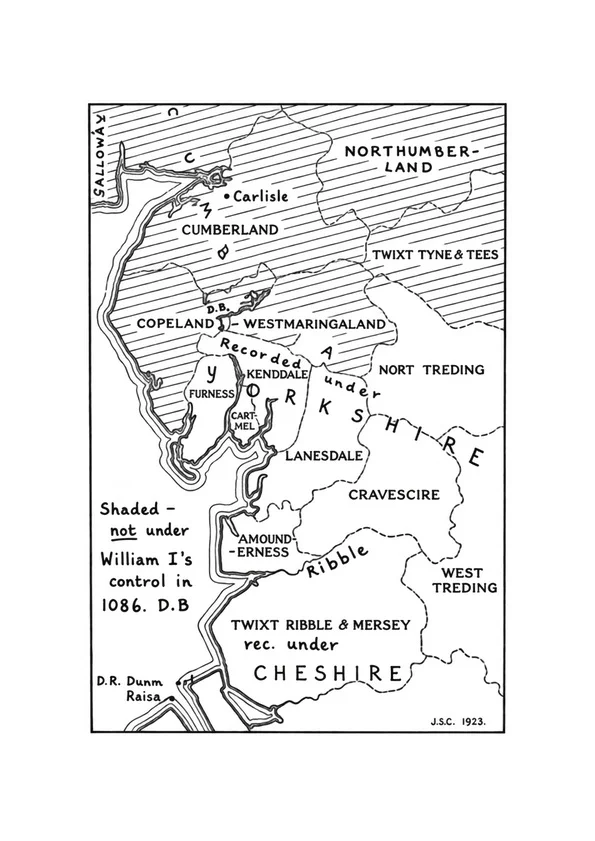
The map shows the land which William the Conqueror ruled at the time of Domesday Book, completed in 1086, only one year before he died. In our area there were no counties of Lancashire, Cumberland and Westmorland. What he held in our area was recorded under the heading of “Yorkshire”, that is the districts of Furness, Cartmel and Kendale (then called “Stirkeland” – the “district of cattle”) whose northernmost point was at the summit of Dunmail Raise, and eastward by the crest of the passes of Kirkstone and Gatescarth, and along the line of the Shap Fells to Low Borrow Bridge on the Lune. Warton (with Priest Hutton) was one of a scattered group of manors which were attached to the manor of Austwick and were also in the King’s hands, while Yealand (presumably both Yealands) with Borwick were grouped with Beetham and Heversham.
To the north lay lands which once formed the ancient British (i.e. Celtic) district of “Cumbria”, part of an old kingdom called Strathclyde, which now acknowledged the King of Scots. It included the district called “Westmaringaland”, later the north part of the county of Westmorland.
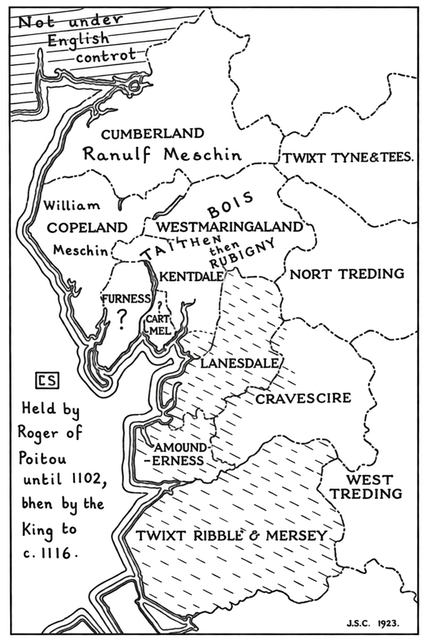
His son, William Rufus (1087-1100) pushed the bounds of his kingdom northwards to roughly the line of the Solway Firth, (see map 2) and fortified Carlisle, giving it, and the districts of Cumberland, Copeland and “Westmaringaland” (W.Farrer’s term) to Ranulf Meschin I, and he in his turn granted out other parts to his knights, including his brother William Meschin who became lord of Copeland, centred on Egremont. New settlements were established and populated with peasants brought from the south-east and new Norman overlords to control the area. Further south Roger of Poitou became lord of most of Lancashire including Warton. And that is why Warton is in Lancashire!
William Rufus’s sudden (and suspicious) death brought the youngest son of William the Conqueror to the throne of England as Henry I. He had inherited much of his father’s character, being astute, able in warfare and ruthless. Having rapidly got himself crowned King of England he determinedly set about taking Normandy from his eldest brother Robert, to whom William the Conqueror had left it. At the battle of Tinchebrai in 1106 he routed Robert and his supporters and imprisoned Robert for the rest of his life. Inevitably this made him enemies who rallied to support Robert’s son. So Henry had to cope periodically with defending what he had won. Like his father and brother he understood the value of castles sited at strategic points and manned permanently with well-armed soldiers as a means of holding an area under control. Trusted followers were established in manors round about the castles holding their land by knight service, which meant that in return for their land they were to come to the aid of their overlord when required with a body of armed men.
These castles, at least at first, were the motte (a mound) and bailey (an enclosed courtyard) type often consisting of raised earthen platform with a higher, smaller mound built at one side of the platform, each crowned by a stockade of very solid timbers standing on earthen banks surrounding both the motte and the bailey. The earthworks of one are still readily visible at Kendal above and to the west of the town, and a better (because less modified) one at Burton in Lonsdale. There may have been a small motte at Warton too – the name Castle Dyke appears on the Tithe Award map on the old road to Silverdale, perhaps demanded by the King himself as overlord of the Honour of Lancaster after Roger of Poitou was sent into exile for yet another rebellion.
While such small castles could relatively easily be avoided by an enemy they served to overawe the local inhabitants, and could provide a ready body of armed men to watch and control important corridors of movement. Kendal lying at the junction of two Roman roads whose surfaces continued for centuries to preserve them as local routeways, was one such site, and one might speculate whether Warton’s role (the name means “guard settlement” from the Anglo-Saxon weard and tun) was to keep watch on the cross-Bay landing places as well as the crossing of the river Keer. The construction of these castles would be overseen by Norman lords and knights but the labourers would be drawn from the local peasants, who would have to delve the deep ditch which provided the earth for the mound, and haul the timbers into place.
There was not necessarily resentment between the new overlords and their tenants. In many of the villages of north-west England the new manors functioned using types of tenure and old customs which undoubtedly originated from long before the Norman Conquest and some of these were still being recorded as late as the 17th century. Furthermore many incoming Normans, whether aristocratic or simple soldiers, married themselves to native heiresses. Thus the ensuing generation could make some claim to an inherited continuity through their mothers.
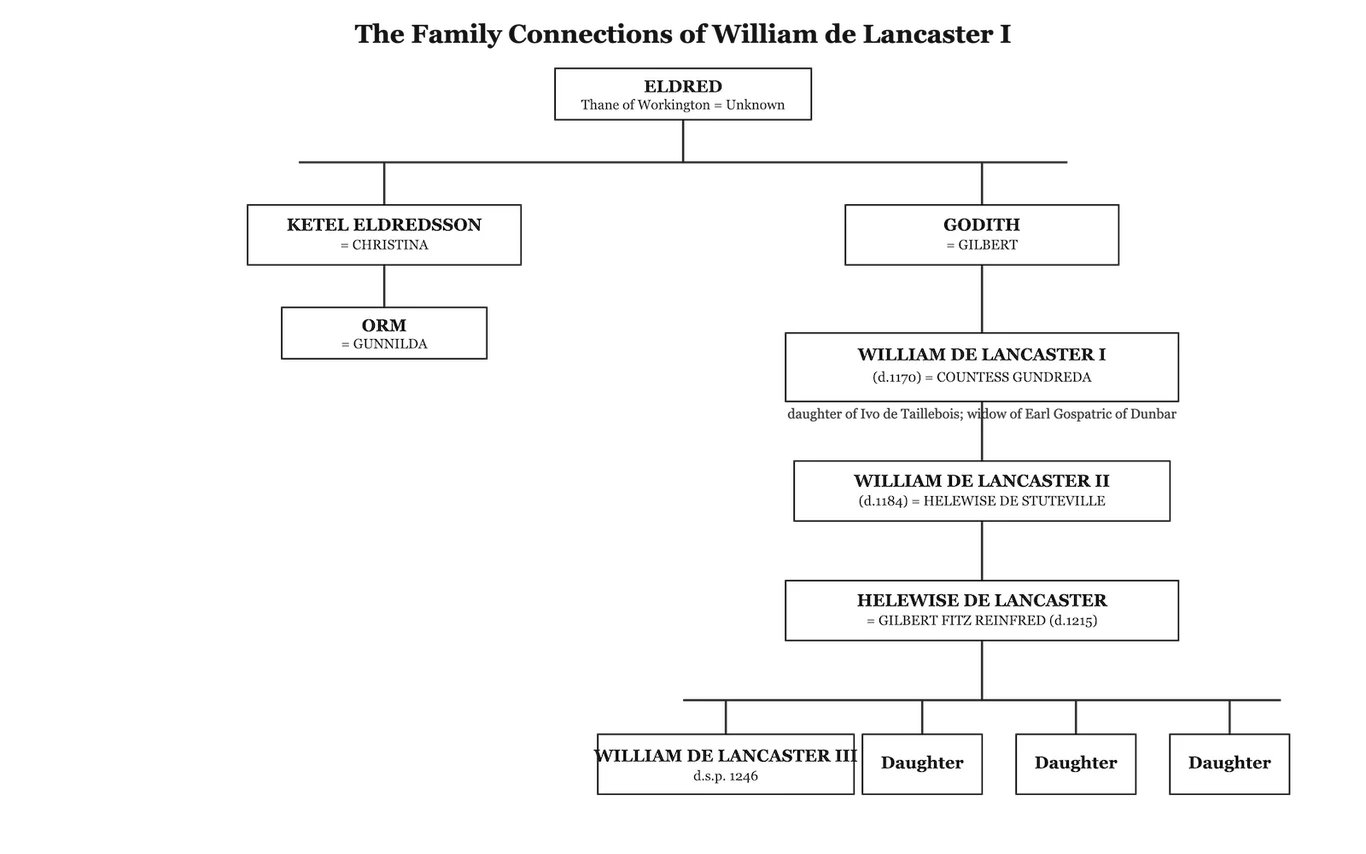
Note
1. William de Lancaster I’s daughter, Avice was married to the son (Richard) of Hugh de Morville, Constable of Scotland, lord of Westmoringaland and lifelong friend of David, King of Scotland
2. Gunnilda was the sister of half sister of Etheldreda, wife of King Duncan of Scotland and mother of William fitz Duncan.
One such was Gilbert the father of William de Lancaster I. (see family tree). William was known at first simply as William fitz Gilbert, William the son of Gilbert. Nothing is known of Gilbert but he must have been well-regarded for he was married to a well-born native lady, probably with an Anglo-Scandinavian background, called Godith. She was the daughter of a thane (an English nobleman) called Eldred, who was the Lord of Workington and had very illustrious connections. His son Ketel appears to have been married to the daughter of an earlier Lord of Kendal called Ivo de Taillebois, and Ketel himself held land in Kirkby Kendal and a large part of the area north of Kendal, perhaps giving rise to the township-name of Strickland Ketel.
Farrer records William de Lancaster being enfeoffed by King Stephen as Lord of Warton and Garstang only as late as 1135, but I wonder whether Gilbert might himself have held Warton and Garstang, and that William acquired them by inheritance at his father’s death. William almost certainly acquired from his mother Godith, or from his Grandfather Eldred, the property called Swartahof (near Whitehaven) which he gave to the priory of St. Bees.
If Gilbert did indeed hold Garstang and Warton at this time, in 1116 he got a new overlord, a man who was to play a very important part in the future. This was Stephen, Count of Blois, King Henry’s nephew, who, (probably when he came of age) was given the newly created Honour of Lancaster, including both Furness and Cartmel. One of the lasting consequences of this was the establishment by Stephen of a colony of monks in Bekanesgill, which eventually became the Cistercian monastery of Furness Abbey. Another of King Henry’s protégés, who like Stephen, were to influence future events, was David, soon to be King of Scots, for whom Henry arranged an advantageous marriage with the heiress of the Earl of Huntingdon, and wide estates in that area.
Like any manorial lord of the time the Lord of Warton would obtain his living mainly from the agricultural produce of his manors, and for that, he depended on the labour of his tenants. Some of these would be freemen, free to leave the manor, but the great majority were bondmen, the property of their lord and tied to the land. This did not, however, mean that they were without rights. They were entitled to “the customary rights of the manor”, which meant a right (which could be passed to an heir, after payment of a heriot) to a share of arable land (usually in scattered strips in the “common fields”) for growing their own food. This arable land carried with it rights to meadow (also in strips) for hay; to common pasture for grazing their animals; to certain classes of timber for housing, tools and fuel; and, in much of the north, to turbary and rushes from the local peat mosses. In return the bondmen owed seasonal labour services (ploughing, harrowing, and harvesting the corn on the lord’s demesnes of Leighton,. Hyning, Tewitfield and Yealand Hall) and had to grind their corn at the lord’s mill at Whitebeck.
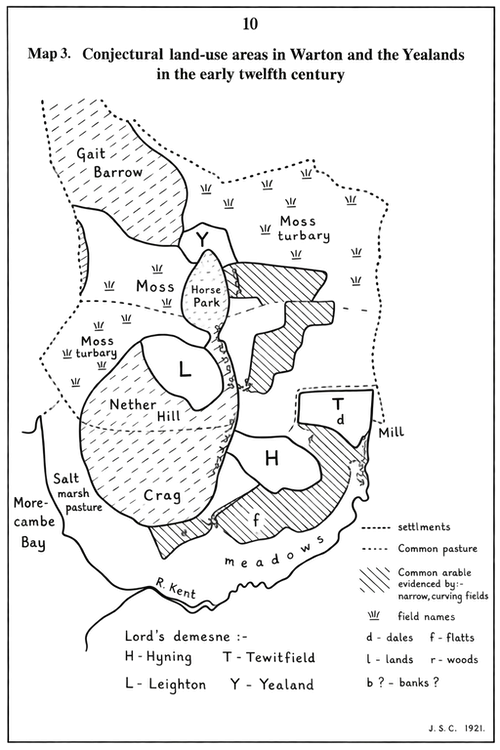
The map above shows the probable distribution of these types of land in Warton and the Yealands. The evidence for it comes from field-names (like land, flatt and dale) and other written records; from the landscape itself (like “ridge and furrow” and field shapes) and what the Orwins called “the common sense of farming practice”. Tradition was strong enough to preserve much of the medieval status quo until the 16th or 17th centuries, and some Westmorland Tithe maps show arable strips still unenclosed in the 19th century.
Disaster fell on Henry I and his kingdom in 1120. His only legitimate son with his retinue of young noblemen were all drowned on the voyage from Normandy to England when their vessel, the “White Ship” was destroyed in a violent storm. This left Henry with no legitimate male heir and only one other legitimate heir, his daughter Matilda. By her first marriage to the Holy Roman Emperor she had no children, but after his death (1125) she was married to the count of Anjou, by whom she had two sons. She preferred to retain her imposing first title and was known as the Empress. She was able, well-educated and courageous, and had played a full part with her first husband in the government of the Empire. She had however “a notoriously sour nature” perhaps a consequence of a harsh upbringing by a formidable aunt and her unsympathetic second marriage. Henry I determined that she should inherit the throne of England and made his barons take an oath of allegiance to her as his heir. Despite their reservations about a female sovereign most of them did.
But waiting in the wings and much of an age with Matilda, was another grandchild of William the Conqueror, a more likeable character and well-known to many of the barons, her cousin Stephen, Count of Blois, lord of the Honour of Lancaster, and endowed with many other titles and lands in England. No wonder that R.H.C. Davis (1990) said of the period after the loss of the “White Ship” that “waiting for the death of Henry I was like waiting for the Bomb.” It was clear to most of the leading barons and the King’s counsellors that the succession was going to cause trouble.
During his reign Henry I had “disinherited” members of the nobility who had opposed him in the course of his fight to obtain, and then keep, the throne. Furthermore in order to have loyal servants to help him govern he made several “New Men” and rewarded them with the lands of the “Disinherited”. Among these and their heirs there were understandable resentments which boded no good to the future monarch. There were other problems too, as there was economic inflation in the latter part of Henry’s reign, and in 1131 a widespread outbreak of an animal disease afflicting pigs and cattle caused not only a serious shortage of meat and dairy products, but also an acute loss of oxen to pull the ploughs.
Stephen was bound therefore to face difficulties and one arose immediately. David, now King of Scots since 1124, had not forgotten that the Earldom of Northumbria and the old kingdom of Strathclyde had, some forty years before, been part of the Scottish kingdom. His obligations to Henry I had presumably kept him quiescent until now, but when Stephen seized the throne in 1135 David immediately declared his support for his niece, the Empress Matilda, and invaded Northumbria. In reality, however, he was playing his own game, and it was largely successful during the years of Stephen’s reign. In 1136 Stephen ceded Carlisle to David with much of Cumberland and Westmorland north of the Dunmail -Tebay line, thus making the district of Kendale once more a border region, and agreed to recognise David’s son, Henry, as Earl of Huntingdon.
In these areas David pursued policies similar to those he had employed in the territories of Nithsdale and northward to the Clyde estuary of settling his Norman friends in those areas to pacify and develop them, and also to provide a bulwark against the wild Galwegians of Galloway. One life-long friend was Hugh de Morville, David’s Constable of Scotland, who was granted “Westmaringaland” and the district of Kendale. David also followed the example of his mother, Saint Margaret, wife of Malcolm, King of Scots, in making generous grants of land to already existing abbeys and monasteries and founding new ones. Under both lords and monastics his kingdom developed both culturally and economically, and came more firmly under his control. Like any king of the period David also arranged marriages of his own nobles to heiresses whose lands would extend his control beyond his existing territories. One such may have presented a dilemma to William de Lancaster I.
The heiress in question was Alice de Romilly, the unmarried daughter of William Meschin, Lord of Copeland, and his wife Cecily de Romilly, Lady of the Honour of Skipton and the wide lands belonging to it. William Meschin died about 1135 and the only male heir also died shortly after. Although Alice was the youngest of three daughters it seems she was the one who would inherit not only Copeland, but also the Honour of Skipton, making her a very desirable bride. Whether, as Paul Dalton suggests, she was the object of an abduction and forced marriage or not, the fact remains that shortly after he led a raid into Yorkshire, King David’s nephew, William fitz Duncan was married to Alice and in a position to influence both Alice and her mother Cecily, and he was later recognised as lord of both Copeland and the Honour of Skipton. The story as it was told by English monastic chroniclers of the period was as follows:
While King David was laying siege to Norham, he sent his nephew, William fitz Duncan back to Carlisle whence they went “with the Galwegians and part of his army on an expedition into Yorkshire … and they came thither and … . destroyed by sword and fire the possessions of a certain noble monastery which is situated in Furness, and the province which is called Craven.” They were “slaying and pursuing around Clitheroe” where they encountered a force of English knights, put them to flight and then proceeded to carry off “much spoil and a multitude of captives, sparing no rank, age or sex …. Many were slaughtered … children before the eyes of their parents … and husbands before the eyes of their wives .. and then alas! promiscuously with other women and with their spoil, they carried off as well the noble matrons and the chaste maidens … Stripped also, bound and fastened together in troops by cords and thongs, they drove them away before them, goading them with spears and arrows.”
Reading the account one gets the feeling that the chronicler (a monastic) was more appalled that the high-born were roped together with women of lower orders, than that women were carried off at all! Nevertheless, all the contemporary accounts of raids by the Galwegians whether in north-east England, or this (relatively rare) raid into the Ribble valley, express acute anxiety and horror at their brutal practices. These accounts were probably somewhat exaggerated, but nevertheless King David came under criticism even from his own Norman barons and knights for his use of the Galwegians for it was recognised that they were cattle raiders and slavers and were liable to be brutal when taking part in raiding. Occupying land west of the river Nith, they were only nominally part of the King of Scots realm. They were too poverty-stricken to afford armour and weapons other than light lances and their role was to move at speed, in small groups, to surprise and spread havoc and terror across a swathe of land in advance of the main body of armoured knights and cavalry. Since their own interests in any raid were in the capture of cattle and slaves (especially women, and children of working age) they inevitably lagged behind the main body of the army on the journey home and would normally return by a different route than that by which they had come.
That is the story as it was told at that time. It cannot be certain by what route William fitz Duncan and his army arrived at Clitheroe, but it seems very possible that he passed from Carlisle westward and through Copeland into Furness. Nor is it certain that they actually attacked Furness Abbey itself (though there might have been some satisfaction in doing so since it was King Stephen’s foundation) as the account merely says “possessions” were destroyed by sword and fire, which seems to imply at least that the countryside nearby was laid waste and some of the inhabitants put to the sword. If however that was the chosen route, it would seem certain that they then crossed Morecambe Bay making towards, or skirting, Lancaster en route for the Trough of Bowland. This would bring them down into the area around Clitheroe with a sufficient amount of surprise to overcome a body of mounted troops.
An alternative route might have been immediately southward from Carlisle, through the friendly territory of the Eden Valley and through “Westmaringaland” held by David’s friend and Constable of Scotland, Hugh de Morville. Either of these routes would bring the invasion into the lands of Kendale and past Warton, both of which may by then have been in the hands of William de Lancaster I.
What then would be the reaction of William de Lancaster to such an invasion and a further one in 1149? His overlord for Warton and Garstang was King Stephen, but he was enfeoffed as the first Baron of Kendale by Roger de Mowbray, who had apparently recovered his lands by entering into alliance with King David. Were William’s lands also friendly territory? Dalton says “if he was anybody’s man, he was probably for David, King of Scots, rather than Stephen”. Certainly, in his family connections he had close contacts with David’s subjects. His uncle Ketel was now dead and his cousin Orm, the Lord of Workington was married to Gunnhilda, daughter of Earl Gospatrick of Dunbar and she was half sister to the mother of William fitz Duncan. William de Lancaster’s daughter Avice, was the daughter-in-law of Hugh de Morville, Lord of “Westmaringaland” and David’s Constable.
There must have been many landholders in the North-West who found themselves facing similarly difficult decisions, but possibly they decided in favour of the power that was closest. Power in the North-west for much of Stephen’s reign was in the hands of David of Scotland as far south as the river Ribble, and chroniclers of the period concede that David kept the area largely peaceful. There was probably a considerable incentive to remain quiescent and wait on events (no doubt keeping a careful watch on one’s own cattle while the raiders went by!).
King David must have hoped to leave his son Henry as king of this enlarged “Scotland” but the year 1152 saw the death of Prince Henry, and David himself died the following year, leaving a young grandson as his heir. Stephen too, had the sorrow of losing his elder son a few months later, and pressure from the greater barons forced King Stephen to agree to accept the Empress’s son Henry as his heir, thus resolving the civil war at last. On Stephen’s death at the end of 1154 that heir was crowned as Henry II. The young grandson of David of Scots was no match for Henry II, a man as astute, firm and ruthless as his grandfather Henry I had been, and the border between England and Scotland. was soon pushed back to where it had been under William Rufus. The county of Lancashire was emerging, and the ancient British district of Cumbria was soon to vanish in the creation of the counties of Cumberland and Westmorland. Until of course, it was resurrected in 1974!
Note: I have used Farrer’s frontispiece from The Barony of Kendale as a base for maps 1 and 2.
Bibliography
A.O. Anderson, Early sources of Scottish History, Paul Watkins 1991 (first published 1922)
A.O. Anderson, Scottish annals from English Chronicles, Paul Watkins 1991 (first published 1908)
G.W.S. Barrow, The Kingdom of the Scots, 1973
J.Bradbury, “The early years of the reign of Stephen 1135-9” in England in the eleventh century, 1988 Harlaxton Symposium.
D.Crouch, The reign of King Stephen 1135-1154, Longman 2000
P.Dalton, Conquest, Anarchy and Lordship, CUP 1994
R.H.C.Davis, King Stephen, 3rd edition 1990
W.Farrer, Records of Kendale, Titus Wilson 1998 (first published 1923)
W.Farrer, Lancashire Inquests, extents and feudal aids, 1999
J.Rawlinson Ford, “The customary Tenant-right of the manors of Yealand”, in Trans.C.& W. n.s. ix. 147-160 (1909)
Judith Green, “Aristocratic loyalties on the N.W. Frontier”, in England in the eleventh century, 1988 Harlaxton Symposium.
D.Nicolle, Medieval Warfare Source Book, vol. 1 BCA 1996
G. Washington, “The parentage of William de Lancaster, Lord of Kendal.” In Trans. C. & W. n.s. Ixii 95-100. (1962)
Published in Mourholme Magazine Issue 40 2000