by Michael Wright
In 1808 Robert Inman of Lancaster, merchant and Freeman of that town, bought the Hole House (Hill House) Estate in Silverdale from a Lancaster solicitor Jackson Mason, and so became one of the largest landowners in Silverdale Township. When Robert died the property passed to his son Thomas, and by the time of the 1846 Tithe Award, Thomas owned 219 acres of land in Silverdale as well as 77 acres at Tewitfield in Warton Township.
Inman Land in Tewitfield in 1846
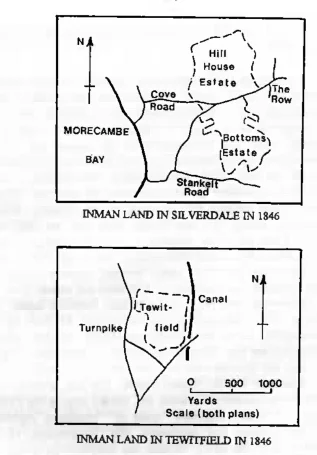
Most of the Silverdale land was sold in 1851, when Thomas died. This article traces the history of three generations of the Inman family, from Robert’s father Charles, to Robert’s son, Thomas, and their involvement with Lancaster and with Warton Parish.
During the eighteenth century, Lancaster prospered both as a market town and as a port. The seaborne trade included coastal shipping and trade with more distant places, especially the Baltic ports and the West Indies. Of these the latter proved to be profitable and grew considerably in the second half of the century. Lancaster shopkeepers and merchants supplied goods for export to the West Indies including items such as clothing, cloth, utensils and furniture. Some merchants (for example William Stout1) were tempted into investing in the shipping ventures themselves, though this was fraught with risk, not only from shipwreck but also from privateers, especially during the wars that so frequently haunted that century. Those ships that returned unscathed from the West Indies brought valuable cargoes of sugar, molasses, rum, mahogany, dyewoods and cotton. It was to this prosperous port that Charles Inman, Robert’s father, had come in 1741, sponsored by his half-brother, Michael, for an apprenticeship to the Butterfields, merchants. Michael Inman, nine years older than Charles, was already a merchant in Hull at this time, but his entry into the world of commerce had been a new departure for the Inman family. For the previous two centuries, the Inmans’ had owned and farmed land in the Pateley Bridge and Kirkby Malzeard areas of Yorkshire, becoming respected yeoman and gentlemen. The complexities of the management of the family fortunes and landholdings during this period have been chronicled in some detail by Alfred Inman. Land-dealings and opportune marriages had brought gains to their wealth, but there were also setbacks, as when Michael and Charles Inman’s grandfather had had to find “portions” for five surviving daughters when they married.
A year after his father’s death in 1737 Michael Inman was raising money on his inherited share of the Inman estates at Bewerley and Bishopside, Pateley Bridge. He was still evidently prospering when he sponsored Charles for his apprenticeship in Lancaster in 1741, but by 1752 he was in difficulties and had to sell the estates to pay his creditors. The family, including Charles, helped Michael, and eventually his portion of the ancient Inman estates was restored to him, only to be lost again at the end of the 1760s in a business venture of Michael’s son’s. They were never regained.
Charles was more successful. He started his apprenticeship with the Butterfields at the age of 15. It was three years after this that Thomas and William Butterfield seem to have become involved in the slave trade (the triangular trade) in 1744, when Thomas Butterfield sent the slave ship Expedition on its first voyage to Africa. In 1745, at the age of twenty, Charles married Susanna Casson, the daughter of a Lancaster mercer and alderman, John Casson who had been Mayor of Lancaster in 1730-31 and 1741-42. John Casson was connected with the linen merchants of Kirkham who used the port of Lancaster. In December 1746 Charles became a freeman of Lancaster, even though his apprenticeship was not complete. He paid a fine of £3.3s.0 in lieu, one of the assessors being his father-in-law. In April 1752 his wife died, but one child, Susanna, survived from this first marriage.
Around 1748 and 1749 Charles was raising money on the security of his inherited share of the Yorkshire estates, which included Harefield near Pateley Bridge. Whether he needed money to help his half-brother, or to venture on business in Lancaster is not known. But by 1753 Charles had joined with Thomas Satterthwaite in the slave trade. Thomas, eight years his senior (but still only 33) was a brother-in-law of Charles’s first wife. He was a well-established West Indies merchant and a Quaker, though disowned by the Society of Friends because of his involvement in the slave trade. The partnership between Charles and Thomas in the slave trade lasted from 1753 until 1760, during which time we know that they owned at least the ships Swallow (1753-56), Gambia (1755-56), and with others the Marlborough.
In 1755 Charles was married again, in Durham, to Mary Bowlby, and it was at about this time that he became an agent for Gillows in Jamaica. In 1760 his partnership with Thomas Satterthwaite came to an end, and Charles became a resident agent in Jamaica, dealing with the imports and exports of his former partner. Thomas Satterthwaite reverted to the bilateral West Indies trade and was accepted back into the Society of Friends. Charles’s son Robert was born at Harefield, Pateley Bridge, in 1756 and there followed two daughters Elizabeth and Mary. In 1767 Charles succumbed to the unhealthy Jamaican climate. He died at the age of 42 in Kingston and is buried there. The ventures of this large and energetic man (he was 6ft 2ins tall) had enhanced the fortunes of his branch of the Inman family, but on his death his son and heir, Robert, was only 11 years old.
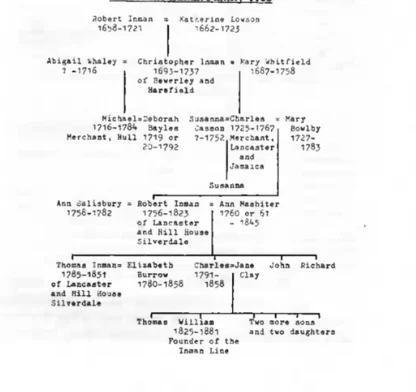
Robert Inman became a freeman of Lancaster at the age of 16, and in 1777, when he reached the age of 21, he inherited Harefield and other Nidderdale estates. In 1784 he married Ann Salisbury, daughter of Thomas Salisbury of Kirkham, and in the same year he took a lease on a plot of land in the Fryerage, Lancaster. Here he built the impressive house (now the Reform Club) that still stands so prominently in Great John Street. In 1790, he sold off Harefield and all the other Nidderdale properties so severing the last connection of the Inman family with that part of Yorkshire, and demonstrating his commitment to Lancaster.
Some idea of his business interests can be gained from the list of ships, possibly incomplete, in which he is known to have had a share. It shows a steadily increasing involvement over the years, culminating in the three largest ships, all newly-built in Whitby, dating from 1804-06 and named after his three younger children. The losses of ships in the early years are high. Of the ten for which we have details up to 1800, no fewer than three were eventually captured by the French.
Lancaster Ships In Which Robert Inman Is Known To Have Had An Interest
| Date | Name of Ship | Tons | Built at | Owner | Notes |
|---|---|---|---|---|---|
| 1786 | Thomas* | 115 | Hull | Joint | Ownership passed to others |
| 1787 | Britannia* | 172 | Whitby 1784 | Joint | |
| 1796 | Henry | 120 | Hull | Joint | ‘Taken’ in April |
| 1796 | Favourite | 122 | St Andrews New Brunswick | Joint | Sold to Liverpool 1797 |
| 1797 | Aid* | 106 | Whitby 1797 | Joint | |
| 1797 | Ann* | 220 | Whitby | Sole | Taken’ by French W. Indies 1797 |
| 1798 | Laurel* | 154 | Joint | ||
| 1799 | Robert* | 314 | Whitby 1799 | Sole | Captured in W. Indies 1806 |
| 1800 | Active* | Joint | |||
| 1800 | Helen* | Joint | |||
| 1801 | Active (2?)* | 246 | Whitby 1801 | Joint | Son Thomas was one of the partners |
| 1804 | John | 374 | Whitby 1804 | [Co.] | Robert Inman and co owners sold to Liverpool 1808 |
| 1805 | Charles | 329 | Whitby 1805 | Joint | Sold to London 1807 |
| 1806 | Richard | 345 | Whitby 1806 | Sole | Sold to Liverpool 1807 |
| 1812 | Neptune ** | A prize? | Sold to Glasgow 1813 |
*Registered at Lancaster
** Re-registered at Lancaster
After 1800 the West Indies trade from Lancaster declined rapidly. The productivity of the estates was falling, and there were continuing problems with merchantmen being attacked by the French. The convoy system which had been introduced to protect transatlantic shipping favoured ships that started from the larger port of Liverpool. Some merchants moved to Liverpool, but rather than do this Robert evidently decided to sell his remaining ships and concentrate on his work as a timber and general merchant in Lancaster. Having sold his ships by 1808 he turned to investment in land, buying the Hill House estate in Silverdale, which was within easy reach of Lancaster. The estate had been owned by Jackson Mason, son of William Mason, Freeman of Lancaster and one-time mariner, who had owned property in Lindeth (Slackwood). Jackson Mason spent well over £1000 on property in Warton parish between 1794 and 1805. He bought the Hill House estate from Enoch Fryer in February 1800 for £525, and it appears from the Manor Court records that the Fryer family had put the estate together about 50 years earlier than that, by amalgamating several much smaller, older properties. A few years after Robert Inman had acquired the property the Silverdale Enclosure Award (1817) allocated a large section of the common land that lay north of Hill House to him. This was in exchange for grazing rights to which the tenant of the Hill House estate was entitled.
Some of Robert Inman’s notebooks2 relating to work that he carried out on the Hill House estate are held in the local history collection at Lancaster Public Library. Many of the entries relate to wall-building and tree-planting, work which considerably changed the appearance of the northern edge of the village. Many of the ancient field boundaries were swept away and replaced by larger enclosures, but some of the old hedgerow trees seem to have been left in place to mature in the new fields. Others were newly planted, including the lime trees that flank the driveway up to the house. The changes made to the old common land behind Hill House were ever more marked. The western part was left for grazing, but large plantations were this on the stonier areas. Further east a large area was allocated for coppice, with ornamental plantings of beech.
Robert Inman had fourteen children, two by his first wife and twelve by his second. Of these he was survived by only four sons (Thomas, Charles, John and Richard) and four daughters. Robert died in 1823 and the estate passed to his son Thomas, who also continued with the timber business in Lancaster. In 1819 Thomas had married Elizabeth Burrow, daughter of Thomas Burrow, a West Indies merchant who was Mayor of Lancaster in 1806-7 and again 1815-16. Thomas Inman’s house was in Fenton Street, Lancaster. His father’s house in Great John Street was occupied by his widowed mother and his sisters until at least 1871. Thomas and Elizabeth had no children, and after Thomas died in 1851 the Hill House and Bottoms estates in Silverdale were sold off, apart from a property on The Green, which was left to William Williams, the gardener at Hill House.
The Inman ownership of land in Silverdale left its imprint on the landscape, but none of the family remained in the village. The venture into land ownership had been incidental to the main preoccupation of the family with the world of commerce. This concern with commerce had absorbed the family ever since the middle of the eighteenth century, when Michael and Charles Inman had entered apprenticeships with merchants. After that time the Yorkshire estates were used to raise money for business ventures, and had been completely lost or sold off by 1790. As to the Hill House estate in Silverdale, it was later owned by a succession of industrialists who had made even greater fortunes than Robert Inman.
Footnote – William Inman and the Inman Line
Readers may be interested in the connection between the Inmans of Hill House, Silverdale and William Inman, founder in 1857 of the Inman Line of Steamships. William was the son of Thomas Inman’s brother Charles, and it is entirely possible that he visited Hill House, though the estate was sold when he was 26. William’s father Charles (1791-1858) grew up in Lancaster but moved to Leicester to become a partner in Pickfords, carriers. In 1838, he moved with his young family to Liverpool and became a director of the Bank of Liverpool. William (1825-1881) worked in Liverpool as a clerk with various firms of merchants, and then became a partner in Richardson Brothers in 1849.
William was very impressed with the performance of the early screw-propelled iron ships for transatlantic crossings. He was convinced that these would easily outperform both sailing ships and paddle-steamships. He persuaded his partners to buy one of the earliest of the screw-driven ships, the City of Glasgow, and went on to establish the Inman Line of steamships in 1857. By 1860 he was running a weekly service from Liverpool to Philadelphia and New York. The service became more frequent during the 1860s, and the company made efforts to improve the standard of accommodation for the large numbers of emigrants that used its ships. The Inman Line is thought to have carried well over one million migrants to America.
When William Inman built himself a house near Upton on the Wirral during 1858-59, he named it Harefield House, remembering the ancestral family home near Pateley Bridge. This house was extended later, and re-named Upton Manor after William had bought the title and rights of Lord of the Manor of Upton in 18653. In summer William Inman used a large gothic house in Windermere called The Abbey, which he had bought and enlarged in 1864. This was demolished in 1962 and the land was used for the housing development of St. Mary’s Park. At both Upton and Windermere William Inman devoted much time and money to the Anglican churches, St Mary’s Church, Upton and St. Mary’s Church, Applethwaite.
Acknowledgements Some of the information for this article has been collected by Margaret Bainbridge. She has also kindly read the early drafts and made helpful suggestions.
Sources of Information
- M.M. Schofield. Outline of an Economic History of Lancaster from 1680 to 1860. Trans. of the Lancaster Branch of the Historical Association. No.1, 1946 and No. 2, 1951.
- Andrew White (Ed.) A History of Lancaster, Ryburn Publishing, 1993
- Alfred H. Inman. A short account of the Family of Inman of Nidderdale. Appendix to Upper Nidderdale with the Forest of Knaresborough, by Harry Speight, London, Elliot Stock, 1906.
- Melinda Elder. The Slave Trade and the Economic Development of Eighteenth -Century Lancaster. Ryburn Publishing, 1992.
- Lancaster Register of Shipping 1786-1911 (Lancashire Record Office, Preston).
- Lancaster Gazette (especially shipping news and trade advertisements).
- Board of Trade Shipping Returns (Public Record Office).
- Lancaster Apprentice
- Rolls. Rolls of the Freemen of Lancaster. Record Society of Lancashire and Cheshire v.87 1935 and v.90 1938.
- Warton Manor Court Records.
- Silverdale Manor Court Records.
- Parish Registers
- Tithe Awards for Warton Township and Silverdale Township 1846
Notes
- Marshall, J.D. (Ed.) The Autobiography of William Stout of Lancaster, Chetham Society, 1967. Appendix A pp. 282-291 for details of William Stout’s shipping ventures. ↩︎
- Alfred H. Inman, A short account of the family of Inman of Nidderdale (full reference above), pp.iii-xxxviii for details of the early family history. ↩︎
- R.A. Pullan and K.J. Burnley. Set Upon a Hill: The story of St Mary’s Church and Parish, Upton, Wirrall. St. Mary’s Parish Church, Upton, 1993 pp. 14-29. ↩︎
Published in Mourholme Local History Society Issue 36 1999