
by Andrew White
People have long been finding fragments of green-glazed pottery in Silverdale. The story of rediscovery of the site begins in 1865. In that year James Murton of Silverdale sent some examples of pots to a meeting of the British Archaeological Association, together with a note describing the discovery of pottery of a coarse kind and ‘ovens or kilns’ on rising ground at Silverdale. The exact whereabouts was not recorded, but it would be most economical to think of it as being the area of Potter’s Hill/Elmslack Lane. H. Syer Cuming, an expert of that period, ascribed the pottery to the early 17th century and commented that the chief item of manufacture seemed to be spigot-pots, i.e. Vessels with a hole near the bottom for a spigot to be inserted1. (We would now term these ‘cisterns’ or ‘ale-jars’.) Further correspondence from Mr. Murton and from Dr. Walling of Preston (a native of Silverdale) the same year took the story on a little by recording further examples including one with a stamp impressed into it and by considering where the clay for the pottery could have come from2.
The next chapter opens with the work of Dr. J.W.Jackson of Manchester University at Dog Holes Cave on Warton Crag in 1909 – 1912. Jackson was what we would call today a palaeontologist, rather than an archaeologist. His interests lay principally in the field of animal remains, hence his dig at Warton Crag. He should also be remembered as a link with the discovery of Tutankhamun, since he accompanied Howard Carter’s expeditions to Egypt in the late 1920s. I myself remember meeting Jackson when he was extremely old and I was a novice museum assistant in the early 1970s. In 1912 a house called Beechwood was being built in Silverdale. Pottery and fragments of baked clay from the kiln structure were found during its construction and Jackson, as the nearest practising archaeologist, was called in to see it. While he wrote nothing on the find he did note it on his Ordnance Survey map as ‘Old Pottery’ (Jackson’s archive is now at the Buxton museum in Derbyshire) and a small collection of finds, given him by a Miss Price or Prince, went back to Manchester University with him. There was at that time no Museum in Lancaster. Many years later the finds were handed back to the City Museum in Lancaster by the Keeper of the Manchester Museum.
************
Since the 1960s the speed of rediscovery has increased, as a result of building work and greater local interest. In the early 1970s Mr. & Mrs. Masheter of ‘The Prospect’ found considerable quantities of pottery in their garden and enlisted help from the Lancaster City Museum in identifying it. They had heard local stories of the 1912 find and this helped to establish the facts with the current regime at the Manchester Museum. Subsequently, the County Archaeologist, Ben Edwards, followed up a number of local finds from gardens and in an article in Contrebis3 established the approximate spread of the pottery finds as Cove Road, nos. 4 – 18 (even), Woodlands Drive, nos. 2 – 8 (even) and ‘The Prospect’, and Clevelands Avenue, nos. 1,3,7 and 2 – 12 (even). In 1977 the present writer gave a conference paper on the site and this was subsequently published4.
Since then more finds have continued to be made. These include Birch Drive, no.6, Elmslack Lane, no.8 and ‘Potter’s 21 Hill’ and Wallings Lane, no.4 (‘Bradshaw House’). The latter extends considerably the western limit of the scatter of pottery. Or does it signify another focus? We shall not know until more gardens have revealed, or failed to reveal, pottery.
In 1996 John Jenkinson summarised the known facts in a brief article for this magazine.
What is the pottery like?
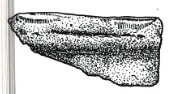
It mostly consists of wasters, over-fired, distorted and shattered pots which failed in the kiln. The fabric can be reduced (grey) or oxidised (reddish) although it is clear from examples which are found elsewhere that the intention was for the fabric to be reduced. It is very fine with almost no inclusions and can often be soft enough to mark paper. The glaze is usually an olive green/bronze colour, although in over oxidised fabrics it often appears brownish. Again, away from the kiln the usual colour is olive green. We must remember that what remains at the kiln site usually consists of failures. The range of vessels is quite limited, consisting of large heavy farmhouse and kitchen items, bowls, jars, jugs, possibly chafing- dishes, and above all, ale-jars with bung holes. Decoration generally consists of thumbed pie-crust strips but a few vessels bear impressed grid-iron stamps and, very occasionally, seal-like prints. It is likely that the potters concentrated on an area of production which did not attempt to compete with imported wares of the period, such as cups and dishes, or even the products of more advanced English potteries. The retreat into utilitarian wares is very characteristic of late and sub-medieval country potteries. Below is some hand drawn pottery fragments.
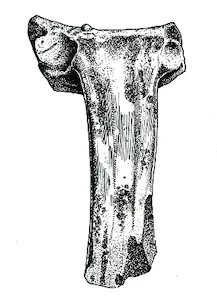
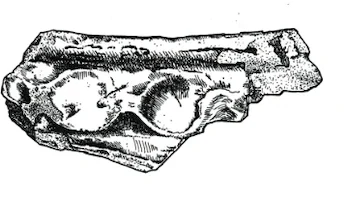
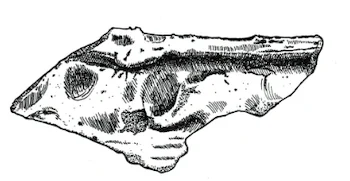
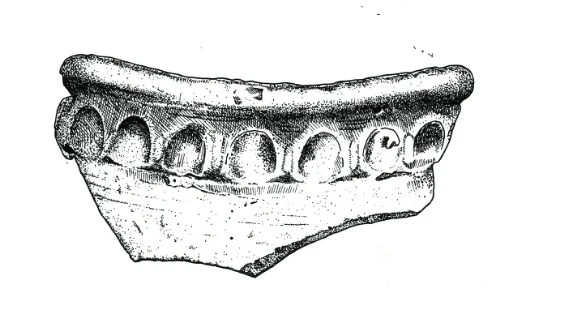
Why did they make pottery here?
Silverdale was not the most propitious place in which to manufacture heavy fragile items. Apart from fuel (supposing that Silverdale was then as wooded as it is now) it had few advantages. Clay sources are no better than elsewhere, while transport out must have been a problem. It may be that sea transport took away the finished products from the Cove. While we might assume that wood was the natural fuel, access to it may not have been guaranteed. Poor quality coal was widely available in North Lancashire5, while turf from the coastal saltmarsh and from low-lying wetlands is another possibility. Mr. Beale of Elmslack Lane has demonstrated the possibility that usable clay was widespread in this area, not just from the Haweswater area. Large and convenient supplies of clay were crucial to potting, and we should expect a very local source.
Where did the pottery go?
After many years of fieldwalking and excavation we can be sure that Silverdale wares were the characteristic local pottery in the 16th and 17th century. They occur very widely in Lancaster, the Lune valley, and even Kendal and the Kentmere valley. It is likely that they were taken to Lancaster market for redistribution. However, we should be cautious in ascribing too much to Silverdale. There may have been other potters working in the same tradition elsewhere in the North-West. It should be noted that very similar pottery has turned up in a number of gardens in Black Dyke Lane, Arnside, in 1978 and this must represent a quite separate centre of production. Are there any others waiting to be found?
Finally, what date is the pottery and who made it?
The first part we have already answered, in part. The pottery seems to be characteristic of the 16th and 17th century, from archaeological evidence, and belongs to a more widespread tradition of the period. How early it began we do not know. Examples have been found at Cockersand Abbey and it would be tempting to ascribe it to the pre-1539 period, before the Dissolution. However, as with most abbeys, Cockersand was partly occupied as a house after 1539, so it was quite common for potters to be farmers, the two trades supporting each other. Without land and access to clay and fuel, they would not get very far. So, we should be looking for well-established local families who passed the trade down from generation to generation. Recent work at the Lancashire Record Office has suggested some possibilities. At this period wills were often accompanied by probate inventories, lists of the deceased’s property, carried out by three or four neighbours. Much depended on the care and interest of these neighbours, the age of the deceased (had they passed on the trade to a son?) and even the time of year (if the potter had just fired a kiln recently, the whole stock might be inventoried, or not mentioned at all if it had all been sold). A search among members of the Hadwen family revealed:
- WRWK 1596 Robert Hawden Extensive range of farm gear and ‘Item a sark? With olde potts xiid’ out of a total value of £43.19.02
- WRWK 1674 James Hadwen Mostly farming gear but ‘Item in potes and pipes 13.00.00’ out of a total value of £97.13.10
- WRWK 1599 Thomas Hadwen Mostly farming gear but ‘Item ale potts & pitchers xiid’
These seem to be significant. Most people had some pottery but in probate inventories it was usually regarded as of little or no value. To itemise it is unusual. James Hadwen’s £13 worth is relatively very valuable – more than the value of his cows. Robert’s pottery may not mean much but Thomas’ ‘ale potts & pitchers’ are just how we would describe Silverdale pottery. The family connection enhances each small reference. If twelve pence seems very small value for someone’s stock in trade we should think again. Most items in a probate inventory were of a capital nature; horses, carts, ploughs etc. They were bought very rarely and lasted for years. Pottery, on the other hand, could be made quickly and frequently, many times in a year. Probate inventories freeze a moment of time and conflate large and small, property and turnover stock. So it seems that the Hadwen family were potters. Were they alone? Who was working at Arnside?
My liberal use of question marks shows how many loose ends there are and how many opportunities for local research. Who will take this up?
Notes
- Journal of British Archaeological Association 21, 1865, 85 ↩︎
- Journal of British Archaeological Association 21, 1865, 85 ↩︎
- B.J.N.Edwards, ‘Late Medieval Pottery Kiln(s) at Silverdale’, Contrebis, 2,2, 1974, 41 – 5 ↩︎
- A.J.White, ‘Silverdale’, in P.J.Davy, (ed), Medieval Pottery from Excavations in the North West, 1977, 102 – 3, 121 ↩︎
- P.J.Hudson, Coal Mining in Lunesdale, 1998 ↩︎
Published in the Mourholme Local History Society Magazine Issue 37 1999