
Michael Wright
The Silverdale pottery was situated on the north edge of the village, in the Elmslack area, and was probably active in the 16th and 17th centuries. It produced a limited range of large farmhouse and kitchen items, including bowls, jugs and ale-jars. Like other locally based potteries it did not try to compete with wares such as cups and dishes that were produced in large quantities by larger potteries1. In his description of the evidence for the pottery Andrew White has pointed out how many questions remain to be answered. Among these is the identification of the source of the clay used in the pottery. This article is written to place on record work initiated by Colin Beale who organised tests on clay found in Eaves Wood, on the hillside above the site of the pottery.
Clays in the vicinity of the pottery
Since clays are of widespread occurrence in most parts of Britain it is difficult to identify the source material for a pottery that has no remaining historical records. In Silverdale at least five sources of clay are possible candidates. These are (in order of increasing age) silty muds from the tidal flats of the estuary; silty clays in the Haweswater Moss area; windblown deposits that collected in the pockets on the limestone hills shortly after the retreat of the last glaciers; glacial deposits of boulder clay; and shales that were deposited among the limestones in the Carboniferous, 300 million years ago.
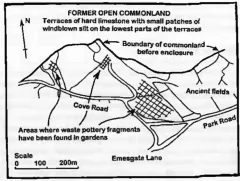
Plan showing the areas in north Silverdale where waste-debris from the pottery has been found. Kilns may have been located along the southern edge of the common land, and pottery clay may have been dug on the common, upslope from the kilns.
No doubt the inhabitants of Silverdale were familiar with all these clays, as they sought to maximise use of the resources available to them. And it was the manorial common lands that were most heavily explored and exploited, since manorial tenants (that is, most of the inhabitants of Silverdale) had the right to dig freely on the commons for limestone, sand, gravel and clay, so long it was for use within the township. It is no surprise that the old common land areas, such as Eaves Wood and the Lots are heavily pockmarked with small and large-scale digging. During such delvings and excavations the inhabitants would have become familiar with all the local varieties of glacial and post-glacial sands and clays.
Requirements of a pottery clay
It would therefore be easy to make an informed choice of source material for a pottery. We can assume that those who ran the Silverdale pottery were very knowledgeable and experienced. Michael Eden comments that recovered fragments of Silverdale pottery show a high degree of craftsmanship and experience2. A potter would look for a plastic clay that could be easily worked but not so plastic that it would shrink a great deal, or crack during firing. A stoneless clay, ready to use without much preparation, would be preferable, and in sufficient quantity for the production envisaged. If a suitable clay could be found on the common land then a manorial tenant would have the right to dig the material without further formality. And a source conveniently upslope of the kilns would make it relatively easy to cart or sled the clay down to the work area. We can assume a nearby source of fuel in the local woodland or hedgerow trees, though the woodland cover was probably quite limited at that date.
All these requirements can be filled by the windblown deposits that lie in the hollows and depressions on the limestone hills. This material, technically known as ‘loess’, was blown from the area now occupied by Morecambe Bay following the melting of the ice sheet at the end of the last glaciation. At that time large volumes of meltwater were carried across this low lying area in a network of meandering river channels. Sea-level was much lower and the coastline lay many miles to the west. Vegetation had not had a chance to get established, and when drier weather prevailed, and a westerly wind blew, the smaller particles of the river-borne sediments were picked up and blown onto the adjacent hills, some of them far inland.
The windblown deposits in the Silverdale area have not been investigated in detail, but Vincent and Lee looked at similar deposits at Hutton Roof where they lie in thicknesses of up to a metre or so in depressions on the hilltop3. The terrace-like topography of the Urswick Limestone has many sheltered depressions and hollows where the eddying silt-laden wind of 12,000 years ago would have dropped its load. Urswick Limestone is found in many places around the Bay, including the Eaves Wood ridge in Silverdale. Vincent and Lee suggested that once deposited the windblown material would be unlikely to be washed away on limestone areas because of the lack of surface water.

Section through an Urswick Limestone hillside showing the hollows where the windblown deposits have accumulated.
The mineralogy of the windblown deposit makes it eminently suitable for use as a pottery clay. In fact, similar wind-blown deposits in other areas have been extensively used for pottery or to make bricks. In the London area a similar windblown deposit is actually known as ‘brickearth’ because of this use. An analysis of the deposit is included in the paper by Vincent and Lee (pp287-8) and this shows that it consists of very fine quartz particles, with small particles of feldspar (which acts as a flux mineral) and clay minerals, including kaolinite (china clay). The samples tested did not contain any calcium carbonate despite the presence of limestone debris among the river-deposited material in the source area in Morecambe Bay. The lime-free nature of the windblown soils contrasts with the lime-rich soil that lies on the surrounding limestone. In fact, the presence of the windblown deposits can be detected by the acid-loving plants that grow on them.
Test firing of the windblown deposits
On the initiative of Mr Colin Beale, samples of the windblown deposit were collected from Eaves Wood and given to Mr Michael Eden of Edenceramics, Hale, near Milnthorpe, for test forming and firing. Mr Eden first had to wash out limestone particles that were contained in the clay (possibly these were contamination from adjacent limestone). He found that the clay was readily workable. Dried shapes formed from the clay were treated with a galena glaze and then fired at about 1,100 degrees Celsius, using wood as fuel and an oxidising atmosphere. The resulting pots closely resembled the old pottery pieces found in the gardens of the area of the Silverdale pottery. It was found, however, that if the limestone particles were not removed from the clay before it was shaped, the final product was spoilt by white blemishes on unglazed surfaces, or blisters in the glaze.
The conclusion reached by Colin Beale is that it seems very reasonable to suppose that the clay used to make the pots at the old pottery may have been collected from pockets on the hill now covered by Eaves Wood. It could also be conjectured that if carefully chosen from the larger deposits of windblown clay, the content of limestone particles should be very low. In fact, Vincent and Lee noted that the calcite was absent from the deposits that they examined, and they speculated that it may have been leached out by weathering. At the date when Silverdale pottery was active the common lands were heavily grazed and very few trees and shrubs would have survived. On the open ground the windblown deposits could have been readily located because they support acid-loving vegetation such as heathers and acid-loving grasses. At the present day these variations can be very clearly seen in places such as Scout Scar near Kendal, and on Farleton Fell. The loess also has the virtue of having a sharply defined base, so that it could be easily dug out, leaving behind any patches of unsuitable stony glacial clay.
Would supplies of this clay have been adequate to meet the demand?
There remains the question as to whether there would have been enough windblown clay to supply the pottery. Taking as a basis for calculation a production of 1,000 pots per year at an average of 2 kg per fired pot, Colin Beale calculates as follows. He assumes that 4 kg of clay would be needed to make a fired pot weighing 2 kg, when losses in washing, weight loss on firing, breakages and rejects are allowed for. One thousand pots would require 4,000 kg clay. Assuming an in situ bulk density of 2,000 kg per cubic metre, this means that two cubic metres of clay would have to be found, dug and delivered each year (say 8 cart or sled loads). If the pottery operated at this production level for 200 years it would consume 400 cubic metres of clay. We know that the clay was most likely dug from shallow, elongated deposits along the hollows that lie beneath the limestone crags. Allowing for a modest depth of half a metre, and a width of 5 metres, a volume of 400 cubic metres could be supplied by digging a length of only some 160 metres of such hollows. Michael Eden suggests that the volume of production may have been considerably greater for commercial viability, though much of the waste in the form of broken unfired pots would have been recycled. Allowing for these factors, and a possibly larger requirement of clay, this could be readily met by the deposits of windblown silt held in the hollows in the Urswick Limestone.
While it is hoped that this article provides convincing evidence that the windblown deposits found on the hillside above Elmslack are a likely source of clay for the Silverdale pottery, this does not automatically eliminate the other possible sources. A practised craftsman may even have wished to blend more than one of the local clays. And if any slips were used for decoration these á would require a white clay source. The lead (galena) used for glazing may have originated from the north Pennine ore field. Analyses of the mineral compositions of the other clays, and of the pottery fragments themselves would be useful, but expensive investigations such as this are not likely to be undertaken in the near future.
There is much more to learn about the Silverdale Pottery. In particular it would be good to know more about the families involved in the work, and whether they worked full time or part-time at pot-making. The work may have been seasonal – Sonia Ely has pointed out that there would be practical difficulties in throwing and drying pots in the winter months in Silverdale. But if winter working was needed to make the operation viable there would probably have been ways to contrive this – for example, waste heat from a chimney flue could be used to warm a raised drying floor4.
Acknowledgements
Much of the information for this article has been provided by Colin Beale and Michael Eden, and they have also made helpful comments on an early draft.
Notes
- Andrew White. Silverdale Pottery: The Story so far. Mourholme Magazine of Local History, 1999-2000, No.3 pp19-25 ↩︎
- Personal communication from Michael Eden of Edenceramics, Hale. ↩︎
- P.J. Vincent and M.P. Lee. Some observations on the Loess around Morecambe Bay, North-West England. Proceedings of the Yorkshire Geological Society, v.43, pt. 3, pp281-294, 1981 ↩︎
- Comment from Michael Eden. ↩︎
Published in the Mourholme Magazine Issue 44 2002