By Nancy Thomas
The following is neither an ’article’ nor a ’document’ as such; it is an entertaining and interesting short extract from an account or day book kept by Abraham Rawlinson, Esq, of Ellel Hall, in the 1780’s1. This gentleman was one of a very large, well-connected, and successful family of early Lancaster industrialists and West Indian traders, and the grandson of Abraham Rawlinson, the Iron Founder.
You may wonder what the Rawlinsons of Ellel and Lancaster have to do with Warton parish. Actually, that is the very question I was trying to answer when I came across this piece in a mass of Rawlinson business accounts. That there is a connection is witnessed by Yealand Manor, formerly Morecambe Lodge, in Yealand Conyers, a Rawlinson residence in the 18th century and the home of the John Rawlinson Ford’s for many years.
The family is a genealogist’s delight, because they regularly preserved maternal surnames in the Christian and middle names of their many offspring. Thus, Thomas Hutton, whose daughter Dorothy married Thomas Rawlinson in 1665, is memorialised by succeeding generations of T. Hutton Rawlinsons; and when John Ford of Morecambe Lodge named his first three sons Hutton Rawlinson (1804), Charles Dillworth (1806), and Robert Lawson (1809), he was proclaiming the blood link between the Fords, the Rawlinsons (grandmother), the Dillworths (great grandmother), and the Lawsons (mother), all important and wealthy Quaker merchant families in 18th century Lancaster.
What I was looking for and what I hope to find is the particular role Yealand Conyers played in the lives of these people, and also what effect they in turn had on Yealand Conyers. Although the following extract sheds no light at all on that subject, I offer it anyway for its domestic and human interest.
‘House Expence a/c from June 1 1782 to June 1 1783
For my Expences with Miss Hinde & my Son Hutton to Durham, theirs, my Polly & Miss Nelly Hindes with my Coach 5 horses. & 3 Servants from Durham to Rusher Ford to Sedgfield Newcastle Jollerford Bridge Glenwhelt Branton Carlisle Corby Castle Penrith Ulzewater Shap Kendal & home 288 Miles Sep. 25 to Oct. 10 is 16 days £44.16 Colthurst Chaise & 4 horses to Sedberg 27 miles @ 15d £1.13.9 Colthurst Chaise & 2 horses to Sunderland 6/- Colthurst Chaise & 2 horses to Glasson 5/- Oct 19 a Load of Oats & Grinding 16/6 Nov 2 pd for Hutton attending Philosophical Lectures £1 1/- Nov 11 Catons Wigs & 1 yrs dressing & dressing Hutton & Shaving myself £6 Nov 18 One Years Subscription to Lancaster Dispensary £ 3 3/- Nov 20 Two New Barrels to my hand organ £ 4 4/- Nov 30 Paid my Lovely Wife £63 Dec 5 Stanley Turner a Chaise & 1 pair horses 13 Aug. to 24 Sep. 1779 is 43 days @ 10/6 – £22.11.6 a grey Mare bought of[f] him. – £10.10 £33. 1. 6 Laborers wages from 1782 Sep. 1 to 1783 Feb. 15 Wm Humber Gardener 168 days @ 2/ £16.16 John Thornton Laborer 137.5 days @ 1/6 £10.6.3 John Hodgson 132.5 days@ 1/6 £9.18.9 Wm Wilson 26.5 days @ 1/6 £1.19.9 Lawr. Cutler 26 days @ 1/6 £1.19.0 Chas Wilson from Aug 18 147.5 days @1/6 £11.1.3 John Hartley from Aug 24 150 days @ 1/6 £11.0.5. Dec 12 Flower Potts @ 1/- £0.63.7 [Ed this is interpretation of magazine] Oct 12 John Whitehead a vine last March 1/6 6 Peaches and Nectarine trees 9/- Nov 2 R. Carder
6 Loads Beans @ 13/6 £.4.1
6 Loads Beans @ 14/6 £.4.4
£0.8.5 Nov 22 WM Sturzaker
4 Dwarf Plumbs £.4.
5 Peaches & Nectarine Trees in Feb £.7.6£0.11.6 Oct 18 Thos Shaw a sun dial calculating painting guilding and fixing to South end of Dining Room £4. 4, 1783 Jan 3 John Procter Porter, Bottles & corks July last £4.. Jan 18 James Cornthwaite Black Smiths Bill 1 Yr £ 6. 8.5 Jan 18 Wm Townson 7 Carts hedging & Peasticks £1.5 Jan 27 John Peacock duty 1 Male Servant to 8 Jan £ 1. 2.0 1 Years Duty on Coach to 20 Dec 1783 £ 6.17 Feb 13 Pd my Lovely Wife £ 21 Feb 5 d the Rev. Win Cotton for 1 years tuition of my Son Hutton ending 9 Oct 1782 £42. . Mar 23 & Mar 30 Pd my Lovely Wife £57.15.0 Mar 7 Pd John Beakbane for Porter in 1781 £3.1.0 Mar 7 Pd Henry Walmsley Bill of Stationary £2.6.0 Mar 7 Pd Jas. Barrow £300 Insurance against Fire .13.0 Apr 8 Pd Fayrer & Co. repair of Coach etc .18.4 Apr 21 Apr 8 Pd Fayrer & Co. repair of Coach etc…, £18,4 21 £9.15 - Lancashire County Archives ref MS 3714 [Ed the layout of the magazine may mean there are inaccuracies in the above] ↩︎
Published in Mourholme Magazines Issue 8 Summer 1984
By Ian Wilson
Today when one walks into many of British Rail’s stations, it is not hard to get the feel of past glory. Carnforth Station is no exception; one has just to walk through the entrance arch to see that the main line platforms have been cut back and that the building itself is rapidly decaying. It is not hard to imagine the time not so long ago when London express trains stopped here while hundreds of people moved around the platforms in the heyday of railways. Go back a little further in time, however, and one would find only a tiny halt, and indeed it is possible that Carnforth may never have had a station at all in the beginning.
By June 1840 a network of railways had come north from London to reach Lancaster. However, after this point there was disagreement about the course the line should take to Scotland. The favoured course at the time was one proposed by Joseph Locke in 1835. He envisaged a line going up the Lune Valley via Kirkby Lonsdale and onto Tebay before descending to Penrith and Carlisle. A second route was put forward by Job Bintley under the insistence of parties in Kendal. He proposed a line running through Carnforth to Kendal and up Longsleddale before tunnelling through to Hawswater and onto Penrith. A third route was put forward by George Stephenson. He suggested a barrage carrying the railway over Morecambe Bay, another over the Duddon, the line then following the coast to Carlisle, thus avoiding any high ground.
These three and other proposals were put before a Royal Commission which was set up to examine railway routes between England and Scotland. The Commission rejected the coastal line as being too long, while it foresaw difficulties in tunnelling under Longsleddale as Bintley had suggested. However, it suggested that the southern half of Bintley’s line could be linked with the northern half of Locke’s line, and this was the course that was finally adopted.
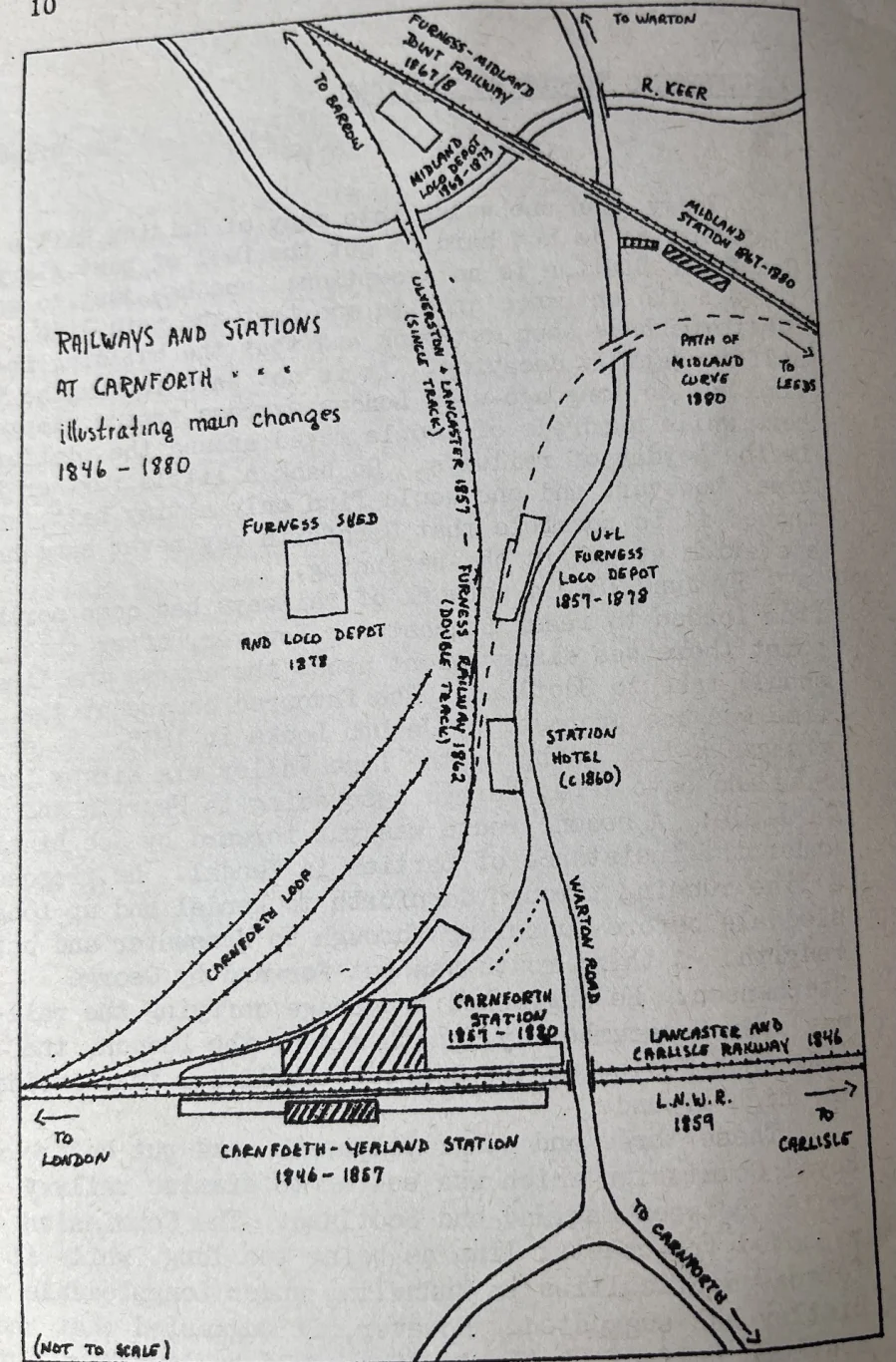
Parliamentary approval for the line was given on 6 June 1844 and work started before the end of the month. The Lancaster and Carlisle Railway Company had envisaged a single line. Demand for their shares was so great, however, that money problems vanished and a double track was built. The line opened to Kendal on 21 September 1846 and on to Carlisle on 17 December. In 1846 Carnforth was a small village mainly built along the present North Road. It would be logical for the company to provide a station for the community as one of its’smaller’ stops on the way to Carlisle. The station was named Carnforth-Yealand, indicating the unimportant nature of the village. There has been some doubt over the actual site of the first station; however, an early O.S. map shows it to have been on the site of the present day main line platforms, just south of Warton Road Bridge. Why the station should have been called Carnforth-Yealand instead of the more logical Carnforth-Warton Station is probably lost in history. The station consisted of two platforms with the station building being on the Carnforth side of the line, probably just south of the present day ticket office [Ed now Heritage Centre].
An 1850 timetable shows that just two up (to London) trains (10:50, 5:24) and two down (from London) trains (11:14, 1:51) stopped at the station with no trains stopping on Sundays. Indeed if it were not for events going on elsewhere at the time, that could have been the history of the station, opened 1846 and no doubt closed around 1970 if not before. The fact that this did not happen was due to events taking place on the Furness peninsula. In 1846 the Furness Railway Company opened a line from Kirkby in Furness to the then tiny hamlet of Barrow with a branch to Dalton. The Dalton line was extended in 1851 to Lindal and then onto the then biggest town on the peninsula, Ulverston. However, the final link from Ulverston to Carnforth was independently constructed by the Ulverston and Lancaster Railway Company. Carnforth was the logical point of junction with the Lancaster and Carlisle. The line was opened on 1 September 1857.
The coming of the Ulverston and Lancaster meant drastic changes for the small Carnforth-Yealand station. To show its new importance, ‘Yealand’ was dropped from ‘ its name, and as ‘Carnforth Station’ it now rivalled Oxenholme and Penrith as the most important station between Lancaster and Carlisle. A new platform had to be built to accommodate U & L traffic, which took the form of a triangle between the main line north and the curving new line to the west, with a new station building on that platform. A small loco depot was built just northwest of the station beside Warton Road, while a number of loop lines were built between the main line and the Ulverston line for goods traffic. The line to Ulverston was at this time only a single track.
Two years later in 1859 a new name appeared at Carnforth Station, that of the mighty London and North Western Railway, the ‘premier line’. That year the L.N.W.R. had leased the profitable Lancaster and Carlisle, which itself had previously leased the Lancaster and Preston Junction Railway and the independent Kendal and Windermere Line. Three years after the L.N.W.R. came to Carnforth, the Furness Railway arrived by absorbing the Ulverston and Lancaster in 1862. The following year the Furness doubled the line between Carnforth and Ulverston, though no new platform was added to Carnforth Station. During this time the L.N.W.R. built its own loco depot south of the station.
The next development at Carnforth started in the 1850’s when a large deposit of haematite, an iron relatively free from phosphorus used in steel making, was discovered at Park just outside Dalton in Furness. This resulted in an increased rail traffic for the Furness, particularly to Yorkshire. Trains bound from Furness to the east, however, had to reverse at Lancaster Castle before going along the single track to join the east-west lines of the Midland Company at Green Ayre.
In 1861 the Furness and Midland proposed a new line to cut out this roundabout route, the new line to go from Carnforth to the Midland line at Wennington. The line was opened to a point just east of Warton Road on 6 June 1867 with the stretch from there across Warton Road and the Keer opened on 1 July 1868. However, as trains from the east would need to reverse down the Furness line to reach Carnforth Station, a new station was opened just east of Warton Road. The steps which can still be seen between the two RR bridges on Warton Road lead up to the site of this station. All trains over this line were run by the Midland, which built a loco depot just north of the Keer in the ’V between the new line and the Furness line to the main station. Only five years later, however, the Midland found these facilities too small and the present Midland shed was built just east of the A6.
The separate Midland station lasted only a short time. Plans were made to build a curve from the Midland line crossing Warton Road and continuing on into the main station. The Furness shed, however, stood in the way, so in 1878 a new shed and loco depot were built on the site of the present shed occupied by Steamtown [Ed. Now a privately run company supplying rolling stock for heitage trains]. The obstructing shed was demolished and the curve opened on 2 August 1880, the Midland station then being closed.
The arrival of the Midland at the main station coincided with its rebuilding in a grand manner and taking on a much more familiar look. The building which now holds the ticket office [now business units] was built, with the platform being extended north under Warton Road Bridge. A bay platform was provided just south of the ticket office buildings. A large train shed was provided covering the bay line and two parallel sidings. The north wall of this can still be seen jutting out into the station car park. A canopy ran the length of the main line platform from its southern end to the end of the buildings just south of the bridge. The triangle shaped middle platform was built with two prongs, one going aside the main line, the other following the Furness curve. The Midland bay, which still can be seen, was at its northern end. The buildings which now stand on this platform were built then. No second Furness platform was built, however; up and down Furness trains still operated from the single centre platform. A large, over-all roof in Gothic style covered the Furness lines and Midland bay.
A large wall for this was built on the site of the present down Furness platform. The siding against this wall inside the shed was given the name of ’Snatchems’. The station stayed unaltered until the days of the London, Midland, & Scottish Railway at the 1925 grouping. In 1925 the L.M.S. closed the Furness shed, as three sheds for the now one company was considered extravagant.
The next changes to the station occurred during 1939-1940. The overall roof was demolished, while a new platform for down Furness trains was finally added. Shortly after this, the station was used for the station scene in the film ‘Brief Encounter’.
In 1935 the Furness shed was demolished and work started on a new shed and loco depot, which existed as ’Steamtown’ [for a period befoe becoming a private comany supplying heritage rolling stock]. The depot included an ashplant and the huge coaling tower which still dominates the town. It was opened in 1945 and at the time was the most modern in Europe. Once the new depot was opened, the old L.N.W.R. shed could be demolished, while the Midland sheds were sold to a private firm.
The station stayed the same for the next twenty years, surviving the 1965 Beeching cuts. The onset of deiselisation and electrification, however, had drastic effects on Carnforth. Steam locos operated out of Carnforth until the end of steam on BR in August 1968. On 31 March 1969 BR closed the loco depot, but by then Steamtown had been born and now flourishes on the depot site.
Meanwhile the station itself came under scrutiny in the interests of speed. The main line platforms were closed and partly demolished. The canopy on the ticket office platform was also demolished. In 1975 electrification work started, resulting in the southern approaches being changed. Electric trains started running from May 1974. Since then the remaining parts of the station have been tidied up and a glass screen added to shield passengers from the main line. Both Barrow and Leeds trains now stop at the Furness platforms, while the Midland Bay is rarely if ever used. The station is still moderately busy, most trains attracting a reasonable number of passengers. During summer months the station gets a boost by the steam specials running either to Ravenglass or York, these always attracting a large crowd. The station should remain open for the foreseeable future, though rumours circulate from time to time about the closure of either the Barrow or Leeds line. And who knows? BR may even one day reopen the main line platforms. At the moment, however, one can only dream about that.
Notes and Queries
Ian Wilson has used the earliest 6″ Ordnance Survey maps (1845-48) to show both the position and size of the first station at Carnforth. These maps also show no other station buildings between Burton and Carnforth. He notes that the station was called Carnforth-Yealand, not, as one might have expected if village size and importance had been the chief consideration, Carnforth-Warton Station. A partial explanation, I think, might be deduced from a Lancaster and Carlisle Railway Time and Fare table, dated July 1848.
On one side are the ‘Up’ and ‘Down’ schedules between Glasgow & London. Stations in our section are Lancaster, Hest Bank, Bolton, Carnforth-Yealand, and Burton and Holme. On the other side are very interesting schedules of Market Day Trains for Carlisle, Penrith, and Lancaster. The Saturday train for the Lancaster market left Burton at 9.06 am, arrived at Yealand at 9.11am, and at Carnforth at 9.19am, returning to Carnforth at 4.51pm and Yealand at 4.58 pm. Thus, there obviously was a clearly established Yealand halt for local traffic in 1848, and this fact might explain why Carnforth, Yealand’s closest station, appeared on main-line schedules as Carnforth-Yealand. What is not explained, however, is where this Yealand Halt was – and why! From NYT
The Yealand ‘Halt’ Discovered? By E.V.Foulds
To the best of my knowledge, the Yealand halt was where the signal box used to be on the A6, opposite the foot of Snape Lane. When we first came to the village in the very early nineteen- thirties, we were told that some considerable time ago there had been a suggestion that a ‘proper station’ should be built for Yealand, and the signal box was pointed out to us as its proposed position, however, the local ‘gentry’ strongly opposed the suggestion, as they preferred the village to be peaceful and secluded, whereas easy access might lead to a large increase in the number of inhabitants and an influx of day trippers. The Halt must have fallen into disuse long before our time, but some focus of activity must have remained within living memory, for we were frequently told the sad and gruesome story of a railway employee who was decapitated by a train when crossing the line at that point in the course of his duties.
Incidentally, younger members may be interested to know that even access by bus was more limited when we first knew the village than it is now. The buses turned round for their return journey at the Peter Hill bus stop, and it was explained to me that it would be not only dangerous but quite impossible for a bus to go down the steep hill leading to the New Inn and beyond.
Notes
Works consulted: David Joy, A Guide to Steamtown. Railways of Lake Counties. Railways of Lancashire.
K. Entwhistle, A History of Bolton le Sandas Ordnance Survey Maps: 1st Edition Lancashire 6″. c.1848 and c.1865.
Published in Mourholme Magazines Issue 6 Winter 1983, Issue 7 Spring 1984, Issue 8 Summer 1984
By R. R. Timberlake
Perhaps others like myself have been intrigued by the motto above the door of Wolf House, Silverdale, Homo homini lupus, or ’Man is a wolf to man’. Although obviously inspired by the wolf crest of the Fleetwood family, it has always seemed to me a rather cynical choice of a motto. The other day I found it quoted in a Spanish novel, La Regenta, by Leopoldo Alas, published in 1885, when it was obviously in common use in the sense of ‘Man preys on Man’. A note in the recent English translation of La Regenta explains that it is borrowed from Plautus’ Asinaria, Act II, sc. ii, 1. 495. A slightly different implication is revealed by a reference to Plautus where the full sentence reads, ‘Lupus est homo homini, non homo, quom qualis sit non novit’, or ‘A man is a wolf, not a man, to another man when he does not know what sort of fellow he is’, i.e. ‘Do not trust a stranger’. ‘Whatever the exact meaning that was intended, it looks as if disillusion or resentment was at the back of it. Can anyone produce an explanation?
Mr R.R. Timberlake raised the question of the motto under the coat of arms over the door of Wolf House but got no answer to his query. It – reads Homo homini lupus, which is usually read as’ indicating a cynical outlook on life – that man is a wolf to his fellow man. It is, however, a line from a play by Plautus.
The full quotation (Asinaria II.iv) reads, Lupus est homo homini, non homo, quom qualis sit non novit, which night be translated as, ‘A man is no man, but rather a wolf, to a man who does not know what sort he is’- a cautious rather than a cynical remark.
The coat of arms, with its six martlets and its wolf crest, belongs to the Fleetwood family, and was presumably put there when the property belonged to Henry Paul Fleetwood (David Peters, In and around Silverdale 1984). The motto, however, is unusual. Fox-Davies (Armorial Families, 19) gives the Fleetwood motto as Quod tibi hoc alteri (What goes for you, goes for the other man, or more colloquially, do as you would be done by.) It is true that in England, unlike Scotland, the motto is not part of the original grant of arms and is not hereditary. Any holder of a coat of arms is free to write in what motto he chooses. The problem remains of why this particular Fleetwood chose this particular motto. Has anyone any information?
Published in Mourholme Magazines Issue 8 Summer 1984 and Mourholme Magazines Issue 14 1990
By Bertha Whitaker
As a reader of Pepys Diaries1, the publication of which was only completed in 1983, I came in the final volumes upon an assertion by the Editor which led me into an interesting by-lane of local 17th century history. The Diaries state that one Robert Withers was a Shipwright of Bolton-le-Sands. As a resident of Bolton- le-Sands and having no knowledge of shipbuilding ever having taken place there, I decided to look into this reference. I soon found that in the time of Pepys, Over Kellet was included in the Parish of Bolton-le-Sands. Indeed, Robert Withers did live in Over Kellet.
However, no more was to be found. Pepys refers to dining with ’Withers – a professed lying rogue’ (Vol. VII, p. 279 & fn.). This did not, to me, fit a gentleman described as a Quaker. I took an interest on his behalf and I have undoubtedly established that Pepys was wrong in his estimation of Mr Withers.
In the Calendar of State Papers, (CSP) 1664-65 (p. 364) we have a reference to a Mr Jonas Shish (who apparently was an innovative shipwright) from Deptford and Woolwich recommending Withers to the Navy Commissioners for the survey of a new ship. In the CSP, 1667 (pp. 558-9) we have the following:
1667. Oct, Proposals by Sir Thos. Strickland to the Navy Commissioners to build three third-rate frigates in Foudray Pill [Walney Island], to be completed by 1 Aug. 1671, upon a similar contract to that of Mr. Baylie, of Bristol. (Admin. Paper), enclosing:
102.1 Edward TyIdesley to (Sam. Pepys). Robert Withers and the writer have viewed Foudray Pill, where they proposed to build ships for the King’s service. Sends a draft sketch thereof, leaving the rest of the business to be transacted by his partners. Sir Thos. Strickland and Mr. Withers. Has such timber as all England cannot show. Lodge in the Forest of Myerscough, 1 Oct. 1667
102.11 Sketch of Walney Island, the pill, bar, etc. in coloured chalks.
The above reference ties Robert Withers firmly into the North Lancashire area and shows his obvious importance in the ship building industry. That is all that I established in the national literature on our friend Robert Withers.
I went to the Cumbria Record Office at Barrow-in- Furness and they kindly led me to the following reference :
Shipbuilding in Furness has a long history – there is evidence that small craft were built from the earliest times, and in 1667 Samuel Pepys caused a survey to be made of the harbour of Piel to ascertain its suitability for building men-o-war. As a result a contract was granted to Sir Thomas Strickland to build a Third-Rate Warship at ’Pill of Foudray’, using wood from the ’Forest of Myerscough’ across the Bay, the dimensions to be 122 feet keel, 38 feet breadth, making 937 tons and approximate cost £7,600. An entry in a manuscript in the Public Record Office (PC.6, 1) dated 1 April 1668 infers that a start had actually been made, but the ship was never completed a treaty of peace with Holland putting an end to naval building.
I then went to the Cumbria Record Office at Kendal and was referred to Stricklandia (two large volumes of history on the Strickland family compiled by a late Strickland) where from I established that that was probably the end of shipbuilding activities for the said Sir Thomas Strickland.
However, John Evelyn in his Diaries quoted carrying ‘one Withers, an ingenious Shipwright, to the King to show his Majestie some new method of building etc’. This was in 1673, a considerable time after the time of the Pepysian remark.
In what way was Mr Withers ’ingenious’? A question which occurs to me – having seen a reference during my searches to the fact that copper-bottoming of ships was thought of 100 years before it was actually adopted – is, in view of the proximity of copper mines in the area, would this have been thought of by Mr Withers? In the publications in the Lancaster area referring to shipbuilding in Morecambe Bay a veil is drawn across activity before the 18th century due to the apparent lack of records. However, we have in readily accessible public records a jigsaw of references to what was probably a highly important shipbuilding attempt which, unfortunately, according to the reference at Barrow-in-Furness, seemed to founder in the construction of one frigate.
The Journals of George Fox reveal the high regard in which Robert Withers was held by George Fox, that he succoured George Fox in his travels and, indeed, accompanied him in travels in England, Scotland and America, experiencing great peril in so doing. Whilst Margaret Fell wrote of him ‘he was not much in Declaration,’ meaning that he was not a great preacher, he was obviously a Quaker of some importance. Is it possible that he was required on these travels, at least in part, for his accomplishments in shipbuilding or repair? The writer is currently making reference to the Record Office at Kew and one more to the Quaker Records at Euston Road, London, for further evidence of the worthy efforts of Robert Withers. If anyone can furnish any more personal information I would be pleased to add it to further work which I intend to devote to this interesting man. I know he is buried at Hilderstone Farm.
By the way, one man who came to light as a ’lying and seditious rogue’ in the works of Aubrey, Evelyn, and the Dictionary of National Biography was George Withers (poet and author of political writings). Samuel Pepys in his Diaries was occasionally guilty of prejudice against people due to wrongful identification because of identical surnames. Is it possible that Pepys was dining with Robert Withers (most probable, there being also present Sire William Batten, Surveyor of the Navy) but endowing him with the infamous reputation of George Withers? Pepys made stranger mistakes elsewhere in the Diaries. I have taken this point up with Professor Lathom, the editor of the Diaries, but he stated he would like more information.
- The Diary of Samuel Pepys, ed. R. Latham, 11 vols. (1970-1985). ↩︎
Published in Mourholme Magazines Issue 8 Summer 1984