Mourholme Local History Society is run by volunteers and has been since its inception over 40 years ago, unfortunately in that period, we have lost some personnel. Here are all the obituaries that have been published in our magazines.
The Late Mr. C.E.A. Burnham – An Appreciation by Jean Chatterley
After the death, in early April this year, of Dick Burnham, his family passed to the society four large box-files. The papers they contained are still being read and assimilated into the archives. I was fortunate to have a preview and found in those tightly packed boxes reflections of the many contributions he made to the life of the Mourholme Local History Society. There were carefully made notes on lectures made in classes held before the Warton History Group was born, and reams of notes resulting from his research work on seventeenth century documents, which are proving to be of considerable interest to the present research team. Dick’s many years as a Warton History Group and then Mourholme Local History Society committee member – he was my predecessor as treasurer – was seen in the neat stacks of minutes. One of the boxes was full of bank statements, receipts and such like- a full archive of the young Mourholme’s financial affairs. He managed the Publication Fund until a few weeks before his death – well into his early nineties – and was sharper with figures than I could ever hope to be! So, there are four box-files a testament to some twenty years service to local history and to Mourholme in particular. But as those of us who worked alongside him know only too well, they tell only a dry part of his contribution. His willingness to help and apply his professional expertise to our needs, his quiet way of dealing with difficulties, his lovely chuckle and smile, and always his gentlemanly courtesy – these will remain as greatly treasured memories of a lovely man, and good friend who will long be sadly missed.
Published in Mourholme Magazine Issue 33 1998
William Rollinson MA PhD FRGS 1937-2000 By Win Hayhurst and Kate Hodgson
March was a sad month to realise our friend and enthusiastic lecturer was no longer with us and we are sure those at the Mourholme will miss his visits to our History Society.
At a ‘Thanksgiving for Bill’s life’ held at the delightful Parish Church of St Mary the Virgin and St Michael at Urswick his friends and associates spoke of the various aspects to his busy life and it certainly, I am sure, made all those there remember the happy days of yesteryear.
Win and I met at classes in Warton and these soon included lectures held by the Extra Mural Dept, of Liverpool University’. After a year or so a new lecturer came to our area and, of course, it was Bill. We can’t remember which course of lectures was first — perhaps the Lake District, Norway, Iceland, Orkney and Shetlands, Isle of Man but which ever it was one was inspired. When hearing about the Lake District you could not but go to the various places he spoke of.
He also took study tours to his speciality Scandinavia. Neither of us was able to go on these tours — perhaps some of you were able to enjoy them. However, we were pleased at a later time to let him know that his lectures had not fallen on stony ground and that we had been encouraged to visit between us Norway, the wonder of Iceland and the historic sites on Orkney and Shetland and all because of his encouragement.
After the lectures our small group from Warton would call at a cafe and partake of tea and toasted tea cakes — which tempted Bill to join us and we all enjoyed good conversation.
Bill felt he was running out of new lectures for us but we were all delighted when he offered a course on the discoveries of the old explorers. Later we suggested winter lectures on Warton and being a good friend by then that is what happened and our numbers grew as the lectures were held in Warton itself. He ‘surrendered’ after that as it was getting very historical: but if we wanted to delve deeper into Warton history he knew just the man — and so the following year we met Paul Booth. After several more years and a wealth of information on Warton the Mourholme Local History Society was formed.
In February 1999 Bill ran a course of six lectures on ‘The Vikings’ with a surprise visit from a ‘fully equipped’ Viking – complete with sword, shield and helmet (without the mythical horns’!) During the lectures various Viking artefacts were on display.
What more can we add except ‘Thank you Bill’ for your friendship and for the interesting talks with which you have inspired us over the years and also at the Society’s meeting.
Brigadier Tryon Wilson – Honorary Vice President 1980-2001 by Jean Chatterley
The members of the MLHS will have been saddened to learn of the death of Brigadier Tryon Wilson in April. He had been one of our Honorary Vice Presidents for all of the society’s 21 years life. Although we did not see him at our winter meetings, he was amongst our keenest supporters.
At the time of our inauguration in 1980, he invited us to Dallam, his private home and the seat of the Lords of the Manor of Silverdale. The first thing to meet us were tables beautifully set out with old books, documents, charters, maps – a marvellous display of archives which he had brought together from various record offices and laid out just for us.
It must have taken many hours of planning and hard work. Then, on our tenth anniversary we were invited back. Many members will recall the gentle stroll, the Brigadier leading the way from room to room, everywhere permeated with the scent of wild garlic! No display of archives this time, but a carefully orchestrated route which ended in a large room lined with trestle tables on which was spread a buffet fit for royalty.
Completely unexpected, and so generous. Equally unexpected were the donations, always generous, always with a letter of encouragement in our research and thanks for his magazines. We, like so many other local groups and charities, have lost a good friend, and shall miss his interest in our life as a society. We responded to the wishes of his family by donating one of our books, in his memory, to Dallam School Library.
Professor Peter Yates.
Members will be very saddened to learn that we have also lost Peter Yates, who died recently. He was a very loyal member of the society, and will be greatly missed. Our sincere condolences go to his wife, May.Published in Mourholme Magazines Issues 33 1998, 38 2000, 41 2001,
by Clive Holden
This was the headline of an article in the Lancaster Guardian of 18th May 1867, which wasted no time in telling its readers that the incident might have a fatal termination’. It told how one railwayman with an iron lever had ’thus murderously armed’ attacked another, whose life is in danger’
The 13th May 1867 was not a lucky day for either James Burns or William Armstrong. At about 7.30 pm Armstrong, a twenty year old London North West Railways [LNWR] breaksman, arrived at Carnforth with a luggage train from Tebay which was due to return the same night with some empty coke wagons, and some carriages which were in No. 9 siding. There was shunting to be done, and it was this that was the cause of the subsequent trouble.
Richard Cock was the yardsman in charge of the goods yard, and he directed James Burns a pointsman, to turn Armstrong’s train into No 9 siding, but when Armstrong saw what was happening he became enraged, and demanded that Burns should have them shunted into No 10 siding. Burns considered himself responsible to Cock rather than to Armstrong, and ignored the demands of the latter, who became even more angry, and a heated argument ensued It might have come to no more than words had not Burns remarked that Armstrong would look better without his moustache, at which point Armstrong lost control of himself and the two came to blows, and then wrestled one another to the ground. Armstrong briefly held the advantage but Burns soon gained the upper hand and thumped Armstrong’s head several times against the ground. Armstrong begged to be allowed to get up so Burns, assuming that his opponent had yielded, rose and moved a few yards away with one hand in his pocket. Armstrong, however, was far from finished, for he walked over to an iron points lever, unfastened it, swung it over his shoulder, walked back towards the unsuspecting Burns and whacked him across the forehead with it. Fortunately for Burns he was wearing a cloth cap with a leather peak which absorbed much of the force, but the bar made a hole in the leather peak and Burns collapsed to the ground bleeding and unconscious.
Only after Burns had lost his senses did Armstrong partly come to his, but he was in a quandary as to what to do next. If he were to seek medical assistance the circumstances of the ‘accident’ would come to light, and he would be instantly dismissed from the service. Burns seemed to be in a bad way, lying bleeding and unconscious until Cock and fireman William Lindsay (whose evidence was later to help Armstrong) carried him to the pointsman’s cabin, where he was left until the train was ready to make its return journey, when he was taken in the van with Armstrong, and put off at Holme near to his lodging.
When Burns arrived home his landlady was not unnaturally appalled at his condition and sent for a doctor, but it was two days before the doctor could attend, and not long after that the police learned of the incident and matters took a more serious turn.
Armstrong was arrested on Friday 17th May. At his first court appearance he was opposed by Police Superintendent Jervis, who stated that the matter had first been reported to the railway officials, who had discharged Armstrong, and only later by chance had information reached the police. He (Jervis) had sent one of his sergeants to sec Burns, who was being attended by Dr Royle who considered it unsafe to remove Burns’s bandages. Jervis was doubtful whether Burns would recover, and urged the magistrates not to allow bail as the offence had been committed with a certain amount of deliberation and was likely to terminate fatally.
At the next court appearance Dr Royle when questioned, stated that on his examination of Burns two days after the incident, removal of the bandages showed only slight injury considering the weapon used. Although Burns was very weak through loss of blood, he (Royle) had never considered it to be a serious accident. Nevertheless Jervis, again in attendance, was determined that Armstrong should face the full rigour of the law, and in spite of the efforts of Armstrong’s solicitor to have the case dealt with summarily by the magistrates, Jervis’s influence prevailed and the case went to the sessions, with Armstrong being allowed bail.
Some weeks later before a jury Burns, by now recovered after being confined to bed for five days and off work for three weeks, declared that he did not wish to prosecute, but things had gone too far and the trial went ahead on a charge of unlawful wounding Mr. Knowles, representing Armstrong made great play of the fact that Armstrong had been handcuffed and marched through Skerton ‘like a felon’ although he had offered not the slightest resistance, but it was the evidence of William Lindsay, the fireman, which probably swayed the jury. He maintained that in addition to making a derogatory remark about Armstrong’s moustache, Burns had tweaked Armstrong’s nose, removing the skin, and this had led to the fight Burns had then ’brayed’ Armstrong’s head against the rail, and when Armstrong was rising having submitted Burns had kicked him. He also stated that Burns had walked unaided to the engine to have his wound attended to and then to the pointsman’s cabin, and that when he had been taken to the metal bridge north of Burton and Holme station, he had alighted and walked unaided to his lodging.
The Chairman charged the jury that there could be no doubt about the verdict, and the jury duly declared Armstrong guilty, but with a recommendation to leniency in view of the provocation he had suffered. The Chairman must have felt some sympathy, as he decided that in the circumstances a fortnight’s imprisonment would be sufficient punishment, which doubtless did not appease Superintendent Jervis, and would seem even in these enlightened days to have let Armstrong off remarkably lightly.
It would be interesting to know what became of the two protagonists. We know that Armstrong lost his job and went to prison, but no more than that. Burns must be assumed to have remained in railway employment after his three weeks off work, and probably looked at points levers with deep mistrust for ever after.
Published in Moueholme Magazine Issue 38 2000
By Paul F Barker
This question posed itself as the result of an unexpected discovery in a bundle of old title deeds in the Cumbria Record Office, Kendal (ret. WD/W/14/26). The bundle contains 37 documents, dated between 1598 and 1774, and the great majority relate to property in Farleton, Westmorland. Seven of them, however, are concerned with Priest Hutton in Lancashire, and the latest of these in date is the Will of Rowland Atkinson of Priest Hutton husbandman, made on the 19th February 1725/6. The Will is sealed with Rowland’s mark, and witnessed by John Braithwaite [mark], Robert Gibson and Robert Walker.
Contents of the Will
The Will bequeathed to Rowland’s younger son John £5, to be paid to him by his older brother Christopher when John reached the age of 21, out of Rowland Atkinson’s house barn and garden in Priest Hutton Christopher was to receive the remainder of the said house with its barn beasthouse and garden’, and also the parcel of hempland called Under Seller estimated at one rood – the premises all lying within the liberties of Priest Hutton. The Will appointed three executors – the testator’s brother Thomas Atkinson of Arkholme and William Walling and John Gibson both of Priest Hutton, these three men were bequeathed all the testator’s personal estate as trustees and guardians for the best advantage of the two said sons until they came of age.Since the Will makes no mention of Rowland’s wife, it could safely be assumed that he was a widower, and another of the documents gives a clue as to his wife’s identity. It is in the form of a Quitclaim, dated 23rd March 1718/19 and made by Thomas Turner of Priest Hutton husbandman to his son-in-law Rowland Atkinson of Priest Hutton for a consideration of £20. Thomas conveyed to Rowland
“two oxon two cowes two steares live heiffers one calfe one coult one mairc four dunghills one Cupboard one Beefe Tub one malte milne one Cheese press four Ruggs three pairs of sheetes five Cowerlets two pairs of Blankets four Brass Panns one Iron pott six pewter dishes six Chaires six quishons two fether Beds three Chaff Beds four pairs of Bedsteads and all. my Come graine of all sorts & all my Hay my hemp flax and Turfe & all my Beefe butter and Cheese my mealle & make And all and singular my Goods Chaltells Wood vessells househould Goods pott vessells housebould Stuffe Utcnsills of Househould stuffe and also all my Jewells peuter plaite Bills Bonds Ready moneys rights Credites and all mine Iron gearc Iron Tooles husbandery Geare & personal Estate whatsoever of what Kinde or nature soever and in whose custody or keeping soever the same or any parte or parcell Thereof now is and hereafter at any time shall be and Remaine (One suite of my Wearing apparrell only Excepted )….”
This is followed by the usual legal formulae, and the document concludes by stating that Thomas, immediately before the sealing of this deed, has formally put Rowland Atkinson in possession of all these items by delivering to him “one Black maire one Brass pann one sheafe of oales in the name of seazin “
Warton Parish Registers
The registers (Lancashire Parish Register Society 1935) furnish more information Margret, daughter of Thomas Turner of [Priest] Hutton, was baptized on 6th May 1688. There is no record of a marriage, but on 12th July 1712 we find the baptism of Christopher son of Rowland Atkinson & Margaret his wife of [Priest] Hutton, followed on 17th June 1716 by that of John son of Rowland Atkinson of Priest Hutton And on 23rd March 1718/19 Margret wife of Rowland Atkinson of Priest Hutton was buried. It will be noted that this is the very day on which Thomas Turner conveyed almost all his personal estate to his son-in-law. Perhaps Thomas was wearing his ‘one Suite of Wearing apparrell” when he too was buried on the 25th March, only two days after his daughter.There is no record of the burial of Rowland Atkinson himself at Warton, but if his Will of 1725/6 was made not long before his death, his sons would have been well short of their majority. The context of the Priest Hutton deeds, however, tells us a little more of one of them The remaining thirty documents in the bundle are concerned with property which came into the possession of one John Atkinson of Farleton, husbandman John’s daughter Isabel was baptized at Beetham in 1743, and when John made his first recorded purchase of freehold land in Farleton in 1746 and set up a datestone bearing his initials at the farm called Ellers, his own son John had already been baptized at Beetham over a year earlier.
So, who was Rowland Atkinson of Priest Hutton?
To an extent, the foregoing has given some answers. Rowland was brother of Thomas Atkinson of Arkholme, and son-in-law of Thomas Turner of Priest Hutton. He and his wife Margaret, née Turner, had two sons, of whom the younger. John, seems in his late twenties to have become customary tenant of the Ellers in Farleton, initially farming some 30 or 40 acres held mainly under the manor of Cappleside, but in due course buying the freehold and beginning a process of acquisition which saw John’s grandson John, at his untimely death in 1838 at the age of 44, owning several farms in Farleton and district totalling some 300 statutory acres, and enough personal estate to enable his trustees to establish a fund of £5600 to maintain John’s wife and six daughters without need to sell any of the real estate bequeathed in trust for his nine year old son John, on which the boy on reaching maturity was able to live the life of a leisured gentleman at Moss Side in Preston Patrick, with his own grandson John establishing himself as a veterinary surgeon with an address in London’s Belgravia.Questions remain about how the original John, younger son of a Priest Hutton husbandman of very modest means who left him a patrimony of a mere five pounds, was able to establish a ‘dynasty’ of John Atkinsons of Ellers who within a generation came to be regarded as members of the minor gentry of South Westmorland but those questions are beyond the scope of the present paper. Rowland Atkinson himself, however, remains an enigma. How did he come to Priest Hutton? Where and when did he marry Margaret Turner? When did he die, and where was he buried? Was it his brother Thomas who looked after the young boys?
How It Was
As chance would have it, the bundle of Ellers deeds containing the Priest Hutton documents came to light shortly before the appearance of the Mourholme Local History Society’s publication ‘How It Was’. Alas, no Atkinson of Priest Hutton is mentioned in its pages. It does, however, contain some familiar names. In 1633 Thomas Turner of Priest Hutton bequeathed clothing to his son and son-in-law (p. 82). Was he father, or perhaps grandfather, of Rowland Atkinson’s father-in-law? Was the Margaret Turner of Priest Hutton, in trouble in 1689 for practising as an unlicensed midwife (p. 106), Rowland’s future mother-in law? His wife Margret’ was baptised in the previous year.These are not the only names to find an echo in the deeds. Of the five not yet discussed, two relate to the house which Rowland bequeathed to his older son Christopher, the other three to the one rood of hempland Not only do they give names of other inhabitants of Priest Hutton during the seventeenth and early eighteenth centuries, but also information which can help to identify these premises.
The land
In a Quitclaim dated 3rd March 1611/12, John Gibson of Priest Hutton gentleman, for a consideration of £5, conveyed to Richard Harlinge of Priest Hutton husbandman “one rood of arable called undersellar land, adjoining the east side of a little wood called Sellar in Hutton aforesaid, of the lands belonging to the Dean and Chapter of Worcester, part of the rectorie belonging to the parsonage of Warton, yearly rent 3 pence to said Dean and Chapter”. On the 10th April 1677 Richard Townson of Priest Hutton yeoman conveyed to his wife Ann, in consideration of his husbandly love and for her preferment after his death, one rood of arable and pasture in the manor of Priest Hutton called Roode under Seller, yearly rent to the Dean and Chapter of Worcester 3 pence, at Easter and Michaelmas yearly by equal division. The deed is sealed, with Richard Townson’s signature, and witnessed by John Gibson (mark), and Richard Dowker (whose signature bears a strong resemblance to the hand which wrote out the deed).If this is the Richard Townson of Priest Hutton, but working as a clothier in Leeds, who had occasion in 1653 to appeal for financial assistance to obtain medical treatment in London (How It Was pp. 121-123) his circumstances seem to have improved somewhat, and his wife was comfortably enough off to give help to others. In May 1689 she conveyed the rood of arable to Hannah Walker spinster, daughter of William Walker of Priest Hutton, for a consideration of 20 shillings, of which ten shillings was to be paid by Hannah Walker to Ellin wife of James Postlethwaite of Priest Hutton, and the other ten shillings to Anne Jackson of Warton spinster. More information is given in this deed about the parcel of land, it is “called Under Sellar Land adjoining to the east side of a little wood called Seller, lately bought by her former husband Richard Harling of John Gibson senior of Priest Hutton”, and excepted from the conveyance to Hannah Walker is “one rigge of the same adjoining a little wood called Seller betwixt the stone and the wood, which Ann Townson grants to James Townson of Priest Hutton husbandman”. The land was to go to Hannah and James after the death of both Ann and Richard Townson. Hannah to pay yearly rent of 21/2d to the Dean and Chapter of Worcester, and James to pay the remaining yearly rent of 1/2d. The deed is sealed, with Ann Townsons mark, and signed as witnesses by Richard Townson (presumably Ann’s second husband). Robert Walker, and Thomas Wood. The description of this land is detailed enough for its identity to be established.
Whitebeck Lane leaves Priest Hutton village in a generally north-westerly direction to meet the A6070 (the former Heron Syke turnpike). Midway between these two points, a green lane (Kirkgate Lane) leaves Whitebeck Lane in a southwesterly direction, leading to the Methodist chapel which stands where the Lancaster Kendal canal passes beneath Kellet Lane. At the west side of Kirkgate Lane where it meets Whitebeck Lane, a gate gives access to a field (the field’s approximate centre is at grid reference SD 526 738) which is still known to its present owner, Mr Edmond Bainbridge of Watson House on Whitebeck Lane, as “Seller”. The field is some 2 acres in extent, but examination of its topography quickly shows the features mentioned in the old deeds. Where it adjoins Whitebeck Lane there is a flat area, at the same level as the lane. As one goes further into the field, the surface of the field “steps up’ a few feet to give a bench of level ground a few yards deep, and then sweeps uphill, some of it being particularly steep. The initial level area is clearly the ‘rood of arable‘ (the customary measure in use in north Lancashire and south Westmorland in the 17th and 18th centuries was larger by some 40% than the statute measure brought into use throughout England in the 19th century, so a customary rood would have been close to five eighths of a statute acre). The flat bench seems likely to have been the “rigge of land” Anne Townson in 1689 reserved for the use of James Townson. It is very easy to visualise the increasingly steep slope behind the bench as covered by uncleared woodland in the 17th century.
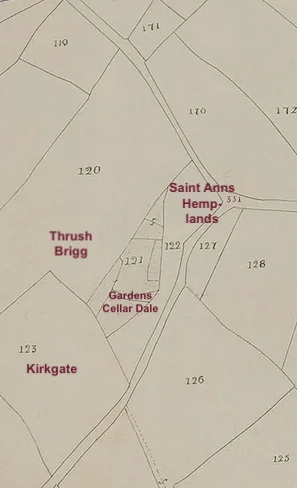
Extract of Priest Hutton Tithe Map 1846 The Tithe map shows this slope as having a number of small enclosures, perhaps representing a preliminary stage in the laborious task of clearing and improving the land for use as pasture The whole of the slope is given the number 121 and in the Schedule to the Tithe Award is described as “Gardens (Cellars Dale)”, being included in the category of Public Roads and Waste Grounds. The long-cleared enclosure below it (number 122 on the map) is named in the Schedule as “Saint Ann’s Hempland and Cellars Dale”, owned and occupied by Robert Muckalt, who was the farmer at Upp Hall with its 193 acres, owned by Lazarus Threlfall. Muckalt was farming a further 68 acres of his own land.The hempland numbered 122 was just over an acre in extent, and must therefore have incorporated the dale belonging in 1718/19 to John Wrayton (see below).
The house
Just over a year before Ann Townson made the conveyance deed of the rood of land, she had in December 1687 conveyed to her “well-beloved friend Hanna Walker” for her better preferment (with no mention of a monetary consideration) a “cottage or fire house with adjoining beasthouse and a garden belonging to it at Lee yeate adjoining the west side of the pinfold within the lordship of Priest Hutton”, of yearly rent 2d. The seal is accompanied by Ann’s mark, and the signatures as witnesses of Richard Townson. Thomas Turner, and Christopher Guy. Guy’s distinctive signature is the same as that which appears as witness on a Bond of Dame Anne Middleton dated 26th August 1673 [Kendal Record Office. ref. WD/RG Acc.1858] acknowledging a fine paid by Josiah Cartmell as customary tenant of premises in Farleton on the death of her husband Sir George, and indemnifying Josiah against any further claim, and it seems likely that Guy may have drawn up both documents (see How lt Was, p.109)).In February 1718/19 Hannah Walker conveyed the house and the parcel of hempland for a consideration of £16 to Robert Walker of Priest Hutton yeoman. The deed describes the promises as the
“dwelling house in which Agnes Whormby now lives formerly belonging to Ann Townson deceased, with barn beasthouse and peathouse, all adjoining the pinfold in Priest Hutton, with an orchard and garden lying close by the side of the Kings streete on the fore side of the said house; and one rood of arable hempland in a place called underseller adjoining the west side of a parcel of hempland belonging to John Wrayton of Priest Hutton; said house garden and outhousing being within the liberties of Priest Hutton, now in possession of Hannah Walker and her undertenants, and part of the lands sometime ago purchased from Sir Robert Bindloss of Borwick Hall… out of fee farm estate into fee simple and held under annual rent of two peppercorns payable to Sisily Standish lady of said premises during her life or time of true abode at Borwick Hall, and then to her heirs; and said hempland held under annual rent … to the Dean and Chapter of Worcester and is of lands pertaining to the rectory of the parsonage of Warton”
On the Tithe Award map of 1846 the house is numbered 156 it was owned at that time by Edward Dawson its occupier being John Geldert.
From the context of these deeds it is clear that the premises conveyed by Hannah Walker to Robert Walker arc those beqeathed in Rowland Atkinson’s will to his older son Christopher. There is no indication of how they passed from Robert Walker to Rowland Atkinson, but it is intriguing to find the signature of a Robert Walker as witness to the will.
Another identification and more speculation
On the south side of the small triangular village green in Priest Hutton is the former school, now a private residence. It stands on the site’ of the old pinfold, and immediately to the west of the school is a house called ‘Beckside Cottage’ When bought by the present owner Mrs Fisher and her late husband in 1956 it was a farm-cottage with attached barn, and adjoining the west gable of the barn a large tank forming part of a rainwater catchment system. The cottage and barn have been modified internally to improve the living accommodation, a garage added where pigsties formerly stood and the water tank demolished, but Beckside Collage is still recognisably the properly described in the old deeds.It was suggested above that on Rowland Atkinson’s death his young sons might have passed into the care of his brother Thomas at Arkholme.The parish registers of Melling (L P R S 1911) record the marriage in January 1703/4 of Thomas Atkinson and Jane Holme, both of Arkholme, and the baptism of their son John in the following December. Exactly the same entry occurs in October 1708. suggesting the death in infancy of their firstborn, but there is no record of a burial. A daughter Margaret was baptised in November 1710, and her sister Agnes in June 1713. A further interesting entry in the Melling registers is that of the marriage in January 1733/4 of Christopher Atkinson of Warton parish and Margaret Harris of Melling. If this was the older son of Rowland Atkinson, he would have been aged about 21 at this time, and entitled to claim his inheritance. But why are the deeds of the premises among documents belonging to the first John Atkinson of the Ellers in Farleton? Perhaps it was John who inherited the property as the result of his brother’s death. Yet in the several bundles of old deeds in Kendal Record Office which deal with premises owned by John Atkinson of Ellers and his descendants, there is no further reference to Priest Hutton. Perhaps Christopher, or John, or their father s trustees, had sold the property. In that case, however, one would expect the deeds to have gone to the purchaser.
The Townson connection
The Warton registers add some biographical details Richard Harlinge of Priest Hulton was buried on the 9th June 1664, and on the 3rd June three years later Ann Harlinge married Richard Toulnson (the surname of husband and wife is spelled ‘Towlnson’ in the 1687 deed conveying the cottage to Hannah Walker, but Richard’s signature as witness is clearly ‘Townson’.) There is no record of any child of the marriage, and Ann Townson was buried on 31st May 1689 the same month as the conveyance of the parcel of hempland to Hannah Walker. It will be recalled that one rigge of this land was to go to James Townson of Priest Hutton, husbandman. Richard Townson’s burial was in September 1695.That detail in the conveyance deed suggests that Richard Townson was the son of Anthony Townson of Priest Hutton, baptised in November 1630. In June 1636 Anthony’s son James was also baptised There is no marriage entry for a James Townson of Priest Hutton, but the name occurs several tunes. A son Edward was baptised in June 1697, a daughter Alice in June 1701, and wife Eliner buried in May 1710. In 1714 a James Townson of Priest Hutton married Ann Dowthwaite of Warton, and it may be the same man who was buried in December 1726. If all these entries feature Anthony Townson’s son. James had a remarkable constitution. He may have married round about the time of the death of his brother Richard, perhaps having inherited the latter’s estate; James would have been almost 60 at the time. Remarriage in his late seventies was followed by death aged about 90.
Conclusion
Much contained in this paper is highly speculative but given the fragmentary nature of the evidence so far discovered it could not be otherwise. It may be that fellow members of the Mourholme Society have come across material which would support, or negate, some of this speculation In either event, the writer would be very glad to learn of it. Warm thanks are owed to Mrs Fisher and to Mr and Mrs Bainbridge for their kind consideration and assistance in the identification of the house and land.Published in Mourholme Magazine Issue 38 2000