by ‘A.R.’
This typescript book was recently given to the Mourholme Society. Heavily bound in leather with gilded lettering, it records in detail the daily events of the holiday, illustrated with many contemporary postcards. We do not know who “A.R.” was. We only know that his holiday began when he caught an early train from Sunningdale and travelled via London to the North. Referring to a similar tour made in 1906 he writes “Another record of a pleasant holiday. How much pleasure is added to life by means of such records.”
Here is the first of three extracts from A.R.’s journal. His route from’ Arnside to Borwick is recorded so meticulously that it can easily be followed to-day. The return journey is harder to follow. Could “A.R.” have fallen asleep? It seems probable that he was an elderly man. In one of the other extracts we find him sitting in the carriage when others got out to walk to help the horses, and he did not attempt to cross the stepping stones near Grasmere, though he boasted that he had done so twenty-five years before.
Extract I
Thursday, August 8th 1907. Today was very fair indeed. We were expecting the visit of Mr. and Mrs. Fell, and little Bessie. They came to Arnside by train arriving about ten o’clock. After a little breakfast we took two boats out and had about two hours on the water. We enjoyed it very much and then came home for lunch. As soon as we had got that over, the weather continuing fine, we decided to have a drive as far as Borwick Hall and back. Mr. Bush sent us a small waggonette, but finding it to be too much so, we got the driver to change it for one a little larger. This we found most comfortable and so set off. Our route lay by Sandside, Milnthorpe, Whassett Farm, over the Bela at Hang Bridge, along Farleton Knott, (where we met a “tourist-shoe-black”, evidently out of work), passed the L&N.W. Ry, when we noticed a very fine house with beautifully-kept grounds. This was “Helmsfield”. Then we came to Holme, observing “Brook House”, occupied by a Mr. Rothwell, and intimate friend and neighbour of the “Parker” family. Leaving Holme we crossed the Canal Bridge, and had another sight of children on “clogs”. Just near here is a very nice house with fine “rockeries”. Turning now into the Main Road we proceeded past Clawthorpe Hall and into the little village of Burton. Here we saw the Vicar having a chat with one of his parishioners. The Vicar is a Mr. Carpenter. Passing on by Burton house and Thorn Leigh we came to Dalston Hall, occupied by Major Hornby; and so to Buckstone Hall, the residence of Miss Burrows. This property seems to be an exceedingly pretty one, and is in a very neat condition; in the afternoon sunshine it appeared most attractive. Just near we saw another poor fellow at work, a one- legged stone-breaker. Close by we were struck with a “shippon” having most peculiar windows; I fancy it was owned by a Mr. Muckalt, a gentle-man farmer of Priest Hutton. At Priest Hutton church we saw an old-fashioned Lych Gate. Passing along by Lindale Hall (Mr. Sharpe’s) we arrived at the village of Borwick and soon were in the courtyard of the old Hall.
There we had tea – there is always a plentiful supply ready – and then some of the party inspected the ruins1.
Here again we came across children in clogs. One hardy little mite, fifteen months old, was trotting about in them as comfortably as could be. We have never seen any of this foot gear in the South of England, but it apparently won’t die out in the North.
We made enquiries about the “Book” on Borwick, but found it was in tatters. Wishing once more to keep all the information available together, for the use of any future visitors, I offered to re-write the whole, and bind it in a more durable form. Mrs. Jackson most kindly lent me the papers again for the purpose, and I brought them home.
Since then I have written it all out on linen- backed sheets, had it well bound, and have sent it back to Borwick Hall for the pleasure of visitors. Needless to say, I have kept an exact facsimile for my own library.
On our return to Arnside we noticed at Capernwray Hall, a “mounting-stone” (I forget the old north-country name). One does not come across many of these things nowadays.
Coming along by the Four Lane Ends we met several Brakes and Charabancs returning to Morecambe from their afternoon trip to the Levens Hall Gardens. At Town End some houses by the road side are protected by railings. The road here seems to have been filled in at some time, and is practically level with the cottage chimney-tops.
Leaving Burton we turned to the left and passed under the Aqueduct near Burton station; and were soon into the Main Road again. While driving along by the “Garden of Eden” a very neat little “Baby” motor passed us. It almost made one break the Commandment against covetousness.

Fairy Steps We had a fine view of the Fairy Steps before we came to the Stream which divided the two Counties at Brackenthwaite Farm. I believe the stream is called “Leighton Beck”. At the farmhouse there was a lovely rose-bush in full flower. Then we came on by Coldwell Farm, and the Crossings, to Arnside, so ending a very pleasant outing.
Extract II
Monday, August 19th 1907
This morning we set off for a tour round the lakes. The six lakes tour. Mr Bush’s cab took us to the Station, and we left Arnside at 9.46, arriving at Lakeside at 10.50; here we directly got upon the boat on Windermere, the “Tern”, and set off up the lake, against a strong wind. We made the usual calls at the various boat landings, and found a considerable amount of boating at the “Old England” hotel landing. We reached Waterhead at 12.20, having had a fine blow as we sailed up the lake.
We took the bus up to the Wansfell Tower Hotel and had lunch there. Finding we could stay there for a night we did so. At the “White Lion” we got a wagonette and drove round by Fleming’s place, Brathay Hall and Church, Red Bank, (the new road), and so on to Grasmere.
At the top of Red Bank, Mr Butcher and Parker set off walking across the footpath and so entered the new road. On their way Parker slipped in the little rill and got terribly wet; Mr Butcher also stumbled on the slippery grass, but did not much harm. The rest of us rode down the steep bank and waited at the bottom for the arrival of the pedestrians. We were sorry to hear of their mishap, and decided to hurry back to the hotel at Ambleside.
After a hasty glance round the churchyard, we purchased a few postcards, and drove off, fearing that colds might result from the wet clothes that Parker was wearing. Coming round the lake we pointed out Wordsworth’s seat, the Wishing Gate, and the Stepping Stones, &c. to Mr. Butcher.
At the Wishing Gate we stopped to examine the bars to see if the old initials we had carved on one of them some years ago were still discernible. It was a very pleasant surprise to find them still there, for we afterwards found, on reference to our diaries, that we placed them there on 30th April 1882 .- twenty five years before. The gate was simply a mass of rude attempts at initial-carving, and the wonder was that it had stood so long. We made no additions to it on this occasion.
On arriving at the Stepping Stones our people at once ran across them. I did not venture, although on the 29th April 1882, when the stream was running level with the top of the stones, I was foolhardy enough to tackle the crossing, and did it successfully. I put it this time that not only was the necessity for so doing absent, but that there was now added responsibility on me, the consequence of my early impetuosity.
Soon after we reached the Wansfell Tower, and at once made Parker more comfortable. Happily he took no cold from his immersion.
After dinner we amused ourselves in looking about the hotel and its surroundings, and were highly amused at the performances of a score of Roman Catholic clergy who were staying there. They had rooms to themselves, and they were a merry party indeed. Whatever duties were imposed upon them during the day, and I believe they had no small amount of them to attend to, they certainly devoted their evenings to the lighter side of entertainment. They seemed to keep one person exclusively occupied in drawing corks, and the rest of them were engaged in singing all the latest songs, (much to the amusement of passers-by), and in enjoying themselves to the full, until the time for closing arrived. They were fine specimens of the “Friars of Orders Grey”.
The Wansfell Tower Hotel had been built, so I was informed, for the purpose of a Roman Catholic College, and its windows and other features quite led one to realise that such had been the case. The rooms were lofty and spacious, and the accomodation was just such as a building of that description would suggest. Possibly at some future date we may learn more about it.
… As we had arranged to go early the following day to Coniston, we made the most of the time allowed by our hilarious house-fellows for sleep.
Extract III
August 20th 1907
Having washed and refreshed ourselves, we looked round the Ambleside shops and made our way up to the Salutation Hotel, where the coaches start for Keswick. We got our seats on the Coach, the back seats, and we found that we fully occupied the whole of that back seat, notwithstanding the endeavours of the coachman to make room for “six”.
The fact of the matter is that this Coach business is a most disagreeable “frost”. They advertise everything as being most comfortable, and they seem to be utterly ignorant of everything except Compound Addition. They pretend that each seat must hold so many persons, and it is no concern of theirs whether these persons are infants or adults. However, in our case they did not succeed in what was simply an utter impossibility. Of course we had the pleasure of listening to their special abuse of everyone who did not quite agree with their pre-conceived notions as to the space actually required for each person. A shower of rain, though slight, did not add to the pleasure of the start. At last we got away, and the rain ceased. It was not until we threatened to write to the Furness Railway Co. and to other responsible parties, that the insolence of the coachmen ceased.
We followed the same course as in 1906, by Grasmere and Wythburn. As we proceeded the rain began to fall heavily, and all the way up to Wythburn it literally poured down, with the result that all of us, wrapped up as we were, and provided with umbrellas, were simply drenched. Mr Butcher and Parker walked and so were well tired in addition to being wet. They avoided, however, the pretty wee rills that always abound on a charabanc when it is found necessary to put up umbrellas in a storm of rain, and which so materially assist in finding out a way to one’s neighbour’s skin. In this instance we all were neighbours. The effect upon hats and bonnets was appalling.
At the little Inn we did not stay long, although we managed to get a cup of tea which was very acceptable. Since our last visit the dear old landlady had passed away. We were favoured with the same old blue china. This little inn is a delightful place, and travellers seem always to be readily supplied with the little comforts they need, and the cheery manner of the servants and others in attending to everyone is worthy of mention and is much appreciated.
Soon we were off again, but it was found to be necessary to “water the horses” (and the driver too) at the King Edward Hotel further on.
The rain somewhat subsided as we proceeded and the journey ended all right. It was more than we had expected, as the capacity of these drivers seems to be unlimited when pints of beer are agoing. This ought not to be so, as they are in charge of four horses all the time, as well as a mixed load of passengers.
However, all’s well that ends well, and we arrived safely at Keswick. We were set down at the George Hotel and soon found our way to 7 St. John’s Terrace, where our landlady for this visit lived. The accommodation was exceedingly good, and Miss Graham (the landlady) very soon had us all made very comfortable. A bright fire and a change of clothes, followed by a good dinner, soon made us happy and refreshed. We remained indoors for the evening, and amused ourselves without any difficulty, for there was a piano and other attractions in our sitting room. Our bedrooms were equally comfortable, so we felt we had fallen upon a good lodging.
Parker’s boots were so wet that we had to send out and buy him a new pair, to be in readiness for the morrow. Happily we found that none of us had suffered any ill effects from the drenching rain. We had had a very eventful and busy day, and were glad to retire to rest about ten o’clock.
Honister Pass
Wednesday, August 21st, 1907
A very wet morning caused us to hesitate whether we should turn out or not. The charabancs were all driving round in that alluring fashion to which we were so accustomed, booking seats for “anywhere”, but for Honister Pass in particular. For some little time we considered matters and decided to have none of them. After a further while we put on our so-called waterproofs and went out for a stroll in the town to see how matters stood … Although it did not really cease to fall, the rain seemed to be more kindly disposed. We decided to risk it.
But the coaches had all (or as many as could get a complement of passengers) set off at ten o’clock; now it was half-past. So we tried one or two hotels for a suitable brougham for the day, but the terms were prohibitive. However, we found our old friend at the Queen’s had some horses apparently doing nothing, and we made suitable terms with him. By eleven o’clock we were seated inside a closed landau and prepared to face the elements to Honister and Buttermere.
… When we got to Seatoller we found that a new road had been completed up the Pass, for the use of the slate company’s carts. It was much easier than the old road, the ascent being rendered much less difficult by winding away in gentle slopes. On payment of a Sixpenny Fee public conveyances are allowed the use of this road. We tried it, but although we found it more convenient, it was certainly much less interesting than the old one … We arrived at the top of the Pass all right, the pedestrians being much less fatigued than on the former ascent.
Nearing Buttermere we met an old man, apparently of the unemployed class, and, considering the arduous walk in front of him, we encouraged him in a manner he quite appreciated.
Leaving Buttermere on our return journey we slowly climbed the long road leading through the Newland Valley. Although we would now and then have a ride, for the greater part of the way there was nothing for it but walking; even I was obliged here and there to join the pedestrians. It was amusing to see the manner of the horses when called on to rest a little, they did the “easing back” into the little ruts just as if they had the thing off by heart.
All the same, one cannot help feeling “done” when one takes into account the long distances the tourist has to foot it, notwithstanding it is given out in the railway and other Notices that the Coaches will convey passengers to so and so. This is not as it should be. A short walk no-one would probably object to, but when it means “miles” of exertion, it is no joke. The Companies ought to employ such a number of horses as would be able to carry or pull the passengers up these hills, except in extra-steep places, or to adjust the load to the horses employed. The remedy is with the tourists themselves.
By the time we arrived at Keswick the Pencil Works were closed, so we did not visit them this time. After dinner we spent an hour or two looking round the shops in Keswick, buying postcards at Pettitts. In Pettitts we came across two “pure Northumbrians” who entered into conversation with us. To Mr Butcher the northern burr was highly amusing; but the couple, who were having a short holiday, evidently enjoyed themselves.
Having had a long day we were ready for a good night’s rest.
- Borwick Hall was bought by J.A.Fuller-Maitland, music critic of the Times in 1911, at which time it had been unoccupied for some fifty years. ↩︎
Published in Mourholme Magazine Issues 30 1997 and 31 1997
by Neil Stobbs
In the accounts of the Lancashire family of Shuttleworth1 in the late sixteenth century there is considerable information about the details of the material requirements for a funeral; the requirements, that is, in a family of standing, for the Shuttleworths, from small beginnings in the thirteenth century, had by the sixteenth century amassed a considerable fortune by strategic marriages and the practice of the law. At the time of the accounts considered here the family was settled at Smithells, near Warrington. Later they made Gawthorpe, near Burnley, their chief residence.
Lady Shuttleworth died in April 1592, and in the accounts are to be found the following entries which give some insight into the arrangements for the funeral of so important a lady. The arrangement of the extracts has been altered to group those items which seem to belong together. The original spellings have been retained, except that the prices are given in arabic rather than roman numerals for ease of reading.
geven to Mr Boldes mene, that did ryde with Wm Kenion to Crostaffe in the nighte when my Lady dyed. 12d
Sir Richard Mullene horse kep, for ottes when Wm Kenion wente to Mr Peter Leighe, upon the death of my ladie. 6d
To Thomas Marche for making a coffyn 2s
a mason and makers of the grave 12d
for stone plate 4dmakynge the hersse and for settynge the same uppe and for the carrighe of the same vnto Wynwyke boughte of Alex Norris these p[ar]cells 11s
of blacke cotten for the coveringe of the litter and barbing2 the towe horses as follothe – one pece of cotten of 14yds of lengthe at 8d/yd 9s4d
one other pece of 15 yds of lengthe at 9d/yd 12s
one other pece of 10yds at 7d/yd 5s10d
a pounde of black thride 18dto the tayllors for making a covering to the litter, and barbing the horses with blacke 10s
coloinge [?] the staffe which carrethe the flagge over the horses 3d
to the ringers at Deane Church, the said first daye of April 2s6d
to the ringers at Leighe churche the same daye 2s
the ringers at Boultone the same daye 3s6d
to eighte ryngers at Wynwicke 5s
the pryst at Wynwick the same daye 3s4d
the clerke 9dRichard Tayler for 24 messe of meate at dynner at his howse at Wynwicke the same daye 58s8d
spent in ale at the same howse 5s5d
the wyffes of Wm Taliores the same daye for two messe and a halffe at dynner 3s4d
horse meat at Wynwicke the same day 3s8dPaied for alle when the gentle folkes was at Smytheles at the funerall 3s
It is obvious that the death of the Lady Shuttleworth was acknowledged over a considerable area of Lancashire, as shown by the number of places from which the bells were rung; at Dean by Bolton, then ten miles south at Leigh and ten miles west to Winwick, just north of Warrington where the Lady had died. The first two entries, all that riding and special payment for oats for the horses, seem to indicate an urgency in spreading the news of her death, perhaps to other members of the family.
Funerals tended to follow rapidly on death at that period, commonly only one to two days after, for reasons that are fairly obvious, especially in the warm weather. Lady Shuttleworth, as befitted her rank, had a coffin and all the panoply of a hearse, a litter and horses draped in black. It was only in the seventeenth century that the use of a coffin became common for the less well off. Before that it was quite usual to bury the dead wrapped merely in a shroud. Only the very great, prepared to spend money on lead lined coffins or some form of preservation could afford to spin out funeral arrangements3.
Food was plainly important for the numerous people who must have been required, for various reasons, to be at Winwick on the day of the death of Lady Shuttleworth and, as the last entry indicates, the funeral was accompanied by drinking.
In December of the following year Thomas, the brother of Richard Shuttleworth, the then head of the family, died. The entries for his funeral expenses were somewhat different from those of his mother.
14th December 1593. The charges of the burryal of my brother Thomas and other expenses :-
The charges of the buriall of Mr Thomas Shuttleworth, being the 8th day of December 1593, at Bolton inn the Mores, as followeth :-
In primis. geven to the pore fourtie-seven shillings and eight pence. 47s8d
At Humpfray Wallers that dyned three score and ten after six pence the meall, whereof there was towe shillings abatted, so it comythe to 33s
At Andrewe Wardes that dyned three score and sixtyne, after fivepence the meall, whereof there was batted sixtyne pence, so it comethe to 30s4d
At Alex Walnydes that dynes three score and fyve after fyve pence the meall, where ther abatted thirtyn pence, so yt comethe to 26s
[Ed Total]£6-17s
Drinkinges
In primis, at the Dearkes 19s
Item at Richard Makondes 9s
at James Norres 6s8d
at Beffore Gooldens 5s8d
at Ric. Tildesles 4s8dpaid to Mr Astley for the funeral sermon 5s
geven to the ringers 2s6d
paid for makinge the grave 6d
paid for churche duties 18d
S[um]ma totalis £9-2s-6dThe first entry shows the custom of giving money to the poor on the death of an important person. There is no indication of this being done at the death of Lady Shuttleworth. Was it only on the death of a male member of the family?
In accounting for food at the funeral it appears that the mourners were fed at three different places and that the food for two groups was costed at 5d per meal, whilst the first group was costed at 6d (in all cases the estate claimed a discount!). Was this a form of social discrimination?
In the second small account ‘Drinkinges’ take precedence over the costs of the funeral service – the sermon, the bell ringers, duties and making the grave only coming to 9s.6d out of a total of £9.2s.6d.
From the following entries it would appear that Thomas may have been ill for some time before his death.
The charges of Mr Doctor Renoldes and of oulde Broune as appeareth by a bill of the prcells thereof. mayed by Robert Aspen 19s10d
— Laid out by my Mr for the chardge of Ellis Houlden and for the chardge of the horse the Mr doctor ride upon 4s
– -Spente by Roberte Aspden at severall tymes in cominge and goinge for the said docter 13s4d
— payd to the said docter for his last cominge to the Smythels £3 13s 4d
S’mma total. £14 13sMoney spente by me Robert Aspden the 4th daye of December, 1593, in goinge for the docter to Chester and cominge home to Smetheles, on home, his mans and myselfe and our horses, as followethe:
In primis, upon Tewsday at night for my super in Chester 6d
Item for heye and provender to towe horses the same night in Chester 2s4d
— geven the ostler there 2d
– — spente upon Wedensday in the morninge 1d
-spente in Warrington for the docter, his mane and my owne diners 12d
— paid for the baett of three horses there 10dS’mma is 4s11d
On this last occasion the doctor could no longer help. He arrived on December 5th and Thomas was buried on the 8th, this must mean that he died no later than the 7th, more likely on the 6th, if the funeral arrangements were to be made. Was the hearse, litter etc. used at Lady Shuttleworth’s funeral still available and used again? Was the funeral less elaborate, or was his death expected and all the arrangements were made in advance, and hence the speedy burial? All these questions occur to anyone reading the accounts. There is obviously a need for further research if they are to be answered.
Notes
- John Harland (ed.), ‘The House and Farm Accounts of the Shuttleworth Family’, Pt.4., Chetham Society, Vol.35. 1854-5. Chetham Society, ,1861. ↩︎
- a ‘barb’ was a cover for the breast and flanks of a horse ↩︎
- Stephen Porter, ‘From Death to Burial in Seventeenth Century England’, The Local Historian, Vol.23, No.4., 1993, pp.199-204. ↩︎
Published in Mourholme Magazine Issue 30 1997
by Michael Wright
There is a wealth of information for the historian in the pattern of field-boundaries, but it is unfortunately rarely possible to date the initial construction of a wall, or the planting of a hedge. Occasionally, documentary evidence can be matched with evidence on the ground, and this has proved to be the case with a two-kilometer length of wall on ground that is now part of Gait Barrow Nature Reserve, North West of Yealand Storrs. This wall, built by Thomas Middleton to enclose 85 acres of what was then Yealand Common, played a part in a bitter dispute between the Middleton family and their tenants in the seventeenth century.
Thomas Middleton of Leighton Hall had strong leanings to catholicism and was fined for recusancy sometime after 1605. By 1629 he had had two-thirds of his estate sequestered and was looking at ways of raising money from his tenants. As Lord of the Manor of Yealand Redmayne, Yealand Conyers and Silverdale he drastically increased the particular fines payable by his tenants when there was a change of tenancy, as well as the general fine that was payable by all tenants on the death of the Lord of the Manor. His son George took the family much further into debt when he was fined for his royalist sympathies. He squeezed his tenants even more by further doubling the general fine. This was too much for the tenants to bear, and they presented a Bill of Complaint in 1642. The dispute dominated relations between the Middletons and their tenants for much of the seventeenth century. The wall at Gait Barrows concerns only one facet of this dispute.
Among the complaints made by the Yealand tenants in 1642 was the comment that “there are certain commons or waste lands for which the tenants pay yearly to the king a quit rent of thirteen pence. The said Thomas enclosed with a wall a large portion of these, the portion being the most fertile thereof … he also debarred them from the use of several wells which they have always been accustomed to use.” This enclosure can therefore be dated to Thomas’s lifetime. We know that he died in 1640, and that he had become heavily fined by 1629. If the enclosure and development of the commonland was seen as another means of raising much needed money, it is most likely to have taken place in the 1620s or 1630s.
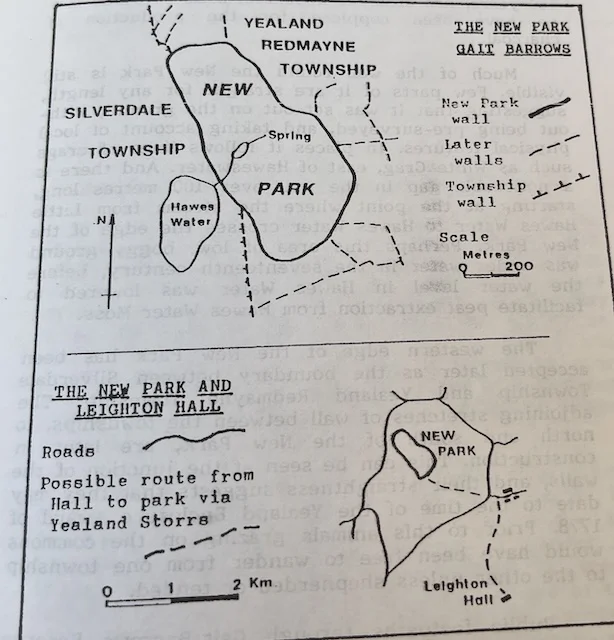
The location of the enclosure would have remained difficult to pin down were it not for the ever-helpful Lucas. In his History of Warton Parish (p.53) Lucas comments that “the Middletons being Lords of the Manner, inclosed a large Piece of Ground in the East Part of this township [Silverdale] which from the Original Use it was designed for … received the name of Colt Park.” He further locates it as lying northwest of the crag or fell at Brackenthwaite. With this information, and the First Edition six inch to the mile Ordnance Survey map of the area, it is reasonably easy to pick out the oval flattened shape of this primary enclosure. The irregular line of its wall contrasts with the later straight enclosure award walls. Lucas is incorrect in placing the New Park within Silverdale Township. It is wholly within Yealand Redmayne Township, as shown on the accompanying plan, though township boundaries may not have been accurately defined in Lucas’s day.
The Colt park, or New Park, 85 statute acres in extent, was an appreciable addition to the Middleton estates, and in indentures of the seventeenth century is listed among their possessions immediately after Leighton Hall and park and the mosses of Warton and Leighton (for example Lancashire Record Office ref DDTo/Q/9/2). No doubt the original intention was to use it for rearing horses, and the rather sparse limestone grassland, with watering places, would be well suited for this purpose. The inventory of George Middleton’s possessions, made at his death in 1672, includes 58 horses ‘young and old’, as well as geldings, mares and colts, in total worth over £150. A likely route from Leighton Hall to the New Park would be the track through Yealand Storrs, as indicated on the accompanying plan.
Confirmation that this enclosure is indeed the Middletons New Park is readily found in the plan accompanying the Yealand Enclosure Award of 1778, though by this time the park had passed into the ownership of Edmund Adamson. At the time of the enclosure the Yealand commonland is shown as being without any woodland, as would be expected from its continuous use for grazing. In contrast the New Park, which had been protected by its wall for some 150 years, has areas of woodland, some of which may be have been coppiced for the production of charcoal.
Much of the wall round the New Park is still visible. Few parts of it are straight for any length, suggesting that it was set out on the ground, without being pre-surveyed, and taking account of local physical features. In places it follows lines of crags such as White Crag, east of Haweswater. And there is a noticeable gap in the wall over 100 metres long, starting at the point where the stream from Little Hawes Water to Hawes Water crosses the edge of the New Park. Perhaps this area of low, boggy ground was under water in the seventeenth century, before the water level in Hawes Water was lowered to facilitate peat extraction from Hawes Water Moss.
The western edge of the New Park has been accepted later as the boundary between Silverdale Township and Yealand Redmayne Township. The adjoining stretches of wall between the townships, to north and south of the New Park, are later in construction. This can be seen at the junction of the walls, and their straightness suggests that they may date to the time of the Yealand Enclosure Award of 1778. Prior to this animals grazing on the commons would have been free to wander from one township to the other unless shepherded or tended.
Public footpaths through Gait Barrows Reserve give access to the New Park wall at several places. Standing beside it in this peaceful setting it is difficult to feel the deep resentment and anger that must have been experienced by the local tenants when they saw being it constructed on the commonland that was such an important source of grazing for their livestock. It is not surprising that this late attempt to revive the medieval rights of the lord of the manor met with determined opposition, especially in the inflammatory atmosphere of the mid- seventeenth century. Since last year the grassland in the New Park has been grazed by Exmoor ponies, so bringing it back close to its original use as the Colt Park.
Published in Mourholme Magazine Issue 30 1997