By Neil Stobbs
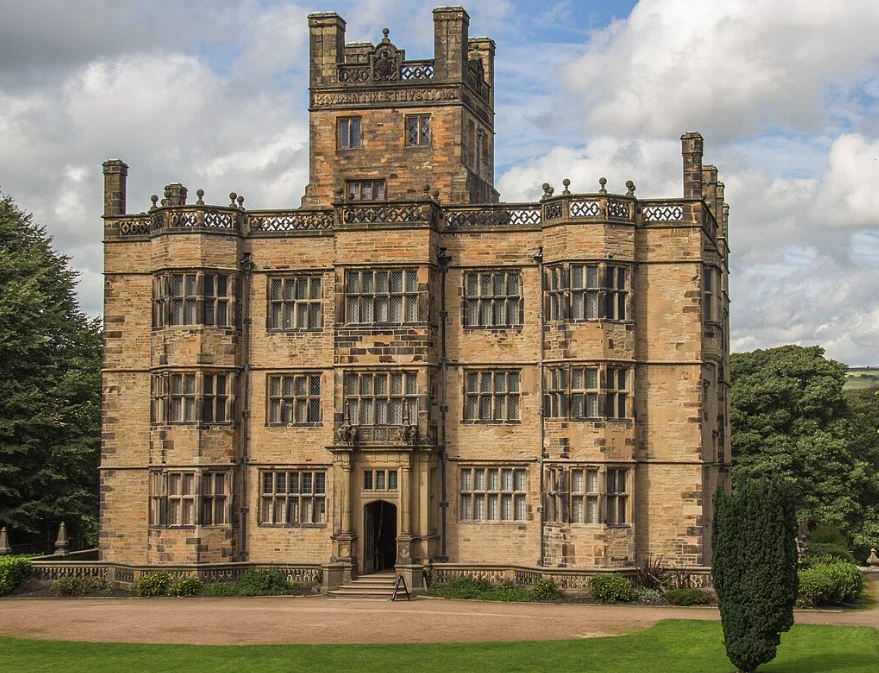
Photograph by Mike Peel (www.mikepeel.net). The household accounts1 of the Shuttleworth family living, finally, at Gawthorpe Hall at the end of the 16th century and the beginning of the seventeenth, it can give us an insight into the diet of an upper class family. An analysis of the entries appertaining to diet, over a period of about ten years, at the end of the sixteenth century has been undertaken. Problems arose when it was discovered, in a foot note, that the original editor, J.Harland Esq. F.S.A., had decided to “omit items that re-occur and would fatigue the reader”. This, of course, makes it impossible to apply any meaningful statistical analysis to the entries.
There are a number of interesting facts which have become obvious from the study.
- The large number of birds of all kinds that were eaten.
- The apparent strict adherence to the non-eating of meat during Lent.
- The large quantities of fish of various kinds that were eaten throughout the year, but especially during Lent.
- The entry of “White Bread” as a special item
- The absence of any indication of the eating of beef, except for one entry.
- The large amount of food which is entered into the accounts as being by “Gift”.
It may be of interest to list some of the birds that were eaten, even though the use of local names and aberrant spelling makes some hard to identify.
Domestic:– Hens, chicken, capons, geese, turkeys2, drakes, green geese.
Wild:– Woodcock, wild fowl, larks, swan, pigeons, cygnet, plovers, heron, “suesse, pires” [?], snipe, teal, redshank, “puffers'[?], lapwing, curlew, grey plover, “snipe-naves” [jack snipe], partridges, fieldfare, thrushes, mallard, whekers [wheatears?], yellow-hammers, “pereterghe” [partridges?], “odd birds”, sea-birds, “cargrasses” [cargoose or Crested Grebe?], blackbirds, sparrows, “scargraffe” [?], “oucles” [?], pheasants.
Similarly with fish :-
Salted salmon, cockles, “smeltes and tenchies”, pike, fresh eels, herrings, mussels, bream, white herring, red herrings, fresh salmon, salted eels, sprats, skate, flook, “fish with claw”, “stubbing” [?], tench, fresh- water trout, “Kongereel”, dace and perch, “morttes” [third year salmon], gudgeon, ling, organ-ling [a larger ling said to be the commonest fish in the North Sea], codlings and greylings, whiting, “stoke fish” [stock-fish or dried cod?], porpoise and sturgeon (the latter a present from Lord Derby).
Meat in the early years was for the most part mutton and veal, only in March 1585 is there any specific entry naming beef, “a buttock of beef cost 2s4d”. Mutton appears 19 times in the accounts between 1582 and 1593, once in 1582, 1585, 1588 and 1592, twice in 1593, 4 times in 1587 and nine times in 1583. The distribution suggests it was very popular in 1583, but then lost popularity. Or was it that the original editor did not transcribe the entries?
The main meat eaten seems to have been venison in various forms, variously entered as doe, fat doe, buck, venison, fat stag, hind, shoulder of stag, “wenysonne”. Considerable numbers of the entries show the venison as a gift, often from named persons. It may be possible with further research to build up some idea of the social circle of the Shuttleworths from this information.
Other entries show that veal was a common dish and also calf’s heads. One interesting entry reads: – Cows feet and calves feet from 8 cows and 12 calfs, 22d, with jelly bag and strainer”. Another entry lists “22 cows feet and 28 calf feet for 2s- 6d from Manchester”. Obviously they made calf’s foot jelly. And possibly cow heel pie?
Rabbits appear in the accounts as both rabbit and “conyes”. 22 brace of rabbits cost 20 pence in December 1594. 5 brace are entered at 3 shillings in November 1590. “4 brace of conyes” cost 3s-4d in January of 1593, 6 brace cost 5 shillings in December 1592 and October 1591. A considerable variation in price if we take them both to be the same animal.
Fruit does not have any large number of entries. Apples and pears are the most frequently mentioned but also “fidges”, peaches, oranges and lemons. Other fruit listed are”bastard wardens” [a type of pear], “press-codes” [?] and puselides [?].
There are other types of food listed, but not in much variety :- white bread, bread “for dry leche” [?], hopps, “artichope slypes”,[v.i.] parsnips, eggs, “sallat”, oil, woodcock pie, pots of honey, pigs, bacon, gammons of pork, oat cakes, puddings, “sewett”, butter.
One of the problems of analysing the accounts is that the house and farm accounts,in the early years, are run together and it can be difficult to decide if an entry means a live animal, which could be used for breeding purposes, or if it is named as a food source. For instance the pigs mentioned above could be such a case, as there are also entries for bacon and gammons of pork. The entry “artichope slypes” may refer to the slips used to propogate artichokes; one could then infer that artichokes would appear on the menu later.
It is interesting to note that herrings, sprats and other fish and shell fish seem in some cases to have been sold in barrels or measured by volume, in others by count. Herrings appear sold “in messe”[?] sprats in a “hundreth” and also in one half “ceade” [cask] containing a thousand. Mussels and cockles were bought in pecks or “mettes” [the local name for a bushel].
The remaining entries have to do with wine. The first entry, in 1582, was simply “wine, one quart 6d”. By 1583 the entries became more specific as: – February Claret Wine 10 gallons 3 quart 14s-4d. Sac wine 3 quarters, 2s. “White wine” is mentioned later, also bottles of ale, “Ipocras”, “spiced wine, a gift”. In trying to calculate the total amount drunk a hogshead has been taken as containing 522 gallons and a “tieresse” 35 gallons (as it is said to be one third of a pipe which contained 105 gallons). A bottle seemed to have contained 2.86 quarts, baseing this on the average price of sac wine at 4d/quart. Between 1583 and 1594 the household had imbibed, as far as can be calculated, a total of 741 gallons. If this is broken down, they used 74 gallons a year on average, or just under 1.5 gallons per week. This would be for the family only one would suppose.
Also among the inventories are various quantities of hops, so they must also have brewed beer and/or ale. There is nothing to show if they produced any wine on the estate, but considering the poor summers and cold winters which were frequent in the period, the growing of grapes in Lancashire is not something which could be imagined.
One further insight into the domestic arrangements of the household regarding wine can be seen from the entry for May 1592 when a hogshead of claret and one of white wine were purchased from Mr Richard Bavin of Chester, and 33 gallons of sac from Mrs Calpounne of Chester. After giving the price of the wines the entry runs as follows:-
houpinge and spannynge of the vesseles 12? the porteres for loding the same wyne 6d Carredge of the said wyne from Chester 9s 4d expendies of Roberte Aspenden when he wente for the said wyne to Chester, and home agane 3s 8?
Obviously new barrels were made to transport the wine to the house, the loading of them must have been a heavy or skilled job as porters were paid to do the job. The carriage of the wine had been contracted to an outside carrier, and was also important enough for Robert Aspenden to be sent with the order and for him to return with the wine. As far as can be seen from the accounts Aspenden was a Gawthorpe servant, but quite high up in the hierarchy of the estate.
There is a considerable amount of detail in the accounts which can give us some insight into the working of an estate and household of the late 16th and early 17th centuries. The most likely households of the level of Gawthorpe which existed in the Mourholme area are those of the Bindlosses of Borwick and the Middletons of Leighton Hall. One can postulate that they would have run their estate and household in a similar fashion, but without similar accounts it is difficult to tell.
References
- John Harland (ed.), Shuttleworth Accounts”, Chetham Society, 1861. ↩︎
- Possibly American turkeys by this date, but the name was also used for guinea fowl ↩︎
Published in Mourholme Magazines Issue 28 1996
By John Findlater
There is a tendency to have preconceptions (if such a word is allowable here) about illegitimacy. Peter Laslett in his book ‘The World We Have Lost‘1 cites the error of Gregory King, the seventeenth century writer and statistician. he believed, like everyone else, that London was a dreadful place, where decent standards were defied. We are certain that he was wrong here in one respect, as to illegitimacy … up to 1910 London had one of the lowest levels. Are we therefore to expect the Warton rural story to be all “wanton wenches and wayward wives, peasants and illicit sex”2?
In the Warton Parish Registers of Baptisms only 463 entries, for the whole century, were identified as concerned with illegitimate births. Reference to three more illegitimate persons is to be found in the Burial Registers. No further information, such as their ages, is available about these three. I have not found them in the Registers of Baptism.
In 12 of the 46 instances the baptismal record is of a son or daughter of a named woman when, in normal circumstances, it was the father’s name which was recorded. For example, on October 10th, 1652 “Maria fillia Allis Hardie de Carnford [Carnforth]” is recorded. The presumption is that such children are illegitimate, but it is not absolutely certain. On June 13th, 1669 there is a record of “Richard s. of Mary d. of Tho: Relph of W [Warton]” which makes the presumption even more likely. Somehow the short entry on February 12th, 1656, “Thos: s of Ann Wilson a stranger” makes one anxious to know what happened to this little mite.
But a rather different deduction might be made about the entry on April 13th, 1650 for “Jone fillius widdow Watson de Yealand Redman“. The most likely explanation here is that the boy was a posthumous son. In the Register of Burials is to be found “Richard Watson of Yeal.Storrs” on February 16th, 1650, that is to say three months earlier. It seems likely that this was the father.
There are two baptismal entries in 1647 which are puzzling:
6 June Agnes fillia Athera Barrow de Silverdall
20 June Elline fillia Athera Barrow de Silverdall
Were they twin girls, daughters of the same person (presumed to be female), whose baptisms were two weeks apart? Perhaps for some reason Elline was not well enough to be baptised at the same time as her sister. They may not have been twins, but sisters with a considerable age difference between them.For the remaining thirty children there can be no doubt of their status as illegitimate. Twelve are labelled “spurius” or “spuria”, five as “nothus”, seven as “base begot” and five as “bastard” or “basterd”. There is a vehemence starting from the page on
March 17th, 1644. “Isabella filia Eliz: Kenie de Lindeth spurius cum Thom: Crofte de Poulton base begot“: spurius and base begot and the guilty man named. Then on July 25th, 1652 we find the same woman appearing again, this time in connection with twin boys – “Will: & John base begot childeren of Elizabeth Kenie” – but no man named.There is another woman whose name appears twice:-
1645 29 March Tho: the sonn of Jenet Hadwen de Silverdall base begot.
1647 17 December Tho: fillius Jenet Hadwen de SilverdallThe first entry specifies base begot, the second does not, but the presumption is there. Both babies are called Thomas. Interestingly, an entry in the Marriage Register for February 15th, 1657 states that Will Atkinson of Beetham was married to Jenet Hadwen of Silverdale. Had Ms Hadwen found a man to take her on with her base begotten children? Was he the father of them?
Then there is the case of Anna Johnson whose, child Robert was baptised on February 22nd, 1601; could this be the Ann Johnson who married Lancelot Stable on October 13th, 1601? Perhaps they had just jumped the gun with Robert. Could the Anthony Mason, who had fathered a bastard on Agneta Crozier (baptised on July 23rd, 1601), be the same man who married Margaret Burrow of Warton on January 16th, 1601. I have not found Agneta Crozier in the Marriage Register.
There are examples where the illegitimate child is assigned to the father, with no mention of the mother.
1601 3 October Jennet filia Thomas Widder de Over Kellet spurius
1612 17 October Ann the basterd daughter of Willia[m] Watson of Leighton
1622 18 November Thomas the basterd sonne of William Beaneby, a strangerAn important source of information on the subject is a book published in 1980 “Bastardy and its Comparative History” edited by Peter Laslett and with contributions from many writers. All the quotations and figures given below are taken from this book, unless otherwise stated. (I made the mistake of looking at chapters on other countries. Happily I could confine my interest to England. That was fortunate because, for a Scot, it was disconcerting to find Scotland a bit of a black spot.)
The findings for the seventeenth century – based on formidable family reconstitution studies involving many parishes – looked so definite. It seemed pretty well agreed that the reproductive rate and the rate of illegitimacy and pre-nuptial pregnancy followed the same course; a rise from 1570 to about 1620, with only a slight increase up to 1700.
Then the apparent simplicity of it all began to erode. There were many problems which could have been affecting the reliability of the conclusions. To begin with, it was admitted that there was great ambiguity in legal definition of bastardy. There was “general bastardy” if the parents did not marry after the birth of the child, and “special bastardy” if they did. Special bastardy, unlike general bastardy, could not be tried in the ecclesiastical courts for it was not recognised as bastardy by the church. Recourse had to be had to common law courts. By secular code – statute of 7 James cap 4 (1610) – it was laid down that
Every lewd woman which shall have any bastard which may be chargeable to the parish, the justices of the peace shall commit such woman to the House of Correction, to be punished and set to work, during the term of one whole year.
Clearly the civil authorities felt illegitimacy might be a dangerous liability to them.
Added to that, and apart from the general problems detracting from the reliability of Parish Registers, there was a change in attitude in mid-century. In 1644, with the Presbyterian party in the ascendant, a Directory of Church-Government was issued by the Westminster Assembly of Divines. It “deprived baptism of sacramental status [with a] shift to registration rather than baptism … mere registration was not so highly regarded and may have been neglected“. Recording of bastardy was not universal, and clandestine marriages were common in the late seventeenth century. So there was considerable irregularity of recording.
Illegitimacy and pre-nuptial pregnancy are to be understood in the light of general courtship and marriage patterns which vary from period to period. All sorts of factors come into play
” … the activities of a core of repetitive delinquents, adultery, prostitution, the exploitation of servant by master, cases related to delays in the solemnisation of contractual marriages, to less stable relationships … and obscure liaisons of transient couples … ”
Little is known, for sure, about the incidence of abortion and infanticide; infanticide was punishable by death by an act of 1624. Uncertainty also reigns over whether the apparent nadir of bastardy in the seventeenth century was real or not. In the early part of the century Puritans denounced, even more fiercely than the established church, institutions and practices they believed encouraged sexual lapses, such as “dancing, drinking, May games, alehouses and brothels”. In 1650 there was an Act against adultery, with incest carrying a sentence of death and the penalty for fornication 3 months in the county gaol for the first offence, death for subsequent acts. Whether the increasingly harsh official attitude to sexual laxness had any effect on illegitimacy is another matter. The apparent sharp drop in the ratio between legitimate and illegitimate births during the Commonwealth may have been largely a statistical artefact, due to neglect of registration, confusion as to who was lawfully married, clandestine baptisms and all the results of the social upheaval of the times.
Illegitimacy occurred across the social scale, but more among the poor. A study of the recorded judicial examinations of the parents of bastards in Lancashire, failed to show any mother of higher rank than a yeoman’s daughter. 24% of the mothers were servants. The fathers were from every social level, though predominantly husbandmen, artisans and craftsmen. 14% were masters of the girls, 8% were fellow servants. 65% of the couples lived in the same township and 23% in the same household.
There has been some interest in what is called a bastardy prone sub-society, with repeated bastard bearers related to each other by kinship or direct personal contacts. The concept of such a sub- culture is not universally accepted. In the Lancashire survey quoted above some of the mothers were rated as promiscuous, but of the 18% who had more than one bastard, it was mostly by the same father. In the case of single bastard conceptions servant women were vulnerable; there was a good deal of exploitation of servants by masters (or their sons), though perhaps not as much as popularly imagined. Apart from two women cited with more than one bastard there is no evidence of a bastardy prone “subculture” in Warton parish.
It is unlikely one can go further than saying that illegitimacy in Warton was low; Forty nine illegitimacies out of a total of 2,743 recorded baptisms, or 1.78% of baptisms over the century. This is lower than in Hawkshead, where it was 2.47%. The pattern of illegitimate baptisms in Warton parish does not mirror the supposed national pattern with a nadir in the 1650s, but the numbers are too small for anything to be concluded from this. All in all it might have been as well to have accepted Dr Marshall’s wise judgement at the outset. “Illegitimacy was not a significant factor in regional history before 1750. This does not mean that premarital conceptions were not common … “4
References
- Peter Laslett, The World We Have Lost, (3rd ed), 1983, p.571 ↩︎
- Peter Laslett (ed) Bastardy and Its Comparative History, 1980, p.xiii ↩︎
- Where twins were baptised together they have been counted as one entry, for example on July 23rd 1682 “Robert & James SS Alis More of YS [Yealand Storrs] ↩︎
- J.D.Marshall “Out of Wedlock: Perception of a Cumbrian Social Problem in the Victorian Context”, Northern History, Vol. XXXI, 1995, p.203. ↩︎
Published in Mourholme Magazines Issue 28 1996
by John Jenkinson
I spent the first fifteen years of my life in a suburb of London, some seven or eight miles south east from the City as the crow flies. We lived in a road of terraced houses which were all alike. These days it would be called an estate, but I don’t think the word was invented then.
The only tradesman’s motor vehicle I remember in the ten years before the war was the baker’s. He had a box like structure in place of a sidecar on his motorcycle. If I was lucky I would meet him on my way home from school at lunchtime and I would get a ride on the pillion seat – a rare treat. The other baker delivering in the road had a two wheeled cart drawn by a horse.
The milkman was a very regular visitor. He called once about 6.30a.m., then at 11, then again in the afternoon. He had a hard job as he had to push a three wheeled cart with iron banded wheels up a considerable hill. We lived at the bottom. Our milk was delivered in bottles which had cardboard caps to them. This was better than the Co-op whose cart carried a large churn. The milkman ladled the milk from the churn into the customers’ cans. Later, possibly just before the war, our milk was delivered from a four wheeled cart with rubber tyres drawn by a horse.
Another horse-drawn vehicle was the dust cart. This was met, at regular times, by a motor lorry. The cart shafts, with the horse attached, were disconnected from a full cart which was then drawn up a ramp onto the lorry after another empty cart had been off loaded.
With all the horses about, manure was not in short supply. I had a box mounted on a plank with a wheel at each corner. The front wheels would steer. 1 It was fun to take this to the top of the hill and ride it to the bottom. It was also very useful for collecting the manure which I sold for ld a bucket. I don’t think my parents would have approved of this had they known!
An uncle, who was a butcher in East London, used to send us our week-end joint through the post every Friday so that it arrived on Saturday morning. This was so regular that I can remember the postman calling on one occasion to say the rush basket containing the meat had not arrived at the sorting office and they had made enquiries about it. This was the only time I can remember it not arriving.
A number of street vendors came round at various times. There was the muffin man who carried his wares on a large tray on his head. He balanced the tray with one hand while he rang his bell with the other. Then there was the man who came round on a Sunday. He sold winkles. Again he carried his wares on a tray on his head. At times the barrel- organ player would stop at the bottom of the road and play for a time. Then I remember there was sometimes a man playing a piano accordion and at times street singers would come round. Another irregular caller was the knife- grinder, with his grinding wheel mounted on a barrow. I have seen these barrows in a museum which makes me realise I am not as young as I was. The rag and bone man came round, sometimes calling out “Rag and bones, any old lumber!” Sometimes one would operate outside the school offering the children goldfish for old clothes. I think this was often stopped by the police for various reasons. Maybe he was taking advantage of the children and not giving them a fair deal.
Although we lived in a London suburb there was a farm about a quarter of a mile from our home. It was on the main road which led to the High Street. I can remember cows being there, but I do not remember there being any fields. Later the farm buildings were used as a depot for vegetables.
Opposite the farm was the blacksmith who spent most of his time shoeing the horses. What a wonderful smell there was, or so we used to think. The hot iron for the shoes gave off a smell when they were quenched in water, before being offered up to the horse’s hoof. As the shoes were still hot the hoof was singed which gave off clouds of smoke with a pungent smell.
Outside the blacksmith’s there was the cats-meat-man who sold cooked horse flesh in 1d packets. He also sold an ointment for chilblains.
Our street was lit by gas and, of course, the lamps had to be turned on and off. No automatic switches in those days. The first lamp lighter used a long pole with a hook at the top to turn the gas tap and with a shielded light to ignite the gas. The later gas lamps must have had a pilot light as the man only had to turn on the gas. He must have come round in the morning to turn the lights off again, but I do not remember this. Perhaps I was still in bed.
The road menders worked in a gang of at least five men. To break the road one of the gang held a spike with a long pole, while the other four hit it with sledge hammers. They got a very good rhythm going and I do not recall seeing them ever miss the spike. Later, spikes were attached to the back of a steam roller which dragged them on the road to break it up. For some reason most of the men working on the roads wore straps round their trousers just below their knees. They were still called navvies then, probably from the time they worked digging the canals.
As well as steam rollers, steam lorries were by no means a rare sight as they chugged along the road. Some steam vehicles were still used during the London blitz. I remember seeing the fairground steam tractors being used to pull down damaged buildings. I believe it was mostly the steam lorries that used chains to direct the power from the engine to the rear wheels, but it was not only the lorries that used such a system. The Brook Bond Tea Company used Trojan vans which used this system.
The first buses I remember in London were, like the trams, open topped. Attached to the back of each seat on the upper deck was a canvas sheet which could be hooked on to the seat behind in an attempt to keep it dry when it rained. The staircase to the upper deck was outside.
Some of the trams took their electricity from overhead wires, while others had an underground supply. Quite often the collecting pole for the overhead supply came off the wire so everything came to a stop while the conductor tried to relocate the pole. He did this with another long pole carried specifically for the purpose. The problem with the underground supply was that it made a slot in the roadway to catch the unwary cyclist. The tram tracks themselves were a hazard too. The driver of a small car, such as an Austin Seven, had to be very careful that his wheels did not catch in the track causing the car to go where the driver did not intend.
From school we went by tram to the local swimming baths. We enjoyed this ride, particularly as there was a pedal near the driver’s position that struck a bell. Of course everyone of us made sure he trod on the pedal as we came down the stairs. The conductors did not have much of a sense of humour after a whole class of us had found the pedal.
A rather unusual sight was to see an ox wagon, drawn by four of six oxen, being driven along the main roads. I believe it was to advertise Atora Suet, but I cannot be too sure now of the name of the product being advertised.
Sainsbury’s had a shop not far from where we lived. Like most of the grocers and butchers at that time the floor was covered with saw dust. The butter was kept on the counter in large blocks and the assistant would estimate the amount wanted, which he then cut off with a butter pat. After weighing the lump of butter it was shaped into an oblong with the pats and then wrapped in paper. Sugar was another commodity that was always sold loose, being weighed out into blue paper bags. Why always blue paper?
I wonder what the bakers do with their cakes that have not sold these days? A baker’s shop, run by a Miss Whorley near my home, would sell us boys a pennyworth of stale cakes. Monday was the best day to go and if we were lucky we would get a whole bag full for our penny.
A visit to the dentist’s surgery at Bliss Hill Open Air Museum, Ironbridge, brought back memories. This dentist used a drill that was operated by treadle power, somewhat like that used on sewing machines. A dentist I visited in London in the early days of the war used such an instrument of torture. An improvement was the drill that was turned by an endless belt driven by an electric motor. I should think the belt was made of string with the two ends knotted together and every time the knot passed the drill it made it jump. How lucky that such things are now relegated to history.
How things have changed! The baker no longer calls and the milk is only delivered once a day. Horses have disappeared from the streets, so manure is worth much more than one old penny a bucket. It would be a very foolish person who entrusted a parcel of perishables to the post hoping for a next day delivery. While most of the street vendors have gone we are now left with young men selling household lines from door to door who say they are out of work. The last time I passed the old forge the blacksmith and cats meat man had gone. The building was still there, but now it sold motor cars. The street buskers are still with us, though, so some things don’t change.
Published in Mourholme Magazine Issue 28 1996