by Michael Wright
It is a peculiarity of Hale Moss, north of Yealand Redmayne, that it drains both to the east, into Holme Beck, and to the west, into Leighton Beck. The gradients of the ditches draining the Moss are so low that alterations of a few feet in depth can induce reversal in the water-flow direction. The water flowing east once helped to power the mills on the River Bela, while that flowing west down Leighton Beck was needed by Leighton Furnace, which was built by the Backbarrow Company in 1713.
John Bolton has suggested that the drainage west from Hale Moss into Leighton Beck was man-made, intended to augment the flow down the Beck and so keep the furnace working1. Strong support for this suggestion comes from two letters in the estate papers of the Earl of Derby, which show that the managers of the furnace were seriously concerned to maintain a flow of water from the Moss into the Beck, and were actively involved in organising drainage of the Moss. Both of the letters are addressed to the Earl of Derby’s Agent at Knowsley2.
In the eighteenth century the Earl of Derby owned the Beetham Hall Estate and he wished to improve the drainage of about five hundred acres of the low lying land that extends from the River Bela south to Holme Moss and Hale Moss. The improved land would then command a higher rent from the Earl’s tenants. This was evidently planned to be a large-scale undertaking, in contrast to the routine cleaning of ditches regularly demanded of tenants, evidence of which is revealed by the records of the Beetham Manor Court. The work was apparently to be supervised by a local agent, Thomas Sill.
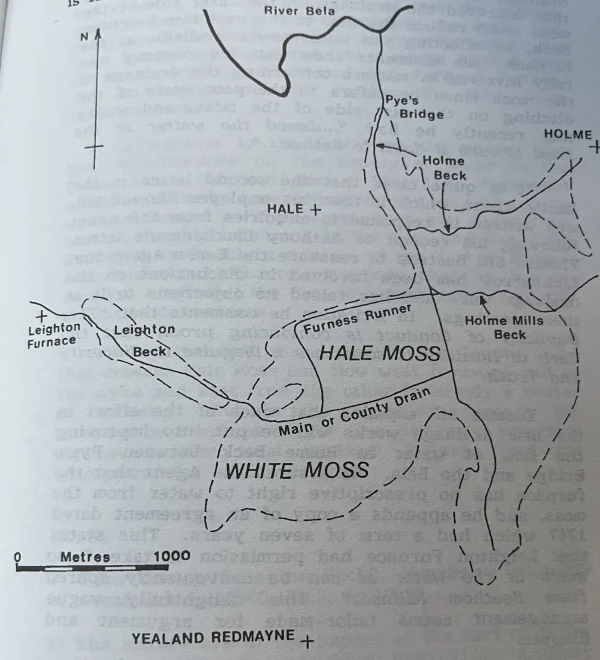
Sketch map of the drainage from Hale Moss
The broken lines show the boundaries of the areas of moss and low lying damp groundThe first letter to the Earl’s Agent at Knowsley is from Anthony Lickbarrow, agent to the Leighton Furnace Company. Though he was in favour of the drainage scheme he was concerned that any work that improved the drainage on the east side of the moss could reduce the flow to the west into Leighton Beck, so affecting the waterpower available at the furnace. His comments show that his company was fully involved in matters concerning the drainage of the moss since he refers to the poor state of the ditching on the east side of the moss, and writes that recently he had ” … damed the watter at the head to turn it down to Bethom … “.
It is quite clear that the second letter to the Earl’s Agent, which is from his employee Thomas Sill, was written in response to enquiries from the Agent following his receipt of Anthony Lickbarrow’s letter. Thomas Sill hastens to reassure the Earl’s Agent that Lickbarrow has been involved in discussions on the drainage work and has raised no objections to it at these meetings. In irritation he comments that “This Duplicity of Conduct is convincing proof, that the Garb of Humility is sometimes a Disguise to Sincerity and Truth.”
Thomas Sill explains that much of the effort in the new drainage works will be put into improving the flow of water in Holme Beck between Pye’s Bridge and the Bela. He assures the Agent that the furnace has no prescriptive right to water from the moss, and he appends a copy of an agreement dated 1747 which had a term of seven years. This states that Leighton Furnace had permission to take ” … so much of the Water as can be conveniently spared from Beethom Millns … “ This delightfully vague arrangement seems tailormade for argument and dispute.
Thomas Sill’s letter may throw further light on the origin of the Furness Runner, the ditch that cuts across the moss plots near the north side of Hale Moss. He mentions that during discussions with Anthony Lickbarrow they had considered the possibility of diverting water to the west from Holme Mills Beck. Though not specifying how this was to be achieved, it must be significant that the eastern end of the Furness Runner reaches the Beck, and could no doubt be lowered to capture its water. As John Bolton has suggested, the Furness Runner may be more correctly designated the Furnace Runner, dug to supplement still further the flow down Leighton Beck.
Adjustments to the flow from the mosses also had repercussions on the supply of water to the farms down Leighton Beck. The 1747 Agreement specifies that the watercourse to the west should be well maintained so that water does not damage the land in Arnside belonging to the Hon. and Rev. John Stanley (presumably a relative of the Earl of Derby). And Anthony Lickbarrow mentions that he has on occasion controlled the flow to ensure a water supply for cattle downstream.
Today the fact that water in the County Dyke that crosses Hale Moss can flow west from one end of the dyke and east from the other is largely a matter of curiosity. But in the eighteenth century the direction and volume of the flow had very important implications for local wetland drainage and for waterpower for local industries.
Notes
- James Bolton Leighton Beck ↩︎
- The letters are in the papers of the Earl of Derby at the Lancashire Record Office; DDK/432/43 (Anthony Lickbarrow’s letter); DDK/432/37 (Thomas Sill’s letter, with appended copy of the agreement with Leighton Furnace Company).
↩︎
by Basil Clarke
Joseph Mitchell was the vicar at Yealand Conyers from 1889 to his death in 1927.
He was born in Leicester in 1844 and educated there at the John Highton Collegiate School. He entered St. Thomas’s Hospital in 1866. There he was among the first men of his year and won prizes. Subsequently he took his M.R.C.S. (Eng.) in 1869, his M.R.C.P. (Edin.) in 1875 and his M.D. (St Andr.) in 1887. In 1886 he had become the medical attendant and secretary to Dr John Haddy Jones, a blind doctor at Exeter, until the death of Dr Jones. He then had fairly short attachments to the Tower Hamlet Dispensary and in Plaistow, and was the resident accoucheur at St Thomas’s Hospital.
Then in 1870 he began a private practice in London, and was elected the medical officer of No.4 District of St Pancras Workhouse. He had many dealings with the people of the slums in St Pancras; and he had much experience of their physical and spiritual needs.
Being strongly religious and belonging to the evangelical side of the church, he decided to give up his medical career and spend his time in missionary and social work. While a doctor he had become an enthusiastic temperance lecturer, and sometimes shared a platform with Lord Shaftesbury.
He passed the Cambridge theological examination in 1877 and was ordained Deacon at Ripon. In 1878 he was made a Priest. His first sermon was in Pentonville, London, and the ‘ same evening he preached at Somers Town to a crowded congregation consisting largely of his old patients, among whom he was popular.
His first curacy was in New Wortley, Leeds. He then spent a few months in Reading and, when the benefice of New Wortley became vacant in 1881, he was unanimously chosen as the vicar. New Wortley was a large urban parish; many of the men there worked on the railway, and it was said that a warm affection developed with them and their families. A new church was erected in New Wortley, largely through his efforts.
His wife, nee Emma Burton, whom he had married in 1871, was a very active helper. But Leeds did not agree with her health, and Dr Mitchell resigned in 1889, and accepted from the Hyndman Trustees the living of Yealand Conyers .”A picturesque village near the English Lakes“. Mrs Mitchell’s health improved, and she remained an enthusiastic aide till her death in 1908. Dr Mitchell continued to work successfully in Yealand for over thirty years.
One small child was sent to him with a button in her ear. He said his instruments would be a little rusty, but he dealt with the problem without trouble. The child recalled this in age, when visiting Yealand, where she no longer lived.
He was a keen supporter of Sunday Observance and of Foreign Missions, and was personally a strict teetotaller; but he remained very tolerant of those who disagreed with him.
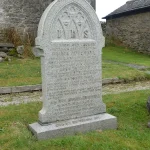

Rev Joseph Mitchell’s Grave He resigned finally in 1919, when 75, through failing health and eyesight. His farewell sermon made a great impression, and a copy was in circulation in the village till a few years ago. He retired to Kew and then to Wadhurst in Sussex, where he died in December 1927 at the age of 83. He is buried at Yealand Conyers. He asked for the words “God is my exceeding joy” to be engraved on his tombstone; they are on the base of the stone.