The following article has grown out of the work of a group of Mourholme Society members who are at present researching the seventeenth century history of our area. Neil Stobbs, a member of this group, has gathered together information about the culinary practices of a well-to-do Lancashire family of the period. The second section is an attempt, by the group, to see how far his findings can be applied to the ordinary people of this area.
Part I; The Gawthorpe Accounts
By Neil Stobbs
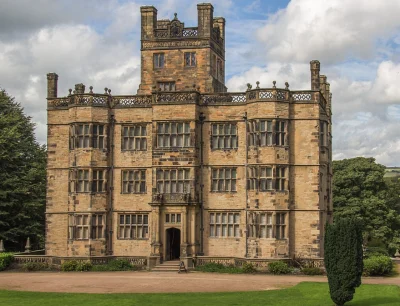
Photograph by Mike Peel (www.mikepeel.net). Gawthorpe Hall, near Burnley, was the home of the Shuttleworths, a Lancashire family which, from small beginnings in the thirteenth century, had by the sixteenth century amassed a considerable fortune by strategic marriages and the practice of the law. A set of accounts1 kept by their steward, running from 1582 to 1621, still survives for two Shuttleworth estates in Lancashire, Gawthorpe itself and Smithils. In a previous article2 the accounts were used to illustrate the cultivation and use of liquorice. In this article the same accounts have been used to learn something of the flavouring and preservation of food at the time.
The most important kitchen requirement in this study is salt. It appears in the accounts noless than 31 times, in quantities variously described as kerves, krennekes [crannocks], mettes [bushells], lodes and quarters. The nineteenth century editor of the accounts translates kerves as baskets. The quantity of salt contained in the basket is not recorded, but the cost of three baskets was about 39 pence, that is about 13 pence a basket. A crannockof salt cost about 16/-, suggesting it was about fourteen times the size of a basket. A mette was variously priced at anything from 18d to 3/4d. So it appears that a crannock was anything from 5 to 10 bushels large. This fits in with the definition in the Oxford English Dictionary; “For corn, the crannock of 2 or 4 bushels is mentioned; for salt it appears to have been much larger” There must be uncertainty in such estimates, however, because of the wide variation in price and uncertainty about the local meaning of the measures used.
The Gawthorpe accounts indicate that the salt was bought at Northwich, which is not surprising, since the salt-springs in Cheshire (to which the place-name element “wich”refers) were a long- standing and increasingly important source of salt. The accounts also show that salt was subject to a “towlle” [a toll], apparently paid as the salt left the town. Both these points are taken up in the second half of this article. Among actual spices, the most frequently recorded was pepper (or peper as it was spelt in many entries). It appears 15 times in the period. The first entry was found in 1582, when two pounds of pepper were purchased for five shillings. It was sent to Lyme [Lymm in Cheshire] “when the stagges were sent to London.” This would indicate that it was used to preservethe meat on its journey. It probably did help to keep it sweet. There has been a tendency to hold that pepper was used in the past more to disguise taint than as a true preservative, but it seems that pepper does have some proven antibacterial properties.3
In London, where the Shuttleworths mostly bought their spices, 21/2 lbs of pepper cost 7s/ld, that is 2s/10d a pound. In Lancashire they paid 2s/6d a pound. An ounce of pepper costing 3d was put into a “wodkoce pie which was sent to Londone” in September 1584. This gives a price of 4 shillings a pound, but then, as was also the case with salt, price per unit tended to go up as the quantity purchased decreased. The last entry for which it is possible to calculate a price was in 1617 when “4lbs of case pepper” cost the strange sum of 9s/13d, or in more ordinary terms 10s/1d. The price per pound is therefore 2s/6 1/4, not significantly different from the price of 2s/6d in 1582, but the comparison may not be valid. The Oxford English Dictionary suggests that “case pepper” meant cayenne pepper.
A frequently occurring purchase during the whole run of the accounts was vinegar, which appeared in many spellings such as vinyeare, venykerke, vinyker and venycer before settling down as vinegar after 1610. It appears eleven times in the accounts, in quantities from 1 pint to “seven gallones and a querte”. Prices vary, but ordinary vinegar is usually quoted at 4d a quart, and for larger quantities at 31/2 pence a quart, but on one occasion wine vinegar was bought; “foure gallone and a halfe … at 5d a quarte.
It is interesting to note that the three most frequently occurring entries in this study are for materials which were used for the preservation of foodstuffs. The lack of modern refrigeration required the cook to preserve as much of the produce grown in the season as possible, especially in rather isolated communities during winters, when travel would be difficult if not impossible. Methods used would include salting, and pickling.
Of the other spices purchased cloves and mace, often purchased at the same time, occur frequently. They appear in the accounts as early as 1584, as “masse and cloffe”. By 1608 the entries are separated. Cloves are purchased at 1s/9d the quarter pound and “largemace” at 2/6d. This gives a cost per pound of 7/- and 10/- respectively. In the accounts for1617 there is a list of “the usuall p[ro]porc[i]on of spices yearely bought in London at Michaelmas terme”; three-quarters of a pound of mace, and half a pound of cloves.
Another frequently recurring spice was nutmeg which occurred ten times in the accounts between 1610 and 1621. Mace and nutmeg are separate parts of the same fruit, mace being the scarlet aril, or seed-coat, which surrounds the ovoid nutmeg seed. It seems strange that mace should be mentioned as early as 1583, and nutmeg not till 1610. It may be nutmegs were included in some of the general entries about the purchase of spices. The price of nutmegs was quite variable, 4 ounces costing on different occasions 1s/6d, 2 shillings and1s/8d.
Spices were not only bought for cookery. They had medicinal uses. The Gawthorpe accounts list herbs and spices bought for the lying-in of one of the ladies of the household.The use of cloves in the pomanders which were carried to ward off infection, is well documented. Oil of cloves, as now, was used for toothache. Nutmeg was used to promote digestion, being, as a modern herbalist says” carminative; aromatic; stimulant. Used in smalldoses to reduce flatulence4“. Perhaps one should mention here that it is also poisonousand can lead to disorientation, double vision and convulsions. It has been known for centuries that moderate doses of nutmeg cause a feeling of unreality and visual illusions. Did we have sixteenth century drug takers? Probably not; the trip given by nutmeg apparently tends to be extremely unpleasant5.
Other spices which appear in the accounts include saffron, fenugreek, ginger, aniseed [“annelsied”], cinnamon, coriander, poppy seed, liquorice, pomegranate seed, saunders, turnsole and dragon’s blood. The last three are colouring rather than flavouring agents. Saunders (sandalwood) and dragon’s blood (a coloured resin) for red colour, and turnsole (a mediterranean plant) for purple.
One of the other important materials mentioned is sugar. It appears very early in the accounts, in 1583, though the amount purchased then is not noted. The earliest indication of price is 1/10d a pound. Later, in July 1621, an entry reads “p’d to Francis Austin, grocer, for ij loves of Fine sugar … at 13d per lb” Sugar was purchased in various forms, sugar loaf, white sugar, powdered sugar, brown candy, kitchen sugar, “suger in peeces”. It came from various sources such as Preston and Colne.
The prices of all these articles do not seem, at first sight, impossibly high, but the wages of servants quoted in the accounts show how large a proportion of the wage would have been spent to obtain the various materials under review. A female servant apparently received 1/-a month “hur halffe yeares waghes vis”, and though one female domestic was paid the very high wage of £9/6s a year, this seems to have been exceptional. Male servants received as much as 40/- a year, e.g. “His first qereters weghes xs”. The editor of the Gawthorne Accounts gives a table of wages for the period. General labourers earned approximately 3d a day. Skilled craftsmen were paid up to 7d or 8d a day. It is clear that the price of cloves and mace would be beyond the reach of most wage earners of the periods.
Part II
The townships of Warton Parish.
The Shuttleworths were a wealthy family. The comparison, given in Part I, between the cost of spices and the wages paid to their servants, shows the need for caution in extrapolating from Shuttleworth kitchen practices to those of more ordinary people. Would our predecessors in north Lancashire have used anything like the same range of ingredients for flavouring and preserving? In trying to find what was happening in the north-west two main local sources were used. One was the. autobiography of William Stout6. Stout was born in Bolton-le-Sands in 1665 and spent his working life in Lancaster, where he died in 1752. He was in the grocery trade for much of his life, and also involved in the import of foreign goods to Lancaster. He was thus in a position to speak authoritatively on the supply of the goods under consideration.
The other main source of information used by the group were the collection of wills held in the Lancashire Record Office. In the seventeenth century wills were still required, by law, to be accompanied by an inventory of the testator’s possessions before probate could be granted. These inventories, drawn up by respectable neighbours, were often very detailed, including even quite minor household equipment.
The inventories7 were searched for references to the preserving and flavouring agents referred to in Part I. A start was made by looking for references to salt. Direct references occurred only in 21 inventories of the 242 searched. Only once, in these direct references, was a quantity given. In January 1612 Alice Jackson, a widow of Silverdale, died possessing “halfe a strike of salte and a pecke of hempseed” valued at 1s/8d. But what was the size of a strike round here? According to the Oxford English Dictionary it could be equal to anything from half a bushel to four bushels. It was not even possible to work out quantities from the values given, since mostly salt, as in Alice Jackson’s inventory, was lumped together with other items, and then all were valued together. In only seven inventories was it priced alone. The range was from 4d to 6 shillings. Using the estimate from the Gawthorpe accounts of 18 pence a bushel for salt this gives holdings of from under a quarter of a bushel to four bushels. George Townson of Borwick died in 1638 owning salt and a barrell, worth together £2. If, as seems probable from values in other wills, most of the £2 was the cost of salt, then this would suggest a holding of something like 32 bushells. Townson, however, was exceptionally rich, with holdings in both Borwick and Halton, and property valued at £228 pounds.
Compared with what a modern household would store the amounts of salt held seem large.The explanation would seem to lie in the other common reference to the use of salt in the inventories. There are 15 references to “salting tubs” and a further 23 references to “beef tubs” or “flesh tubs”. It is no longer believed that most of a farmer’s stock had to be killed off and salted in the back end, because of the difficulty of over-wintering animals. Dr J.D. Marshall, for instance, found no evidence for this practice in Cumbria. “It will be noticed that there is no sign of any mass Martinmass slaughter … a community of cattle-dealers would think twice before indulging in textbook massacres, and an overwintered young beast gained in market value8“. Nevertheless animals had to be killed and, in the absence of refrigeration, almost the only way of preserving the meat for any length of time was by soaking it in brine in just such tubs. There were other methods of preserving meat, the inventories mention “hung beef” and “powdered beef”. Some of the bacon so frequently mentioned may have been smoked, nevertheless for large scale preserving salt was needed. William Stout thought the lifting of the salt excise in 1731 would be a great relief to country farmers and labourers since “a farmer of twenty pounds a year useth as much saltas many gentlemen of some hundred pounds a year use9“.
The inventories also give evidence of the more small scale uses of salt. Six inventories mention “salt butter”, which probably meant butter packed in salt to preserve it. Five mention “a salt“. This was a common word at the time for a salt-cellar, an interpretion which is supported by the fact that when “a salt” is mentioned in an inventory, it is along with the pewter and dishes. James Burton of Silverdale even had “3 saltes”. Possibly a man who liked things fine about him. He was not outstandingly well to-do, yet as well as the three salts he had “11 peices of pewter” and an expensive table cloth, valued at two pounds, to put them on.
The salt used in the Warton townships probably came increasingly from Cheshire. There had been important salt-pans on the Cumbrian coast, especially near Holme Coultram, but even there Cheshire salt was ousting it as early as the reign of Elizabeth10. Earlier, Cheshire salt had been manufactured by evaporation from the salt springs there. By 1670 the rock salt itself was being mined, and William Stout mentions that by 1688 it was being brought into Lancaster, though he adds that salt was also being imported from France and Spain11.
The inventories were also searched for any possible mention of sugar, but none was found. This does not necessarily mean that it was not being used. There were conventions about what was and what was not mentioned in inventories. Kitchen utensils and kitchen cupboards were mentioned, but not what was in them except farm produce likely to be stored on a fairly large scale; beef, bacon, suet, meal, malt and butter. The absence of all mention does suggest, however, that sugar was not being stored on a large scale. On the other hand it would be surprising if it was not being used at all, at least later in the century. It was no longer the luxury item of the middle ages, suitable only for sweet meats for the rich. Then it had come, via Venice, from India and Arabia. By the fifteenth century Venice’s monopoly was broken. Sugar cane was grown first in the Canary Islands, and from the end of the century on, in the Americas, Columbus having taken the first canes there in 149312. It was available in Lancaster. William Stout stocked it in his shop. By 1684 it was coming into the port in such quantities, through via London and Bristol rather than direct from the Indies, that it was worth setting up a sugar refinery in Lancaster.
There are two hints that sugar might have been used in the Warton townships by the end of the century. The first is a possible falling off of bee-keeping in the second half of the century. In the 242 inventories bees, honey, or both, are mentioned 38 times; 32 times before 1650 and only 6 times thereafter, a ratio of 5.3 to 1. It is true that there are, by chance, more surviving inventories for the first half of the century, but in nothing like the same ratio. (192 from 1600-1649 and 90 from 1650- 1699, a ratio of 1.7:1.) Was the arrival of relatively cheap sugar lessening the need for bee-keeping? The other hint, admittedly a tiny one, is that, when Sir George Middleton of Leighton Hall died in 1672, he had in his kitchen two preserving pans. Perhaps, in this rich household, sugar was being used as a method of preserving food.
No evidence has been found in the inventories of holdings of spices or vinegar. They were both obtainable locally. Ginger was coming in from the West Indies according to Stout and in any case the tradesmen of Lancaster were in touch with London. In 1693 Stout ordered goods from London, including oil and vinegar. Unfortunately they were “long a-coming, and damage by rats, who eat out the corks in liquor and oyl caskes, to the loss [of] some whole caskes of oyle and vinigar!13
The prices for spice suggested by the Gawthorpe accounts were high but not astronomical. The more substantial farmers would probably have been able to afford them. The question is rather would they have wished to? Spices are not essential to health like salt, nor even essential to palatable food. Herbs have always been a cheaper alternative. As long ago as the twelfth century a physician, talking about flavouring medicine, put it in a nutshell.” We usually give things for things and words for words. For empty words we give herbs … , but for precious money we give spices14“.
In Part I of this article it was mentioned that at Gawthorpe a whole ounce of pepper was put in a pie, surely an excessive amount even for the largest pie? The rich seem in general to have used very large quantities of spices, partly perhaps as a form of conspicuous consumption. It is possible that northern farmers’ wives preferred not to give “precious money” for spices when they could flavour the family food out of their own gardens for nothing. And simply because herbs cost “nothing” they would not appear in inventories. The only home-grown flavouring that got a mention in the inventories was onions.
In conclusion it has not proved easy to find direct evidence for local practices in preserving and flavouring food. At most it can be said that salting remained the important way of preserving, and that, though exotic spices were available to flavour the unpalatable result, no direct evidence has been found of their use. There are only hints that sugar may have been increasingly used. William Drummond, the classic writer on the history of food, thinks that the fall in the price of sugar also popularised the serving of fruit tarts or puddings after the meat course, and dates the practice from the middle of the seventeenth century.15 There is one entry in William Stout’s autobiography which suggests that fruit puddings may have been coming in up here. In 1682, when he was serving his apprenticeship as a grocer, he had to make up parcels of goods for sale on market day for people coming in from the country. The packets included sugar, tobacco nails etc. “and particularly prunes, which we made up in summer time about one hundred weight weekly in pounds and two pounds, and sold them three pounds for four pence comonly … 16“
Notes
- Chetham Society, Vol. XXXV, 1856. ↩︎
- The Use of Liquorice ↩︎
- E.J. Shellard, Emeritus Professor of Pharmacology, in Culpepper’s Colour Herbal ed.David Potterton ↩︎
- M.E. Stuart, The Encyclopaedia of Herbs and Herbalism, 1979 ↩︎
- G.S. Venables, “Nutmeg poisoning”, British Medical Journal, Jan.1976, p.96. ↩︎
- Ed. J.D. Marshall, The Autobiography of William Stout of Lancaster 1665-1752, 1967 ↩︎
- The original wills, with their inventories, are held in the Lancashire Record Office. There are transcripts of almost all of these in the Society’s archives, the outcome of much work, over the years, of members past and present. ↩︎
- J.D. Marshall, “Agrarian Wealth and Social Structure in Pre-Industrial Cumbria”, Economic History Review, p.512, 2nd series Vol.XXXIII, 1980 ↩︎
- Ed. J.D. Marshall, The Autobiography of William ‘Stout of Lancaster 1665-1752, 1967, p.254 ↩︎
- C.M.L. Bouch & G.P. Jones, A Short Economic and Social History of the Lake Counties1500-1830, p.117, 1961 ↩︎
- Ed. J.D. Marshall, The Autobiography of William Stout of Lancaster 1665-1752, 1967, p.95 ↩︎
- Tom Stobart, The Cook’s Encyclopaedia, 1980, p.402. ↩︎
- Ed. J.D. Marshall, The Autobiography of William Stout of Lancaster 1665-1752, 1967,p.108 ↩︎
- B.A. Henisch, Fast and Feast, 1976, p.103. ↩︎
- William Drummond, The Englishman’s Food, 195 ↩︎
- Ed. J.D. Marshall, The Autobiography of William Stout of Lancaster 1665-1752, 1967, p.79 ↩︎
This year the Society has obtained a photocopy of a 1908 guide book1. The guide was published for the “Carnforth Improvement Syndicate”, and is plainly an attempt to push Carnforth as a tourist centre. The book is called “Carnforth: Gateway to the West Country“. Its opening paragraphs state that while Carnforth is known mainly for its railway junction and for its
“very up-to-date Iron Works” it was becoming increasingly known for its “wonderful healthfulness, for the beautiful district of which it is the centre and its close proximity to the Lakes and a score of places of interest”.
It then lists these places. Among many which are still much visited today, such as Warton Crag, Levens Hall, and Arnside Knot, it places “Dunnal Mill Caves” in Nether Kellet. Visitors are advised to provide themselves with lantern or torch, and promised they will see “Weird winding caverns with overhanging boulders and fantastic shapes in stone“. The guide also assures its readers that “in dry weather the descent into the entrance cave is easily made even by ladies”. After visiting the cave refreshments might be had at a nearby cottage.
It seemed odd that such a dramatic sight was no longer attracting tourists. More especially as research in Lancaster Library showed that the caves had been known, as a sight to visit, long before 1908. In 1796 Father West had described Dunald Mill Hole in his “Guide to the Lakes”. Moreover he was quoting from an earlier description in the “Annual Register” of 1760. Lancaster Public Library was able to produce many more references from the nineteenth and twentieth centuries.
As these were studied an interesting sequence appeared. To the early visitors the cave huge and “horrible”. The Annual Register in 1760 describes the brook leadingto the cave as falling down “several beautiful cascades“. The entrance to the cave “has something most pleasingly horrid in it”. There were “vaults so capacious we could not see either roof or sides“. As the writer and his companions made their way through the cave the brook
“entertained us with a sort of harmony well suiting the place – for the different heights of its falls were as so many keys of music, which, all being conveyed to us by the amazing echo, greatly added to the majestic horror which surrounded us”.
and so the writer goes on, piling phrase on phrase.

From The People’s Gallery of Engravings, 1846 In 1846 the caves were featured in a book of engravings2, what we might now call a coffee table book. The text speaks of Dunald Mill Hole as
“one of those curiosities of Nature that combine impressions of terror with those of grandeur and sublimity”, and of “capacious vaults, whose boundaries are not discernible”.
The illustration above shows the intrepid visitors dwarfed by the dark magnificence of the cavern.
By 1865 a more prosaic note has entered the descriptions. A clergyman, Mr Addison Crofton, and his two brothers visited the cave3. They kitted themselves out professionally, with tin holders in their caps to hold candles, with ten yards of rope, a bull’s eye lantern, a compass and a note-book. They put on flannel trousers and flannel shirts with sleeves rolled to the elbows. Like the previous visitors they entered the cave through the corn mill whose wheel was turned by the beck that fell into the cave, (carefully leaving with the miller their coats and braces). The caves still impressed. The three brothers found one of the caves
“a perfect paradise of white forms; hundreds of stalactites hung pendant from the roof … from the tips of which a continual shower of drops came down, very beautiful in their glistening succession”.
But they note, more practically, that the dropping water threatens to put out their candles and move on hastily. They listen to “the eternal drop of the stalactites … and their music in the pool below,” but they also experiment. They struck the stalactites with their hammers and found that some sounded in C and some in G. They are even prepared to be humorous; they noted that in one cave the stalactites, when hit,”gave a discordant yell of indignation”, which sounded to them like “cats on the house tops“.
In June, 1889 a party from the Geological Section of the Barrow Naturalists’ Field Club visited the caves. It was plainly an entertaining outing, The members walked through the lanes, enjoying the chance to pick botanical specimens, including bee orchids, they took group photographs outside the cave and finished up with “a substantial tea” at the Limeburners’ Arms in Nether Kellet. Yet the expedition was also the beginning of a season of serious study. In November of that year Mr J.P. Smith gave a full account of the work to the Barrow Field Club4. He produced a map of the whole complex, gave accurate measurements of all the caves and passages, and speculated on the course of the underground river and where it might emerge.
He was very careful to distance himself from the hyperboles of his predecessors. Measurement had shown him that none of the caves in the complex were so big as to have indiscernible walls. In fact he found none wider than 10 feet. Even he could not help being a little impressed at the “fine rugged entrance to the cave … in all its boldness and grandeur“, but he immediately draws back from such enthusiasm.
“It would be the correct thing I believe here to break out into rhaphsodies of the scene, and quote a few verses from the poets, &etc, but as this is a plain matter of fact paper, I must refer those who are of a poetic turn of mind to some of the previous descriptions which contain a great deal more poetry and flowery description than reliable fact.”
The 1908 guide book showed a slight lapse into the flowery, but since then Dunald Mill Hole seems to have been left to the geologists who have shown all the matter-of-factness desired by Mr Smith. Dunald Mill Hole has become “a primary phreatic [of or pertaining to a well. Underground water which may be reached by a well] network of tubes in solutionally widened joints5“.
Armed with this information your chairman and secretary attempted to visit the cave to make a report on it. Today the way to the cave is muddy and derelict. The cornmill is no more. Even when the Barrow Field Club visited in 1889 the mill had been out of use for some fifteen years, though the wheel and a pair of stones were still insitu. Now there is only a ruined wall, and a treacherous jumble of stones to be crossed. It is no path for a “lady”. Yet the cave is still there and the arched entrance still impressive, certainly evocative of something more than the entrance to “a network of tubes“. Perhaps the earlier writers had a feel for something in the landscape which had a little escaped Mr Smith and the geologists. Whether the caves inside in any way approached the drama of the 1846 engraving could not be checked. We had not the skill, or courage to enter even the outermost cave. TheBarrow Field Club had noted that dry weather was needed to enter the caves. At the time of our visit the beck, swollen by prolonged rains, fell over the rim of the cave into the darkness beyond in a way that did not invite casual exploration.
In 1760, the writer of the article in the Annual Register said that he had read no previous description of the cave, and added “its obscure situation I take to be the reason“. Obscure to whom? Mr Smith of the Barrow Naturalists’ Club had for a guide a local game-keeper. When he asked local inhabitants how far into the cave one could penetrate he received answers which he dismissed as guesses, but which showed that a number of locals had been inside the caves. An “obscure situation” is a relative thing. There was once, it is said, a man from the Hebrides who visited London. He had nothing to say against it, except that it was “so far from anywhere“.
Dunald Mill Hole is still known to those living close by. The very first passer-by on the road above the mill knew exactly how we should get to it. Moreover his uncle had once investigated the route of the underground river by the use of dyes. The present inhabitants of the cottage by the mill, when questioned, were able to refer us to the valuable collection in Lancaster Public Library. Once it was so much visited that Mr Smith, of the Barrow Field Club noted sadly how many of the stalactites had been chipped away by visitors. When did the caves slip from the tourist route? It is true they now lie on land belonging to Dunald Mill Quarry. Yet it seems that they disappeared from the knowledge of all but speleologists and geologists even before they were taken over by the quarry. It is hoped that some local person who may chance to read this article may be able to throw light on what happened.
Notes
- By kind permission of Mrs Dora Roberti. ↩︎
- The People’s Gallery of Engravings”, Vol.3, p.92, 1846 ↩︎
- Preston Chronicle, August 19th, 1865 ↩︎
- J.P.Smith, “Paper on Dunald Mill Hole”. Barrow Naturalists’ Field Club, November11th, 1989 ↩︎
- Ed. A.C. Waltham, The Limestones and Caves of North-West England, 1974, p.221 ↩︎