By H.Gregson.
This article is taken from a chapter in Mr Gregson’s book on Borwick. The book only exists in typescript, and so is not as widely known as it deserves. We are fortunate that he allowed this shortened version to be put together for the magazine. He was not able to see the proofs before he died, but his wife has read the article and given permission for its publication.

Mr Fuller-Maitland was another distinguished occupant of Borwick Hall. A more cultured tenant than many of his predecessors and a man remembered with affection by some present residents of the village.
He was born on the 7th April, 1856, at 90 Gloucester Place, Portman Square; a house which had been inherited by his mother and in which she had lived for three years before her marriage to John Fuller-Maitland of Park Place; a mansion which had been owned by Frederick, Prince of Wales. Fuller-Maitland described his grandparents, each an only child, as representing two of the wealthy and devout families that made up the “Clapham Sect”1. Undoubtedly, the family into which he was born was very wealthy and well-connected in London society. His mother had moved in literary circles and had known Dickens and also Charles Lamb.There were signs of eccentricity in his father’s family and particularly in one great-grandmother, who was fond of riding and still continued to ride on Clapham Common up to the age of 93. One day she saw a butcher’s boy on an attractive looking cob. She enquired of his employer if he would sell the horse and concluded a satisfactory deal. When she tried to ride the cob, it would not move, so she sent for the boy. He explained that it would only go when he had a basket on his arm. The great-grandmother set up a basket and, for the rest of her life, she rode with it on her arm.
Life at Gloucester Place and Park place was very happy for the young Fuller-Maitland and, although there was not much music played, the young boy did learn to read music. The family moved to a new house in Phillimore Gardens in Kensington. Fuller-Maitland was considered to have poor health and, when he went to his first school (a class taught by a Miss Offord, the daughter of a Baptist Minister), he was not allowed to play out with the other boys. In fact, there were symptoms of some serious infantile disorder and the boy was coddled, being given a sponge cake and a glass of port each morning break. At the age of ten, he was sent to a school “for the sons of gentlemen” called “Argyll College”. Music was taught at the school, an unusual subject in schools at that time, but there was also outside tuition on the piano by a Miss Allen.
In 1867 Fuller-Maitland caught typhoid fever at the school and it turned out to be a severe attack. However, instead of the usual convalescence at the sea-side, he was entered at Westminster School as a day boy. The food was unattractive to the young boy, who seemed to attach much importance to the matter, and the daily journey on the underground was not good for his health. After a year, during which little progress had been made, he was taken from the school and given daily lessons by a private tutor, a curate named Wilmot. Some better progress was made. Music was the only thing in which young Fuller-Maitland was interested, but his parents only co-operated reluctantly. In the eighteenth seventies, it was not considered right for a boy to play the piano and he was encouraged to confine his music to singing and playing the violin. However, eventually, he was allowed piano lessons, which he enjoyed.
There were eminent visitors to the home, including Longfellow and Disraeli. In fact, he was introduced to Disraeli by Lady Beaconsfield2 with the words “James, this is Dizzy; Dizzy this is
James”. His name was John. There were visits to concerts, including the new Albert Hall and he became familiar with the standard oratorios.In October 1875, Fuller-Maitland entered Trinity College, Cambridge, and this was to him a special joy. He did not seem so excited by the prospect of learning, but he relished the musical atmosphere. He immediately joined the C.U.M.S [the University Music Society], and took part in all its activities. Life was more and more a matter of deeper involvement with music and he enjoyed the friendship
of those who had similar interests.Fuller-Maitland’s father objected to young men having no profession. Law had been considered, but this course was now abandoned. Music was the only possibility. Study with Liszt was considered, but his parents thought this inadvisable as there was a strong anti-Liszt movement. He did travel regularly to country houses, enjoying his music and playing the piano in very good company. The Bach Choir was just starting and he took a very active part in its development. Professionally he gained employment with The Guardian as a critic and he stayed with them for five happy years.
Besides his literary work he played at many concerts in London. At the end of these five years, the Times critic died and Fuller-Maitland was engaged for a month’s trial; this term was eventually extended to twenty-two years. Apart from his work for The Times, he edited a collection of nearly 300 pieces known as the Fitzwilliam Virginal Book. He collected folk songs and, in 1893, he published them in a book entitled English Country Songs.
In 1910, whilst staying with the Welch family in Lancaster, Fuller-Maitland saw the empty Borwick Hall and was immediately attracted to it. At the time the hall was owned by George Marton of Capernwray, but it was unoccupied and had been so for approximately fifty years. He became the tenant in 1911 and spent £7,000 on restoration, including the farming capacity which he transferred to Manor Farm, which he built. He furnished the house with the best of furniture, Sèvres porcelain, Chippendale furniture, and fine paintings. In the dining-room was a huge display of wine-glasses, liqueur glasses, sherry glasses, port glasses, hock glasses, custard glasses, tumblers, cut and engraved decanters with matching glasses, a rare Waterford sweetmeat stand with twelve hanging baskets. There were services in Wedgwood, Minton, Rockingham and Crown Derby. There was a Spanish Mahogany table, extending to 15ft, an inlaid mahogany pillared table, a bow-fronted mahogany sideboard and an Empire mahogany pedestal sideboard (with drawers, sliding trays and a cellarette) to store and display them all. The room was given colour by his collection of vases and bowls; some oriental, some Delft, some Blue and White, some Canton and some Worcester. There was also a banqueting Hall, with maroon velvet curtains, and a display of objects in copper and brass, a Smoke Room, furnished in oak…The detailed list is fascinating, but too long to be included here.
These were furnishings that would be typical of a house occupied by someone of Mr. Fuller-Maitland’s standing at that time, but other furnishings reflected his own special interests. In the Banqueting Hall was a 1765 Snetzer German Chamber Organ in a panelled mahogany case; it had 5 stops, 4 1/2 octaves and a foot blower. In the Smoke Room there was an upright grand by John Broadwood & Sons. There was also a 1795 harpsichord and a clavichord. He also had a great music library which is now in Lancaster Public Library. It included sixty volumes of the complete edition of the works of J.S.Bach.
Mr. Fuller-Maitland took an interest in the area in which he had come to live, particularly in the parish church at Warton, where he became Choirmaster and where he did much to improve the standard of music. He took an interest in the Mary Wakefield Music Festival and the Morecambe Musical Festival. He had a procession of distinguished guests at the house, and there were regular musical evenings. Several local people, who showed talent, were helped by Fuller-Maitland and, in some cases, lessons were paid for by him.
He also co-operated with Mr. Rawlinson-Ford of Leeds in the publication of the Lucas manuscript, which is a fascinating account of life in Warton in the early seventeen-hundreds. Mr. Fuller-Maitland died on the 30th March, 1936 at the age of 79. He had made a very generous contribution to the life of the area. Borwick Hall in his time must have given much pleasure to his many guests and visitors. Indeed, it may be we are still all in his debt for, without his injection of a considerable amount of money, the fine building could well have become a ruin.
Notes
- Clapham Sect. c. 1785-1830. A group of Evangelicals, influential in such matters as the fight against slavery, the founding of the Church Missionary Society, and missionary activity in India. ↩︎
- Lady Beaconsfield. Mrs Disraeli was created Viscountess Beaconsfield in 1868, eight years before her husband was raised to the peerage ↩︎
By Basil Clarke
Previous articles have shown that a Dr John Walling MD, from Silverdale, practised in Yealand Conyers. He lived somewhere “adjoining” Beechfield until about 1857, and then moved to Preston.
Dr James Matthews practised from The Croft (Clifford Hall) but did not begin work there till 1868. In between came Dr Peter Allen. Allen was born in Kent in 1827, the son and grandson of country surgeons. He was at King’s College, Aberdeen, and became M.D., MRCS Eng., and LSA in 1849. In 1851 he was practising in Dorset at Bridport and married Flora Nicholetts, a solicitor’s daughter, there. In Bridport in 1852 he was a certifying surgeon under the Factories Act, checking children allowed to work in factories. In 1853 he wrote “Practical observations on deafness arising from exanthemata” [measles, etc.].
In July 1855 he became an acting assistant surgeon in the Army’s Medical Department, and was sent to the Crimea. He received a medal and clasp for Sebastopol: the siege ended in the autumn of 1855. He was in Yealand Conyers (and Burton) in 1858. There seems to haye been no overlap with Dr Walling, whose effects were auctioned in 1857 after he moved to Preston.
Dr Allen was again a certifying surgeon under the Factories Act in 1858 and a medical officer to the Lancashire Union; Dr Matthews, his successor, held both these positions. In Yealand Conyers Dr Allen lived with his wife and mother-in-law at Ivy Cottage (opposite the Catholic church). He was there by the census of 1861, when he also became the honorary surgeon to the 10th Lancashire Volunteer Rifles.
He may have stayed on for a while after Dr Matthews arrived, since Matthews was at Dykes Lane, not Ivy Cottage. A directory shows Allen still in Yealand Conyers up to 1868. But Matthews’ first-year casebook runs from the beginning of 1868, and any handover would have happened before the end of 1867.
From 1869 to 1871 Dr Allen was at 1 Queens Square, Westminster, but by the 1871 census he was at 15 Saville Row and was a consulting surgeon at St Mary’s hospital. In 1872 he had moved to 117 Harley Street. He caught typhoid fever in January 1874 and died in February 1874 at forty seven.
It is noted that these three doctors in a small village were all well-qualified. Dr James Matthews, at least, ran a very wide general practice. No details of Dr Allen’s professional activities and techniques have come to hand as yet.
Acknowledgment is made to Mr Maurice Allen for information about Dr Peter Allen.
Published in Mourholme Magazines Issue 19 1992
By Robin Greaves

Green Garth [Ed There are two articles which I have copied as written in the Mourholme magazines]
The main part of the house dates from 1604. It was built as a three- storeyed farm house by a Jenkinson and lived in by that family for three hundred years. Across the road are large barns and outbuildings, and there is a pump and well recently renovated. Behind the house at the top of the garden is the grave, complete with stone and urn, of James Jenkinson who died in 1808 aged 70, and was buried there ’according to his wishes’.
He was first buried in Warton but ’he did not settle’. Several times after his death he was seen walking up the road from Warton to Yealand, and eventually, after the vicar had tried in vain to exorcise his spirit, he was exhumed and reinterred where he now lies.
The ground floor of Green Garth has been much altered but there is still an old stone fireplace in the main room very similar to others in the village. It has been painted and has the motto ’Palma non sine pulvere’ written beneath the mantlepiece. Beside it is a fine old oak bureau built into a recess, with cupboards above and below it. Through a door is the original staircase which leads to the upper floors. There is some old woodwork upstairs and on the walls of one of the top rooms and on several doors are initials carved presumably by the farmhands who slept there.
In 1950 I lifted a loose floor-board on the staircase and found under it, covered with dust, a Catholic Book of Hours, bound in leather and enclosed in a brocade case lined with velvet. It is written in French and Latin and the date of publication is 1753. On the back page is written the name Peater Desbourd. Who was this secret Catholic who hid the book? Who stitched the beautiful case so carefully, even covering the button in blue velvet?
Green Garth and The Jenkinsons: a House and its History
by Carol Shaw
In 1945 my parents bought the house in Yealand Conyers which is known as Green Garth from the Miss Hardings, who had been left it a few years earlier by an ex-pupil. She was Elfrida Roper, who also owned Beechfield. She had bought Green Garth in about 1932, and had made considerable alterations to it. From the Miss Hardings, my parents learned that the house had been built in 1604, and from that time until it was sold to Miss Roper it had belonged to a family called Jenkinson who were Quaker farmers.
One of them, James Jenkinson, was buried in the copse above the orchard in 1808 “at his own request” according to the inscription on the tomb. Initials on the doors and walls of the rooms on the top storey were said to have been carved by the farmhands who were housed up there. My sisters and I were brought up on this story, and there seemed no reason to doubt it, apart from one rather peculiar circumstance: my elder sister, going up the back staircase one day, felt a sudden desire to lift a loose board and look underneath. In the dust at the back of the hole she found a small book, carefully preserved in a case made of brocade and fastened with a button. The book proved to be a Catholic breviary, Heures a Trois Offices, l’usage de Rome dated 1753, with the name Pieter Desbourdes in the back.
What was a Quaker farmer doing harbouring a Catholic, and, by the sound of his name, a Frenchman? Was he being persecuted, and did the Quaker family take pity on him? Why did he hide his breviary under the stairs and leave it there? There were no further clues. Years later, several things began to make me question the established story.
My husband, looking at the initials in the top rooms, remarked that they must have been very small, and very literate farmhands. “If you are carving your name on a door, you normally do it at shoulder height, and some of these initials are only three feet or so from the floor.” Certainly the letters, with their elaborate serifs, are not what one might expect from rough eighteenth century farmhands. Might they, he wondered, have been not farmhands but schoolboys from the Quaker school down the road, boarded out with a friendly farmer?
I made a list of the initials and went down to the Meeting House to compare them with those carved on the door there. Many of them tallied. My sister, researching into early seventeenth century wills, found no record in them of any Jenkinsons in Yealand, which was odd. If they had lived in such a large house from 1604 onwards, surely there should have been some wills. There certainly was a Jenkinson family connected with the house. Apart from James in the orchard, my mother had been visited in the 1950’s by Jenkinson descendants wishing to see the tomb.
My brother-in-law suggested I should try to trace them in the old Quaker minute books still kept at Yealand Meeting, so I borrowed them and read my way through the 1670’s, 1680’s, 1690’s. No Jenkinsons. I found the first mention of the name in March 1729, when Michael Jenkinson was appointed schoolmaster at Yealand for one year. He was still there in 1733: “Michael Jenkinson our present master…is to teach all poor children belonging to this meeting and all others who are of ability.” In 1734 he married a local girl, Ruth Robinson, and settled down to produce a large family and presumably continued to teach at the school. There is no mention of where they lived.
Two of Michael and Ruth Jenkinson’s sons, John and James, later played an important part in the Meeting’s affairs, being appointed to several committees, travelling to Manchester and to London, _ and entrusted with various business matters. John is described as a schoolmaster and a yeoman. Both he and James rented land from the Meeting and in 1764 it is recorded that John bought a “dwelling house and also the close called Overcroft.” He also paid £30 for the alteration of a house which Friends bought in 1763 and converted into a school. There seems no way of telling whether either of these houses has anything to do with Green Garth.
In 1778 John married Margaret Hall of Height, and they had three children. He died in 1796, and his wife Margaret in 1813. The children seem all to have left the Society of Friends, since there is no further record of them in Quaker sources. Ruth, the eldest, certainly left: she married Mr Clarkson of Brackenthwaite in Warton church, and was eventually buried at Cartmel Priory.
James, Michael and Ruth’s other son, is a more shadowy figure, He never married (or, at least, no such marriage is recorded in Friend’s records). He was active in the Society, and in 1768 transferred his membership for a time to a meeting in London (another place to look for evidence of his activities). In 1775 he published A Generic and Specific Description of British Plants, so he must have been something of a scholar and a naturalist. He and John appear to have been involved in a printing and publishing business at one time – there is a pamphlet printed by “J. and J. Jenkinson, Printer of Yealand” *in the Lancaster Reference Library.
There is a curious note in the Meeting accounts: In 1802 James Jenkinson bought the school house and garden”. It is unlikely that this was the present Old School, since it still belongs to the Society of Friends. Was it Green Garth? James certainly owned the house when he died in 1808. He is described in Friend’s records as being buried “in the croft above his house at Yealand Conyers”. In quite another context I came across a letter on “Antiquities in Lancashire” written in 1788 by a William Hutchinson to George Allan Esq1. which refers to “British remains in the parish of Warton” and continues “Mr Jepkinson, who conducts a great seminary at Yelling, where he teaches the languages, conducted us through the scenes of antiquity…..At his house he showed us two urns which his workpeople recovered from cairns levelled down within his new enclosures on the skirts of Warton Crag.” It is fairly safe to assume that for “Jepkinson” we can read “Jenkinson” and for “Yelling”, “Yealand”. Mr Jenkinson was presumably John, the schoolmaster, who was by this time, it seems, a prosperous farmer, reclaiming land on the slopes of Warton Crag. This could have been the land above Green Garth, which could have been the house Mr Hutchinson visited. But still no proof. There is a lot more work to be done. The next step is probably to go to Preston and see whether the Lancashire Record Office has any record of John or James Jenkinson purchasing a house in Yealand Conyers that could be Green Garth. Meanwhile, James still sleeps above the orchard, and I am still intrigued.
- William Hutchinson 1732-1814, and George Allan 1736-1800. Both distinguished antiquarians in their day, both Fellows of the Society of Antiquaries. It was Allan who encouraged his friend to publish his “Account of the Antiquities of Lancashire”, Archaeologia ix 211-18. 1788. ↩︎
Published in Mourholme Magazines Issue 7 Spring 1984 and Issue 19 No 2 1992
By S.B. MeyerBurtt and Mary Meyer were estate manager and housekeeper at Yealand Manor when it was an evacuation school during the Second World War, and after that ran the Manor as a guest house for about ten years. The article that follows is thought to have been written sometime during those years, but has only just come to light. There are a few minor points, mentioned in notes at the end, on which one would like to have been able to consult the author, but it seemed a pity not to give the Society the benefit of this careful piece of work, so it was judged best just to print it in its entirety.
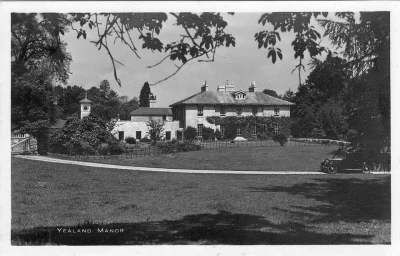
Yealand Manor
Yealand Manor occupies, without doubt, one of the finest sites in the three villages bearing the name of Yealand – Conyers, Redmayne and Storrs. These cling to the eastward side of a limestone ridge which terminates to the south in Warton Crag. The most reliable derivation of the name Yealand is from the Anglo-Saxon geahland, meaning “steep land”. In Domesday Book, and much later, it is called Jalant. The lordship of Conyers was never a large one, and was early linked with that of nearby Leighton by marriage. In later years it passed, by sale, into various hands.The original manor house, of which all trace is lost, is known to have stood in the park at a little distance from the lodge. The site is marked by a yard pump in the shade of a group of beech trees, and it seems probable that the ancient track, called Crag-gate, which can be traced leading down from Summerhouse Hill to the village below, past the former manor house. This may well have been little more important in size than some of the larger farm houses to be seen in the district today.
The present system of roads in the village is very different to that of former days. Up to the early nineteenth century there was little wheeled traffic and the so called Coach Road from Warton which enters the village down Peter Hill dates from that time only. Other roadways were widened during that century and their sides secured by retaining walls, as may be seen along the Manor boundary.John Ford, a ship-owner and builder of Lancaster, whose family came there in the eighteenth century from fforde Green in Staffordshire, bought the manor land at Yealand about 1800 and on it built the new mansion soon after. A great part of the stone was quarried locally, but the pillars and the steps of the portico, and possibly the casing of the main walls, came from further afield.
Two engraved stones – one above a side door and the other over a gateway in the garden – were brought from the family home in Lancaster, the site of which is now occupied by the Judge’s Lodging1. The Latin motto on one stone suggests that wealth may prove an incumbrance. The large bell, inscribed “Lady Cathcart” is reputed to have come from a sailing vessel of that name belonging to the family. Updated Mrs R. Greaves has found further information about these stones in Cross Fleury’s “Time-Honoured Lancaster”. The stones came, not from the Judges Lodgings at the top of Church Street, but from a house in St. Leonardsgate, now demolished, where at one time it is said, the Judges
used to lodge. Cross Fleury records the inscription on the stones.
One reads
Distribuendo Suum Cuique Neminem Timeas (by distributing his own to everyman you need fear no-one).
The other is a typical local date stone: L. I. R. 1756 The letters stand for Robert and Jane Lawson, great great grandparents of J. Rawlinson Ford the last to occupy Yealand Manor as a private house.The striking clock in the turret is probably of composite origin, as one of the three faces does not match the other two in size. Beneath the clock is a deep well, hewn from the solid rock. Formerly this supplied all drinking water to the house; for other purposes water was piped from catchments on the hillside. Later, the large covered reservoir, to the north side of the house, was constructed. In the distant past, smaller wells were sunk at many points on the estate, emphasising the extreme difficulty of maintaining a water supply on this rock foundation.
The manor walls themselves rise on solid rock, and in the surrounding pastures the soil is rarely of any depth. To gain such depth is doubtless the reason why the kitchen garden was made at such a distance from the house. This garden is contemporary with the house, but the rock garden was developed by the late Rawlinson Ford and his wife, who were the last to occupy the Manor as a private house. It subsequently became a guest house and, during the last war, a school.

The Summerhouse on Summerhouse Hill, Yealand Conyers mid 18th to mid 20th century (from MLHS Archives) It is known that the Summerhouse was at one time used as a club house by the Yealand Cricket Club, and that during the war the scouts were allowed to use it. Its history would repay further research.
Rising sharply above the manor is Summerhouse (formerly Barrow) Hill, on the summit of which John Ford built his gazebo2, with a clearance in the trees towards Ingleborough and a view, then
unobstructed, of the port of Lune3 to the south. With a telescope the family could identify ships at the quayside. An interesting feature hereabouts is a number of massive boulders of Shap granite
which were left in the path of the ice-age glacier.Alongside the primitive Crag-gate (referred to above) is an early grave site, marked by an old thorn bush, which was excavated by John Ford in the second decade of the last century and from which he took a clay urn containing bones and ashes. Tradition has it that this urn was later purposely destroyed by a superstitious house-maid. Many other signs of burial and tribal gathering from earliest times are in evidence; notably a few remaining stones of what is held to have been a circle4. The name Cringlebarrow, which is applied to the northern end of the ridge, is derived from Old English kringla, a circle.
Several ancient rights-of-way cross the Manor lands; one coming along Little Deepdale at the back of the Rock Garden and known as the “corpse road” was the quickest route from Far Yealand to the then parish church at Warton. Beyond this track is the real Deepdale, an impressive basin caused by rock faulting, and nearby are to be seen many specimens of the native yew tree. Those yews were accompanied formerly by a thin growth of alder, ash, birch and thorn. Later, coppice woods were developed to feed the charcoal industry and to provide material for bobbin making and other crafts. A century and a half ago the magnificent beech and other standard trees, including some fine conifers, were planted around the Manor and there are now more than forty varieties of tree on the estate.
Notes
- The Judge’s Lodgings date back to the seventeenth century. Perhaps the text should have read “near” the site of the Judge’s Lodgings. ↩︎
- Gazebo. The “Summer House” is older than this. Mr Tom Clare (personal letter) dates it to c.1750. ↩︎
- Port of Lune. Presumably Sunderland Point, or Glasson Dock, rather than Lancaster. ↩︎
- The idea of a stone circle on Summerhouse Hill has not been supported by later work. ↩︎
Published in Mourholme Magazines Issue 19 1992