The following letter is one of the documents belonging to the Quakers of the Yealand Meeting.
Thomas Cummings went to America in 1728 and settled in Chester, Pennsylvania, a few miles south of Philadelphia on the Delaware River. He is writing to his cousin Edward Cummings of ’Hilderstone nr Yealand’. (The original letter was almost entirely without punctuation. I have punctuated this transcript to make it easier to read and, I hope, grasp the sense of the letter. The last three paragraphs here were one paragraph in the original. Some explanatory notes follow.)
Chester on Delawar 1st mo, the 23d, 1747/8
‘Dear & Loving Cousin I Could not well Omitt this Opportunity by our Dear Friend & Neighbour Jane Hoskins (who is Comeing to visit you in these troublesom times) of Aquainting thee that I and my Family is in a good State of health at present, I hopeing she may finde thee and thine In the Same Enjoyment tho I must own & I doubt not but thou findes it that Age Creeps on apace & brings its Common Attendants along with it, yeat I have been & Still am favoured beyond most Considering my Weakly Constitution. My wife has been often ayling but I hope is now Growing more harty, tho fatt & heavy. I Question not but Ere now thou must have heard that Brother Enoch & Sister Ann is both dead Sometime agoe so that I have none on this Side of the water but the young offspring of my Brothers & Sisters who tho Near & Dear to me yeat Seems Somewhat removed from that Nearness that Appeared amongst us of the Elder Stock; & when I look over the Seas towards you I finde my Self much In the Same Circumstances & I seem like one left after the Vintage to be Gleaned up in time, for which I hope to wait with patience. May those favours Conduce to the leading me on into a more & Intimate Union in Spirrit with the Divine Goodness which is the Center of all our happyness.
Benjamin Bispham & his Good wife is Removed to Mount Holly1 at a Greater Distance from us then formerly So that we Can Seldom hear from them, but I know not but they are both well. I believe he has Got a Considerable Estate, tho I Can hardly be perswaded he is got to a better place for Getting money then where he was. He thinks he is and I wish it may prove So.
Cousin John Cumming is out of his time2, is a good workman I hope likely to Do well. At present he has taken a tour towards New York. His Brother Thomas is not yeat free but is in health So far as I know. We In this part of the world have hitherto been very much favoured with peace dureing this Jangling Warr3. What this Summer may prove I Cannot foresee. We are very much Threatened with an Invasion, tho for what I Can hardly tell. Here is no Great Stock of plunder to Invite them Excepting provision that is plenty here & Scarce with them, but then they have the Oppertunity of taking our Bread & flower at Sea, & that they do not let Slipp, for our Merchants has Suffered a pretty deal; & If they Should undertake to Ruin the Countery & Render us Incapable to Raise it for them or Carry it out, that would be to their Detriment & they must Suffer want, for if they had the Country they Could not raise it themselves So that I am In hopes they will let us alone, Except Some Stragleing Privateers that may do Some Damage here and there where the(y) fall upon the Ihabitants about the Borders of the Sea & River.
Our People (many of them) Seems Uneasie for the Citty of Philadelphia & has proposed to Raise forts & Batterys (tho I think friends keep Clear) but nothing yeat I think is done towards it, at least of any Consequence, and In Order to Strengthen themselves Many have Entered into an Association for mutual defence & Exercises themselves at Sell times4 and has Chosen Captains & Other Officers who has Got Commisions. But I think very few under the Notis of friends has Signed the Association & None that I know of undertakes to Exercise themselves, but the rest has formed themselves Into Companys to a Considerable Nomber, and tho I think they Can do no Good, from the manner of their Establishment, yeat I fear they may do hurt from the knowledge & union of their Strength, in Altering our Assembly by Governing in Elections. I believe heretofore by all that knew us we were looked on as a peaceble harmles people, but If this Go on we are likely to make another Sort of figure &, like Swizerland, become a Colony of Souldiers, without peace; or Some Other Event hapen .(to?). Stop our Career. I pray God may defend us from our Enemy & from (our?)Selves & When I Consider how for a few Righteous persons he would (have?), spared Sodom, I have Some hopes he will Spare us for his Peoples Sa(ke?). If not it is our duty patiently to Endure, knowing this, that tho no afliction be Joyous for the present, yeat there may be in it an Exeeding Weight of Glory. I hope.
Thomas Gawthorp is arrived Ere this. Pray remember my & my wives kinde Love to him & to John Griffeths & his Companion, honest Old Peter, when they Come your way, & If Ebenezer Large Should be your way after this Comes to hand, Give my Dear Love to him. Likewise Remember mine & my wives Kinde Love to William Backhouse, John Lancaster, Sister Jennet Barrow & Sister Eiling Cummings & all their familys. To her that was Ruth Robinson and Sibball Russel, if Living, to Thomas. Beakbain & family and to all our Other Friends, Relations & Aquaintence as If Named & Especially to thy Self, thy wife & Sone, a Large Share of the Best Respects of thy Assured Loving & Wellwishing Friends
Thomas Cunnings & Alice Cummings’
- Mount Holly’, about 100 miles west of Chester. ↩︎
- ‘out of his time’, finished his apprenticeship, unlike his brother who is ‘not yet free’ ↩︎
- his Jangling Warr*, ‘King George’s War’(1745-8), the Colonial arm of Europe’s War of the Austrian Succession. The French did not invade and the Treaty of
Aachen ended hostilities until 1754. ↩︎ - ‘Sell times’, favourable or proper times. ↩︎
Published in Mourholme Magazines Issue 6 Winter 1983
By Ian Wilson
Today when one walks into many of British Rail’s stations, it is not hard to get the feel of past glory. Carnforth Station is no exception; one has just to walk through the entrance arch to see that the main line platforms have been cut back and that the building itself is rapidly decaying. It is not hard to imagine the time not so long ago when London express trains stopped here while hundreds of people moved around the platforms in the heyday of railways. Go back a little further in time, however, and one would find only a tiny halt, and indeed it is possible that Carnforth may never have had a station at all in the beginning.
By June 1840 a network of railways had come north from London to reach Lancaster. However, after this point there was disagreement about the course the line should take to Scotland. The favoured course at the time was one proposed by Joseph Locke in 1835. He envisaged a line going up the Lune Valley via Kirkby Lonsdale and onto Tebay before descending to Penrith and Carlisle. A second route was put forward by Job Bintley under the insistence of parties in Kendal. He proposed a line running through Carnforth to Kendal and up Longsleddale before tunnelling through to Hawswater and onto Penrith. A third route was put forward by George Stephenson. He suggested a barrage carrying the railway over Morecambe Bay, another over the Duddon, the line then following the coast to Carlisle, thus avoiding any high ground.
These three and other proposals were put before a Royal Commission which was set up to examine railway routes between England and Scotland. The Commission rejected the coastal line as being too long, while it foresaw difficulties in tunnelling under Longsleddale as Bintley had suggested. However, it suggested that the southern half of Bintley’s line could be linked with the northern half of Locke’s line, and this was the course that was finally adopted.
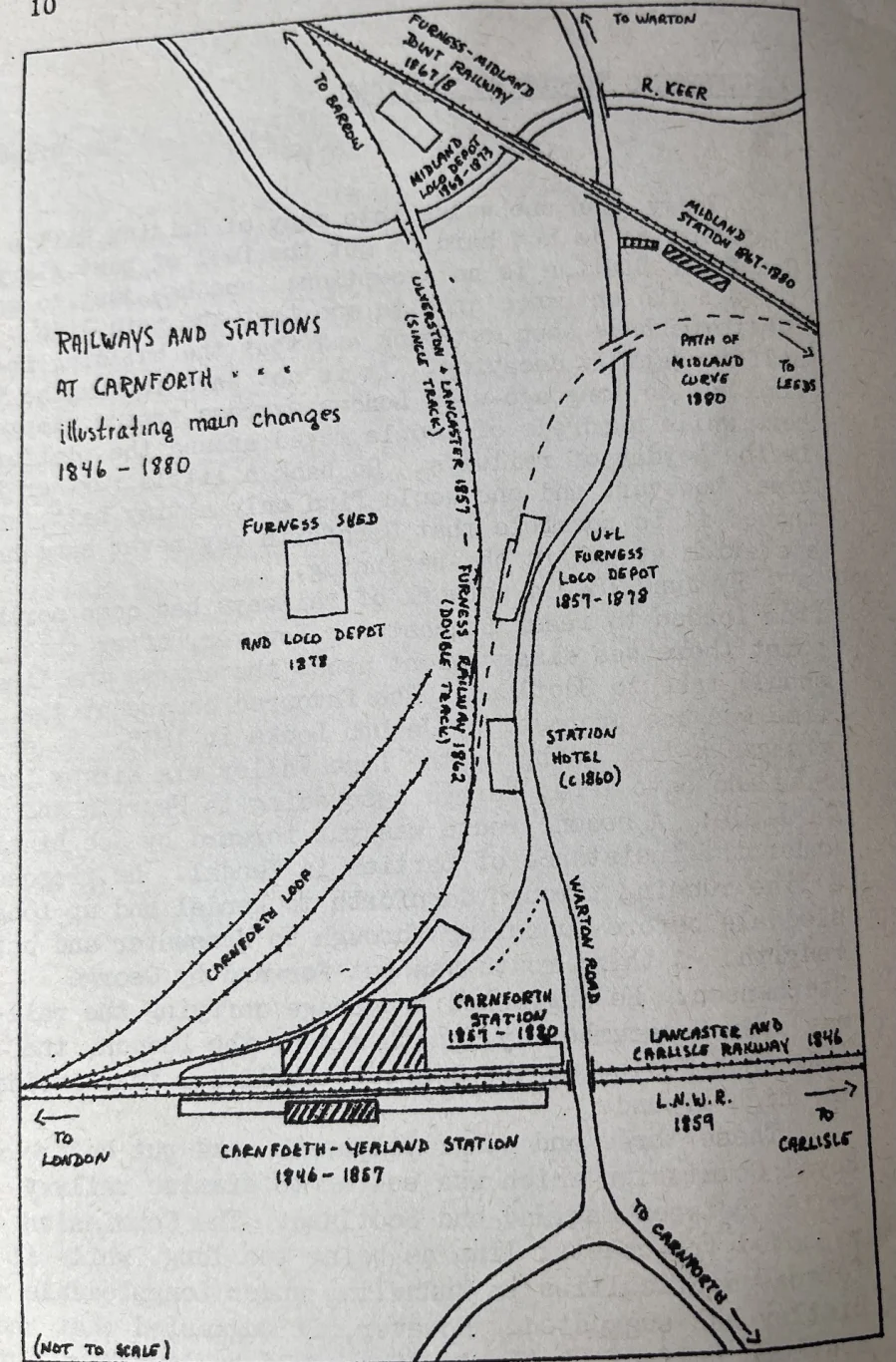
Parliamentary approval for the line was given on 6 June 1844 and work started before the end of the month. The Lancaster and Carlisle Railway Company had envisaged a single line. Demand for their shares was so great, however, that money problems vanished and a double track was built. The line opened to Kendal on 21 September 1846 and on to Carlisle on 17 December. In 1846 Carnforth was a small village mainly built along the present North Road. It would be logical for the company to provide a station for the community as one of its’smaller’ stops on the way to Carlisle. The station was named Carnforth-Yealand, indicating the unimportant nature of the village. There has been some doubt over the actual site of the first station; however, an early O.S. map shows it to have been on the site of the present day main line platforms, just south of Warton Road Bridge. Why the station should have been called Carnforth-Yealand instead of the more logical Carnforth-Warton Station is probably lost in history. The station consisted of two platforms with the station building being on the Carnforth side of the line, probably just south of the present day ticket office [Ed now Heritage Centre].
An 1850 timetable shows that just two up (to London) trains (10:50, 5:24) and two down (from London) trains (11:14, 1:51) stopped at the station with no trains stopping on Sundays. Indeed if it were not for events going on elsewhere at the time, that could have been the history of the station, opened 1846 and no doubt closed around 1970 if not before. The fact that this did not happen was due to events taking place on the Furness peninsula. In 1846 the Furness Railway Company opened a line from Kirkby in Furness to the then tiny hamlet of Barrow with a branch to Dalton. The Dalton line was extended in 1851 to Lindal and then onto the then biggest town on the peninsula, Ulverston. However, the final link from Ulverston to Carnforth was independently constructed by the Ulverston and Lancaster Railway Company. Carnforth was the logical point of junction with the Lancaster and Carlisle. The line was opened on 1 September 1857.
The coming of the Ulverston and Lancaster meant drastic changes for the small Carnforth-Yealand station. To show its new importance, ‘Yealand’ was dropped from ‘ its name, and as ‘Carnforth Station’ it now rivalled Oxenholme and Penrith as the most important station between Lancaster and Carlisle. A new platform had to be built to accommodate U & L traffic, which took the form of a triangle between the main line north and the curving new line to the west, with a new station building on that platform. A small loco depot was built just northwest of the station beside Warton Road, while a number of loop lines were built between the main line and the Ulverston line for goods traffic. The line to Ulverston was at this time only a single track.
Two years later in 1859 a new name appeared at Carnforth Station, that of the mighty London and North Western Railway, the ‘premier line’. That year the L.N.W.R. had leased the profitable Lancaster and Carlisle, which itself had previously leased the Lancaster and Preston Junction Railway and the independent Kendal and Windermere Line. Three years after the L.N.W.R. came to Carnforth, the Furness Railway arrived by absorbing the Ulverston and Lancaster in 1862. The following year the Furness doubled the line between Carnforth and Ulverston, though no new platform was added to Carnforth Station. During this time the L.N.W.R. built its own loco depot south of the station.
The next development at Carnforth started in the 1850’s when a large deposit of haematite, an iron relatively free from phosphorus used in steel making, was discovered at Park just outside Dalton in Furness. This resulted in an increased rail traffic for the Furness, particularly to Yorkshire. Trains bound from Furness to the east, however, had to reverse at Lancaster Castle before going along the single track to join the east-west lines of the Midland Company at Green Ayre.
In 1861 the Furness and Midland proposed a new line to cut out this roundabout route, the new line to go from Carnforth to the Midland line at Wennington. The line was opened to a point just east of Warton Road on 6 June 1867 with the stretch from there across Warton Road and the Keer opened on 1 July 1868. However, as trains from the east would need to reverse down the Furness line to reach Carnforth Station, a new station was opened just east of Warton Road. The steps which can still be seen between the two RR bridges on Warton Road lead up to the site of this station. All trains over this line were run by the Midland, which built a loco depot just north of the Keer in the ’V between the new line and the Furness line to the main station. Only five years later, however, the Midland found these facilities too small and the present Midland shed was built just east of the A6.
The separate Midland station lasted only a short time. Plans were made to build a curve from the Midland line crossing Warton Road and continuing on into the main station. The Furness shed, however, stood in the way, so in 1878 a new shed and loco depot were built on the site of the present shed occupied by Steamtown [Ed. Now a privately run company supplying rolling stock for heitage trains]. The obstructing shed was demolished and the curve opened on 2 August 1880, the Midland station then being closed.
The arrival of the Midland at the main station coincided with its rebuilding in a grand manner and taking on a much more familiar look. The building which now holds the ticket office [now business units] was built, with the platform being extended north under Warton Road Bridge. A bay platform was provided just south of the ticket office buildings. A large train shed was provided covering the bay line and two parallel sidings. The north wall of this can still be seen jutting out into the station car park. A canopy ran the length of the main line platform from its southern end to the end of the buildings just south of the bridge. The triangle shaped middle platform was built with two prongs, one going aside the main line, the other following the Furness curve. The Midland bay, which still can be seen, was at its northern end. The buildings which now stand on this platform were built then. No second Furness platform was built, however; up and down Furness trains still operated from the single centre platform. A large, over-all roof in Gothic style covered the Furness lines and Midland bay.
A large wall for this was built on the site of the present down Furness platform. The siding against this wall inside the shed was given the name of ’Snatchems’. The station stayed unaltered until the days of the London, Midland, & Scottish Railway at the 1925 grouping. In 1925 the L.M.S. closed the Furness shed, as three sheds for the now one company was considered extravagant.
The next changes to the station occurred during 1939-1940. The overall roof was demolished, while a new platform for down Furness trains was finally added. Shortly after this, the station was used for the station scene in the film ‘Brief Encounter’.
In 1935 the Furness shed was demolished and work started on a new shed and loco depot, which existed as ’Steamtown’ [for a period befoe becoming a private comany supplying heritage rolling stock]. The depot included an ashplant and the huge coaling tower which still dominates the town. It was opened in 1945 and at the time was the most modern in Europe. Once the new depot was opened, the old L.N.W.R. shed could be demolished, while the Midland sheds were sold to a private firm.
The station stayed the same for the next twenty years, surviving the 1965 Beeching cuts. The onset of deiselisation and electrification, however, had drastic effects on Carnforth. Steam locos operated out of Carnforth until the end of steam on BR in August 1968. On 31 March 1969 BR closed the loco depot, but by then Steamtown had been born and now flourishes on the depot site.
Meanwhile the station itself came under scrutiny in the interests of speed. The main line platforms were closed and partly demolished. The canopy on the ticket office platform was also demolished. In 1975 electrification work started, resulting in the southern approaches being changed. Electric trains started running from May 1974. Since then the remaining parts of the station have been tidied up and a glass screen added to shield passengers from the main line. Both Barrow and Leeds trains now stop at the Furness platforms, while the Midland Bay is rarely if ever used. The station is still moderately busy, most trains attracting a reasonable number of passengers. During summer months the station gets a boost by the steam specials running either to Ravenglass or York, these always attracting a large crowd. The station should remain open for the foreseeable future, though rumours circulate from time to time about the closure of either the Barrow or Leeds line. And who knows? BR may even one day reopen the main line platforms. At the moment, however, one can only dream about that.
Notes and Queries
Ian Wilson has used the earliest 6″ Ordnance Survey maps (1845-48) to show both the position and size of the first station at Carnforth. These maps also show no other station buildings between Burton and Carnforth. He notes that the station was called Carnforth-Yealand, not, as one might have expected if village size and importance had been the chief consideration, Carnforth-Warton Station. A partial explanation, I think, might be deduced from a Lancaster and Carlisle Railway Time and Fare table, dated July 1848.
On one side are the ‘Up’ and ‘Down’ schedules between Glasgow & London. Stations in our section are Lancaster, Hest Bank, Bolton, Carnforth-Yealand, and Burton and Holme. On the other side are very interesting schedules of Market Day Trains for Carlisle, Penrith, and Lancaster. The Saturday train for the Lancaster market left Burton at 9.06 am, arrived at Yealand at 9.11am, and at Carnforth at 9.19am, returning to Carnforth at 4.51pm and Yealand at 4.58 pm. Thus, there obviously was a clearly established Yealand halt for local traffic in 1848, and this fact might explain why Carnforth, Yealand’s closest station, appeared on main-line schedules as Carnforth-Yealand. What is not explained, however, is where this Yealand Halt was – and why! From NYT
The Yealand ‘Halt’ Discovered? By E.V.Foulds
To the best of my knowledge, the Yealand halt was where the signal box used to be on the A6, opposite the foot of Snape Lane. When we first came to the village in the very early nineteen- thirties, we were told that some considerable time ago there had been a suggestion that a ‘proper station’ should be built for Yealand, and the signal box was pointed out to us as its proposed position, however, the local ‘gentry’ strongly opposed the suggestion, as they preferred the village to be peaceful and secluded, whereas easy access might lead to a large increase in the number of inhabitants and an influx of day trippers. The Halt must have fallen into disuse long before our time, but some focus of activity must have remained within living memory, for we were frequently told the sad and gruesome story of a railway employee who was decapitated by a train when crossing the line at that point in the course of his duties.
Incidentally, younger members may be interested to know that even access by bus was more limited when we first knew the village than it is now. The buses turned round for their return journey at the Peter Hill bus stop, and it was explained to me that it would be not only dangerous but quite impossible for a bus to go down the steep hill leading to the New Inn and beyond.
Notes
Works consulted: David Joy, A Guide to Steamtown. Railways of Lake Counties. Railways of Lancashire.
K. Entwhistle, A History of Bolton le Sandas Ordnance Survey Maps: 1st Edition Lancashire 6″. c.1848 and c.1865.
Published in Mourholme Magazines Issue 6 Winter 1983, Issue 7 Spring 1984, Issue 8 Summer 1984
by J.D. Marshall [Ed: This is an amalgamation of three separate magazine articles]
The old Ward Lock Guides to towns and regions of England were in the habit of remarking upon ’Literary Associations’, and upon authors of note who had written about the districts concerned. Should these things concern a serious local historian? It is true that far too much of our time is spent in front of a flickering screen, which trains us in mental rubber-necking which does not, at the same time, involve us in any real effort, ‘we are too accustomed to the ‘ooh-think-of- that’ kind of appeal, to the satisfaction of idle curiosity. To what extent, then does it matter that famous people have trodden our lanes and looked at our magnificent scenery and – perhaps – written about it?
I think (with some reservations) that it does matter. A good and vivid writer will tell us things about our own historic landscape that we might not appreciate, or that we might not have noticed. Sometimes such a writer’s descriptions have real documentary value, and, at the very worst, a rather unfashionable or stilted author will at least tell us something about the attitudes and values of his or her own age.
Mrs Elizabeth Gaskell
The Mourholme Society’s territory is exceptionally blessed in that it has had some literary attentions from remarkable people. In at least one case, the writer’s observations were not meant to be published, but appear in private letters. Many readers will know that Mrs Elizabeth Gaskell, one of the most famous ‘social novelists’ of Victorian England, was in the habit of taking holidays at Gibraltar Tower, Lindeth, in the 1850s, and, fortunately for us, she wrote about it at fair length. Her letters were published in 1966, edited by Chapple and Pollard, and they contain numerous insights into local life. The difficulties of getting supplies of provisions are mentioned in June 1858, and Mrs Gaskell wrote:
‘Silverdale is so wild a place we may be happy to get a leg of mutton at all. I have had to dine 15 people as hungry as hounds, on shrimps and bread and butter and when they asked for more to tell them that there was no bread nearer than Milnthorpe 6 miles off, and they had to come down to oatcake and be thankful.’
Mrs Gaskell, in the original letter, even gives us the the pronunciation of Milnthorpe (‘Milthrop’), and, for the rest, we are sharply reminded that carrier’s carts were apt to be slow or non-existent, and that a Victorian family could face real privation in taking a holiday.
The habit of fairly well-to-do Victorian families was to rent houses for holiday purposes, and to stay away from home for up to a month. Hence, in an undated letter (c1850), Mrs Gaskell writes about ‘our annual migration to the sea-side’, and, during a longish stay, one could acquire numerous guests. Mrs Gaskell added: ’And we are keeping holiday in (the) most rural farmhouse lodgings, so that our children learn country interests, and ways of living and thinking.‘ In 1852, she was at the Lindeth lodging again, and she remarked: ‘We may have the tower-house at any time, but there it was so close’. (Here, then, is solid evidence – she did stay in this edifice, as the story goes, but historians are often right to distrust literary folk, and there is considerable tension and suspicion between the two interests! The history of the Lake District is bedevilled by scribblers who repeat each other’s stories, but let that pass). Nor was the closeness, or fug, in the Tower the only problem; letters tended to get lost in the country lanes, and the place swarmed with poultry, and, no doubt, their characteristic scents. But Mrs Gaskell helped in the tasks of the adjoining farm as well as entertaining guests. She also used Silverdale as a base for visiting eminent friends in the Lake District, and travelled to Kendal, and then to Windermere to meet, among other people, Mrs Wordsworth and the widow of Dr Arnold at Fox How near Rydal.
She was again at Silverdale in the August of 1855, and seems to have been in and out of the place from July to early September. She was excitedly collecting material for her famous Life of Charlotte Bronte, Three years later, she explained why the Morecambe Bay scenery so entranced her (in a letter of 25 July 1858):
I think – and it is pleasant to think — that one is never disappointed in coming back to Silverdale. The secret is I think in the expanse of view – something like what gives its charm to the Campagne – such wide plains of golden sands with purple hill shadows – or fainter wandering cloud-shadows, & the great dome of sky – (We have not sate up all night on our tower this time, partly because there have been no tranquil nights…)
So, we know what the Gaskell family did as a special treat when the weather was suitable. They sat on the top of the famous tower, doubtless watching the moonlight spraying across the damp sands when the moon was in the right quarter, and, perhaps, watching the sunset in the evenings, and feeling the impact of the dawn to landward in the early morning. And here is a comment on the changes of over a century. The countryside really was quiet in those days, and one could find blessed peace and solitude. This passage could have been quoted to the irresponsible and insensitive people who wish to dam up the Bay and to turn it into a still pond for motor boats.
Let Mrs Gaskell make a few more comments. It should be mentioned that she visited Poulton (Morecambe), Grange, Seascale and other places in the area. But she and her family were still visiting Silverdale in the summer of 1861, and their connection with Morecambe Bay plainly lasted for over a decade. Their descent on Lindeth, which commenced in the July of that year, had its disadvantages. The post was not only dreadfully slow: the postman rode a pony ’almost as old as himself to Lancaster every morning to fetch the letters; delivers them to Yealand; walks here; gets thirsty on the road; drops his letters, or forgets in which of his various pockets he has put them…’ The family, it appeared, were starved of reading matter, and our local resorts had a long way to travel before they became more than ‘adventure playgrounds’ of a testing kind.
Elizabeth Gaskell died suddenly in November 1865. Many members of the Mourholme Society will have read her Mary Barton, or North and South, or Cranford (a description of her home town of Knutsford, and the most delightful of all). Her home at 84, Plymouth Grove, Manchester, is safely in the hands of that city’s university, and has become a museum dedicated to her. When we visit it, we shall also remember that she forsook it sometimes to visit our own lanes.
Edwin Waugh
The opening of the railway line from Carnforth to Ulverston (1857) brought numerous travellers and settlers on the fringes of Morecambe Bay. One of the most remarkable visitors by rail, one who had a great affection for Silverdale and its district, was the Lancashire dialect writer and topographical author, Edwin Waugh (1817-1890).
Waugh is perhaps best known for certain dialect poems, like ’Cum Wham to thy Childer an’ Me’ and ’Besom Ben’, and he lived through, and partly created, a great resurgence of dialect writing in his home county. Like many of his fellows, he had to ’addle’ a living in ordinary pursuits for much of his life, and until the age of forty, he worked as a journeyman printer, secretary and salesman, chiefly in the environment of industrial Manchester, which he heartily disliked. Like many thousands of intelligent artisans, he had a profound hankering for the countryside, and had, as a young man, been drawn into the exploration of the Lancashire moors. In his first published volume, Lancashire Sketches (1855), he exploits the possibilities of local speech to the full, and, just as interestingly, he was later enabled to do so in the case of Lonsdale and the Lake Counties, especially when he published a further volume, Rambles in the Lake Country and its Borders (1861)1.
It will be noticed that this was written soon after the opening of the through coastal railway route. Indeed, the last mentioned book contains numerous references to the railway:
’Before the railway was made, the old way of crossing the sands from Lancaster to Ulverston must have been very striking..,(p.44); ‘the new line of railway from Lancaster to Ulverston winds by Silverdale, with the grand features of land and sea full in sight’ (p.47).
Surely this sounds just like a guide book? Yes, indeed, this is just what Waugh was really writing. He was advertising our quiet corner of England in persuasive style, resting his approach on the new accessibility of the area and the growing taste for travel which was now reaching to the artisans as well as the ‘middling’ groups in society. He has a highly personal style, loaded, it is true, with the usual Victorian clichés and phrases; but, all the same, it succeeds in being fresh and lively, and one can be sure that he has really looked at the area he is writing about. His evocation of Grange-over- Sands is superb, giving us a picture of the Crown Inn before it had reached its later uninteresting respectability. And, of course, one should never forget that he helped to make our own area popular, or fashionable. Since the great majority of our students of local history are ’offcomers’, we must feel some sympathy with Edwin Waugh.
In Rambles in the Lake Country, there are three complete chapters, making a ‘Book’ on its own near the end of the volume, with ‘Silverdale’ as the subject. In the opening sentences, Waugh remarks
‘I sometimes think it strange that I should have lived so long in Lancashire without hearing of the place before’.
Not too surprising, for the author was raised in Rochdale, a very different place, and was a young man when the first railways were built. He goes on to say that ‘the life of this retired spot is all rural repose‘, and he keeps to the theme consistently. He writes of the ‘quaint manners, language and peculiar way of life of the inhabitants’. He used the Silverdale station as his starting point, and turned left towards Slackwood and Silverdale Green, but remarks that Silverdale itself is hardly a village; there is only a ‘village part… nearest to the sea, where the two hotels, and the little hat-full of a post office, with three or four other dwellings, stand within a few yards of one another’. The author asks for ‘Mister Fawcett o’ th’ Victoria Inn’, and there was indeed such a place at that time, as well as a post office and grocery – both appear in the Mannex Directory of North Lancashire for 1865. The ‘Victoria’ was ‘a large, plain white-washed building upon high ground’, and the author discovers later that his bedroom in the inn was used by the Salford M.P. Joseph Brotherton, a famous campaigner against the Corn Laws. There are other bits of local history: ‘This is the table ‘at old Lord Derby’s steward used to receive his Arnside rents on’.
Waugh, like Mrs Gaskell, looked with fascinated eyes at the awe-inspiring sweep of the tide-empty sands: ‘Out towards Lancaster the water was in full sight, bright and smooth as a mirror’. He noted the existence of a solitary cottage known as ‘the Bath House’. More strikingly, he noticed a drove of cattle on their way from Kents Bank to the Warton shore, another piece of striking lore, because one does not usually think of the Bay as a drove road! Yet it plainly was one, and, of course, cattle regularly crossed the Solway sands in the same manner. The landlord later tells him that ‘if you’ll be up in good time i’ th’ mornin, you’ll see maybe eighty or a hundred fishin’ boats in the bay – like a fleet cornin’ up to tak th’ place’.
So, the shrimping and other vessels were as numerous as that, even in 1860, before Morecambe had properly appeared. These evocations of rural peace and quietude were, of course, enjoyed when the Carnforth furnaces had not been built, and when Barrow’s first ironworks was only beginning to smear the horizon with its smoke. Meanwhile, it is not likely that Waugh was inventing many, or any, of these observations, because he had a remarkable ear for speech, and he paints pictures of individuals emitting dialect and strange expressions. The impression, much of the time, is of a silence so unearthly that one can hear the sea going out or coming in across the Bay – not something that most of us notice today. At the same time, it should not be thought that Waugh was so sensitive that he painted scenes different from those of most other people; it was simply that he came from industrial Manchester, where the iron tyres of drays and lorries were beginning to make a frightful noise on the flags of the streets, and where hooters, whistles and buzzers were becoming the rule. Likewise, Silverdale was very thinly settled; one had to look hard to pick out the houses. We need the assistance of vivid writers to interpret the quality of life and scenery in the past.
Local history is not all ’facts’ of a down-to-earth kind; it calls for imagination in order that it can be properly understood. We are lucky that Edwin Waugh visited the district when he did.
Many of the ’literary associations’ of our area are mere accidents, glancing and fortuitous. How could it be otherwise? Hundreds of distinguished people have passed through Carnforth station on their way round the Bay, all of them carrying their own unforgettable impressions of the district, and some of them taking away images that were less than pleasant.
I recall that Lord Bullock, somewhere in his writings, describes how he stood on Grange-over-Sands station and heard the news of the outbreak of the last war. Our area has attracted distinguished scholars of one kind and another, and one only wishes that more of them had written about it. On another occasion, however, one of the most gracious of our novelists in this century did leave a charming note behind her. Many members of the Society will have read, and been enthralled by, Winifred Holtby’s South Riding. Much of Winifred’s story is told in Vera Brittain’s Testament of Friendship, and her personality is immortalised in Winifred’s own letters, which have been published (Letters to a Friend, 1971). One can imagine this tall, eager, unspoilt young woman journeying through Carnforth one autumn day in 1922, when memories of the war, and university, were still keen. Alas, she did not say anything about Mourholme territory, but, on her way to lecture in Seascale, she did stop in Grange, and wrote a letter ’On a rock by the sea at Grange-on-Sands, Oct. 9th:
‘The station comes right up to a rocky beach, and is practically washed by the sea. It’s a glorious day, windy and sunny, with seagulls blowing about the air, so down I came to a rock…The sea in front of me is molten steel. The sky is a faint, steelish blue, and there are sea birds crying. I wish that my paper could smell of salt for you…‘
Published in Mourholme Magazines Issue 5 Autumn 1983, Issue 6 Winter 1983 and Issue 7 Spring 1984
By Desmond Holmes
The earliest documentary evidence we have for the castles of the Barony of Kendal is the treaty of 1216 made between Gilbert FitzReinfred, Baron of Kendal, and King John. Gilbert supported the barons’ rebellion of 1215 against King John; its failure resulted in his suing for peace and the imposition by John of a crippling fine and the seizure of Gilbert’s fortresses, the castles of Morhull and Kendal.
The site of Morhull was lost. Historians, including the late Dr William Farrer, suggested that it probably lay somewhere in the vicinity of Dockacres Farm. As a result of research done by Paul Booth and members of his group, investigations were made in the Dockacres area. There was discovered a concentration of medieval pottery and finds which archaeologists now accept as proof of the existence of a large and important household during the medieval period. Whether the complex of buildings listed in an Inquisition of 1347 were of stone or timber cannot be ascertained, the site having been completely destroyed by gravel workings.
Tom Clare, an archaeologist who worked on the rescue excavations, is convinced that the buildings were entirely of timber construction and consequently would have left no remains. It should be noted, however, that there are accounts of the 18th and early 20th centuries of the remains of mortared freestone walls on the site. It is perhaps possible that these walls had replaced the pallisades of an early motte and bailey castle.
Fortunately at Kendal, the caput of the Barony, there are substantial remains of two castles. A motte and bailey, probably Norman, stands on high ground 730 yards west of Highgate. The large level area on its western and northern flanks is the former Beast Banks cattle fairground. This castle consisting of an earthen mound protecting a triangular shaped bailey has not been excavated and its builder is not known. This type of structure was in widespread use during the Norman period and good examples can be seen at Sedbergh, Halton, and Hornby. It was probably replaced in the late 11th or early 12th century by the stone castle which stands on the hill to the east of the town.
Built on a site dominating the borough of Kendal and the upper Kent Valley, it takes the form of an enclosure castle. It relied on the strength and height of a roughly circular curtain wall surrounded by a deep dry ditch to protect the residential and domestic buildings built within the courtyard or bailey. There is no evidence of a keep but there are substantial remains of four wall towers. The southern tower is the largest and could have provided accommodation for the castle’s constable, the official responsible for the defence and maintenance of the castle. It may have been the tower which in 1409 Agnes, the widow of John Parr (Lord of Kendal), was awarded as part of her dower described as the ’Troutebeck tower ‘, together with a granary and shares in a stable and dovecote, all within the castle.
The entrance to the castle was from the north through a gatehouse of which very little remains. Excavations have revealed it had round fronted towers. It would probably have had a portcullis, and a drawbridge would have been required to cross the ditch. The ruins of the hall built on cellars stands to the east of the gatehouse site. The Royal Commission Survey of 1956 suggests a 14th century date. The earlier hall and domestic buildings may have been originally of timber. A complete excavation of the castle courtyard could give us much more information.
Gilbert FitzReinfred acquired the Barony of Kendal by his marriage to Heloise de Lancaster, whose ancestors had been Lords of Kendal from at least the early 12th century. Their descendants, the Brus, Roos, and Parr families continued to hold Kendal castle until 1571 when William Parr, Marquis of Northampton, died without legal heirs. A survey made in 1572 for his widow Helen details the ruinous state of the castle; only the hall block and the dove cote remained within the courtyard. Helen exchanged her dower rights with Queen Elizabeth for lands elsewhere and the Queen disposed of the castle and park lands, separating it from the Barony.
After passing through the hands of numerous owners the castle was acquired by Kendal Corporation and opened to the public to celebrate Queen Victoria’s Jubilee in 1897. William Parr’s sister Katherine, who married Henry VIII, was, according to the 17th century historian Sir Daniel Fleming, born in Kendal castle. Her parents were, however, attached to the court as her father was Comptroller to Henry VIII, and they had a house in Blackfriars near the Royal Palace of Brideswell. If Sir DanieI is correct there must have been compelling reasons for Katherine’s mother to travel north to Kendal for the birth. Queen Katherine died in 1548 at Sudeley castle in Gloucester, the home of her fourth husband, Thomas Seymour. Some years ago her prayer book was acquired for the town and is now on display in Kendal’s Town Hall. A letter from Katherine to her brother William was sold quite recently at Sotheby’s.
The history of the castle suggests that the Parrs, an extremely ambitious family who acquired estates in Northamptonshire and were drawn to the Court, lost interest in Kendal castle as a residence and allowed it to fall into a condition beyond repair.
Notes and Queries
[Ed] Morhull is also spelt Mourholme in other document, hence the name of the Society
Now We Shall Never Know By Tom Clare
The succinct article on the castles of the Barony of Kendal raised again the question of whether Mourholme was of timber or stone. Whilst it is possible some of the stonework reported at earlier times – and sometimes attributed to Roman docks, etc – belonged to the mediaeval structure, no solid evidence was found in the salvage reconnaissance undertaken in 1974. This is, however, not surprising; the portion of the presumed site then remaining being too small to be an indicator of anything other than rubbish pit. Rather than be convinced that the building was wholly of timber, I believe the evidence does not allow us to say what materials were used. One possible clue is, however, the apparent smoothness of the ridge on which Hallsteads barn stood prior to the commencement of quarrying. The barn is thought to have stood on the site of the castle and the smooth character of the ground not usually what we would have expected if the site had once been a substantial masonry structure. But we should not forget that half-timbered buildings usually require light masonry and that the rebuilding of many manor houses in stone in the 14th century and after allow the suspicion of a late use of timber ‘fortifications’ in the area.
Works consulted:
- Nicholson and Burn, History of Westmorland and Cumberland (1777).
- Royal Commission on Historical Monuments, Westmorland (1936)
- William Farrer, Records of Kendale, Vol 1 (1923).
- Tom Clare, Archaeological Sites of the Lake District (1981).
Published in Mourholme Magazine Issue 5 Autumn 1983 and Issue 6 Winter 1983
By Robert Ashmead and David Peter
Origin of Mineral Deposits
Much of North Lancashire and South Cumbria, including the Warton, Silverdale, and Arnside area, is overlaid with a thick deposit of carboniferous limestone. In these limestone beds there is a variety of mineral deposits, most of which have been explored and many worked over a long period of time. They include, in so far as this district is concerned, particularly iron and copper, neither of which however is present in any great quantity.
There are two main schools of thought as to the origin of these minerals. On the one hand it is suggested that they were derived from a thick deposit of New Red Sandstone, quite rich in iron, etc., which once covered the limestone, but which has been largely worn away. Some of the mineral matter, leeched out by water, has accumulated in the cracks and cavities in the underlying limestone. Others however believe that magma, or hot water and gases, with mineral matter in suspension or solution, and welling up from great depths, filled the faults and fractures in the limestone. One or other or possibly both these processes have produced the ores which are now found in irregular masses, veins, pipes, or flats, even though in limited quantities, throughout this area.
Minerals to be Found Here
The main mineral found in this district is iron. This takes many forms, the two chief being:-
- Haematite – Ferric Oxide (Fe20j). This varies from red, earthy powder to a dark compact, shiny mineral. It contains 70% metallic iron.
- Limonite. An iron ore with water. It is in fact natural rust. It is soft and earthy and contains 48-60% iron.
Other forms of iron to be found hereabouts are
- Siderite – Ferrous Carbonate (Fe CO^). It is usually brown in colour. Its iron content is low (45/9*
- Pyrites/Marcasite (Fe S2). ‘Fool’s Gold’, 54% sulphur , 46% iron.
The next most common mineral to be found here is copper. It occurs in close association with iron. The chief forms are:
- Malachite (Green, 57% copper) and Azurite (blue, 55% copper). Carbonates of copper usually found together.
- Cuprite – Copper Oxide (CU2O). It is reddish brown. Formed by the weathering of other ores, it is usually found near to the surface.
Other minerals found locally are
- Manganese Oxide. Used to toughen steel.
- Pyrolusite – Manganese de-oxide (Mn O2).
Non-metallic deposits include:
- Calcite (Ca COj). The most common of the carbonate minerals.
- Aragonite (Ca COj). Harder than calcite, eg. mother of pearl lining of sea shells.
- Dolomite. Similar in crystal form to calcite but harder.
- Gypsum. Used for Plaster of Paris, plaster board, etc.
- Quartz (Si O2). One of the most common minerals. It comprises 12% of the earth’s surface and is a constituent of many rocks.
The Chief Mines on Warton Crag
They are located particularly in the Crag Foot area, where minerals were recovered in three main places:
- 1, Lower Mine (South Level) This lies closely behind the cottages adjoining the old chimney at Crag Foot. From this point there was an extensive interconnecting network of workings. The main shaft (Laycock’s Shaft) is blocked. The adit is 400 ft. long and runs northwest.
- 2, Higher Mine (North Level). Sited 1/2 mile E.N.E. of the Lower Mine, in Grisedale Wood, the remains of an extensive series of workings are still to be seen here. Most are now inaccessible. The main shaft was Gillow Shaft. These two areas were first worked in the 18th century for copper. The mining here can be linked with the bell pits and adits, still identifiable on Heald Brow, on the opposite side of the valley. The copper extracted from all these sites was smelted at the works at Jenny Brown’s Point. This lasted for barely ten years, however, and the buildings, except for the chimney which still stands, were demolished in 1802. The search for copper was inspired by the need to produce bronze, a mixture of copper and tin, to make cannon for use during the Napoleonic Wars. By way of interest, the tall chimney at Crag Foot has nothing to do with the mines. It was erected in the middle of the last century to provide the flue for the engine at the pumping station sited there to drain water off Leighton Moss.
- 3. Crag Foot Mine, including Windy Scout Mine Sited some 4 mile S.E. of the Lower Mine, its main building measured 80 ft by 20 ft and was adjacent to the now blocked main shaft. Only the foundations and the winch beds remain. The ore was raised by means of a steam engine which was housed on the opposite side of the shaft to the main building. A short distance to the north was a small concrete reservoir, which still exists. To the south of the main building were the crushing basins. These were also worked by the steam engine.
The main mineral obtained from the Crag Foot Mines was oxide of iron (Haematite). It occurred at depths of from 0-/0 ft. Open cast mining took place at the eastern extremity, near Occupation Lane, and this was the first area to be developed. Deeper workings were opened later. The ore was really of poor quality, and hardly suitable for smelting. It occurred chiefly in pockets. There does not appear to have been any particular method of mining it. The miners spotted a deposit and worked at it, or tested it and left it. Some rich deposits were left, probably deliberately (as for tin in Cornwall). They knew it was there and left it for a ‘rainy day’. When the demand increased and prices rose, or when there were no other discoveries, they returned to it.
The oxide was first broken into small lumps, and then crushed. After this it was sifted, mixed with water, and placed in wooden troughs. Then the water was run off and the resultant ‘mud’ was dried. Finally, it was graded into different ‘meshes’ and packed into kegs. In the early days it was despatched by pack horse or wagon, but after 1857 it was sent by train from Silverdale station. It was sent to Lancashire towns, and to Lancaster in particular where it was used by Williamson’s and Storey’s (both major shareholders in the mining company) for the making of red linoleum. Other good customers were to be found in Liverpool and Manchester. Some of the finances of the mining companies were derived from these two cities. In addition, the treated ore was used in the manufacture of red paint, hence the local name applied to the workings: the ‘Paint Mines’. Known also as ‘Reddle’ or ‘Ruddle’, it was used by farmers for marking their sheep.
Other Minor Workings in the Area
There were quite a number of other smaller mineral excavations on the Crag: Fairy Hole Mine, Potts Wood and Three Brothers Mine, Warton Crag Mine and B.S.C. Mine, none of which appears to have been very productive. Actually the whole of the Warton, Silverdale, Yealand, and Arnside area is scarred by the excavations left by mining prospectors:
- Arnside, White Creek Mine at Blackstone Point
- Silverdale, Red Rake at the Cove, Jack Scout, Heald Brow, and Challan Hall
- Yealand, Cringlebarrow
Over the years vegetation has covered most of the evidence, making it difficult often to identify the sites.
History of the Mining at Crag Foot
The mines in this area seem to have been worked very spasmodically and for limited periods, when the prices were high or when the demand justified it. Such occasions were followed by closures for lengthy periods. Not many people seem to have been employed at any one time. The census of 1851 refers to ‘four men down below and two men and a boy above the ground’.
Eighteenth Century
Iron ore was mined at Yealand in 1757, actually at Yealand Redmayne Common, near Round Top on Cringlebarrow. In this same year an agreement was made by George Gibson (of Leighton Hall), with Anthony Tissington of Alfreton in Derbyshire for a term of 21 years stipulating ‘no obstruction or interference to be made with Leighton Furnace’. The mine referred to was at Crag Foot, but it was worked for only two years.
In 1782 there was renewed activity at Crag Foot. Robert Gibson (the land owner from Leighton Hall) granted a lease to a company of miners to ‘sink in any part of the common’. An encroachment was made on adjoining land belonging to a Mr Townley. This led to a law suit by Townley on Gibson in 1788 which Gibson lost. No doubt some of this activity in the second half of the eighteenth century bore a relation to the needs of Leighton (iron) Furnace, which operated from 1711-1813.
Mining in the Nineteenth Century
Much of the following information relating to mining activity on the Crag in the nineteenth century has been derived from two local newspapers. The Lancaster Guardian and The Lancaster Gazette. Selections from the advertisement and comment columns of these two papers are given below, as they illustrate vividly the rapid changes which took place in the fortunes of the several enterprises involved.
1836-1841
1836 An agreement was made between ’Edward Dawson of Aldcliffe Hall, John Pratchett of Liverpool, and Thomas Cartwright of Llanassa (Flint), Corn Merchant, to mine for copper, iron, ironstone, lead, tin, calomine, fossils, etc., which can be found under all the enclosed lands of the said E. Dawson, in the parish of Warton for 24 years from Sept last…permission to set up any steam engine etc…One tenth share of all minerals to Edward Dawson.’ Barrow Scout Mine was the only one opened on this land with any success.
1837 A lease was made on 14 Feb between R. Gillow of Leighton Hall and four merchants and one gentleman, all Liverpool Trustees of the Warton Crag, Silverdale, and Leighton Mining Company, for 23 years. The mines were reported to be quite rich in copper. Opened at this time were North Level and Gillow’s Shaft of Higher Mine and Laycock’s Shaft of Lower Mine.
Work was suspended in this year on account of water. A steam engine was installed to deal with this, but a severe three, month frost hindered the work.
1838 (13 Jan) The sale of the five shares in the Warton Crag, Silverdale, and Leighton Mining Company, advertised to take place on 15 January at the King’s Arms, Lancaster, is postponed.
1840 The company ceased to work.
Advert (12 Sep): ‘Valuable mining materials to be sold by auction at the mines at Warton Cragg, including the undermentioned machinery and materials. One 14″ cylinder condensing high pressure steam engine, with Boiler. Two horse whims, one capstan, cast iron pipes for three shafts, anvils, bellows, vices etc. Twenty tons of red paint. Apply Captain Nicholas at the mine.’ By way of interest, there were only two miners, both Welshmen.
1860-1881
1860 Interest was again being shown in the mine. 1865 Iron oxide was being extracted. Mr H. Walduck of Manchester was acting as agent. (He was also agent for the Carnforth Haematite Company.)
1869 (3 Nov) ’It is encouraging to know that the efforts of the energetic searchers for iron ore in the neighbourhood of Silverdale and Arnside are meeting with success. The owners of the workings at Silverdale are able to send off several wagon loads per week. At Arnside also a large quantity of iron ore has been found.’
1876 Walduck became sole agent for several small local mining and quarrying companies.
1877 On the death of R. M. Shipman (one of the partners), Walduck became a partner. Thus was formed the Warton and Silverdale Mining Company, with Walduck as managing director. He lived at West Lindeth in Silverdale.
1877 (19 May) The death occurred at Cragg Foot, Warton, of John Patten, iron miner, aged 67 years.
1879 The Warton and Silverdale Mining Company reported £10,000 Capital in 1,000 shares of £10 each, with the power to increase to £20,000. Up to this time, some 2,305 tons of ore had been sold in Silverdale for £18,533 (£8 per ton).
1880 The company ran into debt. Rent was owed to Dawson, and Gillow was suing for damage to property and rent arrears of £147-5s.
1830 (3 Mar) Advert: ‘Wanted by the Warton and Silverdale Mining Company at Silverdale near Carnforth a clerk to take charge of books, keep mens’ time, and to act as Secretary. Apply by letter stating qualifications and salary to Messrs Boddington and Ball, 1 Princes St, Manchester.’
1881-1890
1881 (19 Feb) ‘Crag Foot Mines. Important sale of mining plant and machinery under a distress for Imperial taxes…Plant and machinery, bar and hoop iron, weighing machine, tram rails, grindstone, pump, gearing and rods, iron piping, two cwts blasting powder.’ The following week (23 Feb) the sale was cancelled.
1881 (June) A new lease was granted between T.R. Gillow of Leighton and the Warton and Silverdale Mining Company.
(2 Aug) The newspapers reported that the Warton Mining Company with offices at Cragg Foot had been charged with having no lightning conductor on the explosives store, exposure of iron and stone, no exclusion of matches, and not kept free from grit. Mr Walduck, Company Secretary, was fined £2.10.0 on one charge, other charges dismissed.
1883 The recently formed Warton and Silverdale Company did no better than previous ventures, and the Dawson property was sold for £510.
1884 (23 Feb) The papers reported a claim made against Mr H. Walduck under Employers’ Liability Act for the balance of wages due to Mr William Armer, miner, at the Paint Mines on Warton Crag. Case adjourned. There was little activity at the mine due to competition from other cheaper paint manufacturers.
1890 (25 Mar) The company was dissolved.
1891-1894
1891 The mine was reopened by the Warton Mining and Colour Company (Regd. Office, 86 King St, Manchester). The venture was no more successful than the one it replaced. Mr Walduck was still agent, but on his death in June 1892 the company closed down and was disposed of in 1894.
1894 (27 Jan) ‘The Warton Mining and Colour Company in liquidation. Auction of the whole of the leasehold interest in Warton Mines producing Warton native Oxide of iron.’
1894 (3 Feb) ‘Warton mines for auction in Manchester last Friday. Only one bid… withdrawn. believe negotiating sale privately.’ Thus ended a period of spasmodic mining activity on Warton Crag spread over 150 years.
Notes
Peter Ashmead, Robert Ashmead’s son, with members of the Lancaster Cave and Mining group, spent much effort and many hours exploring the mines and collecting the data concerning their history. His work, the full report is the primary source for this article.
Published in Mourholme Magazines Issue 5 Autumn 1983 and Issue 6 Winter 1983