By Win Hayhurst
It’s a constant source of amazement to us at Borwick Hall that so many local people have no idea what we do there or anything at all about the history of this lovely old place, so I’ll try to clarify the situation somewhat.
In 1066 the Manor of Borwick was part of the Earl Tostig’s Lordship, recorded in the Doomsday Book of 1086 as Berewic. It was one of seven manors grouped around the Beetham area under Count Roger de Poitou. The immediate owners were the De Berwick family and a certain Patrick de Berwick was mentioned in the records as a juror in 1228.
In the year 1499, Thomas Whittington was the owner through family descent. He was succeeded by his brother and later his son, Thomas. This Thomas died in 1517, leaving a widow Mary (nee Redmayne) and two daughters but no sons. The gentle Ghost of Borwick – Oh yes, we do have one I – whose presence has been felt by many, may be one of these daughters, Elizabeth Whittington, whose death was never recorded. Margaret, the other daughter, married into her mother’s family of Redmayne and her life and death are recorded. In 1548, George and Margaret Redmayne settled the Manor on their sons, Thomas and Marmaduke.
In 1567 Robert Bindloss bought part of the Manor and acquired the rest in 1590. By this time he was becoming wealthy and famous as a wool merchant in Kendal, but unfortunately he died in 1595, having first built the Manor as we know it today. His son Christopher succeeded him but he died five years later and Robert Bindloss the second came into the Manor. This Robert was knighted in 1617 and was Sheriff of the County of Lancaster in 1612-13. His son Sir Francis Bindloss died in 1628 so the Manor then passed to Sir Robert’s grandson, another Robert.
This Sir Robert’s life is very fascinating, but there is only space to briefly outline his life. He married, in 1652, Rebecca, daughter of an Alderman and Sheriff of London. His wealth created a new phrase in the North, ‘As rich as Sir Robert’, he was little affected by the Civil War and seemed to be very careful to be on the ‘winning’ side. He was created a baronet by Charles I in 1641 but by 1645 was a member of the Parliament’s Committee for Lancashire and was elected M.P. for Lancashire, displacing a Royalist member. Yet again, the future King Charles II was entertained at Borwick in 1651, on his way to Worcester, and when Charles regained the throne, Sir Robert Bindloss, Bart., was elected Knight of the Shire and was County Sheriff from 1671-75. He died in 1688 and was buried in Warton Church.
There is an interesting sideline to Sir Robert’s life at Borwick. He had a personal chaplain, Dr Richard Sherlock, who used one of the rooms at Borwick as a chapel. He was a very strange figure with long flowing hair as he vowed he would not have his hair cut until the King was restored to the throne. One of our ‘regular’ visitors to Borwick has vowed that he has seen this strange figure walking in the gardens of the Hall, but I cannot vouch for this personally:
Lady Bindloss continued to live at the Hall after her husband’s death but the ownership of the Manor passed to their only daughter, Cecilia, who had married William Standish. Daughter Cecilia’s son, Ralph, was captured during the Stuart rebellion in 1715, imprisoned in Newgate for many months and convicted of high treason. He was pardoned (we don’t know how or why) and returned to Lancashire where he later married the daughter of the Duke of Norfolk. Again, there were no male heirs and their daughter married Thomas Strickland (from the Strickland family of Sizergh). In 1854 the estate was sold to George Marton of Capernwray for a reputed £28,000.
The Hall then became empty for many years until 1912 when J. A. Fuller—Maitland (music critic of the Times, 1889-1911) became tenant. He undertook a tremendous amount of restoration, installing a bathroom and bringing a large collection of musical instruments including an organ to the Hall. He died in 1936.
From 1940-45 the Hall was used by the Army. Then, for a short time, it was a Country Club and, eventually, it became a family home again, cherished and loved by Mr and Mrs Howarth. In 1970, when it had become a little too much for them to manage, it was sold to the Lancashire Youth Clubs Association to be used for residential courses for youth training. This is a voluntary organisation which is still largely dependent on local authorities for grants and the generosity of ordinary people who give their time and money in order to help young people to develop values.
One item of interest: we have a very old chair at the Hall which is irreverently called by the staff, ‘Charlie’s Chair’. It is purported to have been given to the Hall by Charles II when he stayed there. We hope this story is true; we like to think it is.
So, from Pele Tower in the 13th century, to Tudor Manor House, to family home, to a Residential Youth Training Centre, it has had a chequered career, but the character has remained true. It is still a gracious, dignified Hall with a most beautiful old Spinning Gallery in a cobbled courtyard. To qualify for a grant under the Historic Buildings Trust, the Hall is open to the public for three weeks only every year. These three weeks are usually in August so, if I have aroused your curiosity, you may come and see for yourselves in August 1983. Look out for advertisements of times, etc, in the local press. In the meantime, take my word for it, it is being put to very good use and being cared for very carefully.
Published in Mourholme Magazine Issue 3 Spring 1983
By Nancy Thomas
In his talk to the Mourholme Local History Society on 2 Dec 1982, Dr J. D. Marshall pointed out that literacy in the northwest was consistently high from at least the 17th century, dipping only in urban areas under the pressures of 19th century industrialization. High standards of literacy, he argued, were a reflection of the high value placed on education by society in the northern counties and were very often reflected by the high achievement of northern sons (and daughters, one ‘ hopes) who went to seek their fortunes in the south.
It seemed an interesting project to try to discover if Warton parish fit the pattern described by Dr. Marshall.
One measure of literacy is whether a person writes his name or makes his mark. It is an imperfect measure, of course, for although it is probably safe to say that a person who uses a mark is illiterate, it does not necessarily follow that a signature is a sign of reading ability. Nevertheless, it is an easy measure to use and probably does indicate at the very least a positive movement toward full literacy.
From 1754 onward the published registers for Warton parish indicate whether the men and women married in the church signed the register with a mark or a name. Between 1754 and 1800 inclusive, 442 marriages are recorded. Of the 442 men, 342 or 77.4% wrote their names. Of the 442 women, 243 or 55% wrote their names. Dr. Marshall noted that between 1660 and 1764 in Hawkshead parish 63% of the men could sign their names, and in sample parishes in North Lancashire between 1750 and 1760 80% of the men and 30% of the women could sign. The men of Warton, therefore, seem to fit the average, and the women to be considerably above the average.
Unfortunately, when the printed marriage registers begin to record marks and signatures, they stop recording residence by township. By using other records, however, especially baptism and burial records, it is possible to ‘locate’ couples. For the same years, 1754 through 1800, 43 couples are identifiable as Silverdale residents. Of the men, 42 or 97.6% and of the women, 28 or 65% wrote their names. Possibly these surprising figures point more to errors in the researcher’s methodology or the perverse nature of chance than to the excellence of the educational opportunities in Silverdale in the last half of the 18th century. And if so, the error is compounded by the fact that the one bridegroom who could not write his name was not a Silverdale native, but an out-of parish lad marrying a Silverdale girl, making 100% a truer literacy rate for Silverdale men.
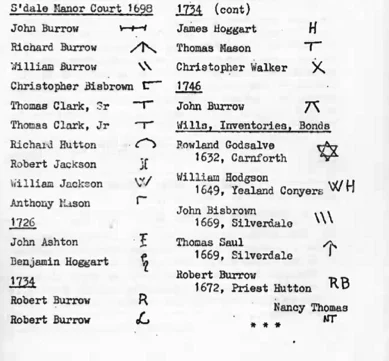
There is other evidence for Silverdale. The Silverdale Manor Court Books have been preserved and date from 1671 to well into the present century. The written records of the Court proceedings are occasionally signed by the men who made up the Jury. At the Court held on 18 May 1698, a fine list of 13 names appears with carefully drawn marks beside 10 of them. Only 3 men wrote their names. The Court held on 10 June 1734 was a special occasion. By the General Consent of the inhabitants within the Township of Silverdale, Haweswater Moss was to be divided and equal shares were to be allotted to each tenant. Nineteen inhabitants were present, probably very nearly all the customary tenants of the Manor. Of these 19, only 7 made their marks whereas 12 wrote their names. In other words, in 1698 23% of the Jury could sign while in 1734 the figure was 63%. Another freak result? Or had something happened between 1698 and 1734 to account for this rise in literacy?
If a society values education, it supports schools and schoolteachers. From before 1600 Warton parish was provided with at least one formal school. In 1595 the Free Grammar School at Warton was founded and endowed by Matthew Hutton, then Archbishop of York. As is pointed out in another article in this magazine, the Quakers ran a school in Yealand throughout the 18th and 19th centuries. Both these schools were supported by gifts from 18th century benefactors. But it is doubtful if either school could have made a very dramatic impact on the ability of Silverdale children to write, given the geography of the parish. Silverdale may, in fact, offer a special illustration of a community’s attitude toward education – and the arrangements made to obtain it.
A few words of historical background are necessary. From ancient times Silverdale had had a chapel. Its function as a Chapel of Ease from medieval times was to provide the community a more convenient place for certain religious observances than the Mother Church at Warton, so many difficult miles away. From Lucas’s History of Warton we learn that it had suffered a long period of neglect and deterioration during the 17th century. ’Ancient inhabitants’ alive at the end of the century could remember a time when the Chapel had had £40 a year belonging to it which had been lost through ’iniquity and different Turns of the Times, and for want of looking after’. Both the pastoral care of the inhabitants and the physical care of the chapel fabric had eroded, so that by the end of the 1670’s dissention was rife within the flock and decay had ruined the building.
But at the end of the 1670’s a change occurred. The chapel was rebuilt in 1679, presumably by and at the expense of the inhabitants, a new young curate appeared on the scene in about 1682, and by 1687 the inhabitants of Silverdale and their curate, Mr James Atkinson, were resolutely engaged in a struggle with Mr Thomas Lawson, the Vicar of Warton. The Vicar was not pleased ty the developments in Silverdale. Not only did a well-supported Chapel of Ease threaten to divide his flock, he thought, it also threatened to diminish his income, by fees lost and by the amount of the £5 stipend he was being called upon to find for the Silverdale curate from his own pocket. The details of that struggle, interesting though they are, are not our subject here.
What is important is the person of Mr James Atkinson and the fact that he is referred to throughout the papers dealing with the dispute as ‘the Schoolmaster’ quite as often as he is called the Curate. It is probable that James Atkinson was a member of an ancient and important Silverdale family closely associated with Challan Hall and Waterslack, with connections in Beetham. It is certain that he was educated, possibly at Beetham School, that he was a qualified schoolmaster, and that he served the community in that capacity.
In 1722 in answer to a Diocesan questionnaire the Vicar of Warton stated that ’In Silverdale the Curate teaches in his own House English and Latin’. He died in 1727 after more than 40 years as curate and schoolmaster. To what degree he and his family were the driving force behind the resurgence of community spirit and determination in 1679 can only be guessed, but his presence in the community during those 40 or more years must have had a significant impact which the Manor Court literacy figures may in part reflect.
In 1728, one year after the death of the ‘Schoolmaster’, Joseph Burrow of Waterslack died. He founded in his will what the 19th century Charity Commissioners called the ‘Burrow’s Charity’. Their Reports describe it as a rent-charge of £3 on certain pieces of land to be disbursed annually, £1 to the poor of Silverdale and £2 to the Reader of Silverdale Chapel. It seems a routine enough endowment for the period. But when one examines the will itself and reads it in the context of events, it takes on a critical new significance. He provides:
‘a payment of £2 yearly to the reader of Silverdale Chapel provided said reader do live at Silverdale frequently and do qualify himself to execute the office of schoolmaster and teach boys and girls to read and write, and also grammar and other useful Books; and I order constitute and appoint (if the Reader for the time beeing doe conform to the rules sett down) that the Churchwarden for the time being there being and his successors forever do take care for the raising yearly of the said summe of two pounds and paying the same to such a reader and schoolmaster and not otherwise.’
This attempt to insure the continuation of a Schoolmaster/Curate is a clear indication of the value one member of the community at least placed on education. It should probably also be read as an acknowledgement of James Atkinson’s importance to the community. Whether Joseph Burrow’s hopes were realized or not can be discovered by a look at the credentials of the curates appointed to Silverdale Chapel during the rest of the 16th century.
In 1756 Mr Francis Haygarth, Schoolmaster of the Free Grammar School at Over Kellet, was appointed. He was succeeded in 1759 by Mr Thomas Turner. A letter survives from Mr Turner to the Bishop of Chester, a sort of 18th century C.V. It is dated March 17, 1759, from Silverdale and reads in part as follows: ‘I was born at Slyne in the parish of Bolton- Educated at the free Grammar School in Lancaster under the Care of the Rev’d William Johnson with whom I continued ’till I was elected Master of a Grammar School at upper Kellet from whence in November Last, (the time Mr. Haygarth was removed by your Lordship to Mobberley) I came hither; where I officiate as Lecturer, and employ myself in Teaching.’
In 1765 Richard Bailey, Schoolmaster at Beetham, succeeded Thomas Turner. Thomas Hest, Schoolmaster at the Free Grammar School at Warton, seems to have served at Silverdale at two different periods. Even into the 19th century Schoolmasters were serving as curates at Silverdale. Richard Knagg, Master of the Warton Free Grammar School, was appointed Curate in 1807 and served until 1820.’ However important James Atkinson and Joseph Burrow were in establishing the precedent, it is quite clear that throughout the 18th century Silverdale residents were served through their Chapel of Ease by an educated and fully qualified schoolmaster, and whatever measurements are used and however results may vary, the conditions did exist in Silverdale which could have produced high levels of basic literacy.
The marks used in earlier centuries are generally much more interesting than the simple crosses one might expect. Following are some of the ones used by local inhabitants.
Literacy In 19th Century Warton
By Jean Chatterley (Thanks are due to Rev. Oddy who allowed access to the registers.)
Following the article above on literacy in Silverdale in the 18th century, I thought readers might be interested in some research done on the Warton marriage registers for part of the 19th century. Between August 1837 and December 1875, 500 weddings were registered at Warton Parish Church. Of the 1000 brides and grooms, 225 made their mark, usually a simple cross, instead of signing their names. This would indicate a literacy rate of 78%. In more detail:
Date
- 1840-1849
- 1850-1859
- 1860-1869
- 1867-1876
Number Married
- 248
- 254
- 250
- 288
Numbers Marks and Approx Literacy
- 75 70%
- 49 81%
- 54 78%
- 50 83%
These figures show a steady improvement towards the second half of the century. Of the 500 weddings, 201 were of either groom or bride or both from the village of Warton itself, and of the 802 persons, only 79 could not sign their names (32 men, 47 women) a literacy rate of 80%, i.e. only slightly higher than for the 1000 persons sample, and moreover, remarkably little higher than for the literacy rate of 77% quoted in Mrs Thomas’s article for the parish in the previous century.
Some other comments on the 19th century marriage registers may be of interest. Many of the witnesses to the weddings were also illiterate. Very few of the 1000 persons were under 21. With occasional exceptions, most Warton men and women married partners from Warton or adjacent parishes. (The exceptions are mainly from the landed gentry or the children of professions which necessitated travel further afield.) Most girls married men in the same trade as their fathers, and cases of ’out of social class’ marriages are very few indeed!
The sources are listed in the order in which they are used.
- The Parish Registers of Warton, 1568-1812, 73,
- Lancashire Parish Register Society (1935)
- Silverdale Manor Court Books, Cumbria Record Office at Kendal, WD/D/S2.
- J.R. Ford and J.A. Fuller-Maitland (eds.), John Lucas’s History of Warton Parish (1931) PP- 49-50.
- Silverdale vs the Vicar of Warton, Lancashire Record Office (LRO), DRCh 37/122.
- Diocesan Questionnaire, LRO DRCh 35.
- Will of Joseph Burrow of Silverdale, LRO WRW DK/1728.
- Reports of the Charity Commissioners (1904). Silverdale Curates, LRO DRCh 37/122.
Lancashire Archives in Preston now hold most of the these records for more information contact them
Published in Mourholme Magazine Issue 3 Spring 1983 and Mourholme Magazine Issue 4 Summer 1983
The following documents are taken from the file on the dispute between the Vicar of Warton and the inhabitants of Silverdale, 1687-1692. Briefly, the parties involved are: (1) the inhabitants of Silverdale and their curate, Mr James Atkinson, who want a fully operational Chapel of Ease and a paid curate, (2) the Vicar of Warton, Mr Thomas Lawson, who wants a minimally operational Chapel of Ease, if one at all, and no paid curate, (3) the Dean and Chapter of Worcester Cathedral who hold the Rectory of Warton, thus receiving all the tithes of the parish, to whom the inhabit its of Silverdale petitioned (1687),
‘…for as much as wee are bound up by the sea on the one hand & Mosses on the other Soe that at some times we cannot with conveniency travell to the Mother Church at Warton beeing in a very obscure & remote place & consisting of nere Three: score families amongst which are very many aged & Decrepit people abounding alsoe (till of late that by the procurement of your Vicar of Warton wee had an honest orthodox it painefull schoolmaster & curate) with many Schismaticks & Quakers…we humbly beseech your Worshippes severlly to take the same into your pious consideration & vouchsafe us some small pention out of your Rectory of Warton to bee yearly paid to our Curate1-..’
and (4) the Bishop of Chester whom the Dean and Chapter of Worcester asked to arbitrate a solution. The Bishop sent his man, James Fenton, to look over the situation and report back. James Fenton’s report, dated 17 September 1692, reads as follows:
Lancaster Sept 1792
“ My Lord,
I had given your Lordship an account of Silverdale sooner but that the inference was depending till now, of which (Since it has taken no effect) I acquaint your Lordship with the following account. The distance between Warton Church and Silverdale chapell I take to be four miles. The way is plain & open from the sides of two great hills to all the severity of the weather seawards. In the midst lies a deep Mosse, where I thought we must have left our horses, and were once in despair of making our way, till Mr Lawsons clerk broke down a hedge, & conducted us thro mens grounds, who might have indicted us for a trespasse. When we got with much difficulty to Silverdale chapell, there were about 30 of the chiefe ancient Inhabitants waiting for us, who expressd a very earnest desire of having constant prayers at their chapell thro out the year, acquainting us that since there had been constant service there, not one in the dale had turnd Quaker, nor had any loiter’d & play’d among the hills on Sundays, as their practise had been before but their children & younger sort were very much reclaimd by Mr Atkinsons constant catechising. The more understanding men feard that (if their chapell was shut up for any time) they would relapse into their former loosenesse on the Lordsday, & a great part of them be made a prey to the Quakers.
In Reference to the Vicar & church of Warton they freely ownd their subjection, & declard that on Every Sacrament day at Warton, their chapell should not be open, but that they would repair with their Curate to Warton to receive. Mr Atkinson shewd great humility & respect to Mr Lawson, and offerd him his best Service at any time of Mr Lawsons indisposition or absence. Some of them talkd of certifying the chapell at the Sessions for Church of England prayers in case of extremity, but hop’d your Lordship would prevent all such ungratafull methods by a speedy determination in their behalfe. Mr Atkinson was sadly troubld at this last notion of some of them, & declard he would not do any thing without your Lordships approbation. Mr Lawson stood upon an agreement formerly between them, which they were all perfect strangers to, and likewise upon the late orders from Worcester. This my Lord is an account of that days work. Now my Lord I beg of your Lordship to be as speedy as your Lordships other weighty affairs will permit, in the determination of this unreasonable difference, which has raisd some scandall & great heats. I allso humbly offer my thoughts, which are that I wonder (considering the distance & badness of the way, the commendable desire of Silverdale people, the good which is don among them by a pious man, & the sad consequences which I plainly forsee upon inhibiting their chapell for some months onely) I wonder how any clergyman can resist so good and hearty desires of a tractable people or hazard the mischiefs which (without a miracle) are sure to fall on that place if the chapell be shut up. The Quakers are pleasd with this difference, and stand expecting & wishing Mr Lawson may prevail, pray my Lord forgive this tediousness in
My Lord I beseech your Lord to write to Worcester to satisfy them, & obtain the continuance of the five pounds.
My Lordship Your Lordships most obedient servant James Fenton2
“ The outcome: the Chapel was secured for Silverdale and the curate was granted a £5 stipend to be paid by the Vicar of Warton.
Notes
Lancashire Archives in Preston now hold most of the these records for more information contact them
- Lancashire Records Office Reference: LRO DRCh 37/122 (2) ↩︎
- Lancashire Records Office Reference: LRO DRCh 37/122 (9) ↩︎
Published in Mourholme Magazine Issue 3 Spring 1983
By J. E. Housley
In transcribing wills and inventories of the 16th and 17th centuries, the research group of the Society are trying to establish a picture of the social life of the time in the parish of Warton, including Silverdale, the Yealands, Priest Hutton, Borwick and Carnforth.
The inhabitants were mostly husbandmen operating a thrift economy: nothing was wasted. The four honest men who came to value the possessions of the deceased included everything, from clothing to the dungheap in the yard. The main pieces of furniture to survive are chests and arks. In the homes of the wealthy, there was more finish and decoration in the furnishings, but in the working homes of an agricultural economy furnishings were simple. Arks and chests (‘chists’ or kists’ in our northern dialect) were highly prized possessions. Frequently we find them bequeathed in wills: ‘the great chest in the chamber where I lie’, or the chest to stay in the house ‘as an heirloom forever’.
The earliest form of the chest was dug out from a solid tree trunk, but from the 13th century they were constructed from planks fastened together with a flat lid, made to stand on the floor. Chests could be made from ash and elm, but almost all surviving examples (to be found in churches and museums) are made from oak. Oak was the most durable wood though hard to work, the trees having to be felled at the right season, the planks sawn by a vertical saw worked by two men – hence ’top sawyer’ – then immersed in a stream and later dried out. The chest was in use until the 18th century, serving for storage, a seat, or even a bed.
In English Furniture by John C. Rogers, there are explicit instructions on how to construct an early type chest, down to the wrought iron hinges and oak dowels, and on how to adapt it for use as a travelling trunk. In some instances, a simple chest was made in which the sides were carried lower than the back to form feet. The ark was an arcaded chest, a large receptacle of split timber, not sawn but hewn with an adze. It had a roof-shaped lid like a hutch or a bin. Originally of North Country origin, it was used mainly in the kitchen to store food, meal, grain and bread. It had wooden hinges as iron might taint the flour.
In addition to these treasured pieces, many households had bedstocks, a board and three-legged stools. The medieval term ‘board’ was synonymous with table, a flat wooden slab supported by a trestle or legs. The word ‘table’ meant the top only and was used as early as Chaucer’s time in the Canterbury Tales: Curteys he was, lowly and sensable And carf beforn his fader at the table. Seating at table was provided by long backless benches called ‘forms’ which also served as seating in church in this period. It is an interesting aspect of transcribing inventories to see the changes with the passage of time, hone households came to own cupboards, cushions were used on the hard wooden seats, and chairs with backs and armrests began to replace forms and stools.
Notes
Works consulted:
- J. C. Rogers, English Furniture.
- Marjorie Filbee, Dictionary of Country Furniture.
- Joy Woodall, From Hroca to Anne.
- J. Gloag, A Short Dictionary of Furniture
Published in Mourholme Magazine Issue 3 Spring 1983
by Winifred Briggs
Robert Withers of Kellet, who died in the 1680’s, left £6 a year for the teaching of Quaker children at Yealand, and from 1705 a schoolmaster was appointed for this purpose, the school being held at the Backhouse farm, at Hilderstone, Yealand Redmayne. In 1764 the old cottage next to the Conyers meeting house was bought for £40 and altered for a school at a cost of £20. It was enlarged considerably in 1851 and again in 1880, with stables underneath to hold the horses and gigs of Friends coming to meeting. Among the meeting house records shown to the Mourholme Society last summer are a school Admissions Register beginning in 1866, and a log book. Yealand Friends’ School belonged at that time to the British and Foreign School Society, which required its members to keep a daily log, so that we have an illuminating picture of the school’s life from July 1866 to June 1895. There was not always anything special to report; ‘Ordinary progress’ is a fairly frequent entry, however, that progress was usually commended by the regular inspection reports included in the log, and discipline and order were often ’very good’.
At that time the school was not for Friends’ children only. The log records time off allowed for Catholic feast days and for the church Sunday school treat.
Holidays
Holidays seem to have been at the discretion of the master and were given on vastly differing occasions. The wedding day of Miss Bolden of Warton, many funerals, ‘a wild beast show’ at Burton, the holding of a Friends’ monthly meeting (which would need the premises) were some of these. However, there were no long holidays at Christmas or Easter or Whitsun (only for a local ‘Club Walk’); there was a-four-week break at Midsummer and they were back at school in August. One entry records children’s listlessness in the heat.
Attendance
Attendance was 30-65 on average in the early years of this log, increasing in the 1880’s to 120 at times. Numbers were much affected by weather and the call of field, work or an attraction like Lancaster Cheese Fair; an entry for April 1867 reads ‘Some of the children away collecting pace-eggs’ (Easter eggs). As Orlando Pearce, the master, observed cynically in April, 1869, there was ‘a good deal of outdoor occupation for the big boys, such as potato planting, peeling bark, picking stone and weed…’.
Staff
Staff consisted, from 1866 to June 1871, of the master and the sewing -mistress. That year saw the addition of the first pupil teacher, who occasionally found himself in sole charge. In 1879, when George French was already headmaster, a post he held for 18 years, an assistant, George English, was appointed. He stayed only ten months but was replaced. There were always pupil-teachers, one if not two, on the staff.
Curriculum
The Three R’s were relentlessly demanded by the continual examinations and had to have pride of place, but Yealand children also learnt Scripture, Geography, and a little History. What the boys did while the girls sewed is not recorded. In March 1875 the master records that their reading practice was from the Lancaster Guardian. Earlier, in March 1867, he had noted, ‘Gave the children an opportunity of witnessing the eclipse of the sun today, and explained to them how it was brought about’. Homework was set.
Treats

Yealand Manor At first there were oranges and nuts at Christmas, and coffee and cake before the Midsummer break, but January 1869 was special: ‘in the afternoon took the children on the Summer-house Hill for a scramble after sweets and gingerbread, given by Mrs Ford’. Mrs Ford lived at what is now Yealand Manor and took a considerable interest in the school. Towards the end of the century a Christmas tea-party became usual.
Discipline
In September 1868 the master records that he ’Cautioned the boys about using gunpowder during playtime’; in March 1879, ‘having discovered most of the upper boys smoke cautioned the whole school on the habit and communicated with the smokers’ parents’. On one occasion boys had to be reprimanded for ill-treating a ram on Summer-house Hill, and also for bird-nesting. Mrs Ford’s essay prize on ‘Why we should be kind to animals’ (December 1860) seemed a necessary corrective.
Parents’ Occupation
The Record of Admissions of 1866 shows ‘Parental Occupation’ to be varied: veterinary surgeon, farmer, auctioneer, labourer, butler, manservant, groom, coachman, gardener, gamekeeper, agent, grocer, innkeeper, blacksmith, mason, joiner, wagon mender, timber dealer, manure agent, maltster, washerwoman, navvy, dressmaker, engine-driver, plate-layer.
Residence
The Record of Admissions also shows that pupils came not only from the Yealands, but from Warton, Borwick, Priest Hutton, Crag Foot, Tewitfield, Gunnerthwaite, Carnforth and Silverdale. As late as the first two decades of this century, after which the school closed, pupils continued to come from far afield. Miss Gathercole of Yealand Conyers, who left in 1917, recalls a family coming from Arnside, taking a train to Silverdale and walking from there. This distance in bad weather was the main attendance problem. Sometimes they struggled in, as in the log book of March 1892: ’children sent home on Thursday morning as most of those who came were wet through’. Bad behaviour on these long walks is recorded: in March 1867 the Silverdale boys were threatened with expulsion for this. There was one tragedy: in May 1875 Mary West from Borwick was knocked down on the level crossing by a northbound train on her way to school, and died in Lancaster Infirmary.
Yealand Old School (after a woodcut in Elizabeth Brockbank’s Richard Hubberthorne (1929))
Published in Mourholme Magazine Issue 3 Spring 1983