John Findlater
Dr. J.D. Marshall, in the magazine issue 1993, No.2., wrote a short article entitled, “What We Might Do For Local History“. He pointed out that a local history society takes on the responsibility for ‘interpreting the local past for everyone else in our area’. Amongst other things, he suggested that we ought to try to ‘throw light on recent history’ using material that ‘our audience’ or ‘our public’ tells us about their own lives: in other words ‘Oral History’.
An earlier attempt to write an Oral History of Warton, based on interviewing done by previous members foundered for reasons that need not be elaborated.
During Robin Greaves’ chairmanship, the question was posed in the Magazine 1994, No.1, (pp15/16/17) “Should we have an Oral History Group in our area?” followed by a short explanation of what would be involved, because it is not absolutely straightforward. Several members of that time had one exploratory meeting, a few tape-recorders were purchased and nothing has come of it. It is just possible that as the membership has changed there may be a wish to take this up again.
Speaking for myself, certainly not trained in the art, I interviewed sixteen people, after obtaining signed releases for the tapes and transcripts from them to be used by the Mourholme Local History Society and have preserved these tapes.
I have not made a verbatim transcript but give an extract:
Interview with Mrs Margaret Grace Garth (Interview on 6 September 1995 in Carnforth)
Margaret Grace Weeks was born 1 March 1912, at 38 Market St, Carnforth. This address was that of her father’s shop. Her father was William James Weeks, a printer, newsagent and bill poster. He had come from Penrith to work at ‘The Visitor’ in Morecambe, where his sister lived. He then opened the shop at 38 Market St. (a building of three-storeys) for The Visitor, but at some point must have purchased it for himself. Margaret’s mother was also from Penrith; she had worked in Lancaster and had probably known her husband for some time.
The family had living rooms behind the shop and on the first floor; there was a printing press in the bedrooms on the upper floor. This shop was one of a block of three large buildings, the nearest to the Queen’s Hotel; adjoining was Loy’s wool shop and the one beyond was a chemist’s shop.
Margaret was the only daughter but she had two brothers. The elder one died at 9 years old of heart trouble and she doesn’t remember him, the other died aged 19 also of heart trouble, which she thought might have been a congenital problem.
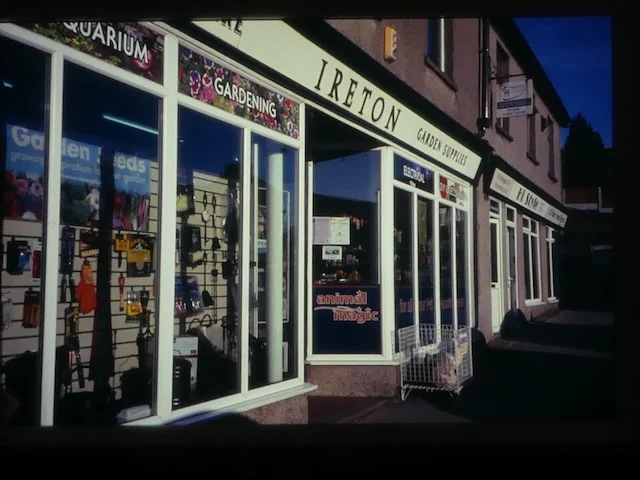
As a child she played in the auction market grounds. A Mr Lawrence had a business in this area making carts, but was very tolerant of youngsters. Reg. Brockbank worked for him and later had a shop in Lancaster Rd. dealing with electrical goods and later he had a television business in the town. Her particular playmate of those days, was Mattie Murray, whose father, John, was a draper with a shop in Hartley’s building near Iretons.
Margaret went to the North Rd council school at five years old. Her teacher was Miss Rowbotham, who lived in Scotland Rd; Mr Barnard was the headmaster. For her ‘school was OK”. She went on from North Rd Primary to Morecambe Grammar School, and claimed to be the only one from Carnforth who did then. She travelled to school with a boy from Warton. Not being a good traveller on the bus, she stayed with aunt in Morecambe from Mondays to Fridays, then went home for the weekend. However, after one year of this she decided she preferred to live at home but had lunches with her aunt.
Her verdict on Carnforth was that it was ‘not much of a place but had nice people’. Her parents were C of E but not very active. She, herself, went to Sunday school. The family was tied to the shop but her father had a motor/bike and sidecar; her brother rode behind her father while she was in the sidecar with mother. They only went to local places like Silverdale, Arnside etc. She did not roam a lot but did go on rambles over Warton Crag and Kellet Seeds. Her parents were not particularly strict.
Mr. Weeks started a picture house – the Kinema- in 1925 when she was about 12 years old where Roxy replaced it later. (It is now a grocery shop). The Station Hotel picture show had been going for some time before that but had closed. Mr Weeks had bill-posted for theatres etc when he met someone who urged him to build a cinema, which he decided to do. Everything went well for the first year or so. As she remembers, seats ranged in price from 5d, 8 or 9d to 1/- or 1s 3d; on three nights a week there were two shows nightly but only one at 7.15 on the others. There was a Saturday afternoon showing for children. But shortly afterwards the Ironworks closed down, people were out of work and could not afford the show. The cinema flopped and Mr Weeks lost money in this venture and Margaret’s mother also accused him of neglecting his main business at the shop.
When asked whether she thought that perhaps Market St. families and railway and ironworks families were rather separate she was unsure; perhaps so but she was rather doubtful if this was really true. She did remember how the sky at night was lit up by furnaces with sparks shooting upwards at the ironworks. Her father used to go to the Station Hotel in the evenings for whisky and meet his friends Billy Williams, Harry Gill and Mr Dearden. or they might go to the Conservative Club. He did not have any hobbies.
Margaret did not have any special ambition while at school and was not terribly fit, though she did not specify in what way. She left school at 14 or 15 knowing her father wanted her in the shop; but for two or three years she was just at home with her brother and mother. Then she did work in the shop, working long hours. She joined the guides and rangers, which had been started by Miss Butler-Cole. Through the guides she got to know and became friends with Ruth Jackson (Dr Edward Jackson’s wife).
Carnforth was quite a busy place until the ironworks shut down with much unemployment. She remembers old Dr Jackson being active in the town. Though the doctor’s house, Robin Hill, was close by she did not mix much with Edward, his brother and sister who were a bit older. Her father died in the mid-thirties. She and mother went to live in Lancaster Rd, in the second house up from Carnforth Inn though they kept the business going.
The 1939-45 war did not seem to have much effect on her. Helped by her mother in the shop, she coped with the rationing managing with some blackmarket help. She employed Emily Palmer for many years and others now forgotten.
In 1951 Margaret married “Billy” Garth. Billy was from Bolton-le-Sands, who had worked in shops after school until he went in the forces. Billy served in the western desert and in Italy. After the war Billy worked in the Co-op shop on the opposite side of Market St. from the Weeks’ shop. He then started work with her in the newsagents for 13 months or so before marrying in 1951. The shop was very busy; they had many lines. Susan their only daughter was born in 1955. They moved to Bloomfield Park in 1956.
*The shop was sold to another newsagent in 1972, and late became part of Carnforth Bookshop, being merged with the two other old shops in the block. Billy died in 1985. Margaret died in 1999.
Published in the Mourholme Magazine Issue 43 2001