A study of the migration of males born in the townships of the parish of Warton as shown in the 1881 census
N.T.Stobbs
It has been generally postulated that there was not much movement of residents outside their own immediate area in earlier centuries. In searching the data in the 1881 census there is some evidence that by the eighties of the nineteenth century movement away from the area was occurring.
The place of birth is part of every census entry, making it easy to see who was born in the area and who had migrated into it. Computerisation of census records means that for certain years it is now feasible to check records nationwide to find out where individuals born in a parish had moved to at a certain date.
If we take the search for persons born in the parish (Borwick, Priest Hutton, Carnforth, Silverdale, Warton and the Yealands) and found in areas other than the immediately adjacent counties, we find that one went to Bedfordshire, one to Caernarvonshire, in fact to a place called Llanbebig. Eleven went to various locations in Cheshire, three to Cornwall, five to Derbyshire, three to Devon, three were found in Leicestershire, two in Lincolnshire, in one location. The appearance of a number of males in one location often indicates a family settled there. Six appear in London, two in Shropshire again possibly a family connection. Seven are in Staffordshire, five in Warwickshire and two in Worcestershire.
Other single registrations occurred in many places: Flint, Glamorgan, Gloucestershire, Hampshire, Hertfordshire, Huntingdonshire, Kent, Norfolk, Northamptonshire, Nottinghamshire, Somerset, Suffolk and Surrey. No residents of the “Parish” were found in Highland Scotland, Lowland Scotland and the various islands in the Census.
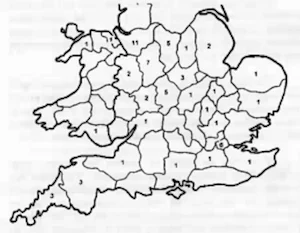
The number of males born in Warton parish who were living in counties south of Lancashire and Yorkshire at the time of the 1881 Census
Of the males found in the search, two were born in Borwick, twenty two in Carnforth, five in Silverdale, nineteen in Warton and the remaining four in the Yealands.
When we consider the distribution of males in Lancashire and the adjacent counties, such as Yorkshire, and the Northern Counties of Northumberland, Durham, Cumberland and Westmorland, we find considerably greater numbers. There were a large number of males who were born in the parish who did not move from their birth township, or only moved to another township in the parish.
Obviously the greatest number would appear to have stayed in Lancashire.
Emigration of Males From Townships of Their Birth in Warton Parish to Other Townships Within the Parish or to Other Parts of Lancashire (From the 1881 Census)
| Township | No still living here | No moved to townships within Warton parish | No moved elsewhere in Lancashire | Total who moved | % of who moved |
|---|---|---|---|---|---|
| Borwick | 41 | 16 | 51 | 67 | 62% |
| Priest Hutton | 19 | 5 | 21 | 26 | 57% |
| Yealand | 52 | 32 | 38% | ||
| Silverdale | 118 | 32 | 69 | 101 | 46% |
| Carnforth | 107 | 79 | 42% | ||
| Warton | 125 | 139 | 52% |
Out of those who born in Borwick, and are found in Lancashire, forty one were still resident in Borwick, eleven in Priest Hutton, five in Carnforth, seven in Over Kellett, four in Burton, two each in Bolton-le-Sands, Dalton-in-Kendal, Glasbory and Preston. These may well have been family members. Single males were found in thirty two other locations within the county. None were found in Warton, Silverdale, or the Yealands.
Of those born in Priest Hutton nineteen remained in the township, three went to Carnforth, and two to Yealand Redmayne, Bentham, Casterton and Newby. The others appeared in fifteen other locations in the county.
There is some difficulty in placing the males of the Yealands as the enumerators seemed to decide that Yealand alone was good enough for the birthplace of both the residents of Yealand Conyers and Redmayne, but when entering where they were at the time of the census they were either in Yealand Conyers or Yealand Redmayne. Of the males born in the two villages twenty five remained in Conyers and twenty seven in Redmayne, five migrated to Lancaster, and five to Thurnham, two to Whittington. The rest migrated to twenty different places as single entries.
Of the males registered as having been born in Silverdale, yet still resident in the county of Lancashire, one hundred and eighteen were still resident in the township on the day of the was to census in 1881. The greatest movement was to Warton-with-Lindeth (seventeen), eleven were in Lancaster, nine in Yealand Conyers, six in Carnforth, four each in Ulverston, Ellel, Dalton-in-Furness and Barrow-in-Furness, three were in Lower Holker. “Twos” were registered in ten other electoral districts, as far apart as West Derby, now part of Liverpool, and Nether Kellet. Single males occurred in nineteen other places, including Upper and Lower Allithwaite, Standish-with-Langtree, Satterthwaite, Fazakerley and Ashton-with-Stodday.
The males of Carnforth show a similar pattern within Lancashire, but with a noted difference which could be connected to the Iron Trades. Eleven moved to Ulverston, and the same number to Barrow-in-Furness and ten to Dalton-in-Furness. Four to Nether Kellet, three to Salford and three to Bolton-le-Sands. Two individuals were recorded as being born in Carnforth and in various electoral districts within Lancashire.
One hundred and seven remained in the township of their birth. With twos and threes there is always a possibility that there are sons of the head of household, so it is only one family that has migrated.
Warton, which at this time had a larger male population than Carnforth, retained one hundred and twenty five individuals in the township in which they were born. Of the migrants twenty eight went to Carnforth, nineteen to Lancaster, also nineteen to Barrow. Fourteen ‘single’ males went to various electoral districts within Lancashire, whilst five ‘twos’ went to Halton, Hesketh-cum-Becconsall, Poulton Bare and Torrisholme, Skerton and Upper Holker.
The only ‘three’ recorded moved all the way to Yealand Redmayne. This could have been a family. It is possible to find this fact out from the census material, but it takes a considerable amount of time, as the names are entered by forename and hence families are separated in the search and you have to look through all the names in a township in an effort to find families. This should then be checked by going back to the full entries. A very time consuming procedure. Four individuals moved to Dalton-in-Furness and Ellel. Of the remaining thirty eight listed as being born in Carnforth, ‘fives’ moved to Bolton-le-Sands and Silverdale ‘six’ to Yealand Conyers and ‘sevens’ to Over Kellet and Ulverston, whilst eight moved to Priest Hutton.
In considering migration to Yorkshire, it has been possible using another method of search to see if the movement consisted of families or individuals. Considering the men born in Borwick and moved to Yorkshire, of the five individuals recorded none of them appear to be related. Of the five, two went to Bentham, and one each to Headingly-cum-Burley, Manningham, and Mirfield. On looking at those who moved to Manningham for example, it is possible to see that there are five families that have moved there, one from Borwick, two from Carnforth and one from Warton and Yealand. Nowhere in the Yorkshire search were there more than two individuals moving to any one place from one township.
In the case of Bradford the two individuals moving to any one place were recorded as sons, Francis Beardall, born 1873 in Carnforth, and Tom French, born 1870 again in Carnforth. This also indicates that their fathers were not born in Carnforth. It is possible to find the family in the Bradford records and hence discover where the father was born. Such a search could also trace the migration of the family around the area, county or country. This is possible by looking at the birthplaces of the children in the family. Again a time consuming operation, but one that could be an interesting study.
There were three families that moved to Halifax, one from Silverdale, one from Warton and one from Yealand Conyers.
It seems that there was less migration west to east compared with north and south. Was this an indication of the traditional antagonism between Lancashire and Yorkshire? Another point that could be explored, or was it only to do with the availability of jobs in certain trades in the areas? It could be that some movement could have been railway related along the line through to Leeds. Again a point that would need more careful exploration of the original data.
The movement to the four northern counties (Northumberland, Durham, Cumberland and Westmorland) on a cursory inspection, seems to have been more related to agricultural and rural employment than in the cases of Lancashire and Yorkshire. All the movements from Borwick appear to be movements to other small villages. Even from Carnforth the majority of movements were to rural areas. Three families did move to Bishop Auckland in Durham, seven moved to Kendal and five to Millom. All the moves from Priest Hutton were to rural areas.
The greatest migration from Silverdale was to Beetham, possibly to work at the Paper Mill, but without further research this can only be surmise.
There was a larger migration from Warton; ten individuals moved. Whether these were ten families or a number of families with sons, is not clear without more research. Nine Warton individuals moved to Holme and seven to Kendal. In total Warton individuals found their way to sixteen different places in the Northern Counties. Beetham was the greatest recipient of males from the Yealands, Kendal received three as did Holme. There was a mill at Holme, and of course Kendal would offer work for men in the various trades that existed in the town.
This is a very superficial investigation into the movement of males from the ‘Parish’ to various parts of Great Britain. Movement does seem to have been occurring, due, possibly to a search for jobs. Connections to the iron trades does appear, as could movement within the railway industry, but the latter is not clear.
Again the census does give one a source of research projects, but it does raise as many questions as it answers.
Published in Mourholme Magazine Issue 44 2002