
by Margaret Bainbridge and Michael Wright.
Lancaster-born William Hewitson (1847-1930), a journalist based mainly in Bury, published a regular column on antiquarian and historical matters in the Lancaster Observer between 1886 and 1926. Even though he seldom named his sources his writings can be of value especially in providing information about Lancaster and district for the years before its own locally-produced newspaper, the Lancaster Gazeteer, appeared in June 1801.
Between October 1887 and June 1888 these contributions were published under the title “Local Incidents of the 18th Century”. The column devoted to the year 1787, published on 2nd March 1888, includes this item :-
“The following is reported as occurring one Saturday evening in August;-
‘Mr John Jackson, a reputable manufacturer at Silverdale, near Lancaster Sands, went for amusement to gather mussels on a place called the Stone-heap, upon the sands, situate very near the land, about which the channel now runs. Being too eager in picking the mussels, he did not observe the coming in of the tide till he was surrounded, when, finding it impossible to get off, he set to work in heaping up the stones to save himself, in which attempt he continued about two hours, when the tide proving too strong for him he was washed off in the sight of several of his relations and neighbours who had been spectators of his dismal situation for some time without being able to give him the least assistance. Next morning his body was found near the place.”
We can add two further details:-
1) the date: August 11th (the Saturday before the victim’s burial on the 14th, a Tuesday);
2) the time: as low tide at Lancaster on that day was 10.04 a.m. and 10.36 p.m., high tide at Silverdale would have been between 4 and 5 in the afternoon1.
This account though short, provides valuable clues concerning both 1) the state of the Silverdale foreshore, about which all too little is known, and 2) on a long-established Silverdale family and local industry.
The foreshore
From this newspaper report the “Stone-heap” can be readily identified as the bouldery ground that lies about 900 metres west of Shore Cottages, Silverdale. The boulders have been washed out of the top of a mound of glacial deposits (probably a drumlin) which is now almost completely buried in the sands of the Bay. Their size and the tenacity of the clay in which they are embedded make them resistant to movement. Even the strongly scouring tidal flows that course over them each day cannot disperse them.
This Stone-heap has from time to time been buried beneath the seaward extensions of the tidal salt-marsh. In 1981, during the cycle of erosion, it lay on the edge of the grassy marsh and could be safely approached on foot from the Silverdale shore. But today the marsh had receded so that the stone-heap is cut off from the shore by the River Kent channel, up which the main force of the incoming tide flows. The 1787 report quoted makes it clear that at that date part at least of the Kent channel flowed between the Stone-heap and the shore. Once the water was flowing up the channel, possibly at 10 miles an hour or more it would have been impossible to wade across, or to cross in a boat, even if one had been available.
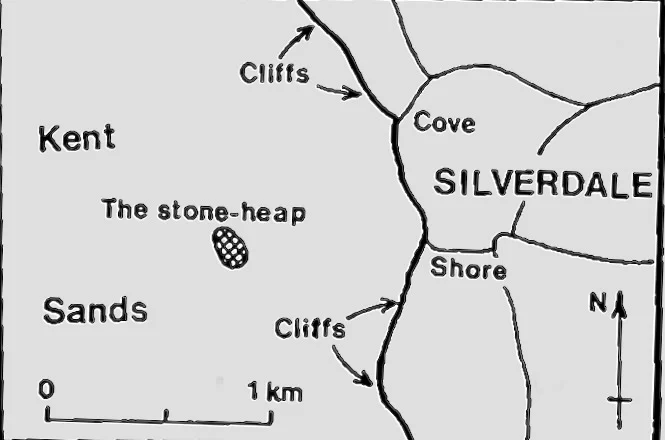
This adds to our knowledge of the fluctuations in the size of the salt-marsh. We know from Stout’s diary that the marsh was very extensive in the 1670s but was rapidly eroding from the late 1670s on. It had all but disappeared by 1700 and had not recovered by the 1740s. Adding this new evidence, it seems likely that the marsh remained small until the late 1700s. It was probably still small in the 1830s since at that date sea-bathing at Silverdale was becoming popular.
Piecing together all the fragmentary evidence from the last 450 years, we know that the marsh was rapidly eroded in the 1570s2, the 1670s and the 1970s. At each of these times the local farmers were facing the loss of hundreds of acres of good grazing on the salt-marsh. It is their complaints about this loss of an important asset that gave us the written evidence for erosion in the 1570s and 1670s.
John Jackson
Warton parish register records John Jackson’s burial on August 14th, describing him as being of Slackwood. From probate records we learn that he was a “batchelor and weaver” and had a sister Sarah, wife of Richard Cornthwaite, also of Slackwood; as John died intestate it was they who were granted administration of his effects. These facts are enough to distinguish this family from other Jacksons in the parish.
The Jacksons had been in Silverdale since the 17th century at least. The John Jackson drowned on August 11th 1787, was the third of the four sons of John Jackson III (1707-1781) and his wife Sarah (1710-1780), daughter of George Hoggart of Challen Hall. Their first son was William III (1735-1795), the next James (1737-1783). John himself (John V) was baptised in 1738 which makes him 49 at his death, not 38, the age given in the parish register. The fourth son, Thomas, was baptised in 1741 and died before 1781. There followed two daughters: Sarah (b. 1747) and Mary (b. 1750).
The father and all four sons were weavers. All five had become freemen of Lancaster in October 1773 as “wevers” of “Silverdale”, thereby being entitled to trade in Lancaster. However, by the time of John V’s tragic death, three had died Only the eldest brother William III and their two sisters survived him.
Which fabric did they weave?
We know that linen was made in the parish; but was it produced for sale? The only document that has so far come to light specifying a cloth is to be found in an account book of Abraham and John Rawlinson, merchants of Lancaster, which is kept in Lancaster library3. An entry dated 9th September 1786 records the payment of £36.13s. To Enoch Fryer of Silverdale for two batches of harden, one made up of 18 pieces, each 33 yards in length, at 17s.6d each, the other of 22 pieces, each 36 yards long, at 19s apiece. Harden was cloth made from the coarser parts of flax or hemp. Enoch Fryer had some customary land in the township. But did John operate through an agent, which Enoch Fryer was, or did he, as a freeman, trade in Lancaster on his own account?
Where in Silverdale was the Jackson’s home? For three generations, until 1795, the senior male of each is described in his will as “of Well in Silverdale”. But which well? It is nowhere specific.
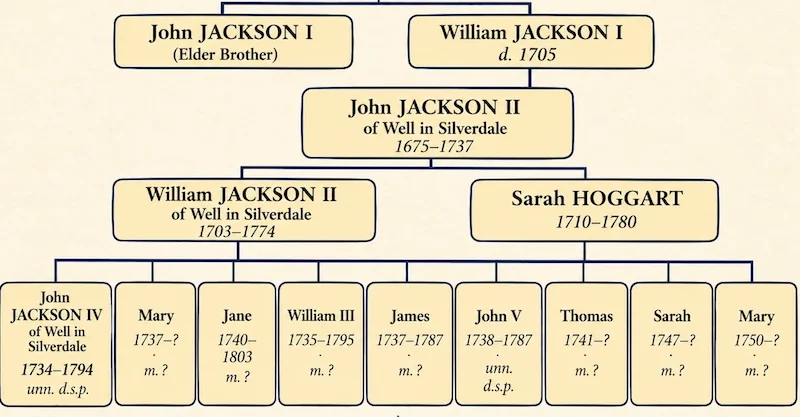
However, the first Jackson we have information about, William I (d. 1705), had besides freehold land, its site not recorded, a customary tenancy at Waterslack. This passed to his only son John II (d.1735), grandfather of the John V who drowned, and then to his eldest son William II (d.1760). It then passed to’ William’s only son John IV who was childless (d. 1794), and thus to his nephew John Askew who eventually sold it.
Although John III, the father of the four weaver sons, being a younger son, did not inherit the land at “the Well” or the tenancy at Waterslack in 1736, the Manor Court Book shows that he and two of his sons acquired customary land at Waterslack by purchase: John III himself in 1757, James his son in 1781 and John V, the son who was drowned, in 1782. It is possible that their childhood was spent at Waterslack. When young the four sons may have worked with their father, but as adults they were dispersed;-
- the eldest William III, bought a customary messuage and tenement at Cove about the time of his marriage in 1764; it is there that at least the first two of his children were born.
- James was a husbandman and weaver at Arnside Tower at the time of his marriage in 1775 and a month before when his apprentice died4. It was there that his four children were born and where he died in 1783.
- John V himself had not always been at Slackwood for, when acting as his father’s executor in 1781 and then his brother James’s in 1783, he is described as a “weaver of Yealand”.
- Thomas was “of Silverdale” when his first child was baptised in 1768 but “of Slackwood” at the baptism of his second in 1777. He may be the Thomas buried in 1780 and described as “of Yealand Storrs”, “weaver”.
- Sally, although also of Slackwood at the time of the incident, had previously lived in Yealand Redmayne where her three children were born.
- Mary, the youngest, married to Thomas Bowskill, lived in Warton at least between 1774 and 1793 when her five children were baptised.
The Jacksons of Waterslack, and later Redbridge also, remained there through the 19th century and into the 20th. There are still descendants in Silverdale today.
Notes
- Nigel Dalziel, curator of Lancaster Maritime Museum kindly supplied this information. ↩︎
- Mourholme Local History Society, “How It Was: A North Lancashire Parish in the Seventeenth Century“, p. 50 ↩︎
- Lancaster library MS 239 4.Beetham parish register. ↩︎
- Beetham Parish Register ↩︎
Published in the Mourholme magazine issue 41 2001