by John Findlater
Last year a lady from New Zealand (Anne Pritchard), who was researching her family history, contacted the society on the trail of any documentation about Sander’s farm in Borwick. This farm looks on to the Green there and is arguably the oldest property in Borwick. We were able to produce some wills and inventories from the archives, and put her in touch with Marie Gregson, widow of Harry who had written an unpublished History of Borwick. Anne was delighted with her discoveries here and generously offered to let us have copies of documents she had unearthed. She even sent some to me from New Zealand. During this period Margaret Bainbridge, one of our members, was researching (exhaustively!) the people at Buckstone House -T.C.Burrow amongst others – and there seemed to be some connection between them and Sander’s Farm (mention Thornton and Margaret is off like a bloodhound). So Margaret delved into Harry’s papers as well as doing intensive investigative work in almost every conceivable place: hearing of Anne Pritchard, she wrote off. The response drew from Margaret the comment “wow”: ultimately we will find out what that means. In and amongst all this I was gleaning material, in particular about John Thomas Bateson, surgeon/apothecary of Lancaster as part of my own researches into medical matters for the book the Mourholme Society is hoping to write about Warton Parish in the 19th century.
John Thomas Bateson, who practised in Cable St, Lancaster, had married Susannah Sander, daughter of Robert Sander of Sander’s farm. This Robert had been getting into debt and died in 1809 owing money. His widow Elizabeth lived on until 1822 though as letters of administration showed in 1827 the estate was burdened by promissory notes. Their daughter Susanna, who seems to have lived in Hest Bank then, inherited and cleared this debt. The property by the laws of the day became the property of her husband, and was rented to James Heslam, blacksmith.
Bateson had originated, it appears, in Wray. He was born 20 November 1803 a twin (his brother, William Thornton). Their father was John Bateson, gentleman, who relocated to Lancaster in 1817. On 2 August 1819 an indenture was drawn up between John Bateson and John Smith, surgeon/apothecary and man midwife of Lancaster, whereby John Thomas Bateson was bound to serve a five-year apprenticeship (the normal period). During this apprenticeship Bateson was to “faithfully serve his said master, his secrets keep and lawful commands gladly obey”. His father had to pay £80 to Smith as well as provide clothes and pay for their washing, but Smith as well as teaching had to provide his servant with lodgings and meals.
A very formal legally drawn testimonial dated 15 October 1824 states that William Wildman surgeon/apothecary and man midwife of Wray in the parish of Melling, who had practised there 26 years had known the Bateson family and delivered John Thomas Bateson, “deponed” and believed that the latter had served a five year apprenticeship to the medical profession and lately gone to London to obtain a legal qualification to practise. One might have expected such a certificate to have been written by John Smith, Bateson’s master, or that Wildman might have said that the apprenticeship had been with Smith – but there it is.
Evidently Bateson was quickly successful because he obtained his ornate licence to practise as an apothecary from Apothecaries’ Hall, London, having satisfied the Court of Examiners (twelve of them, one being Wm Simms and one John Hunter) 19 May 1825. In addition, Bateson had taken his opportunity in London to obtain a Diploma from the ‘Managers of London Vaccine Institution’ (dated 10 March 1825) and given “some glasses and points of active vaccine matter and a report for the year”. The managers were gratified that he was a subscriber because the Institution had expenses incidental to the society not only in the United Kingdom of Great Britain and Ireland, but also in almost every part of the world. Vaccination as a method of tackling the smallpox scourge had really taken hold since Jenner’s work1.
The Lancaster Guardian 14 February 1857 reported the “Death of J.T.Bateson Esq. From an Accident on the North Western Railway”. It reported how Mr Bateson “who has practised as a surgeon in Lancaster for a good number of years and who stood high in the estimation of his professional brethren, and of the inhabitants, was run- down and badly injured by the 7.45 pm train at Settle railway station which he had intended taking to return to Lancaster after a visit 11 February 1857″. He had sustained a broken leg, severe crush injuries and had significant haemorrhage. A local surgeon Mr Burrow and his assistant attended, and since Bateson was determined to return to Lancaster on the train which had been held for an hour, the Settle surgeons accompanied him on the train which was to be met, as arranged by telegraph, by Mr Howitt at Green Ayre Station, Lancaster.
Further details were given in a lengthy account of the subsequent inquest in Lancaster. Mr Howitt had Bateson taken by stretcher to his home in Cable St. and must have been horrified when he assessed his still-conscious colleague. The “broken leg”, for example, was ‘compound’; shattered bones sticking out up into the knee joint, the foot had been amputated. Bateson, on seeing Howitt, had said, “Well Howitt, I’m done for“. Even before the accident he had been infirm for a long time, suffering from asthma. Howitt gave him a little spirit in water and catheterised him, to relieve his distended bladder. Howitt ‘deposed’ at the inquest that Bateson had “asked me if I could do anything for him. I told him it would be cruel to attempt it, as he was in reality dying“. He said, ‘if you say so, I’m satisfied. God’s will be done“. He had asked to see his children (his wife had died in 1844) and his eldest daughter came. Shortly after, he became unconscious and died at twenty minutes to midnight.
John Thomas Bateson was buried at Warton Parish Church, alongside his wife, Susanna, who had died 14 October 1844, aged 37: Bateson was 54 years of age. [There are other family members buried there including his son, Robert Sander Bateson, Deputy Surgeon-General, I.M.S. (Indian Medical Service), after a rather ostentatious funeral (Lancaster Guardian 26.October 1895)].
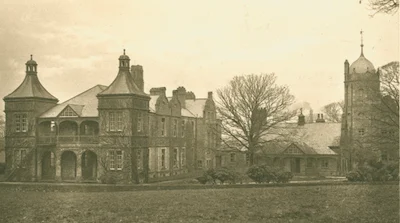
Courtesy of Lancashire County Council Archives Red Rose Collection
A special meeting of the Committee of the Lancaster General Dispensary and House of Recovery (the Old Infirmary), on 17 February 1857, arranged to send an “Address of Condolence” to the family of Bateson, who was senior surgeon/apothecary there at the time of his death. It was the loss of “a valuable life“. The committee expresses ” the high sense they entertain of Mr Bateson’s general character and professional abilities but also more especially of his untiring devotion to all the interests of this important institution …. In him the poor have indeed lost a true and kind friend.”
His will of 28 March 1853 had nominated Thomas Christopher Burrow of Buckstone House and his sister-in-law Margaret Elisabeth Thornton of Lancaster as Trustees and executors. His estate, under £3,000 was left to his children.
To date I have no more information available about Bateson’s work, whether his practice brought him out into our parish. He was President of the Lancaster Medical Book Club 1848/1856 (his old master John Smith had been a founder member and secretary and treasurer 1826-1831.) In 1841 the Book Club had decided to form a library rather than sell the books after circulation to members. This was first housed in a committee room at the Infirmary and the House Surgeon acted as Librarian. In 1853 the relationship was established in a Trust deed. John T Bateson, then President of the Book Club was one of the signatories.2
Notes
- Jenner, An Enquiry into the Causes and Effects of Variola Vaccine, (1798) ↩︎
- The Minutes of the Lancaster Medical Book Club, ed G. Anderson, 1997 ↩︎
Published in the Mourholme Magazine Issue 37 1999